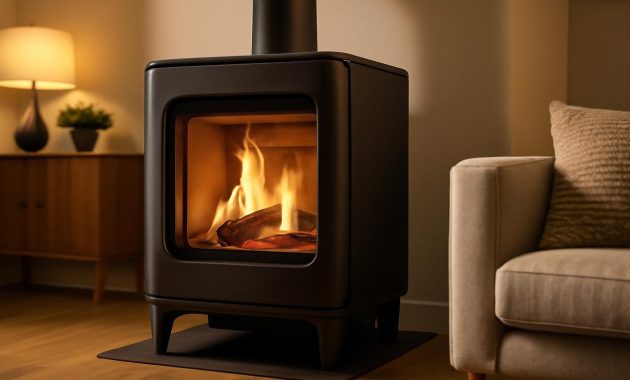
The first thing you notice is the sound. A low, steady hum, like a kettle just about to boil, layered with the gentle tick of expanding metal. No crackling logs, no hiss of smoke in the chimney—because there is no chimney. Instead, a square, glass-fronted box glows with a clear orange heart, the flames curling in clean waves behind spotless glass. The air in the room is warm but not stuffy, the windows aren’t fogged, and there’s no trace of that smoky haze you remember from your grandparents’ cottage. This is a wood stove without a flue, and for many households, it’s quietly rewriting what “cosy” looks and feels like.
From Sooty Chimneys to Invisible Smoke
For centuries, the story of fire in the home was also the story of smoke. Smoke that stained ceilings, clawed at lungs, blackened stone, and crept out of rooflines into winter skies. The flue—a chimney, a pipe, some kind of vertical escape route—was the necessary price of keeping that smoke out of people’s eyes and off their lungs. A house with a fire, the old wisdom went, simply had to have a flue.
Now imagine telling your great-grandparents that you’ve installed a wood stove in your living room, but there’s no flue punching through the roof, no brickwork rising above the rafters, no cold draught sneaking around the edges of a chimney breast. Your fire lives in the same four walls as your sofa and your books, yet your ceilings stay white and your lungs stay clear.
The first time many people see one of these stoves, they instinctively look up. No chimney breast, no flue pipe disappearing through the ceiling. It feels faintly transgressive, like you’ve broken a rule of physics or housing code. But the rule that’s really being broken is the assumption that fire must produce dirty, visible smoke—smoke that needs an escape route.
What’s changing isn’t the human hunger for flame. It’s our ability to tame what the flame leaves behind.
So How Can a Wood Stove Work Without a Flue?
To understand a flue-less wood stove, you have to shift the way you think about “wood burning.” When most of us picture it, we imagine chunky logs, dancing flames, and coils of grey smoke shifting up a chimney. In technical terms, that’s messy combustion—lots of partially burnt particles, gases, and tar that have to be hustled out of the house.
Modern stoves without a traditional flue take that mess and reorganise it at the molecular level. Instead of throwing partly burned smoke out of the roof, they work harder to burn it so completely that there’s almost nothing left to send outside.
Here’s the quieter, hidden sequence happening inside these units:
- Prepared fuel – Many of these systems don’t burn big logs at all. They use densely compressed wood pellets or ultra-dry, carefully sized pieces of wood. This creates a predictable burn with far fewer wild variables than a random armful of logs.
- Managed air supply – Air is fed into the combustion chamber in precise, often computer-controlled amounts. No more guesswork with vent knobs and half-opened doors; instead, sensors decide how much oxygen the fire really needs.
- Secondary and tertiary combustion – The gases that would usually become smoke are captured and re-burned in hot chambers or channels. What looks like a simple orange flame is often a layered system of invisible micro-fires, finishing off what the first flame started.
- Exhaust re-treatment – Before anything even thinks about leaving the stove, it may be passed through catalytic converters, ceramic filters, or heat-exchange surfaces that strip out pollutants and squeeze out more usable warmth.
The net result is that what finally leaves the unit—usually via a small, low-profile vent pipe through a wall or discreet outlet—is less like old-fashioned chimney smoke and more like faint, cleaned exhaust: largely invisible, low in particulates, and surprisingly cool.
In some designs commonly labelled as “no-flue” or “flueless” wood systems, there is technically a vent, but not the tall chimney we’re used to. Others rely on advanced filtration so that most by-products are captured and the remaining emissions are minimal. To the homeowner, the experience is similar: your roofline stays clean; the towering flue is gone.
The Heart of the Innovation: Clean Combustion
To stand in front of one of these stoves is to feel a paradox: the deeply ancient comfort of fire, and the ultra-modern precision of a high-tech appliance. This innovation rests on one key obsession—combustion so clean that the limits of traditional chimney design start to unravel.
Clean combustion is not just a marketing term; it’s a measurable reality. Think of a traditional open fire as someone speaking with their mouth full—words get out, but so do crumbs and spit. A flue-less or ultra-low-flue stove is like a well-trained orator: the same story, but every word shaped, controlled, and refined.
Inside, temperatures soar to levels that would quickly destroy a normal fireplace. These intense conditions break down woods’ volatile gases thoroughly, turning them into heat, carbon dioxide, and water vapour, instead of a roiling cloud of soot and carcinogens. Where old fires belched, these new stoves whisper.
Many systems use something called secondary combustion, where unburnt gases are drawn into a hotter zone to ignite again, and sometimes tertiary or staged combustion, where there are multiple steps of burning and cleaning. Some designs incorporate catalytic elements—surfaces coated with special metals that trigger extra chemical reactions at lower temperatures, grabbing hold of stray pollutants and nudging them into becoming heat instead of smoke.
There’s something unexpectedly satisfying about this efficiency. The log, or the pellet, or the briquette you place inside doesn’t just become a momentary flare of warmth and a column of wasted smoke. Its energy is stretched and re-stretched, every last usable bit squeezed into the room around you.
The Hidden Work Behind the Flame
From the sofa, all you see is a sheet of glass, a steady flame, perhaps the gentle rotation of a fan pushing warmth sideways instead of letting it all pool at ceiling height. But there’s an invisible choreography humming away in the background.
Advanced sensors may be checking oxygen levels in the room, adjusting air intakes if a door closes or a window opens. Safety cutoffs stand ready to snuff the fire if anything slips outside of a narrow safe band. The unit continuously balances three delicate demands:
- Give the flame enough oxygen to stay bright and clean
- Keep indoor air quality pristine
- Maintain a stable, comfortable temperature without sudden spikes
For households that grew up with draughty living rooms and rooms that swung from icy to boiling depending on how enthusiastically someone stoked the fire, this evenness feels almost magical. The stove becomes less like a wild hearth and more like a quietly loyal creature, always there, always predictable, adding glow to the evening without demanding constant tending.
Why More Households Are Falling for Flue-Less Fire
The reasons people are drawn to these systems rarely fit in a single box. For one family, it’s a design dream: no bulky chimney breast, no flue pipe zigzagging up through the ceiling. For another, it’s about air quality and asthma, about keeping the romance of a flame without the wheeze and the throat tickle. For yet another, it’s the maths of energy costs and installation bills.
Ask around in homes that have adopted flue-less wood stoves and you’ll hear a pattern of small, practical delights:
- The installation didn’t involve scaffolding or tearing open walls to retro-fit a flue.
- The room warms up more quickly than with their old open fire.
- There’s far less dusting of fine grey powder from escaped smoke.
- Clothes and curtains no longer carry a permanent hint of bonfire.
In compact houses and modern apartments, the lack of a traditional flue can be the difference between “we can’t have a real fire” and “we can.” Rooms that were never meant to host a hearth suddenly gain that primal focal point: a flame to gather around as light gutters outside and the day folds itself into evening.
There’s also the quiet pull of responsibility. As concern grows about indoor air pollution and particulates from domestic wood burning, many people feel a tension between their love of fire and their awareness of its impact. A flue-less or ultra-clean wood stove offers a way to keep one without ignoring the other. It becomes a compromise that doesn’t feel like a compromise: the same golden glow, a radically lighter footprint.
A Quick Glance at What Sets Them Apart
To see the differences at a glance, it helps to lay them out side by side:
| Feature | Traditional Wood Stove (with Flue) | Wood Stove Without a Flue |
|---|---|---|
| Smoke Management | Relies on chimney to carry smoke outside | Minimises smoke via ultra-clean combustion and filtration |
| Installation | Requires full flue or chimney; often major building work | Typically uses discreet wall vent or compact outlet; less invasive |
| Room Design | Layout shaped by chimney position | Greater flexibility in positioning and interior design |
| Air Quality | More risk of indoor smoke leakage and draughts | Designed to keep particulates extremely low indoors |
| Maintenance | Regular chimney sweeping essential | Less soot build-up; focus on internal filter and system checks |
What It Actually Feels Like to Live With One
Statistics and diagrams can tell you how efficiently something burns, but they can’t quite capture the mood of a winter evening. To understand why these stoves are attracting more households, step inside for a moment.
The day has been long; the sky closed in early. Outside, the cold feels metallic and thin. You drop your bag by the door and walk into the living room, where the stove is already alive with a slow, deliberate flame. There’s no sudden wave of stuffy heat as you open the door; just a gentle gradient of warmth that seems to wrap your shoulders first and then quietly find its way to your toes.
You open the stove, add a couple of pellets or small splits of wood. The short puff of scent—resinous, comforting—vanishes almost as quickly as it arrives, drawn back into the system. The glass remains startlingly clear; the fire becomes a piece of living artwork in the room rather than a sooty mystery behind iron bars.
You can sit closer without feeling your eyes sting. A child can curl up on the rug nearby, building a fort or lining up toy animals to “watch the fire show,” without disappearing into a hazy halo of airborne ash. The noise in the room is soft: an occasional click, a gentle fan, the murmur of conversation instead of the roar of a badly-drawing chimney dragging cold air through every gap in the house.
Morning comes, and instead of a cold hearth lined with powdery black, you open the stove to find a small bed of fine ash. Cleanup is a few quick motions, not a full-scale soot management project. Curtains still smell like fabric softener, not campfire. Your walls remain pale, your lungs un-scratched.
Living with a wood stove without a flue doesn’t erase the ritual of tending a fire—it refines it. You still have that satisfying moment of adding fuel, of seeing flames catch and grow. But you lose the petty annoyances: the smoke that never quite goes where you want it to, the constant balancing act between heat and haze. What remains is the essence of why we’ve always gathered around flames: warmth, light, and a centrepoint for stories.
Questions Before You Join the Flue-Less Future
For all the romance, this is still a heating appliance, not a fairy tale. Before you decide to welcome one into your home, there are questions worth sitting with slowly, like embers before bed.
Is it allowed where you live? Local regulations about wood burning can be strict, especially in urban areas or clean-air zones. Some of the newest flue-less or ultra-low-emission systems are specifically designed to meet tough standards, but rules vary dramatically. Even a near-smokeless stove needs to play by your region’s guidelines.
What kind of fuel will it use? Many of the most efficient designs rely on specific types of fuel—pellets, very dry small logs, or manufactured briquettes. That means thinking about storage, supply, and whether you’re comfortable moving away from the irregular, rustic charm of big logs to something more engineered.
What role will it play in your home? Some people install a flue-less wood stove as a primary heating system, feeding warmth into multiple rooms. Others see it as a secondary, mood-driven source of comfort, backing up a heat pump or central system. Knowing which story you’re writing helps determine the right size, features, and budget.
How much maintenance are you willing to give? While these stoves tend to produce less soot than their ancestors, their sophisticated internals do require occasional professional attention. Filters, sensors, and catalytic parts may need periodic checking or replacement. It’s less sweeping, more servicing.
None of these are deal-breakers; they’re part of the honest negotiation between old desire and new technology. The flame is no longer just a pile of logs and a match. It’s a carefully choreographed process that asks you to meet it halfway—with the right fuel, the right expectations, and the right respect for the rules that keep everyone safe.
A Quiet Revolution, One Living Room at a Time
You won’t see this revolution from the street. There’s no new silhouette jutting from rooftops, no extra plume of smoke joining the winter air. If anything, there’s a lack of signs: fewer sooty bricks, fewer blackened vents.
The change is mostly felt from the inside. A generation that grew up with radiators and humming boilers is discovering that fire can return to the heart of the home without dragging all its old problems with it. Children are learning that “wood stove” doesn’t have to mean smoky clothes and permanently open windows. And homeowners who once wrote off the idea of real flames—because they lived in a flat, or a modern build, or a strict emissions zone—are discovering that the door has quietly opened again.
In that sense, the wood stove without a flue is less of a gadget and more of a bridge. It carries a very old yearning—our pull toward flame—into a future that cares deeply about the air we breathe and the energy we use. It suggests that we don’t have to choose between atmosphere and responsibility, between romance and regulation.
Somewhere this evening, someone will turn off the overhead lights, sink into a chair, and watch the clean flame dance behind glass. Outside, the roofline above their home will be unremarkable. No chimney, no smoke—just a dark silhouette against the sky. And inside, as the room fills with that calm, steady warmth, they’ll feel something profoundly familiar: the ancient comfort of having, at last, a small, tamed sun of their own.
Frequently Asked Questions
Do wood stoves without a flue produce any smoke at all?
They still create combustion gases, but advanced design and secondary burning mean most of the potential smoke is converted into heat. What remains is greatly reduced in particulates and often exits through a small, discreet vent rather than a full chimney.
Are flue-less wood stoves safe for indoor air quality?
When properly installed and maintained, these systems are engineered to keep indoor air quality high, with sensors, sealed combustion chambers, and strict safety cutoffs. It’s essential to use them exactly as instructed and have them serviced regularly.
Can I install one in an apartment or small house?
Often yes, especially in buildings where adding a full chimney isn’t realistic. However, you must comply with local building codes and any rules set by landlords or building managers. A professional assessment is the best starting point.
What kind of wood can I burn in a flue-less stove?
Most designs specify very dry, well-prepared fuel—commonly wood pellets or carefully seasoned small logs. Using the recommended fuel type is crucial for both efficiency and safety, and for keeping emissions as low as the stove was designed to achieve.
Are these stoves more expensive than traditional wood burners?
Initial purchase costs can be higher, reflecting the complex engineering and controls inside. However, installation may be cheaper without a full-height chimney, and fuel efficiency can lower running costs over time. A detailed quote comparing both options in your specific home will give the clearest picture.