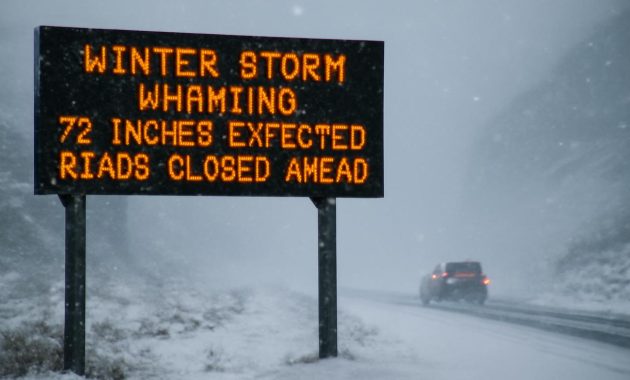
The air changes first, before the sky ever does. You feel it when you step outside to grab the mail in your worn slippers, or when you crack the car door in the grocery store parking lot. That sharp, metallic scent of cold. The silence that hangs heavier than usual, as if the town itself is holding its breath. Somewhere in the distance, a plow rattles awake in a municipal yard, and the first flakes—small, hesitant scouts—start drifting down, not yet a storm, but a promise.
The Night the Alert Arrives
On a Tuesday evening, when dinner dishes still steam in the sink and weather is just background noise on the TV, the banner crawls across the bottom of the screen: Winter Storm Warning: Up to 72 inches of snow possible. Travel could be impossible. Major routes may become impassable.
Your fork pauses midway to your mouth. Seventy-two inches. Six feet. The number lands like a physical weight. We are used to warnings, to advisories that pass with a few sloppy inches and some grumbling about wet boots left in the hallway. But this is different. Up to six feet of snow is not just weather—it is an event, a re-shaping of daily life, a kind of slow-motion natural disaster wrapped in swirling white.
Outside, the streetlights glow halos into a sky that looks, for the moment, perfectly calm. But the meteorologists talk about bands and lake-effect enhancement, about moisture feeds and upper-level dynamics, about how this particular system is lining up in that rare, uncomfortable way that makes seasoned forecasters lean closer to their screens.
Across town, truck drivers check schedules and wonder if their runs will be cut short. A nurse on the night shift eyes the clock, calculating whether she should pack an overnight bag. Parents scroll through school district apps, fingers hovering over notifications that haven’t arrived yet but surely will. Somewhere in a small apartment, a college student texts a roommate: “You see this storm thing? Dude. Six feet???”
The Anatomy of a Major Winter Wallop
By midnight, the storm has a name and a personality on the news. Animated swirls of blue and purple crawl across digital maps, time-stamped every three hours. You hear phrases like “prolonged event” and “snow measured in feet, not inches.” For people living along wind-whipped lakes or in high elevation passes, this is not entirely unfamiliar territory.
Storms like this don’t just materialize; they build like a slow crescendo. Moist air rides in from distant oceans or lakes, slamming into colder masses entrenched over the continent. The temperatures aloft fall perfectly into that narrow band where snowflakes grow big and fluffy, sticking to everything from pine needles to power lines. Wind funnels between mountain ranges, over open farm fields, through city canyons of glass and steel, turning simple snowfall into blizzard-grade whiteouts.
In that cocktail of conditions, 72 inches is not hyperbole. It’s a possibility. Not everywhere, and not for everyone, but for certain hillsides, certain small towns tucked in the lee of a lake, certain freeway summits where snow likes to drift and stack and sculpt, it is astonishingly real.
The Many Ways a Storm Stops a World
When you hear “could disrupt travel,” it sounds almost tame, like a flight delay or a slower commute. But a storm like this can reach into the pockets of daily life and turn them inside out. Picture a snowplow barreling down the interstate at 3 a.m., its lights carving a tunnel through the white. Behind it, a convoy of long-haul trucks crawls along, drivers peering into flurries that smash silently against their windshields.
Now imagine that, within an hour, snowfall rates hit 3 inches per hour. The cleared pavement disappears almost as fast as it’s revealed. Passing becomes unthinkable. Exits vanish beneath sharp-edged drifts. A semi jackknifes on a grade, blocking three lanes. The entire line of vehicles grinds to a halt, engines idling, exhaust pluming into the dark, while snow quietly builds around tires and under frames.
On two-lane state routes, it happens even faster. A single slide-off can straddle a narrow road, leaving a tangle of headlights, hazard flashers, and anxious faces swapping updates through rolled-down windows. A school sports bus, detoured onto a back road and now stuck behind a spun-out SUV, curls into a cocoon of shared snacks, phone flashlights, and nervy group laughter.
Airports fall next. At first, it’s a handful of red “Canceled” lines on the departure screen. Then another. And another. Baggage carousels slow to a stop. Lines at rental car counters stretch toward the automatic doors, where gusts of snow swirl in every time they hiss open. Someone sitting cross-legged by a wall outlet FaceTimes a grandmother states away: “We’re trying to get home, Nana. They say maybe tomorrow.”
The View from the Plow, the Farm, and the Front Porch
For some people, a forecast like this means digging out board games and stocking up on soup. For others, it’s the start of a marathon. In a city garage, rows of orange and yellow plows sit in neat formation, steel blades polished by years of winter battles. Crews in heavy work coats load them with salt, sand, and brine, radios crackling with test calls.
“We’ll be out as long as it takes,” one driver says, though they all know this storm may outlast human stamina. Twelve-hour shifts bleed into sixteen. Coffee poured into metal thermoses at 5 p.m. is still being sipped at 3 a.m., lukewarm but desperately welcome. Each run up and down the main arterials feels like trying to hold back the tide with a shovel.
On the edge of town, a farmer walks the line of a fence before the wind turns wicked. He cinches a gate tighter, checks the barn doors twice, tosses extra hay into the covered feed bunk. Snow stacking up to six feet isn’t just picturesque—it’s a real threat to livestock, to roof structures, to the fragile schedules of rural life. He watches the sky with an old, practiced skepticism: the forecasts have been wrong before, but this time, the air feels serious.
On a quiet cul-de-sac, a woman in fuzzy socks presses her hand against the front window. Streetlights paint each falling flake in a soft cone of gold. The world is still moving—cars hum by, a delivery van makes one last stop—but there’s a sense of deceleration. She knows that by this time tomorrow, those same lights might shine on an alien landscape, sculpted into rounded mounds and sharp, wind-carved corners.
When Routine Collides with the Unusual
In a way, modern life is built on the assumption that roads will be clear and planes will fly. We schedule surgery dates, job interviews, family reunions, truck deliveries, and just-in-time shipments on an invisible foundation of working infrastructure. A 72-inch snowstorm tests that foundation.
Think of the small-town grocery store wedged between a laundromat and a hardware shop. Its shelves will be hit from all sides: locals stocking up, travelers stranded, people who had planned to “grab that later” suddenly realizing that “later” might be a week away. Canned vegetables, bread, peanut butter, batteries, pet food, baby formula—each takes on the sheen of urgency.
Meanwhile, the staff who keep those shelves stocked may be battling their own driveways. A cashier debates whether to call in or risk the slick hill on her way to work. A store manager quietly sets up a cot in the back, in case going home isn’t an option once the heaviest bands hit.
And threaded through it all are those who cannot choose whether to stay home: paramedics, utility workers, nurses, firefighters, emergency dispatchers. They pack go-bags with extra socks and snacks, knowing that the routes they’ve driven a thousand times may be unrecognizable, that response times will swell along with the snowdrifts.
Preparing for a Storm That Redefines “A Lot of Snow”
Preparation, in the face of numbers like “72 inches,” becomes less about comfort and more about continuity—how to keep the essentials of life humming in a world muffled in white. You start to look around your home the way a ship’s captain might scan a deck before sailing into high seas: What’s tied down? What’s vulnerable? What do we absolutely, truly need?
For many households, there are a few key questions that quietly surface: Do we have enough to eat if we can’t get out for several days? What if the power goes out under all that heavy, sticky snow? How do we stay warm, informed, and in touch when the landscape outside the front door begins to resemble the inside of a snow globe?
It helps to think not only in terms of objects, but in terms of time. Could you function, reasonably, for 48 to 72 hours without leaving home? What about a week? In communities most likely to see that upper range of snowfall, this isn’t paranoia; it’s just an honest calculation.
| Focus Area | What to Consider | Why It Matters in a 72″ Storm |
|---|---|---|
| Food & Water | Shelf-stable meals, snacks, drinking water, baby and pet supplies | Road closures and empty shelves can last days beyond the last snowflake. |
| Power & Heat | Blankets, safe backup heat, charged devices, flashlights, batteries | Heavy snow and wind can down lines and make repairs difficult. |
| Medication & Health | Refills, essential medical equipment, basic first-aid supplies | Pharmacies and clinics may close or be hard to reach during peak impacts. |
| Transportation | Full fuel tank, emergency car kit, shovel, blankets, ice scraper | If you must travel, getting stuck is more dangerous in extreme cold and deep snow. |
| Communication | Chargers, backup battery, local radio, contact list written on paper | Staying informed about warnings and closures can shape safe decisions. |
What makes this kind of storm especially challenging is not just the depth of the snow, but its persistence. It’s the way a plowed driveway can vanish again in a couple of hours; the way a cleared side street becomes a trench walled by six-foot banks; the way repeated shoveling becomes a physical endurance test rather than a simple chore.
The Strange, Stark Beauty of Being Snowed In
Yet even as logistics tangle and plans unravel, there is a strange beauty to a world transformed by so much snow. When the wind dies down and the flakes finally ease, an almost sacred quiet settles in. Sound travels differently over that thick, insulating blanket. Footsteps are muffled, voices softened. Tree branches wear heavy white sleeves, every twig outlined in crystalline precision.
Step outside, and the air feels almost otherworldly. Your breath curls out in clean plumes. Every exhale seems to hang longer than it should. Cars parked along the curb are no longer recognizable vehicles but soft, rounded humps. Street signs peek from the drifts like exclamation points half-buried in punctuation.
Kids unzip winter bins and drag out plastic sleds, snowboards, dented saucers. The big banks carved by plows become mountains to climb and dive from. Dogs bound through chest-deep powder, leaving a dotted, zigzag trail of joy behind them. Somewhere, a neighbor who always complains about winter stands on their porch, coffee in hand, and—just for a moment—admits to themselves that it really is beautiful.
In that pause between falling and melting, the storm is more than disruption. It’s a reminder of scale, of our smallness, of the planet’s capacity to shift the rules overnight. The same roads that yesterday felt so permanent, so guaranteed, now sit silent beneath sculpted ridges of snow, and the sky that seemed indifferent has left its unmistakable fingerprints on every surface.
After the Last Flake: Digging Out and Moving Forward
The storm does not end with a tidy fade-out; it loosens its grip gradually. Snow intensity drops from blinding sheets to steady flurries to occasional, drifting sprinkles. Plow drivers emerge bleary-eyed from their trucks. Utility crews rotate home and back again, chasing the last scattered outages. The world wakes up to a new, slower rhythm.
Then the collective effort begins. Shovels clink against buried steps. Snowblowers roar to life, the churn of their engines punctuated by the steady scrape of metal on concrete. People appear in layers of mismatched wool and synthetics, exchanging nods and half-smiles as they chip away at what the storm has built.
On major highways, snowcats and rotary plows attack the biggest drifts, throwing towering clouds of white off the shoulders. In small mountain passes, crews work methodically, sometimes cutting literal canyons through snowbanks taller than the trucks themselves. The first vehicles through those newly opened lanes carry deliveries, emergency workers, and people for whom waiting was simply not an option.
Little by little, the lines of life reconnect. Trains blow their horns again. Airport departure screens shift from fields of red to tentative greens. The grocery store restocks, catching up on days of interrupted supply. Schools weigh the difference between a “snow day” and a “dig-out day,” measuring not just inches on the ground but the accessibility of side streets and bus routes.
And in living rooms where people once watched the first warning scroll across their screens, the conversations change. They become stories. “Remember when they said up to 72 inches?” someone will say. “I swear we had four-foot drifts right over the grill.” Photos are passed around: cars buried to their rooflines, kids standing next to yardsticks swallowed almost to the top, a neighbor’s front door opened to a solid wall of snow, like the inside of a freezer.
These storms slip quickly into local lore. They become reference points, comparisons for future winters. Years from now, when new alerts pop up on phones and TVs, someone will inevitably say, “Well, at least it’s not like that one year…” and everyone in the room will remember the strange mix of fear, inconvenience, wonder, and awe that comes when six feet of sky decide to relocate to the ground.
Frequently Asked Questions
How serious is a winter storm warning predicting up to 72 inches of snow?
It is extremely serious. Forecasts calling for snow measured in feet rather than inches signal a high-impact event that can shut down major highways, close airports, and make even short trips dangerous or impossible. Such storms increase the risk of power outages, roof damage from heavy snow loads, and delays in emergency response.
Should I cancel travel plans if a storm like this is forecast?
If your travel window overlaps the peak of the storm—even by a day—it is wise to consider rescheduling. Blowing and drifting snow, whiteout conditions, and road closures can leave you stranded far from services. When forecasters and transportation departments advise staying off the roads, it’s because conditions may become unsafe even for well-equipped vehicles.
What is the biggest risk during a very heavy snow event?
The combination of deep snow, strong wind, and cold temperatures can create multiple overlapping hazards: hypothermia if you become stranded, carbon monoxide poisoning from improperly used generators or running vehicles, structural stress on roofs, and blocked access for emergency responders. Often, the most dangerous moments are when people underestimate how quickly conditions can deteriorate.
How can I best prepare my home for a major winter storm?
Focus on essentials: food and water for several days, medications, warm clothing and blankets, flashlights with extra batteries, and a way to stay informed (such as a battery-powered radio). Charge devices ahead of time, fill your gas tank, and clear gutters and vents before the storm. If you use backup heat, be sure it’s properly ventilated and safe for indoor use.
Is it ever safe to go out and enjoy the snow during a big storm?
It can be, but timing and awareness are everything. Avoid going out during the worst of the wind and whiteout conditions. Once visibility improves and snowfall eases, dress in layers, stay close to shelter, and tell someone where you’re going. Be mindful of hidden hazards under deep snow, like curbs, ditches, or icy patches, and give plows and emergency vehicles plenty of space to do their work.
Originally posted 2026-03-05 00:00:00.