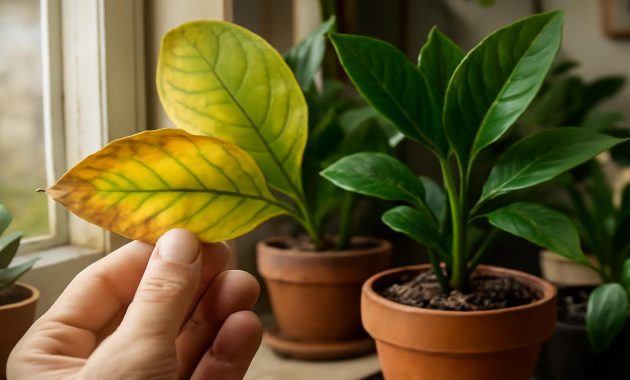
The first time you notice it, you think your eyes are playing tricks on you. Yesterday your pothos was all lush, glossy green, trailing confidently off the shelf. This morning, one leaf near the bottom looks… tired. A little pale around the edges. By the end of the week, that single tired leaf has become three, then five, each one fading from emerald to a sickly pastel yellow. And the question starts circling in your brain as you stand in the kitchen with your watering can in hand: “But I water you. I’m doing everything right. So why are you turning yellow?”
When More Love Means Too Much Water
Most of us become plant parents with the very best intentions. We want our homes to feel alive, to soften the edges of screens and furniture with leaves and stems and vines. So we do the one thing we’re absolutely sure counts as care: we water. A little on Sunday, maybe a top‑up on Wednesday if the week feels long, and if it’s been a stressful few days, well, maybe a bonus drink on Friday too. Love, in liquid form.
But plants don’t feel love the way we do. They feel oxygen around their roots, light on their leaves, and the slow movement of water passing through soil. When a plant’s leaves turn yellow while the watering can is still warm in your hand, there’s a good chance the problem isn’t that you’re neglecting it—it’s that you’re overdoing the only language of care you’re sure of.
Roots, those pale, silent workhorses hidden beneath the surface, breathe. In a healthy pot, there are tiny pockets of air between soil particles, places where roots can exchange gases and absorb nutrients. When we water too often, those air pockets fill and stay filled. The soil never fully dries, and the roots, deprived of oxygen, begin to suffocate. At first, the plant tries to cope: it slows growth, drops a leaf here and there. But over time, portions of the root system give up, turning brown and mushy. You never see this quiet collapse; what you see instead are leaves slowly surrendering their green.
This yellowing—from the base of the leaf outward, or starting at older leaves near the bottom of the plant—is often the first visible sign of root trouble. The leaf feels limp, not crispy. The soil, if you press your finger in, is cool and damp, even days after the last watering. You might notice an earthy, slightly sour smell. Maybe the plant looks both dull and oddly waterlogged at the same time, as though exhaustion had a texture.
In that moment, the instinct is almost always the same: water more. The leaves look sad, so the plant must be thirsty. Yet each extra drink deepens the problem, like refilling a bathtub with a clogged drain. What your plant is really thirsty for is balance—moments of moisture followed by airy stretches of gentle dryness. “Regularly” is not what your plant wants; “appropriately” is.
The Hidden Clue in the Pot
If you could lift your plant gently out of its pot, the truth would be written in roots. Healthy roots are firm, white or light tan, and smell faintly of fresh soil. Overwatered roots, landing in the dark middle territory between “fine” and “rotting,” start to look like something you’d rather not touch: soft, brown, mushy. Encased in soggy soil, they can no longer do their job—no matter how often you pour water over them.
So your plant, sensing that its foundation has become weak, makes a strategic retreat. It sacrifices older leaves, flushes out chlorophyll, and sends their nutrients back deeper into the still-functioning sections of root and stem. The result looks heartbreaking: a once‑full plant dotted with patches of yellow, each leaf a small surrender in the name of survival.
It’s not that you shouldn’t water regularly. It’s that “regularly” needs to mean something different for each plant, each pot, each corner of your home. A cactus in a bright south‑facing window might want deep, infrequent drinks—weeks between soakings. A tropical calathea in dim light might prefer light, consistent moisture but panic if its roots sit in a saucer of standing water. Each plant has a rhythm; our task as keepers is to learn to move in time with it.
The Strange Case of Too Much and Too Little at Once
Here’s the twist that confuses nearly everyone: the yellowing you see from overwatering can look eerily similar to the yellowing from underwatering. To a plant, “cannot get enough water to the leaves” and “too much water suffocating the roots” can end up in the same visual language of stress. It’s as if the plant is shouting the same word—yellow—but in two completely different emotional tones.
Underwatered plants often send you other clues. Their leaves feel dry, papery, or curled. New growth is tiny, hesitant. The soil pulls dramatically away from the edges of the pot, creating a gap where water runs straight through instead of soaking in. You may lift the pot and feel almost no weight at all, like picking up an empty mug you thought was full.
Overwatered plants, on the other hand, can actually collapse under the heaviness of their own environment. The stems may feel swollen and soft instead of crisp. The yellow tends to appear alongside patches of brown that seem wet, not dry. Mold can bloom on the surface of the soil, a delicate white fuzz like forgotten bread. Fungus gnats might begin to hover around the pot, drawn to constant dampness.
Standing at your sink or shelf, watering can in hand, it can feel like a quiet mystery with too many possible answers. The beauty, though, is that once you begin to notice patterns—how the soil feels, how heavy the pot is, how the plant responds over days instead of minutes—you start to understand the deeper story unfolding beneath those yellow leaves.
Reading the Leaves Like a Diary
Every plant carries a kind of diary in its foliage. Yellow leaves aren’t just a complaint; they’re a historical record. The spot patterns, the timing, the way the color spreads—all of it tells you not just that something is wrong, but when and where in the plant’s life that stress occurred.
Sometimes, the story is simple. A lower leaf on a fast‑growing plant slowly yellows over weeks, then drops away. That can just be aging—the plant letting go of older parts to focus energy on new shoots. In that case, the yellow is almost graceful, like autumn arriving on a single leaf. Nothing to fix, just a quiet cycle playing out.
But when yellow appears suddenly, or climbs quickly from the bottom of the plant toward the top, or shows up in oddly specific places—just on leaves facing one direction, or only on new growth—that’s your cue to look more closely. Is a hot vent blasting dry air? Is a window that seemed gently bright in winter now becoming harsh in summer? Did you move the plant last week? Change its soil? Fertilize more heavily?
The leaves remember. The moment you overdid the plant food, new leaves may emerge crinkled or with brown tips surrounded by yellow halos. The week you forgot to open the blinds, foliage near the center may slowly pale. The stretch when work kept you out late every night may show up as a line of small, slightly yellowed leaves along one portion of stem, like a timestamp of that hectic season.
Sometimes, to make sense of these signals, it helps to see them side by side.
| Yellowing Pattern | Likely Cause | What It Feels Like to the Plant |
|---|---|---|
| Older bottom leaves yellowing, soil stays wet | Overwatering / poor drainage | “My roots can’t breathe.” |
| Leaves yellow and crispy, soil bone‑dry | Underwatering | “I’m running on empty.” |
| Yellow between veins, veins stay green | Nutrient deficiency (often iron or magnesium) | “I’m drinking, but the ‘food’ is missing.” |
| Sudden yellow on many leaves after a move | Stress / change in light or temperature | “Everything changed too fast.” |
| Yellow plus sticky residue or tiny specks | Pests (spider mites, scale, aphids) | “Something is feeding on me.” |
When Water Isn’t the Real Problem
You stand in front of a yellowing plant, finger pressed gently into the soil. It feels just right—not soupy, not dust‑dry. You’ve adjusted your watering rhythm, letting the top few centimeters dry before watering again. You’ve even checked the pot for decent drainage holes. Still, yellow leaves keep appearing like unanswered questions. So if it’s not the water… what is it?
Sometimes, “even when you water regularly” is a red herring. The real issue might be light. Light is everything to a plant: its clock, its food source, its sense of place. In low light, a plant can’t photosynthesize efficiently, meaning it can’t convert that careful watering into growth. The excess energy has nowhere to go. The plant becomes leggy, stretching toward whatever brightness it can find, and older leaves—especially those shaded deeper in the canopy—begin to turn yellow and drop to reduce energy demands.
In other corners of the house, the problem is the opposite. A plant nestled on a sill that felt gentle in winter might suddenly be locked into direct summer sun. The leaves, overwhelmed by the intensity, can burn—first fading to a peculiar washed‑out yellow, then turning crisp at the edges. You think, “But I watered you. Isn’t that what you needed?” Yet no amount of watering can offset light that’s simply too harsh for that particular species in that particular pot.
Under the soil, another quiet story may be unfolding: the slow depletion of nutrients. Potting mix isn’t a permanent buffet. Over months and years, as water moves through and roots absorb minerals, the richest parts are used up. The soil becomes structurally fine but nutritionally thin. You keep watering on schedule, but what’s moving past the roots is almost like distilled water: hydrating, but not nourishing. The leaves respond by yellowing between the veins, or emerging pale right from the start.
Then there are the invisible houseguests: spider mites weaving microscopic webs, scale insects disguising themselves as bumps, aphids clustering along tender stems. These creatures pierce or scrape the plant’s tissues, sipping away its sap. To us, the plant just looks tired and yellowing. To the plant, it’s trying to live while being slowly drained.
The Pot That Became Too Small
Every plant, at some point, outgrows its shoes. Roots that once spread comfortably through their soil start circling the pot, binding tightly against its inner walls. When you slide the plant gently out to peek, you might see more root than soil: a dense, pale knot of living fiber. In this pot, water moves strangely—rushing past rather than soaking in deeply, or pooling where roots are too crammed to breathe properly.
In a root‑bound plant, you can water with the devotion of a saint and still see yellow leaves. There’s simply not enough space for new roots to grow and explore. Nutrients wash quickly out of the limited soil, and the plant begins to ration its resources. Older leaves go first, turning yellow as the plant quietly decides where to invest its dwindling energy.
Repotting, in this context, isn’t just a cosmetic upgrade—it’s a reset of the plant’s entire relationship with water and food. Fresh, airy mix gives roots new pockets of life: places to breathe, to branch, to anchor. A pot just one or two sizes bigger invites balance to return. Often, weeks after a repot, the yellowing slows, new growth appears, and the plant seems to exhale.
Changing Your Role from Waterer to Listener
There’s a subtle shift that happens when you stop thinking of yourself as the “person who waters the plants” and start becoming the person who listens to them. Instead of a fixed schedule, you start using your senses: the weight of the pot in your hands, the feel of the soil, the look of new leaves. Suddenly, your home isn’t just a place you decorate with greenery. It becomes a place where living things and daily rhythms intersect.
You might find yourself developing little rituals. Lifting each pot once a week, learning the difference between “heavy with water” and “pleasantly thirsty.” Brushing fingertips along leaves, checking for dust—because a dusty leaf can’t absorb light as well, which eventually translates into weak, yellowing growth. Glancing at the angle of the sun in late afternoon and realizing your peace lily might be getting more light than you thought in summer, or that your fiddle‑leaf fig looks sulky every time the radiator kicks on.
Yellow leaves stop feeling like a failure and start feeling like data. A fern in the bathroom begins to yellow from the tips inward: maybe the air isn’t as humid as you assumed. A snake plant in the hallway develops pale, floppy leaves: perhaps the watering can visits too often for a plant that evolved to endure drought. Each time you notice, adjust, and watch the plant respond, you learn a little more plant‑language—and a little more patience.
Small Adjustments, Big Changes
It doesn’t take a greenhouse or a horticulture degree to turn things around. Often, your plants don’t need elaborate treatments; they need nudges:
- Letting soil dry out more deeply before watering again.
- Switching to a pot with drainage holes—and resisting the charm of pots that are pretty but sealed.
- Rotating a plant 90 degrees every week so light reaches all sides evenly.
- Adding a simple, diluted fertilizer during the growing season to replenish what’s been used up.
- Wiping leaves with a damp cloth once a month, giving them back their shine and light‑catching power.
As you tweak these details, yellow leaves may still appear now and then. That’s okay. Any living thing, yourself included, will have off days, off weeks, seasons of stress. What changes isn’t that everything is always perfect—it’s that you’re no longer baffled when perfection slips. You see the yellow, listen for the story behind it, and respond with curiosity instead of panic.
Yellow as a Beginning, Not an Ending
One day, months from now, you might find yourself standing in the same corner of your home, holding the same watering can, looking at the same plant that once worried you. The plant is fuller now, its leaves confident and wide. Maybe there are still a couple of yellowed leaves near the base, quietly letting go. You reach down, pinch one off gently, and instead of frustration, you feel something closer to recognition.
Those early yellow leaves were reminders that your houseplants are not decorations; they are relationships. Relationships with schedules and misunderstandings and slow, mutual learning. You offered regular watering, and your plant answered in yellow. Over time, you learned to translate that color: too wet, too dry, too dark, too confined, too hungry, too hot. You became, not perfect, but attentive.
And perhaps that’s the real shift: houseplants invite us to practice a different sense of time. Nothing happens instantly. A change in watering this week might show up in leaf color next month. A repot today could mean healthier growth next season. Instead of living in the hurried now, you begin to live in the gentle afterward, always watching for the quiet echoes of choices you made earlier.
So when your houseplants turn yellow, even when you water them regularly, it’s not a simple indictment of your care. It’s a conversation starter. A chance to ask: What else are you telling me? Is the pot too tight, the light too weak, the room too dry, the soil too tired? The yellow is not the plant giving up; it’s the plant giving you clues.
And once you learn to read them, your home transforms. It becomes more than a backdrop for your life. It becomes a small, leaf‑filled ecosystem, where light and water and soil and time mix—not perfectly, but attentively. A place where even a yellow leaf, held between your fingers for a moment before it meets the compost, feels less like a mistake and more like part of the story.
Frequently Asked Questions
Why are the bottom leaves turning yellow first?
Lower, older leaves are usually the first to show stress. In overwatering or nutrient deficiency, the plant sacrifices these leaves to preserve newer growth. Check soil moisture, drainage, and whether the plant might need fresh soil or light fertilizing.
Should I cut off yellow leaves?
Yes, if they’re mostly yellow. Removing them helps the plant focus energy on healthy growth and improves appearance. Use clean scissors or pruners and avoid tearing. If only a small part is yellow, you can wait and observe.
How often should I water to prevent yellow leaves?
There’s no universal schedule. Instead, water when the top 2–5 cm of soil are dry (shallower for tropicals, deeper for succulents). Check by touch, not by calendar, and adjust based on season, light, and pot size.
Can tap water cause yellowing?
Sometimes. Hard water or water high in chlorine or fluoride can stress sensitive plants, leading to browning tips that may spread with a yellow halo. If you suspect this, try using filtered, distilled, or dechlorinated water for a few weeks and watch for improvement.
How do I know if my plant needs repotting?
Signs include roots growing out of drainage holes, water running straight through without soaking in, the plant drying out very quickly, or becoming top‑heavy and unstable. When you slide it out of the pot and see dense, circling roots with little soil, it’s time to move up a size.
Can lack of light cause yellow leaves even if I water correctly?
Yes. Without enough light, plants can’t use the water you provide effectively. They may become leggy, weak, and start dropping yellowing leaves, especially older ones. Moving the plant closer to a bright window (but out of harsh direct sun, if it’s a low‑light species) often helps.
Is one or two yellow leaves always a problem?
Not necessarily. Occasional yellowing of older leaves is a natural part of a plant’s life cycle. If new growth looks healthy and vibrant and yellowing is slow and minimal, your plant is likely fine. Concern starts when yellowing is sudden, widespread, or affects new leaves.