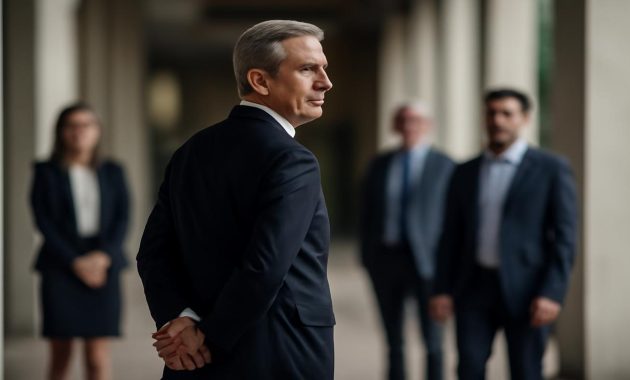
The old man walked along the riverside path with his hands folded neatly behind his back, the late afternoon light catching the silver in his hair. Children raced past him with the wild, forward-flinging energy of youth, arms slicing the air like small propellers. Dogs tugged at their leashes. Cyclists bell-chimed their progress. But he moved slowly, calmly, shoulders soft, gaze unhurried—fingers loosely interlaced behind him as if he were carrying something invisible and precious there. If you watched long enough, you might notice something almost regal about that stance. It looked simple, almost accidental. It wasn’t.
The Quiet Posture You’ve Seen a Thousand Times
Once you start looking for it, you see it everywhere.
A school principal walking down a hallway, surveying the buzz of a new term. A museum curator drifting through silent galleries, pausing before a painting. A CEO on a factory floor, listening more than talking. Often, their hands are not at their sides or tucked into pockets, but linked loosely behind their back.
It’s the same posture you see in portraits of royalty, in military inspections, in monastery courtyards where monks walk in contemplative circles. It’s a strangely familiar silhouette on city promenades and quiet country roads: shoulders slightly back, chest open, chin level, hands folded out of sight. The body language of someone who is not rushing to do anything, but is fully present to what is happening.
On the surface, it looks like a quirk. A comfortable habit, maybe. The way some people cross their arms or swing them freely. Yet psychology, anthropology, and leadership research all whisper the same thing: this seemingly simple way of walking is not random. It’s a posture heavy with meaning, and it shows up again and again in people who hold authority, carry responsibility, or live with a deep inner life.
Walk like this for just a minute, and your body knows it too. Something changes in how you feel, in what you notice, in how the world responds to you.
The Hidden Script of a Simple Gesture
There is a quiet script running through your body whenever you move. Most of the time, you’re not aware of it—not in the way you’re aware of words you speak or decisions you make. But that script is there in the tilt of your head, in the way you turn your feet, in how much space you take up or surrender.
Walking with your hands behind your back is one of those gestures that lives at the edge of consciousness. People rarely decide, “I’m going to clasp my hands behind me now.” It appears more like steam rising from a kettle: a visible sign of what’s happening just beneath the surface.
Psychologists often talk about body language as a negotiation between safety and exposure. When we feel threatened, we protect: we cross arms, hunch shoulders, wrap ourselves with our own limbs. When we feel safe, we open: bare our chest, lengthen our spine, let our hands move freely away from our core.
Now consider what happens physically when you link your hands behind your back. You expose your torso, the vulnerable center of your body. You move your hands—tools of work, defense, and action—out of view. In a very quiet way, you are saying: “I am not reaching for anything. I am not guarding myself. I am here to observe.”
That posture is not submissive. It is gentle dominance—the calm of someone who does not need to prove their presence. It signals at least three psychologies at once: curiosity, containment, and confidence.
Curiosity: Facing the World, Not Your Own Hands
Think about what your arms usually do when you walk. They swing, they fidget, they scroll through your phone, they adjust clothing, they check a watch. They are constantly pulled into small, self-focused tasks. But when your hands are tucked behind you, you remove them from the stage. They stop competing for your attention.
Suddenly, the world steps forward. Your vision widens. You look up and out, rather than down and in. For many people, this posture coincides with a shift from doing to noticing. Leaders walking a site visit. Elders strolling through a town they know by heart. Teachers patrolling a classroom. Their hands are quiet so their eyes can be loud.
In psychology, this is tied to what’s known as “attentional stance”—the way your body either narrows or expands your field of awareness. Your hands behind your back open up your front-facing view. You become an observer. And observers, throughout history, have often been the ones with power or wisdom: inspectors, philosophers, commanders, mentors.
Containment: Holding Your Impulses Gently in Place
There is also something else happening. When your fingers are loosely interwoven behind you, you reduce the temptation to fidget. You’re less likely to point, poke, or wave unnecessarily. The posture creates a gentle, self-imposed boundary.
Leaders who adopt this stance—consciously or not—are doing something psychologically sophisticated: they are containing themselves. When stakes or emotions rise, our limbs want to express that surge—hands slicing the air to underline our words, arms widening for emphasis, fingers drumming with impatience. Linked behind the back, those impulses soften. You don’t suppress your feelings; you simply give them fewer escape routes.
This gives an impression of composure. A manager listening quietly in a tense meeting with hands folded behind their chair sends a different message than one tapping a pen or crossing their arms. The message is: “I can hold my reactions. I can host this moment without spilling over.”
Confidence: Showing You Have Nothing to Prove—or Hide
At first glance, it seems strange that a posture which exposes your core and ties up your hands can signal strength. But our social brains read context faster than we can analyze it. Across cultures, open postures have long signaled power and ease.
Someone nervous in a dark alley does not walk with their hands behind their back. Someone entering a battlefield does not do it either. But in environments where physical threat is low and social stakes are high—boardrooms, schools, neighborhoods, campuses—the people who feel most at home often let their guard down physically.
They might not own the space in any legal sense, but their body language says, “This terrain is not hostile to me.” That’s a quiet kind of confidence, the opposite of chest-thumping bravado. Leadership studies have noted again and again that the most trusted leaders rarely need to assert themselves aggressively. Their calm is what speaks.
Why Leaders Keep Doing It Without Realizing
Watch a documentary about a respected leader—the kind whose influence rests more on respect than fear—and look at the moments between the big speeches. On factory tours. In rural villages. On school visits. You’ll often catch that same silhouette: the relaxed, slightly forward-leaning walk, hands resting behind the back.
This posture shows up in leaders for reasons rooted in both habit and role.
Leadership, at its best, is heavy with observation. A good leader must absorb more than they react, see more than they comment on, walk into spaces as both participant and witness. Hands behind the back support that stance: eyes outward, inner responses gathered quietly inside.
It’s also that many leaders grow into this habit over years, shaped by repeated situations where staying neutral and calm is more valuable than rushing to act. Think of a school headmaster walking the playground, present but not hovering. A senior nurse rounding in a hospital ward, checking, sensing, listening. They are there as guardians, not as constant interveners.
Over time, their body finds a posture that matches this role: one that says, “I am available. I am observant. I am at ease—but I am also responsible.” They don’t practice it in the mirror. It simply grows on them, like a well-worn coat shaped by years of weather.
The Leader’s Walk: Not in Front or Behind, but Among
Notice where leaders often stand or walk when they take this posture: not necessarily at the very front of a group, but moving through it, alongside it, or just behind the main cluster. Hands behind the back support that subtle positioning. You’re not carving a path with your arms or directing traffic with gestures; you’re blending into the current while still radiating quiet authority.
Imagine a head gardener strolling through an old estate, checking on the roses and the hedges. Or a conductor walking through the empty concert hall before a performance. Their hands are behind them not because someone taught them a trick of charisma, but because their mind is busy reading the space. Their body follows.
In those moments, leadership is less about command and more about stewardship. And stewardship has a different gait: steady, unhurried, anchored. Your hands fold away because you’re there to receive information, not force it.
How This Posture Shapes Your Inner Landscape
The relationship goes both ways: your inner state shapes how you walk, but how you walk can also shape your inner state. This is not magical thinking; it’s embodied cognition. Your brain is in constant conversation with your muscles, joints, and posture, adjusting emotions and thoughts based on the physical data it receives.
Try this: take a short walk with your hands behind your back. Not in a stiff, military way. Let your shoulders relax. Let your elbows bend. Let your fingers just lightly hold each other. Notice what happens to your breathing, to your gaze, to the speed of your steps.
Many people find they naturally slow down. They look around more. Their inner commentary softens. Without swinging arms to pump momentum, your stride smooths. Your torso feels more stable. The world seems a bit more like something to be appreciated than conquered.
This can be particularly powerful for people who spend much of their day leaning forward—toward screens, toward tasks, toward deadlines. Walking with your hands behind your back is a counter-practice. It gently says, “For these few minutes, I am not chasing anything. I am just here, walking.”
Leaders who live inside high-pressure roles sometimes adopt this posture instinctively for that very reason. It becomes a moving refuge—a way to think while still tethered to the physical world. The rhythm of footsteps, the grounding of the soles, the openness of the chest, the soft containment of the hands: all of it works together to make space for reflection.
A Posture of Listening—to Others and to Yourself
There’s a reason this gesture often appears in conversations where one person is doing more listening than talking. Hands behind the back reduce the temptation to interrupt physically—even before words form, your body says, “Go on.”
This is powerful in leadership because most people are unused to truly being listened to by someone in authority. When a manager or mentor stands with hands folded behind them and attentive eyes, it often invites more openness. The speaker senses there is no looming reaction in the air, no impatient tapping, no arms folded like a closing door.
Internally, the same thing happens when you walk this way alone. You become a better listener to your own mind. Without the micro-distractions of fidgeting, thoughts can rise and fall more cleanly. The posture becomes a form of moving meditation—not mystical, just deeply humane.
A Small Gesture with a Long History
Long before psychology labs and leadership seminars, humans were already reading meaning into the way others carried themselves. In ancient courts and military camps, in monasteries and manor houses, walking with hands behind the back was a familiar sight among those who inspected, taught, or guided.
Artists caught this in portraits: rulers strolling gardens with hands clasped out of sight, philosophers wandering cloisters, scholars pacing libraries. Even in fictional characters we love—detectives wandering crime scenes, mentors circling training grounds—we see the same shape emerge.
Some cultures even formalized it. In certain traditions, students were taught to walk this way when listening to elders or examining something carefully, as a sign of respect and attention. The posture protected fragile objects from curious fingers and fragile conversations from impulsive reactions.
Our modern world, with its constant forward-leaning speed, has not erased this gesture. If anything, it stands out more starkly now: that one person on a crowded sidewalk not clutching a phone, not dragging a suitcase, not swinging a shopping bag—just walking, unarmed and unoccupied, hands folded quietly behind them. It looks nearly radical.
What Your Walk Is Saying—Even When You’re Silent
The meaning is not identical in every culture, of course. Context always matters. In some groups, it may be seen as overly formal; in others, as a sign of maturity or rank. But across many places and centuries, it has consistently been associated with some blend of thoughtfulness, composure, and oversight.
When someone walks this way past you, you might not consciously analyze it, but you feel something. Maybe you assume they’re deep in thought. Maybe you sense they are in no hurry. Maybe they remind you of a teacher, a grandparent, a character from a story. The posture borrows from all those associations and quietly broadcasts them forward.
Trying It on: A Simple Experiment in Everyday Leadership
None of this means you should start marching around dramatically with your hands behind your back, as if impersonating a movie general. Forced body language rarely reads as authentic. But it does mean you can play gently with this gesture as a tool for self-awareness and presence.
Consider these small experiments in your daily life:
- On your next walk—whether in a park, a corridor, or your backyard—spend a minute or two with your hands loosely behind your back. Notice how your thoughts feel different than when your arms swing or your hands hold a device.
- During a conversation where you want to listen deeply, stand or walk with your hands folded behind you for a short time. See if it affects not only how the other person speaks, but how much more patient you feel.
- When you’re in a leadership role—formal or informal—try this posture while simply observing your environment: your household, your team, your classroom, your community event. Let your body tell your brain, “I am steady. I am watching. I don’t have to react immediately.”
Over time, you may find that this way of walking shows up spontaneously in moments when you’re stepping into responsibility—not because you’re copying anyone, but because your body is searching for a shape that matches your role.
Reading Yourself, Not Just Others
Perhaps the most intriguing part is not what this posture communicates to others, but what it reveals to you about yourself. If you notice yourself walking this way more often, it may be a sign of an inner shift: toward calmer observation, toward more grounded confidence, toward a gentler relationship with action.
And if you never walk this way, that’s fine too. There is no single “correct” posture of leadership or reflection. But tuning into this one gives you a richer vocabulary for understanding the subtle choreography of your own body and mind.
Quick Reference: What Walking with Hands Behind Your Back Often Signals
To bring all of this together, here is a simple overview of the psychological layers often wrapped inside this quiet gesture:
| Aspect | What It Often Reflects |
|---|---|
| Attention | Shift from doing to observing; eyes outward, world-focused |
| Emotional State | Calm, reflective, unhurried; reduced reactivity |
| Leadership Signal | Quiet authority, stewardship, oversight rather than control |
| Interpersonal Message | “I am listening, I’m not about to pounce or interrupt” |
| Inner Experience | A sense of holding your impulses, making room for thought |
Faq
Is walking with your hands behind your back always a sign of confidence?
Not always. While it often reflects comfort and composure, some people simply find it physically comfortable or habitual. Context matters: if the posture appears with relaxed shoulders, steady breathing, and open eye contact, it usually suggests quiet confidence. If it’s combined with tension or stiffness, it may just be a self-soothing habit.
Do all leaders naturally adopt this posture?
No. Leadership styles and body language vary widely. Some leaders are more animated, others more reserved. Walking with hands behind the back is a common pattern among reflective, observant leaders, but it’s not a requirement for effective leadership. It’s one gesture in a much larger language of presence.
Can I use this posture to feel calmer in stressful situations?
It can help. By gently clasping your hands behind your back, relaxing your shoulders, and slowing your walk, you signal safety and steadiness to your nervous system. This won’t erase stress, but it can reduce impulsive reactions and create a small pocket of calm in which to think more clearly.
Is it ever inappropriate to walk with hands behind your back?
In some settings, it may read as too formal or detached—for example, in very casual social situations or when someone expects active, hands-on participation. In emotionally intense moments, people may also prefer more visible engagement, like open hands or supportive gestures. Reading the room is more important than following any particular posture rule.
How can I practice this posture without feeling awkward?
Start in low-stakes environments: a quiet walk, a stroll through a park, or when you’re alone at home. Focus on keeping the grip light and the spine relaxed. As it begins to feel natural, you can let it appear briefly in conversations or work settings where listening and observation are your main roles. Over time, it will either settle into your body’s repertoire or gently fall away if it’s not for you.