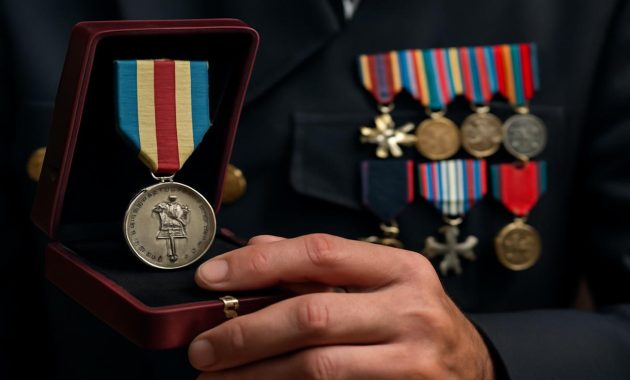
The medal sat in the pool of light like a small captured sun—bronze warming under the lamp, the ribbon folded just so, its edges softened by a hundred thumbs. People had passed it around the table all evening, as if it were a story you could hold. Outside, night pressed gently against the windows. Inside, the air smelled of coffee and rain-soaked jackets. When it finally reached you, the room faded for a moment. The Sentinel Medal. You had heard of it before, in brief headlines and half-remembered conversations. But here it was, with its quiet weight and quiet power, a symbol of something that feels increasingly rare in a hurried, distracted world: the choice to stand guard when no one is watching.
The Quiet Origin Story of a Loud Symbol
Every medal begins as an idea—a need, really—long before it becomes metal and ribbon. The Sentinel Medal is no different. It grew out of a gap that people could feel but not quite name: there were honors for courage in the middle of the storm, for leadership in the thick of crisis, for victories that could be tallied and recorded. But who recognized the ones who spent their lives on the threshold, preventing storms before they gathered, guarding people and places so completely that danger rarely even made the news?
In the years when the concept of “sentinel” began to take root as an award, the world was shifting fast. Technology was erasing distances. New threats were less visible—data breaches instead of broken doors, quiet tensions instead of open conflict. Yet, in fire stations and coastal watch huts, in dim security operations centers and remote border posts, one pattern remained constant: there were people whose main job, whose main gift, was vigilance.
Conversations started in back offices and at conference tables, among people who had seen the same pattern play out again and again. They talked about the guard who noticed a tiny inconsistency in a logbook and discovered a smuggling route. The analyst who spotted an anomaly in a stream of data and prevented a catastrophic breach. The ranger who stayed an extra hour on patrol and found the first whisper of a wildfire before it turned into a roar.
These were not always the most decorated people. They were not usually the ones interviewed on television. But without them, the moments we do celebrate later—the rescues, the dramatic saves—might never have been survivable at all.
From that recognition, a question emerged: what would it look like to create an honor for those who choose to watch, to wait, to stay ready? A medal for those whose greatest achievement might be that nothing terrible happened the day they were on duty. The answer slowly took shape in the form of the Sentinel Medal.
The Meaning Hidden in Metal and Ribbon
Place a Sentinel Medal in your palm and you’ll feel it immediately: it isn’t flamboyant. Its beauty is quiet, deliberate. Whether you’ve seen a formal version in a military context, a civil service variant, or a custom design used by a particular agency or organization, the shared language is unmistakable.
At the center, there is often a watchful motif: an eye, a tower, a shield, a standing figure facing outward. These are the symbols of guardianship, of being attuned to the world beyond one’s own needs. Around it, geometric lines or circular borders suggest a continuous perimeter—no corners to collapse, no edges left unguarded. The ribbon tends to draw from restrained, serious colors: deep blues, muted greens, somber reds, or combinations that echo long traditions of duty and service.
The name “Sentinel” does as much work as the design itself. A sentinel is not simply a guard. A guard can be a job title; a sentinel is a posture, a promise. It implies someone who remains when others leave, who wakes when others sleep, who raises the alarm not to be a hero, but to keep others from needing one. In many organizations, the citation that accompanies the medal uses words like “watchfulness,” “steadfast presence,” and “preventive action.”
What makes the Sentinel Medal especially powerful is that it recognizes something intangible: the discipline of attention. Anyone who has ever pulled a long night shift knows the battle against fatigue, complacency, and the siren song of “it’s probably fine.” The Sentinel Medal is, at its core, a marker that someone chose otherwise. It says: when dull routine could have swallowed your focus, you stayed sharp. When no one was checking, you still cared. When it would have been easy to coast, you didn’t.
In a culture that often rewards quick results and visible excitement, this medal honors the opposite: patience over spectacle, prevention over drama, the long arc of responsibility over fleeting flashes of glory.
Who the Sentinel Medal Is Really For
To understand who receives the Sentinel Medal, it helps to imagine a day not when everything went wrong, but when everything quietly went right because someone refused to look away.
Sometimes that person is in uniform—a soldier at an observation post, a sailor on watch, an air traffic controller tracing ghostly green dots across a radar screen. In many formal frameworks, the Sentinel Medal is tied to military or governmental criteria: long, exemplary service in a security or monitoring role, repeated acts of vigilance that a board of peers and superiors can clearly document, or a single episode of watchfulness that prevented major harm.
But the spirit of the medal has been adopted in wider circles too. In emergency services, it might be presented to a dispatcher who notices a pattern of distress calls and triggers an investigation that uncovers a serial threat. In environmental protection, it could go to a field scientist who tracks subtle changes in water quality for years and sounds the alarm before a river reaches a point of no return. In corporate security or critical infrastructure, it might honor a specialist who quietly maintains and monitors systems in ways that make crises conspicuously absent.
What unites these people is not their job title but their stance toward the world: they lean toward responsibility. They are the ones who double-check the door, scan the horizon twice, read the extra page in the report. Often, they are introverts, or at least not performers by habit. Many will tell you they were just “doing their job.” The Sentinel Medal pushes back on that, suggesting that staying consistently alert in a distracted age is not just a job—it’s a form of everyday bravery.
Imagine, too, the broader ecosystem around each recipient. Supervisors who track years of reliable service. Peers who remember the moment someone’s small observation turned into a major prevention. Review boards who study timelines, logs, and testimonies. By the time the medal is pinned to a uniform or placed into a calloused hand, a whole web of witnesses has quietly agreed: this person stood watch in a way that changed outcomes.
How the Path to the Sentinel Medal Usually Unfolds
Unlike some honors that arrive out of nowhere, the Sentinel Medal usually grows from a long, almost invisible story. If you were to chart the path of a typical recipient, it might look less like a straight line and more like a patient spiral, looping through long days of practice, small decisions, and rarely noticed choices.
First comes the assignment itself. Not everyone is drawn to watch posts and monitoring roles. You have to be comfortable with silence, with repetition, with being the unseen node in a network that only becomes conspicuous when something goes wrong. Those who accept these roles find themselves in control rooms, on lonely towers, behind screens glowing in the dark, on forest ridgelines where wind presses through the trees with soft insistence.
Then comes the craft. Yes, craft. Watchfulness is a skill, sometimes an art. Radar images must be learned until they feel like second nature. Camera feeds teach you the difference between usual nightly motions and that one shadow that is out of place. Weather patterns, traffic flows, seasonal animal movements—whatever the domain, the sentinel learns what “normal” truly looks like so that “not quite right” leaps out of the background.
From there, the story can branch in many directions. Often, the nomination begins not with the recipient at all, but with someone else writing a report: “If they hadn’t noticed X, we would never have caught Y.” In some systems, a formal recommendation is prepared, describing the incident or the prolonged period of service. Documentation is gathered—incident logs, duty rosters, statements from those who were protected or whose missions depended on this uneventful safety.
Boards or committees review these materials. Not every act of attention becomes a medal; not every long shift earns a citation. They look for patterns: was this a fluke, or does it fit a larger story of dependability? Was the person following a script, or did they show initiative, critical thinking, moral courage? Did their vigilance change what happened next in a measurable way?
By the time an approval is given, the recipient may still have no idea. Often, they are called into a room under another pretense, or told there will be a “small ceremony” without details. It’s only when they see the medal glinting on the table, or hear words like “for outstanding vigilance” echoing through the air, that the years of invisible work suddenly come into focus—if only for a moment.
Practical Steps: If You Hope One Day to Earn It
Medals are strange things. Chase them too directly and they tend to recede. Ignore them entirely, and sometimes they find you. The Sentinel Medal, in particular, belongs to that second category: it often lands in the lives of people who were watching the horizon, not their own reflection. Still, if you feel drawn to this kind of recognition—not out of vanity, but because you love the idea of standing guard—there are ways to align your path with its spirit.
Choose Roles that Put You on the Threshold
Look for positions where safety, security, or early detection are central. That might mean joining the military or a reserve force, focusing on intelligence, radar, or perimeter defense. It could mean training as a firefighter, a dispatcher, a lifeguard, a park ranger, or an emergency manager. In the civilian world, it might involve cyber security, infrastructure monitoring, or environmental surveillance.
Treat Watchfulness as a Discipline, Not a Mood
Attention wavers when it’s left to chance. Build habits: checklists before and after each shift, deliberate scans of your environment at regular intervals, mental games that keep you alert without burning you out. Learn the details of your tools and systems until minor oddities stand out like a shout in a quiet room.
Document Quiet Wins
You might feel awkward about it, but keeping simple, factual records of what you notice and how you respond can matter later. Incident logs, reports you write, and emails that describe potential threats or issues—these become the raw material of any future nomination. You’re not bragging; you’re creating a trail that shows how prevention looks from the inside.
Invest in Integrity When No One Is Looking
The Sentinel Medal is as much about character as skill. If you cut corners, fudge records, or treat “boring” days as disposable, it shows. Instead, cultivate reliability: show up early, stay a little later when needed, own your mistakes, and learn from them. The people who may one day write your nomination are watching too—your supervisors, your teammates, the ones who rely on your quiet steadiness.
Seek Mentors Who Have Walked the Watch
If you encounter someone who has received the Sentinel Medal or a similar honor, ask them about their path. Most will say they never expected an award, but you’ll hear patterns in their stories: extra training they chose to pursue, unpopular shifts they agreed to cover, tough calls they made that others avoided. Let their trajectories shape your own choices.
A Glance at How the Sentinel Medal Compares
In the wider landscape of honors and decorations, the Sentinel Medal sits in a specific and meaningful niche. It doesn’t replace medals for valor or bravery under direct fire, nor does it overlap entirely with long-service awards that mark time rather than impact. Instead, it threads a line between duration and decisiveness, naming a kind of heroism that unfolds slowly and then, sometimes, all at once.
To see this more clearly, it helps to set the Sentinel Medal alongside other common forms of recognition.
| Type of Recognition | Primary Focus | Typical Scenario |
|---|---|---|
| Valor / Bravery Medal | Courage during immediate, visible danger | Running into a burning building to rescue someone |
| Service / Longevity Award | Length of service over years or decades | Completing 10, 20, or more years in a role |
| Achievement / Merit Medal | Particular project or mission success | Leading a major operation to a successful outcome |
| Sentinel Medal | Sustained vigilance and preventive protection | Detecting and stopping a threat before it becomes a crisis |
Seen this way, the Sentinel Medal becomes a kind of hinge. It tells the story of the “almost” that never was—the disaster that stayed hypothetical, the attack that never launched, the accident that stayed a near miss. Its recipients live in that thin margin between what might have happened and what actually did, and they widen that margin with every careful choice.
There’s a quiet beauty in that. Many of the most important things in our lives are defined not by dramatic presence but by absence: the disease we never contract, the storm that veers away, the line that never gets crossed. The Sentinel Medal is one of the few honors that leans into that paradox and says: absence can be an achievement, too.
Why the Sentinel Medal Matters More Than Ever
Stand on a balcony in any major city at night and you can watch the nervous system of our age at work. Lights flicker along highways, data pulses through unseen cables, planes drift like slow-moving stars overhead. Somewhere, in the background of all that shimmer, someone is watching—a cybersecurity analyst in a dim office, a controller in a tower, a patrol moving through the dark with the hush of careful boots on gravel.
We live in a time where a single unnoticed detail can snowball into something vast. A missed signal in a control room might mean a blackout that ripples across regions. An overlooked anomaly in a network could become a breach that spills millions of lives into the open. A shrug at early environmental warning signs can harden into years of irreversible damage.
In such a world, the virtues embodied by the Sentinel Medal—patience, vigilance, humility, endurance—are not just admirable; they’re essential. Celebrating them openly sends a cultural message: the watchers matter. The quiet ones at the edges of the map matter. The people who keep their eyes on the long view, who take responsibility for the unseen seams that hold our shared life together, matter.
Perhaps that’s why, when the medal passed from hand to hand around that small table at the beginning of this story, the room grew still. People weren’t just looking at a piece of metal; they were looking at a mirror held up to a way of being in the world. A reminder that somewhere, someone was awake while they slept. That someone’s practiced attention had kept their ordinary day from tipping into chaos.
One day, it might be you—standing at a podium under unflattering fluorescent lights, or on a parade ground with wind tugging at a line of flags, or in a modest office where someone clears their throat and reads your name from a sheet of paper. You might feel unworthy. You might remember every shift when you were tired, every moment you almost missed something. And still, the medal will rest in your hands with steady weight, saying: you showed up. You watched. You held the line when it counted.
Whether you ever wear that ribbon or not, living in the spirit of the Sentinel Medal is its own quiet reward. To move through the world awake, to be the person others trust to keep an eye on the edge of things—this, in the end, is a kind of honor that needs no ceremony at all.
Frequently Asked Questions About the Sentinel Medal
Is the Sentinel Medal only for military personnel?
No. While some versions of the Sentinel Medal exist within military or government systems, many organizations—public and private—use their own adaptations to recognize outstanding vigilance and protective service in civilian roles.
Can you apply for the Sentinel Medal yourself?
Typically, no. Most systems require that you be nominated by a supervisor, peer, or official review board. Your own role is to perform your duties with excellence and integrity; others initiate the formal recognition process.
Does the Sentinel Medal require a single heroic act?
Not always. Some recipients are honored for one decisive moment of watchfulness that prevented a major incident. Others receive it for a long pattern of reliable, attentive service that repeatedly safeguarded people, assets, or environments.
How long does it usually take to be considered for the Sentinel Medal?
There is no fixed timeline. For some, recognition comes after many years in a sentinel role; for others, it follows a specific critical incident. Boards or committees typically review cases carefully, which can take several months.
What can I do now if I hope to earn the Sentinel Medal in the future?
Choose roles that center on protection and monitoring, treat your attention as a disciplined skill, document your work responsibly, act with integrity even when unseen, and seek mentors who embody the same vigilant, steady spirit. Even if a medal never arrives, you’ll be living the very values it exists to honor.