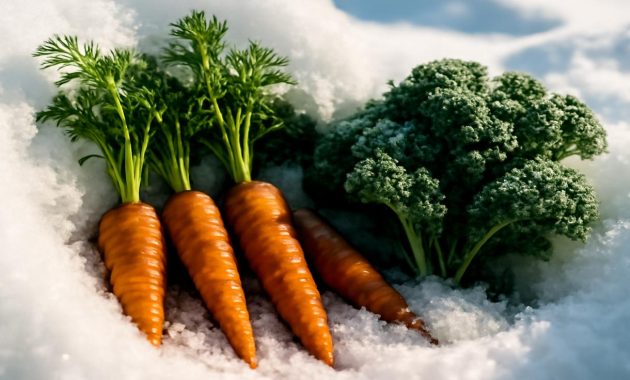
The first time I saw carrots pulled from beneath a crust of snow, I laughed out loud. Not politely, not in that “oh, how charming” way. It was a startled, almost disbelieving laugh—the kind that slips out when reality disobeys what you were so sure you knew. The air was biting cold, the kind that pins your breath to the back of your throat. Snow squeaked under our boots. And there, in a garden that looked deserted and finished for the year, a hand plunged into a mound of white and came back up holding a perfectly crisp, bright orange carrot that looked as if it had just been washed and posed for a seed catalog.
The Garden That Refuses to Die
We tend to think of winter gardens as poetic metaphors, not practical realities. A “winter garden” is a black-and-white photograph, bare trees against a low sky, maybe a bird feeder swaying in the wind. Dirt sleeps, seeds dream, gardeners flip through catalogs indoors and promise themselves that this spring, yes this spring, they’ll finally trellis the peas properly.
But on a small northern homestead, somewhere that would make most vegetable gardeners throw up their hands and turn to canned tomatoes, winter is not an off-season. It’s half the point.
The garden is not green in the postcard sense. No glossy leaves, no buzzing bees. Instead, what you see is oddly plain: rows only hinted at by gentle humps in the snow. A label stake here, a forgotten coil of twine there. Everything looks done, finished, packed away until April.
Then someone kneels, brushes aside the powdery top layer like you’d turn down a blanket, and reaches into the earth. The snow has insulated the soil like a thick duvet. Beneath, the ground is cool but not frozen solid. The parsnips slip out with a satisfying tug. Leeks emerge like winter candles, stems pale and fat. Kale leaves, drooping but stubbornly alive, crunch between your fingers—still fragrant, still defiantly green.
No greenhouse. No glowing plastic tunnels. No humming electric heaters. Just snow, patience, some old-fashioned know-how, and a refusal to accept that “gardening season” has to end in October.
The Northern Trick We Forgot
The first thing you notice about this northern technique isn’t how clever it is—it’s how embarrassingly simple it feels. There’s a sense of being quietly called out: Have we really given up that easily? Have we wrapped our vegetable beds in black plastic and our desires in excuses, while somewhere further north, someone is calmly eating fresh carrots in January without so much as a sheet of polycarbonate?
The secret isn’t magic. It’s timing, variety, and a deep trust in the old relationship between cold and soil. In much of the north, stable cold plus snow actually makes winter gardening easier than in the erratic, ice-spitting climates further south. Snow, as it turns out, is less a destroyer and more a surprisingly loyal collaborator.
Out here, growers sow with winter fully in mind. Not “we’ll see what lasts until frost,” but “what will be sweetest in December?” Root crops like carrots, beets, parsnips, and celeriac are allowed to reach full size by late autumn, then simply… left in the ground. The soil holds them like a pantry. When the snow arrives, it doesn’t bury them in a frozen tomb—it tucks them in.
Snow is an insulator. Under a decent snowpack, soil temperature tends to hover just below the surface freeze line, often settling around the same cool-but-not-deadly temperatures as a root cellar. For the plants, that’s not a problem—it’s a slow dial-down. Growth nearly stops, but tissue doesn’t shatter from rapid freeze-thaw cycles. Instead, it concentrates sugars, thickening and sweetening the flavor. That’s why winter-dug carrots are almost shockingly candy-like; the cold nudges their chemistry toward survival, which in our mouths translates to sweetness.
Why Snow Is a Better Gardener Than We Are
We spend a lot of money trying to outsmart winter. We build greenhouses, rig lights, buy space heaters. Yet here the snow is doing, for free, what high-end storage tech mimics but never quite matches: steady, gentle cold and darkness. Your backyard becomes a living refrigerator.
It humbles you. Especially if you garden in a milder place where winter flails around—rain, sleet, rogue thaws, black ice. Those fickle winters are hard on overwintering crops: repeated freeze-thaw can destroy roots and split stems. Ironically, the harsher, consistently cold northern winter—when partnered with a stable snow cover—can actually be kinder to plants than the moody shoulder seasons of more temperate regions.
This is the quiet irony: in some of the world’s “too cold” regions, people are harvesting fresh vegetables in midwinter while far milder places insist, “We just can’t grow anything this time of year.”
Under the Snow: A Hidden Pantry
Walk through such a garden in January and you’re really walking through a disguised larder. Every apparently blank patch of snow has a memory underneath it. The gardener knows where everything is by heart, the way a cook can reach for spices in the dark.
“Here,” they’ll say, stabbing a mittened finger toward a low, rounded hill of snow. A few scrapes with a boot, a brush of wool against white, and out comes a cluster of beet tops, their stems tinged maroon against the gray light. Another patch yields leeks. Another, parsley—wilted but aromatic, still ready to lift a soup.
In northern Europe, in Scandinavia, in pockets of Canada and the northern United States, this technique has many local versions and names, but the principles rhyme. Plant hardy crops. Let them size up before winter. Use mulch—straw, leaves, or simply rely on the snow if your climate is consistent. Harvest as needed instead of all at once, turning your frozen garden into the most local grocery store imaginable.
To the touch, the vegetables feel dense and tight, more compact than their summer siblings. When sliced, they glisten. Winter carrots snap with a crispness that echoes in the quiet kitchen. Parsnips roast to a caramelized, nutty sweetness. Cabbages, if you grew storage types and left a few heads in snug mulch, peel back that first battered outer layer to reveal perfect, tightly wrapped leaves beneath, as if they’ve been guarding their own hearts.
The snow outside may glow blue in the fading light, but your cutting board is a celebration of color—deep orange, crimson, creamy white, green veined with purple. Winter, it turns out, has more flavors than we’ve been letting it show.
The Simple Logic of “Plant It for Winter”
None of this works if you plant like summer. The logic flips. You’re not racing to get crops mature before frost so you can rip them out; you’re aiming for them to be almost done, but still rooted and alive when the first serious cold arrives.
Imagine your growing calendar turning on its head. Instead of thinking, “How late can I plant and still get a harvest before winter?” you’re asking, “How early must I plant so the harvest ripens into winter?”
So you sow carrots not for August, but for December. You choose varieties known for storage and cold-hardiness. Same for leeks, cabbage, kale, beets, turnips, and hardy herbs. You resist the urge to pull them all in at the usual time. You leave them, deliberately, knowing that while your neighbors are filling up chest freezers and canning jars, your soil itself is becoming the storage space.
| Crop | Planted For | Overwintering Behavior | Winter Harvest Notes |
|---|---|---|---|
| Carrots | Late fall–winter | Rest under snow, sweeter in cold | Dig as needed; cover with mulch where snow is unreliable |
| Parsnips | Winter–early spring | Flavor improves after hard frost | Often left until late winter for peak sweetness |
| Leeks | All winter | Tolerate deep cold if well established | Harvest by pulling from thawed topsoil under snow |
| Kale | Late fall–mild winters all season | Leaves withstand repeated freezing | Pick outer leaves; sweetest after frost |
| Beets | Late fall–early winter | Bulbs store well in soil under cover | Mulch heavily in areas with shallow snow |
No Greenhouse, No Excuses
Every gardener has a list of obstacles. The soil is poor. The slope is wrong. The shade is excessive. The climate is too this or too that. And for many, winter sits at the top of that list as the unquestioned, immovable barrier. “We just can’t grow in winter,” they say, even as they scroll past photos of people further north casually yanking leeks from drifts.
It stings a little, doesn’t it?
This northern technique doesn’t just expand the harvest; it exposes our tendency to underestimate both plants and ourselves. We’ve outsourced so much to technology—a greenhouse, a store-bought grow light, a climate-controlled pantry—that we forget the original systems were already here, refined over millennia.
Snow as insulation. Cold as a sweetness trigger. Soil as a storage room. Plant metabolism as a built-in antifreeze. None of this requires a credit card. It requires observation, some courage, and a willingness to be out there on a January afternoon with cold fingers, brushing aside the snow while neighbors watch from their windows and wonder what on earth you’re doing.
So this is where the “shame” comes in—not as a scolding, but as a challenge. If people pulling food from under snow without a single pane of glass above it can stretch their season, maybe our excuses need to shrink a bit.
What This Looks Like in Real Life
Imagine your own garden, even if it’s small. A few raised beds, a strip of soil along the fence, a scrap of allotment. Picture one bed reserved for “the late ones.” In midsummer, while everyone else is fixated on tomatoes, you sow another row of carrots, another block of beets. In late summer, you tuck in leeks and hardy kale. You choose varieties marked “cold hardy” or “storage” instead of just “early.” You plan backwards from when the ground usually first freezes.
Come autumn, while neighbors are yanking everything out and layering their beds with leaves, you selectively harvest. You take some, but not all. You leave the biggest, the strongest, the ones you know will ride winter best. You might lay down a blanket of straw or shredded leaves—but not to end the season. To extend it.
Weeks later, the first snow falls. Then more. Your garden disappears under a soft, leveling white. It looks, to anyone passing by, completely done. Yet you know that beneath that white stillness, your pantry is alive, waiting.
One early evening, when the sun begins to sink ridiculously early and your body insists it must be bedtime even though the clock disagrees, you put on boots and step outside with a basket. The snow shines faintly in the last light. Your breath hangs around you. You walk to that one familiar spot, clear a small window through the snow, and push your hand into the earth.
Your fingers close around something solid. It resists, then loosens. Out comes your dinner—cold, crisp, real. In that moment, winter does not feel like a dead season. It feels like a secret.
Relearning What Winter Can Be
There’s something deeply human about this. Before supermarkets, before shipping containers and refrigerated trucks, people partnered with their climate instead of constantly trying to overpower it. They fermented. They cellared. They dried and smoked. They understood that winter’s harshness could also be used, gently, as a tool.
Snow-covered gardening is a modern rediscovery of that older conversation with the land. It says: I know you will freeze. I know the light will go. But instead of fighting you with buzzing machinery and heated domes, I will adjust my timing and my expectations. I will plant for your rhythms. And in return, you will keep some of my food safe underground, beneath your own blanket.
This technique will not hand you ripe tomatoes in January. It will not give you cucumbers or sweet corn while the world outside is a monochrome sketch. But it will give you life: roots that carry the memory of summer’s sun in concentrated, sugary form. Leeks that taste like a distilled version of all the soups you’ve ever loved. Kale that crackles faintly as you tear it and sends a wild, green scent into your kitchen when everything else smells of starch and storage.
It’s modest, in a way. Humble food, nothing flashy. And yet, when you slice into a winter carrot grown this way, the knife hits the cutting board with a certain satisfying thump that feels like proof: we didn’t give up. We kept growing, even when the world said it was time to stop.
The northern growers who quietly dig under snow without greenhouses are not just showing us a trick. They’re offering a different story about what winter can be. Not an empty pause between harvests, not a sterile season of fluorescent-lit produce aisles and plastic-wrapped vegetables shipped from far away, but an extension of the growing year—slowed, softened, sweeter, yes, but still alive.
So when you hear someone insist, “You can’t grow vegetables here in winter,” you might think of that first shocked laugh in the snowy garden. Of orange against white. Of a hand disappearing into the earth and re-emerging with something living. And you might ask, quietly, “Are you sure?”
FAQ
Can any climate use this snow-covered growing technique?
No, it works best where winters are consistently cold with reliable snow cover. In areas with frequent freeze-thaw cycles or little snow, you’ll need heavier mulch (straw, leaves, or wood chips) to protect roots, and some winters may still be too harsh or erratic.
Which vegetables are best for leaving in the ground under snow?
Carrots, parsnips, beets, celeriac, leeks, hardy kale, winter radishes, and some cabbages do very well. These crops either tolerate freezing or are protected enough by soil and snow to remain harvestable through much of winter.
Won’t the vegetables rot if they stay in the soil all winter?
If drainage is poor and the ground is waterlogged before it freezes, rot can be a problem. In well-drained beds with stable cold, most hardy roots and leeks stay sound. The combination of low temperature, darkness, and limited oxygen actually slows decay dramatically.
Do I need special varieties for winter harvesting?
It helps. Look for varieties labeled “storage,” “winter,” or “cold hardy.” These types are bred to hold quality longer, resist splitting, and tolerate low temperatures better than quick, early-season varieties.
How do I find my crops once everything is buried in snow?
Mark rows clearly in autumn with tall stakes or durable labels that will stick up above snow level. Many gardeners also draw simple maps or take photos of their beds before the snow falls, so they can locate specific plantings even when everything looks uniformly white.