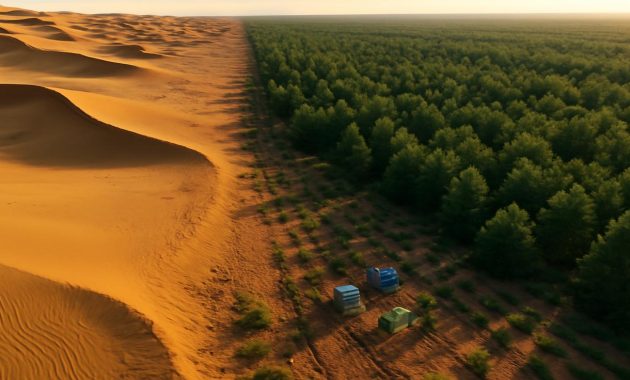
On some spring mornings in northern China, if you stand on the edge of a village that once braced itself against dust storms, you can taste the difference in the air. It’s softer now, threaded with the faint, bitter-green scent of young leaves and damp soil rather than the dry metal tang of blowing sand. The sound is different too: the rough rasp of wind over bare earth swapped for the softer hush of branches rubbing together, birds calling from new perches that did not exist a few decades ago. Where there were once shifting dunes inching toward homes and fields, there is, astonishingly, a young forest.
The Day the Sky Turned Yellow
Ask anyone old enough to remember the 1990s in parts of Inner Mongolia, Gansu, or Ningxia, and you’ll hear stories that sound almost apocalyptic. People recall afternoons when the sky darkened in minutes as dust storms rolled in from the north and west. Windows rattled, door frames hissed with fine sand, and the world outside turned the color of old parchment.
In Beijing, hundreds of kilometers away from the advancing edges of the desert, yellow dust storms became almost seasonal events. Grit collected in the folds of clothing, in the corners of eyes. The horizon blurred. Children walked to school with masks wrapped around their faces long before masks became part of global vocabulary for another reason. Cars and buildings wore a thin crust of sand that seemed to come from nowhere and everywhere at once.
The Gobi Desert, long considered a distant, harsh frontier, was on the move. Overgrazing had stripped grasslands bare. Unsustainable farming—plowing fragile, dry soils, pumping groundwater without restraint—had weakened the land’s natural defenses. Climate change amplified every mistake. Each strong wind took a little more topsoil, a few more clumps of long-rooted grass, widening the scars in the landscape. On satellite images, you could see the pale, raw patches of land expanding like burns on skin.
China was confronting a creeping disaster: land turning to desert at a scale that threatened villages, cities, and the food systems tying them together. Drought deepened. Lakes shrank. Farmers watched fields they’d planted for generations turn into something that looked more like a beach than a farm. The question hanging over the country was as blunt as it was terrifying: could the desert be stopped—or even reversed?
The Audacious Idea: A “Green Great Wall”
In the late twentieth century, Chinese scientists, policymakers, and local communities began to coalesce around an idea that sounded almost mythic in scope: what if China planted its way out of this problem? Not with a few symbolic tree-planting ceremonies, but with a living barrier, thousands of kilometers long, to hold back the advance of sand and restore broken land. A “Green Great Wall,” they called it—an echo of the stone one that snakes across the country’s northern frontier.
By the 1990s, earlier experiments in tree planting had shown promise but also exposed difficult lessons. Monocultures—large swaths of the same tree species—often failed in harsh environments. Trees planted without tending, or without community buy-in, withered. The land was harsh, and the climate unforgiving. But the stakes kept rising: rural livelihoods were crumbling, and dust storms were not just local events; they were crossing seas, affecting air quality in neighboring countries.
So China doubled down, refining its approach. The government launched and expanded massive ecological restoration programs, including what would become one of the largest afforestation and reforestation efforts in human history. By combining state support, scientific input, and local participation, China started to commit to planting—not millions, but billions—of trees.
Over the decades since the 1990s, more than 1 billion trees have been planted across northern and northwestern regions, weaving belts of green through places that had known only dust and scrub. The aim was not merely to make the landscape look better; it was to change its behavior: to slow desert expansion, stabilize soils, and give life another foothold.
How Do You Plant a Billion Trees?
The scale is almost impossible to wrap your mind around. A billion is a number we hear in headlines, not see in a field. But on the ground, a billion trees looks like this: schoolchildren carrying saplings on their backs in spring; villagers loading trucks with young pines, poplars, and shrubs; bulldozers carving terraces into slopes so roots can hold on; scientists trudging over brittle ground with moisture meters and seed samples.
Planting that many trees is not simply a matter of digging holes. It’s a choreography of logistics, ecology, and human will. Seedlings had to be raised in nurseries sometimes hundreds of kilometers away from their final home. Roads had to reach places where once only donkey trails ran. Farmers needed training—how deep to plant, how often to water, which species had the best chance of surviving in salty, windswept soil.
The work unfolded over seasons and years. In spring, the land smelled sharply of turned earth as trenches were dug and seedlings pressed into place. In summer, the saplings faced their first trial—heat and drought. Those that survived their first winter, bent and blackened by sand-laden winds, often hardened into tough, resilient trees. Step by step, year by year, lines of green lengthened and thickened along the desert’s edge.
Reading the Land’s Pulse: Is It Working?
For all the romance of the vision, the real test of this massive experiment lay in the land itself. Was the desert slowing? Were degraded areas actually recovering—or were the trees just a temporary, fragile bandage?
Scientists tracked the answers from multiple angles. On the ground, they measured soil moisture, checked root systems, and monitored survival rates. From the sky, satellites watched the color and texture of the land for decades. Dust storm frequency, land cover, and vegetation health became the new vital signs of northern China’s ecosystems.
The emerging pattern surprised even some skeptics. In key regions, the acceleration of desertification began to slow—then, in places, to reverse. Patches of once-bare land started showing signs of life: grasses taking hold where saplings had tamed the wind just enough; birds returning to build nests in new forests; small mammals finding shelter in the underbrush. Regions that once generated dust storms were now increasingly blanketed by green during the growing season.
Degraded land, it turned out, could be coaxed back to health when given structure and shade. Tree roots helped anchor soil and reduce erosion. Leaves broke the force of raindrops, allowing water to soak in instead of skimming away in sudden, destructive floods. Microclimates formed—slightly cooler, slightly moister—around restored areas, creating conditions where other plants could join the party.
To capture some of this shift in a simple snapshot, imagine a segment of northern China over a few decades:
| Indicator | 1990s (Typical) | Recent Decades (Typical) |
|---|---|---|
| Vegetation Cover (Selected Regions) | Sparse shrubs & exposed soil dominating | Noticeable increase in tree and grass cover |
| Dust Storm Frequency | Frequent, intense spring storms | Reduced frequency and severity in many areas |
| Soil Condition | Loose, easily eroded topsoil | More stable soil, organic matter slowly increasing |
| Local Livelihoods | Rising losses from land degradation | New income from forestry, fruit, and eco-tourism in some regions |
The table is an oversimplification, of course. Not every restored area thrived. Not every desert-front town was saved. But taken together, these indicators tell a story that is rare in a century dominated by environmental decline: in some of the world’s most fragile landscapes, things began to move in the right direction.
Villages Between Sand and Forest
Statistics and satellite images cannot fully capture how this transformation feels on the ground. To understand that, you have to stand in a village that once sat on the front line between farmland and dune. Picture a courtyard where an elder sweeps, pausing to watch a line of children walk past with saplings slung over their shoulders. For them, tree planting is not an annual novelty; it’s as much a part of spring as the first thaw.
Many families here remember when the desert felt like a living predator. Sand would creep into irrigation channels. Fields would vanish under drifts. People tell of nights when they woke up to the sound of walls groaning under the weight of a sand-laden wind. Planting trees was not framed as an act of abstract environmentalism; it was survival.
Over time, the relationship between people and the young forests shifted. At first, saplings were fragile things to be guarded. Goats and sheep were kept away with makeshift fences; children were told not to play too close. As the trees grew, they became part of the community’s sensory world. Their shade offered a new place to rest at midday. Leaves whispered different weather warnings than the bare wind once did. Farmers began to notice that their crops, grown behind shelterbelts of trees, suffered less damage from storms.
New economic threads wove themselves into these landscapes. In some regions, carefully chosen species provided fruit, nuts, or timber. Women’s cooperatives began to gather tree products to sell in town. Young people—who once might have left the village because the land could no longer support them—found work caring for forests, managing nurseries, guiding visitors who came to see this reclaiming of the land.
Lessons Written in Roots and Rings
For all its successes, China’s tree-planting story is not a simple triumph. It is, instead, a sprawling, evolving experiment from which the world is still learning. Some early choices—such as planting large areas with single, fast-growing species not well matched to local conditions—had mixed results. In dry years, these thirsty monocultures struggled or died, reminding everyone that you cannot simply paste a forest onto a desert and expect it to stick.
Ecologists warned against thinking of trees as a magic fix. Real restoration, they argued, must work with entire ecosystems: grasses, shrubs, soil microbes, and wild animals all needed room in the plan. In many places, the strategy shifted to include more native species, more mixed plantings, and better protection of existing natural vegetation. Overgrazing was curbed through policies and incentives that encouraged herders to reduce livestock numbers or change grazing patterns. Some lands were simply given time—a form of “natural regeneration,” where the best thing humans do is to step back and let the land heal with minimal interference.
These course corrections are as important as the initial grand vision. They show that large-scale environmental action is not a one-direction march but a conversation between people, policy, and the land’s own limits. Trees are part of that conversation, not the whole of it. In many places, shrubs with deep roots and grasses with dense cover do as much to hold soil as any tall tree.
Still, the central lesson stands: determined, coordinated action over decades can bend a seemingly inevitable trend. Desertification is often presented as a one-way street, but China’s experience suggests otherwise. With enough time, patience, and adaptation, some of the damage can be reversed, and the edge of the desert can be pushed back—if only by a few vital kilometers.
Climate, Carbon, and the Long View
In the early years of these efforts, the main focus was local survival: stopping sand, protecting fields, saving villages. But as the global conversation shifted toward climate change, another layer of significance settled over China’s billion-plus trees. Forests and restored lands are also carbon vaults: they pull carbon dioxide from the atmosphere and store it in wood, roots, and soil.
This doesn’t mean that China’s tree planting is a clean, tidy climate solution—no large-scale intervention ever is. Questions remain about how much carbon is truly locked away, how vulnerable it is to drought, pests, or future policy changes. But when you walk beneath a canopy that did not exist thirty years ago, feel the coolness of shaded earth underfoot, and listen to birdsong in places that had been stripped nearly silent, it’s hard not to think about the atmosphere as well as the soil.
In a warming world, the value of resilient, well-managed ecosystems grows with each passing year. Restored land can buffer communities against floods and heat waves. It can soften the blow of climate shocks even as it modestly slows the buildup of greenhouse gases. The story of these Chinese forests, then, is not just a national one. It’s part of a global pattern of learning how to live more intelligently with land that we have pushed to its breaking point.
What This Means Beyond China
To many people looking in from the outside, the raw scale of China’s afforestation efforts is both inspiring and intimidating. Few countries can mobilize resources on this level. But scale is not the only lesson here. Even in small regions, even in single watersheds, the same principles can apply: know your land, plant wisely, involve communities, adapt when mistakes appear.
China’s experience has become a case study for other nations fighting their own battles against desertification and land degradation. Delegations from countries in Africa, Central Asia, and the Middle East have walked the newly forested belts, sifted the darker, richer soil between their fingers, and asked the same questions: Which species survived? How were local people convinced to join? What policies made it possible to commit for the long term?
There is also a more intimate lesson hiding beneath the sweeping numbers. It lies in the image of a single sapling in a child’s hands, planted in ground that, in their parents’ youth, was bare and hopeless. A billion trees is built one hole, one seedling, one decision at a time. The transformation of landscapes is ultimately the accumulation of millions of small, repeated acts of care.
In the end, the most powerful part of this story may not be that China planted over 1 billion trees and slowed the march of the desert—though that is remarkable enough. It’s that a society chose, over decades, to see land not as something to be exhausted, but as a living partner that could, with help, recover some of its lost resilience. On those spring mornings when the air smells of leaves instead of dust, you can feel what that choice means—not just for China, but for a planet trying to remember how to heal.
Frequently Asked Questions
How many trees has China planted to combat desertification?
Since the 1990s, China has planted over 1 billion trees as part of long-term programs aimed at slowing desert expansion and restoring degraded land across its northern and northwestern regions.
Has tree planting in China really slowed the spread of deserts?
In many targeted areas, yes. Scientific monitoring and satellite imagery show that vegetation cover has increased, soil stability has improved, and the rate of desertification has slowed—and in some locations, partially reversed—compared with the 1980s and 1990s.
What is the “Green Great Wall”?
The “Green Great Wall,” also known as the Three-North Shelterbelt Program, is a massive afforestation and reforestation initiative designed to create belts of trees and vegetation along the northern, northeastern, and northwestern regions of China to protect against desertification, wind erosion, and dust storms.
Are there problems with planting so many trees?
Yes, the effort has faced challenges. Early projects sometimes used non-native or water-hungry species and large monocultures, which in some places led to poor survival rates and water stress. Over time, approaches have shifted toward more diverse, locally adapted species and broader ecosystem restoration, not just tree planting.
Why is China’s tree-planting effort important for the rest of the world?
China’s experience offers practical lessons on large-scale restoration: the importance of long-term commitment, community involvement, species choice, and adaptive management. It also demonstrates that even severe land degradation and desertification can be slowed or partially reversed, which is highly relevant for other regions facing similar environmental pressures.