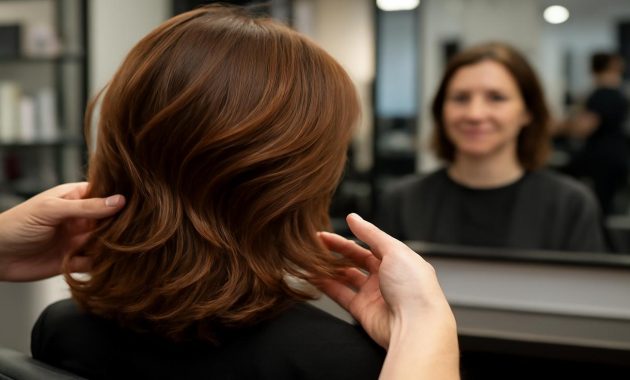
The first thing you notice isn’t the length. It’s the way the hair moves—like grass in a soft wind, like riverweed following a current you can’t see. It doesn’t hang in a blunt curtain or break off in sharp, geometric corners. It drifts. It bends. It curves around the face, catches the light, and then slips away again. Somewhere between the barber’s chair and the sidewalk outside, something subtle has shifted: this haircut doesn’t sit on the head, it lives there. It breathes. It has a rhythm all its own.
The Day You Realize Your Hair Is Tired
You don’t really see it happening until one day you do. There you are, standing in the bathroom mirror under that slightly-too-bright light, and the truth hits: your hair looks…stuck. The ends form a perfect horizontal line across your shoulders like you used a ruler to cut them. The layers—if you can call them that—drop in obvious, choppy shelves. No matter how much you shake your head or run your fingers through it, the shape doesn’t change. It’s as if the haircut is holding its breath, rigid and braced, afraid to move.
Maybe you notice it when you see a photo of yourself from the side. The hair juts out at an angle, a corner instead of a curve. Or maybe it’s during a windy walk home, when the gusts push your hair back and it springs forward in exactly the same place it always does, like an elastic band returning to its default tension.
Stiff lines in a haircut can feel like a uniform—neat, controlled, and undeniably obvious. They declare where the hair starts and stops, what it’s meant to do, and how you’re supposed to wear it. But your life doesn’t move in straight lines. You turn your head to listen, you bury your face in a sweater, you lean into a hug. You sleep badly on one side, you flip your hair without thinking, you tuck it behind one ear and then the other. Your hair knows this; it remembers it. A stiff, squared-off cut works against that memory. A flowing cut listens to it.
Natural movement in hair isn’t a trend so much as a return to how hair actually behaves when it’s left to its own devices: it bends, swirls, springs, collapses, and lifts again. But creating a cut that cooperates with that behavior instead of fighting it—that’s where the magic really starts.
The Cut That Moves: What “Natural Flow” Really Means
When stylists talk about a haircut that has “flow,” they’re talking about the way the hair falls from its roots and how each section blends into the next. It’s not simply about layers, and it’s definitely not just “messy” or “undone.” It’s about harmony—strands moving in similar directions with intentional softness instead of sitting in hard, graphic lines.
A flow-focused cut respects gravity, growth patterns, and texture. Instead of slicing straight across in one solid block, the stylist works in curves, diagonals, and gentle shifts in length. The result is a shape that looks like it’s already halfway styled the moment it dries. When you move, it moves with you. When wind lifts it, it settles back into something believable instead of snapping into a ridge or a shelf.
One way to feel this difference is to close your eyes and run your hand down the length of your hair from crown to ends. In a stiff, line-heavy cut, your fingers will feel a sudden drop where the layers change, an abrupt stop where the line was carved. In a flow-based cut, your fingers just…slide. The change in length is there, but it’s gradual, like walking down a hill instead of stepping off a curb.
Flow doesn’t mean “no structure.” If anything, it’s more technically demanding. To carve a blunt bob is one thing; to shape a bob that swings, curves under, and never looks boxy from any angle is another. The structure is still there—it’s just disguised as ease.
How Stylists Build Flow, Not Blocks
Under the salon’s warm lights, you can usually spot the difference in technique. A stylist aiming for natural flow will lift sections of hair and cut into them on a slight angle, sometimes using slide-cutting, point-cutting, or texturizing shears to soften the edge. They’ll pay attention to the direction your hair naturally leans: where it splits, where it wants to flip out, where it collapses. Instead of forcing it into a shape it resists, they nudge it into a more refined version of its own behavior.
They might:
- Shift the weight away from bulky areas so hair can move instead of sitting in a thick block.
- Blend layers so there’s no obvious “step” between short and long.
- Use rounding motions around the face so the hair frames instead of fences you in.
- Leave strategic heaviness where curls need support and lightness where straight hair needs lift.
The difference isn’t just visual. When a cut is done for movement, washing your hair stops being a reset to “unruly.” It becomes the moment the cut wakes back up.
Listening to Your Own Hair: Texture, Shape, and Story
Every head of hair has a backstory written into it: the cowlick on the right side that refuses to lie flat, the one wave that appears behind your left ear, the crown that always splits no matter how much product you use. Instead of treating these quirks as problems to correct, a natural-flow haircut treats them as environmental data: where does this hair want to go if nobody’s forcing it?
Think of it like a riverbed. You can redirect the water with stones and channels, but at some point the water shows you where it’s determined to run. The best stylists watch how your hair behaves when it’s damp, when it’s towel-dried, when it’s air-dried. They look at your neck length, your jawline, how often you push your hair back. Then they carve a shape that’s less about perfection and more about cooperation.
Flow by Hair Type
Movement looks different on every texture, but the idea—no stiff lines, no forced shapes—stays the same.
| Hair Type | How Flow Looks | Cutting Focus |
|---|---|---|
| Fine & Straight | Soft, airy movement, gentle curves, no heavy edges. | Minimal but strategic layers, invisible face-framing, avoid over-thinning. |
| Medium & Wavy | Defined, S-shaped waves that cascade rather than stack. | Internal layers for bounce, rounded shape, no harsh step-layers. |
| Curly | Ringlets that spiral in families, each curl settling into its own space. | Curl-by-curl shaping, respecting shrinkage, avoid blunt ends that create triangles. |
| Coily & Kinky | Cloudlike volume with a sculpted silhouette that still feels soft. | Shape first, then softness; cutting on dry, defined coils to understand true length. |
A wavy lob that has flow will follow the jawline and collarbones, curling in where the neck narrows and out where your shoulders widen. A curly shape with flow will reveal your face rather than hiding it in a rigid, triangular frame. Coily hair with flow looks like architecture softened by moss: intentional, but never severe.
From Salon Chair to Sidewalk: How Flow Changes Your Day
You feel the difference most acutely the first time you wash and dry your hair after the cut. There’s that moment of doubt—we’ve all felt it—where you wonder if you’ll be able to recreate whatever wizardry happened under the stylist’s hands. The water runs warm, your fingers comb through, the weight of your hair feels slightly changed. You step out, towel-dry, maybe scrunch a little, maybe brush less than usual because your stylist suggested you “just let it settle.”
And then, in the mirror, you catch it: the shape begins to reappear on its own. You tilt your head and the hair follows, instead of resisting. You push it behind your ear and it doesn’t create an awkward bump; it simply redirects and falls back into place when you let go. There are no sharp ledges, no blocks of hair all trying to occupy the same space. It looks like you, but more fluent—like your hair finally speaks the same language as the rest of your body.
On a busy morning, this matters more than it seems it should. A flowing cut asks less of you. It doesn’t require painstaking straightening to conceal a blunt line or endless curling to disguise a heavy shelf. It looks good slightly messy, slightly lived-in, because it was designed that way. When movement is built into the cut, perfection stops being the goal. The goal becomes believability.
Even the little moments feel different. A gust of wind doesn’t ruin anything; it just rearranges it. A hat doesn’t flatten your style so much as imprint a new, temporary direction that your hair can adapt to. Humidity might frizz a few strands, but underneath, the shape holds: soft, rounded, dynamic, real.
Styling in Harmony With Flow
To keep that movement alive, you don’t need an arsenal of tools. You need gentler habits:
- Dry with intention. Instead of rough-towel-drying, squeeze and blot. Let the hair fall how it naturally wants, then encourage it with your hands rather than fighting it with brushes.
- Use lighter products. Creams, milks, and airy mousses support motion better than heavy gels and hairsprays that freeze hair into place.
- Choose tools that respect texture. A diffuser, a wide-tooth comb, your fingers—these are allies of flow. Fine-tooth combs and high heat can crush it.
- Accept some unpredictability. Flow is not about a perfectly identical look every day. It’s about a consistent feel, a recognizable shape that shifts with you.
The best compliment you can give a natural-flow cut is not “Your hair looks done,” but “Your hair looks like that on its own.”
When You’re Ready to Ask for It
Walking into a salon and trying to explain “I want movement, not lines” can be intimidating, especially if you’ve been living in the safe, familiar world of straight-across trims and one-length cuts. But you don’t have to speak fluent hairdresser to get the point across. You just have to speak fluent you.
How to Talk About Flow With Your Stylist
Instead of only showing a photo, describe experiences:
- “My hair always flips out here and I fight it every morning.”
- “It gets really bulky at the bottom and just sits there.”
- “I like when it looks a little tousled, but it often stacks in blocks.”
- “I want to be able to run my hands through without it looking chopped.”
Then add intentions:
- “I’d love the cut to follow how my hair wants to move, not work against it.”
- “I want soft edges, no hard corners or sharp steps.”
- “If I air-dry, I want it to still make sense.”
A good stylist will translate that into technical decisions: internal layers, weight removal, slide-cutting, textured ends, altered perimeter lines. But you don’t need those words. You just need clarity about how you want to feel.
You can also be honest about your styling reality. If you rarely blow-dry, say so. A flow-focused cut for an air-dryer looks different from one designed for a daily round-brush routine. The more your stylist understands your habits, the more they can build a shape that supports them instead of shaming you for not living up to a complicated styling regimen.
Letting Go of the Ruler: A Small Act of Rewilding
In a world that loves sharp edges and clean grids, there’s something quietly rebellious about choosing softness. About saying no to the perfectly blunt line, the immaculate angle, the precise, geometric silhouette. A natural-flow haircut is not sloppy—it’s mindful. It chooses to honor the way hair actually behaves rather than forcing it into submission.
Think about how nature draws its boundaries: tree lines that feather into sky, shorelines that curve into the tide, mountain ranges that rise in waves instead of right angles. You rarely see a hard, flawless edge out there. Everything is softened by wind, water, time, and life moving through it. A haircut with flow borrows that philosophy. It gives your hair permission to respond to its environment and keeps it beautiful while it does.
That doesn’t mean you have to abandon structure altogether. Strong shapes can still have flow—a short crop that tapers gently at the nape, a shag that layers around the eyes and cheekbones without looking like a time capsule from another decade, a long cut that barely kisses the waist but never looks stringy or flat. The difference is intention: you’re no longer sculpting a helmet; you’re tending a landscape.
And like any landscape, it changes. As seasons shift, so will your hair: humidity thickens it, heat lightens it, winter hats flatten it, sun lifts its color. A stiff, line-heavy cut resents that change. It points out where the shape has been disturbed. A cut with natural flow absorbs the change and keeps telling a coherent story.
In the end, this kind of haircut is less about looking like someone else’s Pinterest photo and more about recognizing the topography of your own head—your swirl, your jaw, your neck, your habits—and saying, “Let’s work with this.” It’s a small act of trust in your own texture, a belief that your hair, un-straightened and un-policed, has its own kind of grace.
You’ll know you’ve found it when you stop anxiously checking mirrors and start catching unexpected reflections—train windows, café doors, your own shadow on the sidewalk—and thinking, not “Is it in place?” but “That looks like me.” The lines have blurred, softened, flowed. The haircut is no longer a rigid outline around your head. It has become part of your movement through the world.
Frequently Asked Questions
How do I know if my current haircut has stiff lines?
Look for sharp corners at the ends, obvious shelf-like layers, and a heavy block of hair at the bottom. If your hair looks almost identical whether you’re moving or standing still, and it needs a lot of heat styling to look soft, it likely has stiff lines.
Can short haircuts still have natural flow?
Yes. Short hair can have beautiful movement if the edges are softened, the weight is balanced, and the shape follows your head’s natural curve. Think tapered pixies, soft crops, and rounded bobs rather than severely angled or boxy styles.
Will a flow-focused haircut work with curls and coils?
Absolutely. In fact, curls and coils often benefit the most from movement-focused cutting. When shaped curl-by-curl or coil-by-coil, the hair falls into a pattern that looks intentional but never rigid, avoiding the dreaded triangle or boxy silhouette.
Do I need special products to maintain natural flow?
You don’t need anything fancy, just products that support motion rather than freeze it: lightweight creams, leave-ins, mousses, and flexible-hold sprays. Avoid overly heavy oils and hard-hold gels that stiffen the hair into place.
How often should I trim a flowing haircut?
Most movement-based cuts benefit from trims every 8–12 weeks, depending on your hair type and how fast it grows. The goal is to maintain the shape and weight distribution without constantly chopping off length or reintroducing harsh lines.