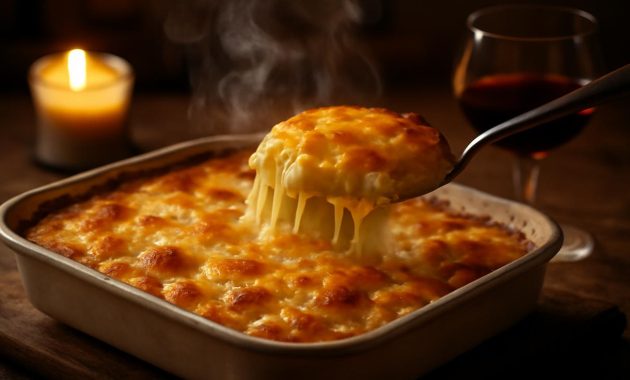
The potatoes are the first thing you notice—that warm, starchy perfume curling through the kitchen like a promise. Outside, the evening is dragging its feet, gray and a little damp, the kind of night that makes you instinctively reach for slippers and switch on a soft lamp. Inside, the oven hums with that low, comforting roar, and somewhere under its glowing coils, a casserole dish is slowly transforming thin slices of potato, cream, and a scandalous amount of cheese into something that feels an awful lot like a hug on a plate.
The Slow Magic of a Cozy Evening
There’s a particular quiet that arrives on slow evenings. The world seems to loosen its shoulders; clocks feel less bossy. Maybe you’ve had a day that asked too much of you, or maybe it was perfectly ordinary in that slightly tiring way ordinary days can be. Either way, by the time dusk starts to smudge the edges of things, you’re not looking for adventure or novelty—you’re looking for comfort.
This is where the cheesy baked potato casserole comes in, not as a recipe, not even really as “dinner,” but as a ritual. It’s the kind of dish that asks you to be present for a little while. You wash the potatoes, their skins slick and cool under the tap. You line them up on the cutting board, each one giving a satisfying thump as you set it down. The knife moves through the flesh with a gentle, damp whisper, releasing that clean, earthy smell of raw potatoes—the scent of fields and soil and something solid and reliable.
Outside the kitchen window, the light is fading. Inside, you’re building layers of comfort: potatoes, cheese, cream, a dusting of seasoning like a whisper of snow. You’re not rushing, because this isn’t the kind of dish that rewards haste. It’s slow by design. It wants to take its time, and in asking that of you, it offers something rare in return: permission to slow down, too.
The Texture of Comfort
Comfort food is more than flavor; it’s texture, temperature, sound, memory. When the casserole finally emerges, the surface is freckled and golden, bubbling softly at the edges like it’s quietly celebrating itself. A little island of melted cheese has pooled near one corner, and the scent that escapes when you crack open the oven door is almost indecent—rich, buttery, salty, and warm.
You set the dish on the counter and listen to the gentle hiss and pop of the cheese settling, the faint creak of enamel against the trivet. This is the moment of anticipation, the pause between making and eating, and it feels almost sacred in its smallness. You know what’s coming. That first scoop will break through the top layer with a soft, crisp sigh, giving way to tiers of creamy, tender potatoes that still hold their shape, each slice cloaked in velvety sauce and tangled with ribbons of melted cheese.
On the plate, it doesn’t try to be photogenic in any clean, precise way. It sprawls a little, leans into itself, the cheese stretching in elastic threads before finally surrendering. Steam rises. The surface glistens. This isn’t food designed for an audience; it’s food meant for you, for this exact moment, for this evening when you needed a bit of edible reassurance.
Why Potatoes Always Feel Like Home
There’s something deeply grounding about potatoes. They’re humble, inexpensive, and almost comically unassuming in their raw form. Yet they carry a weight of memory. Maybe you grew up with mashed potatoes appearing on every holiday table, or those crispy roasted cubes your grandmother used to make, or the baked potatoes wrapped in foil and buried in the glowing coals at a campsite.
Potatoes are the comfort food equivalent of a well-worn sweater—never flashy, but somehow exactly right. A cheesy baked potato casserole takes that familiarity and turns the volume up just a little. It brings in cream and cheese and butter, yes, but it also invites patience and care. You layer the slices carefully, like stacking pages of a story. You season in quiet, thoughtful pinches: a bit of salt, a grind of pepper, perhaps some garlic or onion for depth. Maybe you scatter in a handful of chopped green onions or a dusting of paprika for color.
In the oven, the potatoes soften and sink into the cream, surrendering their edges but keeping just enough structure to give you that gentle bite. The starch thickens the sauce so it clings, and the cheese—sharp cheddar, nutty Gruyère, mellow mozzarella, or some unruly combination—melts into every gap. When you dig your fork in later, it’s like finding all your favorite textures in one place: crisped edges, silky middle, tender slices.
| Element | Comfort Factor |
|---|---|
| Thinly sliced potatoes | Soft, tender layers that feel familiar and filling |
| Melted cheese | Gooey, stretchy richness that makes every bite indulgent |
| Cream or milk | Creates a velvety sauce that wraps around each slice |
| Crispy top | A little crunch to balance all that softness and melt |
| Slow baking time | Gives you space to unwind while the aroma fills your home |
Building Layers of Flavor and Feeling
Part of the magic of this casserole is how personal it can be without ever losing its core identity. At its simplest, it’s potatoes, cheese, dairy, and seasoning. But tucked between those layers, you can fold in pieces of your own story, your own cravings, the little touches that say, “This is mine.”
Maybe you start by rubbing the baking dish with a cut clove of garlic, leaving a faint, fragrant trace in the background. Maybe you whisk a bit of smoked paprika or mustard into the cream, something that adds a gentle complexity you can’t quite name but would miss if it wasn’t there. Perhaps you sprinkle in quick-cooked bacon or bits of ham for a smoky twist, or caramelized onions that bring a slow, sweet depth, like a low note humming in the background of a favorite song.
As you stack those thin potato rounds—each about the thickness of a coin—you’re not just building a meal; you’re building an experience. The first layer is practical: it keeps everything from sticking. The next is generous, overlapping slices like shingles on a roof, making sure every bite will feel substantial. Then comes the cheese, a gentle snowfall of grated strands that catch the light like tiny threads of gold. You pour over some cream or a mixture of cream and broth, watching it snake its way down between the slices, promising to return later as sauce.
Repeat. Layer, sprinkle, pour. Each pass through the pattern feels a little more meditative. The oven preheats in the background, bringing a rising warmth to the room that feels less like a machine and more like a living thing waking up. By the time the final layer is in place—potatoes, then cheese, then perhaps an extra dusting for luck—you feel calmer than when you began.
When the Kitchen Becomes a Refuge
There are evenings when the kitchen feels like a stage, every movement on display, every dish judged by how shareable it is. A cheesy baked potato casserole doesn’t care about that at all. It belongs to another kind of night—the nights when the kitchen stops performing and starts sheltering.
On those nights, you move a little slower. The overhead lights are dimmed, or maybe you’re working under the warm cone of a single pendant lamp. Rain might be ticking softly against the window, or wind could be dragging its sleeves against the walls. The clatter of the day—emails, traffic, notifications, headlines—feels far away in here. In this pocket of space, it’s just you, the cutting board, the potatoes, and the promise of something warm and deeply satisfying.
You slide the filled dish into the oven, feeling that familiar wave of heat kiss your face and forearms. You close the door, set the timer, and then—this might be the best part—you simply wait. There’s nothing left for you to fix or adjust. The oven takes over, and for the next hour, it’s a low-effort symphony: the rise of bubbling cream, the slow browning of cheese, the gradual softening of starch into satin.
As the smell grows stronger, it starts to seep into other rooms, a gentle announcement that something good is on its way. If you live with others, this is when someone inevitably wanders into the kitchen, nose first, asking, “What are you making?” Not because they don’t know—the smell gives it away—but because asking is its own kind of comfort ritual, a way of stepping into the moment with you.
Serving Up a Plate of Quiet Joy
When the timer finally sings, there’s a small, delicious stretch of suspense. You peek through the oven window: the top is deeply golden, spotted with tiny brown bubbles where the cheese has crisped just enough. The cream is no longer visible as a separate thing; it has been claimed by the potatoes, turned into a thick, glossy cloak.
You take it out and let it sit, which might be the hardest part. Right now, the casserole is volcanically hot and still a little too loose; it needs a few minutes to gather itself. During that pause, the kitchen smells like every cozy memory you’ve ever had, all layered together: Sunday dinners, holidays, nights in with nothing planned except being here, now.
Then comes the serve. The spoon eases through the top, breaking the slight resistance of that browned cheese before gliding into the creamy layers below. You lift out a generous scoop and nestle it onto a plate. The edges collapse in slow motion, steam rushing out with a sigh, carrying the scent of butter and toasted dairy and gentle seasoning.
This is not a dish you eat politely in three tidy bites. It invites lingering. You cut through the layers with the side of your fork, the potatoes giving way easily but still offering that soft, reassuring bite. The cheese stretches, clings, then melts on your tongue. It’s savory and rich without needing extravagance, luxurious without pretense. Every bite seems to say the same thing: stay a while, you’re allowed to rest.
Little Twists for Your Own Evenings
Part of the charm of this casserole is how adaptable it is to whatever kind of comfort you’re craving. Some nights you might want it decadent and over-the-top, the culinary equivalent of diving into the deepest, fluffiest blanket you own. Other nights, you want something a bit lighter, still cozy but not quite as rich. This dish can be both, and everything in between.
You might swap in a mixture of milk and broth for part of the cream, letting the potatoes shine a bit more clearly. You could tuck in thin slices of mushroom, letting them lend a quiet earthiness, or add a layer of wilted spinach for a pop of green that makes your plate feel a touch more virtuous. A scattering of chives or parsley at the end brings a fresh, grassy note that cuts through the richness like a cool breeze through a warm room.
If you lean toward a heartier comfort, you might stir in bits of crispy pancetta or leftover roast chicken between the layers, turning the side dish into a full meal. Maybe you go heavy on the black pepper for a subtle kick, or use a mix of cheeses—sharp cheddar for personality, Gruyère for nuttiness, a touch of Parmesan on top for that bronze, frilly crust.
Every tweak becomes part of your own personal definition of comfort. And once you’ve made it a few times, you stop measuring quite so carefully. You start trusting your instincts: a little more cheese because today was long, an extra pinch of salt because the potatoes will thank you, a thicker top layer because that’s the part everyone fights over at the table.
The Way Food Can Hold a Moment
When you think back on your favorite cozy evenings, you might remember the movie you watched, or the book you curled up with, or the conversation that drifted lazily across the table. But chances are, some part of your memory is anchored by what you ate—especially if it was something like this: warm, cheesy, familiar, and unhurried.
This cheesy baked potato casserole doesn’t demand attention, but it quietly shapes the entire evening. It encourages you to linger at the table for a few extra minutes, idly scraping your fork through the last streaks of sauce. It nudges you toward seconds, not out of greed, but out of a desire to prolong the comfort just a little longer.
Later, when the leftovers are tucked into the fridge, cooling under a thin cover of cling film, the house still smells faintly of potatoes and cheese. You might catch a whiff as you pass through the kitchen on your way to bed, a last little reminder that today ended with something warm and good.
And that’s the real gift of a dish like this. It doesn’t try to impress or surprise you. It simply shows up and says: here, I made something soft and golden and satisfying. Sit down. Take your time. Let the world spin without you for a while. Tonight, everything you need is right here on this plate.
Frequently Asked Questions
Can I make this cheesy potato casserole ahead of time?
Yes. You can assemble the casserole completely, cover it tightly, and refrigerate it for up to 24 hours before baking. When you’re ready, let it sit at room temperature for about 20–30 minutes, then bake, adding a little extra time if it’s still quite cold.
What kind of potatoes work best?
Starchy or all-purpose potatoes work especially well. Russet potatoes give a very soft, almost melt-in-your-mouth texture, while Yukon Golds hold their shape a bit better and add a naturally buttery flavor.
Can I lighten the dish without losing the cozy feel?
You can replace part of the cream with milk or low-sodium broth, and use a bit less cheese while still keeping that creamy, comforting texture. Adding a layer of vegetables like spinach or thinly sliced zucchini also helps balance the richness.
How do I get a perfectly browned, crispy top?
Make sure there’s a generous but even layer of cheese on top, and don’t cover the dish for the last part of baking. If it’s fully cooked but not browned enough, you can switch on the broiler for a minute or two—just watch closely so it doesn’t burn.
Does it reheat well the next day?
Absolutely. Reheat individual portions in the oven or a toaster oven for the best texture, adding a splash of milk or cream if needed to keep it moist. The flavors often deepen overnight, making leftovers especially satisfying on another slow, cozy evening.