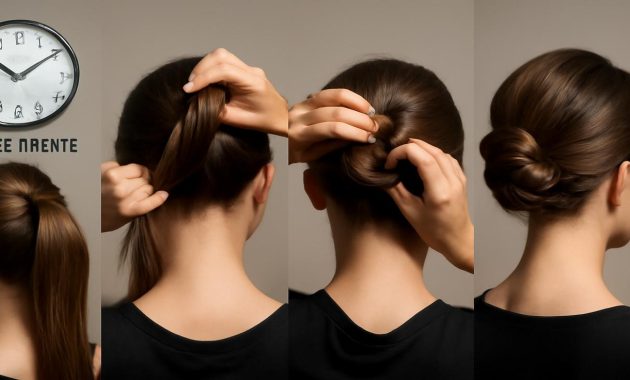
You spot yourself in the reflection of a café window: hair down, a little wild from the day, coffee in one hand, bag slipping off your shoulder. You’re already five minutes late. There’s a text from a friend—“Come up to the rooftop, it’s beautiful tonight”—and somewhere between the sidewalk and the elevator you realize: this is an updo moment. Not a complicated, 47-bobby-pin situation. Something soft, a little French, like you just rolled it up without trying. The kind of updo that looks as if you’ve always known how to do it, like a secret written into your wrist and fingers.
The One-Minute Chic Updo You Can Do Anywhere
Here is the first, and maybe most important, truth: a chic updo is less about skill and more about attitude. It’s not about perfect symmetry or mastering some elaborate braid. It’s about learning one simple motion so well that your hands can do it almost without your brain—while you’re talking, walking, or standing in a bathroom stall with terrible lighting and a line of people behind you.
The “trick,” if there is one, is this: you’re not building a hairstyle, you’re gathering energy. You’re sweeping all the loose, flying parts of your day—frizz, stray strands, half-dry ends—into one gently twisted column, and then you’re pinning that energy in place for a little while. The less you fight your hair, the better it looks. The more you let the natural texture and fall do their thing, the more expensive and “effortless” it appears.
Imagine this motion:
- You gather your hair low, as if making a ponytail.
- You twist it up until it folds back onto itself.
- You tuck the ends, pin once or twice, then loosen a few strands to frame your face.
That’s it. Done. The secret to less-than-a-minute chic isn’t a product or a tool; it’s this simple twist-and-tuck dance, repeated until your fingers remember it better than your head does.
The Quiet Prep: Setting Yourself Up for Effortless
Ironically, what looks most effortless often has a little thought behind it. Not a production—just a few small choices that make your hair instantly more cooperative when the moment comes.
Hair that’s too clean, for example, tends to slip. It’s shiny, light, and often refuses to hold a pin. Hair with a bit of lived-in texture is like fabric that’s been washed and worn: it folds, drapes, and stays where you place it. That doesn’t mean you need two-day-old hair; it just means you want a bit of grip.
Think about the way your hair feels after a day at the beach or a brisk walk in damp air: slightly roughened, a little expanded, more willing to obey. That’s the texture you’re inviting into your life when you’re planning for a fast updo. You don’t need a shelf of products—one light, flexible product is enough to give your hair a bit of “hold memory,” so when you twist, it remembers and stays.
Here’s a simple, mobile-friendly guide to how different hair types respond to this quick updo and what helps each one:
| Hair Type | What Helps | One-Minute Tip |
|---|---|---|
| Fine & Slippery | A touch of dry shampoo or texturizing spray | Backcomb the base lightly before twisting |
| Thick & Straight | Claw clip + a bit of smoothing cream on ends | Twist firmly, then fold the length in half before pinning |
| Wavy | Leave-in spray or light mousse for definition | Let a few face-framing pieces fall out on purpose |
| Curly | Curl cream or gel to keep spirals defined | Gather gently; don’t break up the curls too much |
| Coily & Natural | Oil or butter at ends, edge control if desired | Use a soft scrunchie to create a low puff, then tuck and pin |
You don’t need all of this every time. Sometimes, your hair is perfectly ready as-is. But the awareness—that hair with a little grip and lived-in texture behaves better—will quietly change how quickly you can move from “I should do something with this” to “wow, that looks intentional.”
The Trick Itself: A Soft French Twist in 5 Movements
Let’s walk through the motion together once, as if you and I are standing in front of a foggy mirror, late afternoon light coming in through the window, a mug on the counter growing cold.
1. Sweep low, not high.
Bring all your hair into your hands at the nape of your neck, as if you’re making a low ponytail. Don’t pull too tight; let a little softness stay near your scalp. That softness is what keeps the updo from looking severe. It also leaves room for natural movement as you go about your day.
2. Start to twist—and keep your wrist relaxed.
Now, begin twisting the ponytail upward, toward the back of your head. You’re turning it in on itself, like twisting a rope. Your wrist should stay easy, not rigid. The twist doesn’t need to be tight; medium tension is enough. You’ll feel your hair starting to coil, wanting to cling to itself.
3. Let the twist climb.
As you twist, start guiding that column of hair up the back of your head. Use your free hand to flatten it gently against your scalp, like folding a scarf and smoothing it into place. You’re creating a vertical line—from nape to mid-back of head, or higher if your hair is long.
4. Tuck the ends like you’re hiding a note.
When you reach the top of where you want the twist to sit, you’ll have some ends left over. Tuck those ends down into the fold you just made, like slipping a note into a pocket. They don’t have to disappear completely; a few soft ends poking out can look intentional and romantic.
5. Pin invisibly, then mess it up… just a little.
Slide one bobby pin or hairpin in horizontally across the twist, catching both the folded outer layer and the hair underneath. Then add a second pin in the opposite direction if you need more hold—like forming an invisible “X” under the surface. Finally—and this is where the magic is—gently loosen a few sections around your crown, or pull out a couple of tendrils around your face. You’re creating a story: “I did this quickly, without trying too hard, and it turned out perfect anyway.”
Once you’ve done this a few times, it truly becomes a breath-long ritual. Gather, twist, fold, tuck, pin, soften. The world keeps moving; you just slip briefly into this tiny, private choreography and come out on the other side looking like you plan your life with intention.
The Sensory Side: How a Chic Updo Changes the Moment
There’s something strangely grounding about lifting your hair off your neck. You feel the air again. The back of your neck, usually hidden, becomes a quiet, exposed place—cooler, freer. In summer, a breeze sneaks in and traces a line where your hair used to fall. In winter, a scarf presses closer, softer against skin without tangles in the way.
A good updo doesn’t just change how you look; it changes how you move. Your shoulders roll back. You become more aware of the length of your neck, the angle of your jaw, the way your earrings swing when you turn. You notice the scent of your shampoo or the faint trace of perfume nestled in your hair. Your reflection in windows and mirrors tells a slightly different story: composed, but not rigid. Polished, but still very much you.
The best part? This chic twist doesn’t belong only to special occasions. It’s for grocery runs and deadlines and accidental sunsets. It’s for the days when you’re typing in a café and your hair starts flirting with your lip gloss, so you reach back, almost absentmindedly, and let your hands do the twist they now know by heart. It’s utilitarian and beautiful all at once, like a well-worn leather bag or a favorite coat that somehow goes with everything.
Micro-Adjustments: Making the Trick Yours
Every head of hair is its own landscape—ridges, swirls, cowlicks, edges, curls. The real artistry in this one-minute updo is not in copying it perfectly but in having the courage to adjust it until it feels right on you.
If your hair is very fine, the twist may feel too small at first, like a fragile rope. You can give it more presence by gently teasing the base before you twist, or by spritzing a bit of texture spray through the lengths. A single, well-placed pin at the center of the twist will often hold better than many loosely placed ones—think of anchoring a tent with one strong stake.
If your hair is thick, you can divide your hair into two loose ponytails at the nape, twist each separately, then wrap them around each other as you guide them upward. This makes the twist more compact and easier to pin. A sturdy U-shaped hairpin can be slipped into the fold like stitching cloth—down through the outer layer, then back up against the scalp.
Curly and coily hair has its own magic. Instead of trying to stretch it straight within the twist, work with the curls as they are. Let them form their own architecture. You might not twist as tightly; you might simply gather your curls low, gently rope them together, then roll that rope upward and pin. The coils at the ends can be left to bloom out at the top or base, a soft halo of texture that makes the style distinctly yours.
Over time, you’ll notice where your hair always tries to escape—maybe at your temples, maybe behind one ear. Instead of fighting those spots, you can let them be part of the plan. That one rebellious piece that always falls out? Let it. That’s your signature strand, the one that keeps your updo from looking too perfect, too distant. It’s the human note in an otherwise polished song.
Chic in Real Life: From Commute to Candlelight
Imagine a day written in small transitions, all of them smoothed by this one tiny skill. Morning: you wake up with yesterday’s waves still ghosting through your hair. You brush lightly, add a whisper of dry shampoo at the roots, and leave it down. Midday: the emails pile up, the temperature rises, your hair starts to cling to your neck. Without even thinking, you gather, twist, tuck, pin. Less than a minute later, you’re cooler, sharper, more focused.
Later, you get a message: dinner, maybe a drink, nothing fancy. You go to the restroom, wash your hands, catch a glimpse of yourself in the mirror. The twist has softened in a lovely way, a few pieces drifting free. You decide to lean into it. You coax out one more tendril, smooth a bit of cream over the surface, maybe slide in a single, simple hairpin that you kept in your pocket. Suddenly, the same updo is now… evening-appropriate. Candlelight-friendly.
That’s the real power of this trick. It isn’t about perfection; it’s about fluidity. One hairstyle that can move through your day with you, adapting in small, barely-visible shifts. It lets you be practical when you need to be practical—hair away from your face for work, for cooking, for walking in the wind—and quietly glamorous when the moment presents itself.
In a world that often sells beauty as something you have to buy, schedule, and sit still for, there’s something quietly radical about mastering a one-minute, no-fuss, deeply chic ritual you can do with bare hands and a couple of pins.
Practicing the Gesture: Teaching Your Hands the Trick
The first time you try this updo, it might feel awkward. Your arms will tire. You’ll fumble a little, twist too tight or not tight enough, drop a pin in the sink. That’s normal. You’re not learning a complicated skill; you’re teaching your hands a single, graceful gesture.
Practice when nothing important is at stake. While you’re watching a show at night, twist your hair up, then let it down, then twist again. Notice how the twist feels when it’s too loose (it droops) or too tight (it pulls at your scalp). Notice how far a single pin can go when it’s placed firmly at the center of the twist rather than at the edges.
Think of it like learning to tie a scarf or button a shirt without looking. Once, that was unfamiliar too. Now you barely think about it. The same will happen here. One day you’ll be running late, hair a little wild, and instead of feeling flustered, your fingers will just… move. Gather. Twist. Tuck. Pin. Breathe.
There is a quiet satisfaction in that kind of ease. In knowing that, no matter where you are—a public restroom, a train window, a dark hallway—you carry this tiny, elegant solution with you. A way to feel put-together without needing a salon, mirror, or even a full minute of your time.
And somewhere, in the reflection of a café window or an elevator door, you’ll catch sight of yourself: hair swept up in that soft, almost-accidental twist, a few tendrils catching the light, eyes calmer than before. You’ll adjust a pin with the smallest motion, and the world will go on rushing around you as you slip back into it, a little more composed, a little more yourself.
FAQ
How long does my hair need to be for this one-minute updo?
Shoulder-length hair is usually enough for a soft French-twist style updo. If your hair is shorter, you can still use the same technique but let more ends peek out; it creates a relaxed, undone look that’s just as chic.
What if my hair is too clean and slips out of the twist?
If your hair is freshly washed and very smooth, add a bit of texture: dry shampoo, texturizing spray, or even a light mist of water followed by a quick blow-dry with your head flipped down. This gives the hair some grip so the pins can hold.
How many pins do I really need?
For most hair types, two to four good-quality pins are enough. The key is placement: slide them in so they catch both the twisted outer layer and the hair close to your scalp. Crisscrossing two pins into an “X” gives extra security.
Can I do this with curly or coily hair without losing my texture?
Yes. Gather your curls gently without brushing them out, twist loosely, and pin. Use curl cream or gel beforehand so your pattern stays defined. You can let some curls spring free around your face or at the base of the twist for a soft, romantic effect.
How do I make this updo look more formal for an event?
After creating the basic twist, smooth the surface with a bit of serum or cream, tuck in any big flyaways, and add a subtle accessory—a simple pin, comb, or barrette. You can also increase volume by gently loosening the hair at the crown for a more sculpted, evening-ready shape.
Will this work if my hair is very thick or heavy?
It will, but you may want to twist more firmly and use stronger pins or a small claw clip hidden inside the twist. Dividing your hair into two sections, twisting each, and then combining them as you fold upward can make the style more manageable and secure.
How can I keep the updo comfortable for the whole day?
If your scalp feels tight or sore, the twist is probably too high or too tight. Start lower at the nape, keep some softness at the roots, and avoid over-twisting. Pins should feel secure but not poking; adjust their angle until the updo feels stable yet almost weightless.