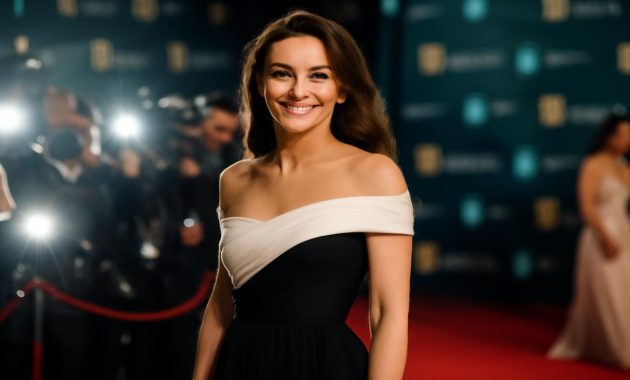
The crowd along the river seemed to lean in toward the building, as if the walls of the Royal Festival Hall were exhaling a secret. Camera shutters flickered like tiny lightning strikes. A sleety London drizzle glittered in the spotlights and pooled in the bricks, but no one moved. Everyone was waiting for the same thing. A red carpet is, after all, just a strip of fabric until a story steps onto it. And tonight, the story had a title: the Princess of Wales was back at the BAFTAs.
A Return Written in Flashbulbs
For months, the narrative around the British royal family has been dominated by absence—who wasn’t there, what wasn’t said, where the silhouettes had slipped quietly out of public view. The Princess of Wales, usually a regular presence at cultural milestones like the BAFTAs, receded into the safety of private life amid health concerns and the quiet chaos that always seems to hover around royalty in the twenty-first century.
So when word spread that she would appear at the British Academy of Film and Television Arts awards again, it felt less like a diary date and more like a season finale. Not the shouted, scripted drama of celebrity scandal, but a quieter, more human anticipation: Is she okay? How will she look? What does it mean that she chose tonight, this night, to come back?
The air held that tender kind of suspense as the cars began arriving. The cream of the film world spilled out first—actors, directors, producers with faces softened by the cold and the flares of lenses. But the energy shifted unmistakably when her car finally rolled into view, a dark mirror gliding along a red river of expectation.
She stepped out into the flashstorm, and for a brief second the noise fell away. There she was again—The Princess of Wales—hands poised in that careful-but-warm royal style, shoulders squared, smile luminous but not quite blinding. The audience, though, was not looking at her smile first. Their eyes were pulled, magnetically, to the deep, immersive richness of what she was wearing.
The Gucci Moment: A Dress That Speaks in Color
The gown was Gucci—and not just Gucci by label, but Gucci by spirit. It was a dress that understood the assignment: this wasn’t a night for quiet camouflage, nor for glittering excess. It was something between the two: cinematic elegance with a whisper of daring.
The fabric fell like poured ink, or the velvet hush of a cinema curtain just before the projector flickers on. Under the bright lights the color shifted: from some angles a regal midnight, from others a forest-shadow depth—Gucci’s signature mastery of tones that don’t quite sit still. It had structure without stiffness, the bodice tracing the strength of her frame, the skirt loosening into a fluid, almost living movement as she walked.
There is always a personal mythology to royal fashion, and this gown slipped seamlessly into the story she has been telling for years. The Princess of Wales has mastered the soft power of clothes: a language built on silhouettes, repeated designers, unexpected high-street pairings, and the quiet echo of reworn pieces. Tonight, though, this Gucci choice carried another layer—because her audience wasn’t just the fashion press.
The world has watched her absence with something that looks uncomfortably like worry. On this carpet, in this dress, she seemed to answer without words: Here I am. Present. Intentional. I still know who I am—and I know you’ve been wondering.
Why Gucci, Why Now?
In a palace wardrobe that balances duty, diplomacy, and a planet-sized spotlight, Gucci is a choice with texture. This isn’t a debutante’s flirtation with a famous label. It’s a conversation with history and contemporary culture at once.
Gucci, the Italian house that has danced through decades of reinventions, has become a kind of global shorthand for the intersection of heritage and modern spectacle. It’s red-carpet fluent. It knows how to perform for distances measured in megapixels. A Princess in Gucci is a princess who understands that monarchy, in the age of streaming and scrolls, must play on the same screen as cinema.
Perhaps that’s why this particular appearance felt almost meta. Here was the Princess of Wales at the BAFTAs—Britain’s own night of cinematic storytelling—wearing a label that knows more than a little about narrative and costume, standing before an audience that has spent months analyzing every frame of her absence. It was as if fashion, royalty, and film had merged into one wide shot.
| Element | Details Observed |
|---|---|
| Designer | Gucci, signaling cinematic glamour with heritage roots |
| Silhouette | Structured bodice, fluid skirt—strength meeting softness |
| Color Palette | Deep, shifting jewel tone, reading as midnight/forest under lights |
| Accessories | Understated sparkle, emphasizing poise over spectacle |
| Mood | A quiet kind of triumph: assured, cinematic, unhurried |
The Weight of an Empty Chair
To understand why this single appearance felt so loaded, you have to recall the empty frames that came before it. Over the past year, royal schedules have been punctuated not by ribbon cuttings and balcony waves, but by cancellations and statements from press offices. Health has become the unexpected headline act, and with it, a sense of fragility that doesn’t sit comfortably with the mythology of crowns and carriages.
The public is used to seeing the Princess of Wales moving: visiting schools, crouching to talk to children at eye level, laughing with artists and athletes, leaning over briefing papers, walking purposefully in well-cut coats through hospital corridors and community centers. That momentum is part of how we know her. So when she disappeared from that constant motion, there was a strange, echoing stillness.
Royal absence is never just absence; it creates a sort of narrative vacuum. Rumors rush in to fill the silence, alongside genuine concern. In a world that has grown used to overexposure—where celebrities document their own recovery, their own fragility, their own hospital gowns—it felt almost old-fashioned, this royal retreat behind palace walls.
Her return to the BAFTAs, then, wasn’t merely a glamorous evening. It was a reset of rhythm. The body that had been the subject of whispered worry—Is she recovering? Is she resting? Is she overwhelmed?—was now walking, straight-backed and measured, down a strip of scarlet cloth under the mirrored ceiling of the world’s attention.
There is something profoundly human in that image: emerging from a period of private vulnerability into a public world that demands composure on cue. The Gucci gown became more than a dress; it was a kind of armor stitched in silk, a way of saying, I am not invincible, but I am still here.
The Dance Between Private and Public
What made the moment especially compelling was the tension it embodied. On one hand: the BAFTAs—a celebration of crafted illusion, of performances rehearsed and edited until they shimmer. On the other: a woman whose daily life is already lived as a kind of performance, but whose recent silence hinted at the off-camera reality most of us never see.
There is always choreography to a royal appearance, especially on a night like this. The steps are familiar: the arrival at the curb, the greeting, the wave, the slow progress down the carpet. But between the set pieces, there are small, revealing details—the way she adjusts her skirt before stepping out of the car, the brief, grounding breath just before the first flash hits, a fleeting glance toward her husband, the Prince of Wales, as if syncing emotional clocks.
Those small gestures mattered more this year. They felt like evidence: she’s steady; she’s present; she’s choosing, again, to share herself with a world that can be unkind, impatient, and insatiably curious. The Gucci gown framed those gestures, catching the light but not stealing the soul of the moment.
Red Carpets, Green Thinking
Even amid the romance of fashion and film, another story hummed in the background: sustainability. In recent years, the Princess has been quietly but consistently rewearing gowns, mixing high fashion with high street, and choosing brands that are, if not perfectly sustainable, at least moving in that direction.
Gucci, too, has been attempting to rewrite its role in the environmental narrative—reducing its footprint, engaging in carbon offsetting, dabbling in circular fashion projects. These moves are complicated, imperfect, and often criticized for not going far enough. Yet, when a royal figure chooses a brand like Gucci on the BAFTA carpet, it sends a subtle signal: the era of mindless opulence is shifting into something more self-aware.
The Princess’s choice seemed to walk that line—unquestionably luxurious, but not screaming excess. The gown wasn’t covered in aggressive embellishment; it relied instead on line and color. The jewelry, too, looked curated rather than overflowing, with pieces that seemed selected to whisper rather than shout. In the sea of sequins, it felt almost serene.
Style as Soft Power
Fashion, in this context, becomes more than aesthetics. It becomes soft diplomacy, a way of speaking without speeches. The Princess of Wales has long understood this. When she chooses British designers, she’s boosting a home industry. When she wears a reworked gown, she’s signaling that even a future queen can resist the pressure to treat clothing as disposable.
By wearing Gucci at the BAFTAs—a British stage celebrating global cinema—she threaded a needle between local pride and international collaboration. The message seemed to be: Britain may be the host, but it understands that stories, like style, cross borders now. And the royal family, whether by instinct or careful planning, wants to stand at those intersections rather than behind them.
Under the Lights, Among the Legends
Inside the venue, the atmosphere shifted from the chill drama of the carpet to the warm hum of anticipation. The Princess took her place among directors whose work has filled bedrooms with late-night streaming, actors whose faces have become emotional landmarks, and writers whose words have been mouthed by strangers across the globe.
Here, her role is strangely doubled. She’s both guest and institution, spectator and symbol. Cameras move between the stage and her reactions: a quick cut to her laughing at a well-timed joke from the host, another glimpse of her listening with unforced gravitas as a humanitarian film is honored. The Gucci gown moves each time she claps, catching a glint of stage light with every applause, like a piece of the night sky stitched into the audience.
What stands out isn’t just her presence, but her ease. For someone coming off a much-discussed absence, she appears unhurried, not flustered. There is no sense of someone racing to reclaim a spotlight. Instead, she seems to inhabit her seat as though this is merely one evening in a much larger, quieter life. That calm is perhaps the most powerful statement of all.
After all, the real drama of the night belongs to the winners and the films. The royal role here is to frame the ceremony with a sense of occasion, to remind the room—and the watching world—that stories matter enough to be honored. Her gown, her posture, her expression all become part of that framing. It’s costume design, live and unscripted.
When the Cameras Turn Away
There is always a moment, after the final award is announced and the last speech is given, when the air in the hall changes. The broadcast ends, but the evening doesn’t. The Princess will rise, the dress moving like a low tide around her feet, and begin the quieter part of the night: conversations in hushed corners, brief exchanges with award winners whose hands still shake with adrenaline, smiles that will never make it into the highlight reels.
It’s in these spaces—between the official photos and the chauffeured departure—that the night sheds its sense of spectacle and becomes something gentler. A director might murmur a thank you for royal patronage of the arts. An actor might lean in, still glittering with stage nerves, to describe a role that changed their life. Staffers will guide her gently through the maze of people and equipment, the Gucci gown brushing against cables and gaffer tape, the illusion of glamour passing inches from the machinery that sustains it.
By the time she steps back out into the London night, the temperature has usually dropped and the crowds thinned. The carpet is a little damp now, smudged with footprints and the residue of a hundred different perfumes. The cameras still click, but with less frenzy. She and the Prince will slide back into the car, the door closing with a soft, final thud.
Somewhere, in that small enclosed space, she will finally exhale. The dress will crease just slightly as she settles into the seat. The adrenaline will begin to ebb. And the narrative—tonight’s narrative of return and resilience, of Gucci and glamour and the recalibration of public presence—will start its transformation into tomorrow’s headlines.
A Story Bigger Than a Gown
What lingers after nights like this isn’t just a memory of what she wore. It’s the sense of a chapter turning. The Princess of Wales’s return to the BAFTAs in Gucci didn’t answer every question, nor did it pretend to. It didn’t erase the reality of health challenges or the complexity of royal life in a hyper-critical age. But it did offer something both simpler and deeper: a glimpse of continuity.
In a world where so much feels unstable, the sight of a familiar figure stepping into a familiar role—a princess at an awards show, dressed for the cameras and yet somehow still human beneath the couture—can feel oddly grounding. The story continues, her presence seemed to say. Not unchanged. But continuing.
And maybe that is where the true magic lies. Not in the Gucci label, though fashion lovers will dissect every seam. Not in the glow of the BAFTA stage, though cinema will always tug at our imaginations. The magic is in the quiet resilience stitched into the evening: in the decision to come back, to move again through the choreography of public life, to let the world see you after a season of being unseen.
A red carpet, in the end, is just a path. On this night, the Princess of Wales walked it in a dress that caught the light and in a body that had known shadows. Both are true. Both belong to the story. And as the last flashbulbs faded and the city folded itself back into ordinary time, that image of her—steady, luminous, undeniably present—lingered like the final frame of a film that invites you, gently, to imagine what happens next.
Frequently Asked Questions
Why is the Princess of Wales’s return to the BAFTAs such a big deal?
Her return follows a dramatic period of royal absence linked to health and personal pressures. She is a central figure in the modern monarchy, and her presence at high-profile events like the BAFTAs signals continuity, recovery, and renewed engagement with public life.
Why does it matter that she wore Gucci?
Gucci is a global fashion powerhouse associated with cinematic glamour. By choosing Gucci for a major film awards night, the Princess aligns royal style with contemporary culture, soft power, and a more international, collaborative image for the monarchy.
Is there a deeper meaning behind her fashion choices?
Yes. The Princess often uses fashion to send subtle messages—supporting certain designers, nodding to sustainability through rewearing, or choosing pieces that balance tradition and modernity. Her Gucci gown here reads as confident, resilient, and attuned to the global stage.
How does her appearance influence the relationship between royalty and the arts?
Royal attendance elevates events like the BAFTAs, underlining the importance of storytelling, culture, and creative industries. Her presence offers a sense of ceremony and continuity while also showing that the royal family recognizes and supports modern film and television.
What might this appearance suggest about her future public role?
While it doesn’t reveal her full schedule ahead, the appearance suggests a cautious but deliberate return to prominent public engagements. It hints at a future where she continues to balance personal health with high-visibility roles, using moments like the BAFTAs to reconnect with the public narrative on her own terms.