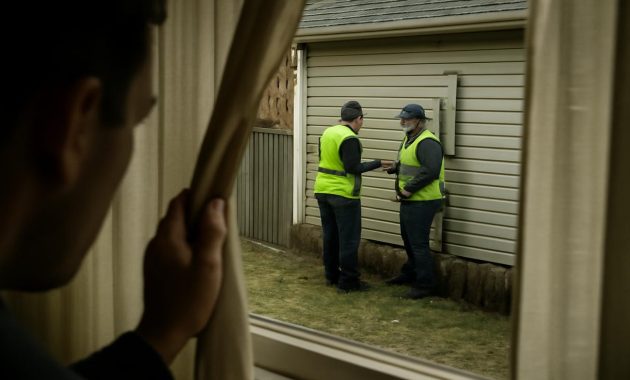
The first time the wires caught her eye, it was late afternoon and the neighborhood was wrapped in that thin, golden kind of light that makes everything look a little softer than it is. Children were biking slow loops in the cul-de-sac, someone was grilling two houses down, and Mrs. Alvarez stood at her kitchen window with a dish towel in her hand, watching a strand of black cable sag from one roofline to another like a skein of forgotten yarn.
She almost missed it. It was just a dark line against the sky, an extra stroke in a familiar picture. But as she turned back to the sink, something pricked at her. She looked again. There it was: a cable leaving her neighbor’s eave, slipping through the branches of the jacaranda, disappearing onto the upstairs balcony of the small rental at the back of the lot next door.
It struck her first as out of place, then as wrong.
The Night the Lights Felt Too Bright
She had noticed the brightness before she noticed the wire. The little house behind the fence—the one squeezed in like an afterthought—had only been there a few years. It had started as a tool shed, then a finished studio, then, almost overnight, it seemed to become somebody’s home. A whisper went around the block about “extra tenants” and “no proper permits,” the way news always traveled in their neighborhood: over hedges, across driveways, carried in with casseroles and bags of citrus.
At first it was just a single young man, quiet and almost ghostly in his comings and goings. Then another car appeared. Then a third. On warm nights, laughter drifted over the fence, the clink of bottles, the crackle of loud music winding too late into the dark. Light burned in every window well past midnight, a bright, unwavering glare that made the curtains in her own bedroom glow faintly, as if it were always just before dawn.
“Do they ever sleep?” she muttered one night, shifting on the mattress. Her husband, half-asleep, grunted something noncommittal. Outside, a dog barked once and then fell silent. The little house’s porch light glared on.
It wasn’t the noise that finally got to her. Neighborhoods breathe and shift. Young people move in, old neighbors move away, a block that was once quiet acquires a pulse. It was that the house behind the fence always seemed too alive for the darkness around it—brighter, hotter, like it was plugged into a different kind of night.
When she finally noticed the black wire, all that brightness suddenly had a shape.
The Wire Between Two Houses
The next day, curiosity pulled her outside. She watered the pots on the back patio, letting the hose linger in the direction of the fence, eyes skimming along the roofline. From that angle, she could see it clearly: the cable running from the side of the neighbor’s meter box, looping up through a hook screwed into the fascia board, then stretching, taut and determined, across the airspace that separated their property from the small rental. It dipped in the middle, heavy with the weight of what it carried.
The end of the cable disappeared into a small, weathered hole on the rental’s upstairs balcony. Around the opening, the stucco was chipped and flaking, like a wound that had never properly healed.
“That can’t be right,” she whispered.
Later, over coffee at the dining table, her husband squinted out the back window, his glasses low on his nose.
“Maybe it’s just temporary,” he said. “You know how people run extension cords for tools and such.”
“That’s not an extension cord,” she replied. “Look how thick it is. And it’s going straight from their meter. Straight into that place.”
He shrugged, torn between seeing what she saw and wanting not to see it at all.
“If it was a problem, the city would be on them already,” he said. “You know how they are with permits.”
He went back to his newspaper. But the line between the houses stayed with her, humming in the back of her mind.
The Quiet Calculus of a Complaint
Reporting a neighbor is not a simple act. It’s less like flicking a switch and more like stepping onto a path that will be difficult to leave once you’ve taken the first step. In the days that followed, she ran her fingers along that edge—between looking away and saying something—again and again.
She thought of all the stories she had heard over the years: overloaded circuits sparking in the night, old houses going up in an instant like dry brush. She remembered a distant cousin whose kitchen caught fire because a handyman had “rigged something up” behind the fridge. She pictured the little rental behind the fence, strung with hand-me-down appliances and cheap lamps, resting on what suddenly felt like a foundation of borrowed electricity and wishful thinking.
Yet each time she picked up her phone, thumb hovering above the city hotline’s number, a wave of doubt washed over her.
What if they’re just trying to get by? What if they can’t afford a separate service? What if I make their life harder?
But then the other questions pressed in, quieter but heavier.
What if it starts a fire? What if my house burns, or theirs, or both? What if the kids two doors down never make it out of their bedrooms because I wanted to avoid an uncomfortable conversation?
She watched the wire as if it might answer her. It only sagged in its lazy half-circle, cutting the sky in two.
The Call That Changed the Street
On a Wednesday afternoon, when the sky was white and flat and the air felt scratchy with heat, she finally made the call. The recorded menu on the city’s non-emergency line walked her calmly from number to number, department to department, until a human voice answered.
“Code enforcement, how can I help you today?”
Her voice surprised her with how small it sounded at first. She cleared her throat and tried again.
“I… I think my neighbor has an illegal electrical hookup,” she said. “I’m not sure. But it looks dangerous.”
The woman on the other end listened carefully. She asked for cross streets, house numbers, descriptions. Did she see any sparks? Smell smoke? Had there been any recent work done?
“No sparks,” she said. “No smoke. But there’s a line running from their house to a rental in the back. It’s not in a conduit. It looks… improvised.”
Her fingers pressed little crescents into her palm as she spoke, guilt and relief tangling together.
“You did the right thing calling,” the woman said. “We’ll create a report. An inspector will check it out.”
When she hung up, the house seemed unusually quiet. Even the refrigerator’s low hum felt too loud. She stood at the sink again, looking out at the wire. It still hung there, indifferent, unhurried, as if to say, You can’t unsee me now.
The Inspectors Came with the Morning
The next day, they arrived before she had even finished her first cup of coffee. It was just after nine, the sun still working its way over the neighbors’ rooftops, when a white city truck rolled slowly down the street and stopped in front of the house next door.
Two people stepped out: one in a light blue shirt with a city emblem over the pocket, the other in a darker uniform, a clipboard in hand. Their boots made hollow sounds on the pavement as they crossed the driveway. She watched from behind the curtain, heart knocking in her chest, feeling both like a conspirator and a guardian.
The inspectors stood for a moment in the street, heads tilted, following the line of the cable with their eyes. One of them pointed; the other nodded and jotted something down.
Inside her own kitchen, everything seemed to vibrate with their presence. The kettle on the stove, the spoon in her hand, the breath lodged between her ribs. She had imagined this moment coming someday—vaguely, distantly—but she hadn’t imagined it would come so quickly. Less than twenty-four hours after her call, the quiet rule of the neighborhood had shifted.
On the other side of the fence, a door opened. One of the tenants stepped out, shirtless, barefoot on the balcony. He squinted into the brightening day, following the inspectors’ gaze. His eyes caught on the wire, then moved back to them, and something in his posture stiffened.
A Conversation Over the Fence Line
She slipped outside under the pretense of taking out the recycling, unable to resist the pull of the moment. On the front walk, the air smelled faintly of damp earth and hot asphalt. The inspectors were speaking with the property owner now—a man who lived in another neighborhood, who only appeared on their block every few months, always on his phone, always in a hurry.
Today, he was all careful politeness and nervous laughter.
“It’s just temporary,” he was saying. “We’re working on getting proper service to the back unit. There were delays with the utility company.”
The inspector in the blue shirt shook his head slowly.
“Sir, that line is not permitted, not protected, and not safe. You’ve got a live feed crossing open air, uninspected, running into a structure that wasn’t built for it. This isn’t a misunderstanding; it’s a hazard.”
From her small distance, she could see the owner’s jaw tighten. For a moment his eyes flicked toward the Alvarez house, toward her, though he couldn’t know for sure who had called. She shifted the recycling bin in her hands, feeling its plastic rim dig into her palms.
“We’re not here to make your life harder,” the inspector continued. “But this has to be disconnected. Today.”
The younger tenant from the back unit appeared beside the owner, arms folded across his chest. Up close, he looked more tired than defiant. Shadows pooled under his eyes. A faint grease stain smudged the front of his T-shirt.
“So what are we supposed to do?” he asked. “We’ve got a fridge full of food. We both work nights. You cut the power, we’re… we’re screwed.”
His voice cracked on the last word, not with anger, but something closer to weariness.
The second inspector, the one with the clipboard, spoke softer now.
“We’ll note that you’re occupying the back unit,” she said. “The city may look into permits and zoning. But as for the electrical, we can’t leave it like this. It’s not just your safety. It’s everyone’s around you.”
There it was, the word she had been carrying since she first saw the wire: everyone’s.
What an Illegal Hookup Really Means
By midday, the black cable lay coiled on the driveway, disconnected at both ends, like a snake whose head had been cut off. The small rental sat strangely quiet now, blinds drawn, a hollow dark behind its windows. For the first time in months, the house seemed to match the time of day.
Inside her own kitchen, Mrs. Alvarez stood at the table with a notepad and pen, trying to untangle the knot in her chest. She hadn’t expected to feel this way—both lighter and heavier at the same time.
She had thought that once the inspectors came, she might feel vindicated. Instead, she felt something more complicated: a textured mix of relief, guilt, and a sober awareness of what that lone dangling wire had symbolized.
It wasn’t just about “stealing electricity,” though that was part of it. It was about how systems designed to keep people safe and accounted for—permitting, inspections, load calculations—could also push those living on the margins into dangerous improvisations. It was about how invisible risks sit quietly in our neighborhoods until someone decides they can’t pretend not to see them anymore.
In the days that followed, she found herself reading about electrical safety in older neighborhoods like hers. Terms like “overcurrent protection,” “fault path,” and “load balancing” became part of her vocabulary. She learned that a single, improperly sized line could heat slowly, silently, beneath tape and siding, until it reached the point where insulation gave way and flame took over. She learned that backyard units patched into the main house’s service could overload panels, melting components that no one ever thought to touch.
One evening she sketched a rough comparison in her notebook, trying to make sense of it all in concrete terms:
| Aspect | Legal Electrical Setup | Illegal Hookup |
|---|---|---|
| Installation | Done by licensed electrician with permits and inspection. | Often improvised by unqualified person, no permits. |
| Safety Devices | Proper breakers, grounding, and code-compliant wiring. | Unknown or missing protection, no verified grounding. |
| Fire Risk | Low, with known failure points and inspections. | High, with hidden hot spots and overloading. |
| Liability | Covered by insurance if up to code. | Insurance may deny claims; legal penalties possible. |
| Impact on Neighbors | Minimal, predictable load on the grid. | Can endanger adjacent homes and shared infrastructure. |
Looking at the table, the whole situation seemed both obvious and heartbreaking: of course running a live line across open air was dangerous. Of course it had to be fixed. And yet, behind every illegal hookup was a story—someone without enough space, enough money, enough options.
What It Did to the Block
The neighborhood buzzed after the truck left. On evening walks, conversations slid gently toward what had happened, the way water finds the low places.
“Did you see them?” asked Mr. Han from across the street, trimming his roses. “City out there first thing. Must have been serious.”
“I heard it was about power theft,” said another neighbor, voice low, as if the word itself might short-circuit something essential. “You know how people are, trying to get around the system.”
Mrs. Alvarez listened more than she spoke. No one said outright that they knew it was her, but she saw the quick glances toward her windows when the topic came up. Not accusing, exactly—more speculative, as if they were trying to place her somewhere on the invisible map of responsibility and blame that overlays every neighborhood.
Weeks later, the back rental got its own meter box. A crew arrived one morning with spools of properly rated cable, conduits, and a small, shining panel. The work was loud and precise: drilling, hammering, the stuttered buzz of saws. When they were done, a tidy gray box sat on the side of the little structure, its seams clean, its switches neatly labeled.
The wire between the two houses never returned.
Shared Air, Shared Risk
Sometimes, when the evening is just beginning to cool and the light slides into that same soft-gold she remembers from the day she first saw the cable, she stands on the back patio again and looks at the empty space where it once hung. The gap between the two houses looks wider now, the sky a single unbroken sheet of blue.
In that open air, she sees more clearly how thin the lines are that separate “my house” from “their house,” “my risk” from “their risk.” After all, fire doesn’t stop at property lines. Exploding transformers don’t choose whose lights go out based on who paid for which permit.
Communities share more than fences and sidewalks; they share infrastructure, vulnerabilities, and the consequences of shortcuts, whether those shortcuts are born from greed or desperation. A single illegal hookup is like a loose thread in a sweater—pull it far enough, and seams begin to unravel in places you never expected.
She doesn’t feel heroic when she thinks about calling the city. She feels human, caught between compassion for the tenants who just wanted a place to live and an unshakable duty to the quiet safety of her own four walls. It’s easy to talk about “doing the right thing” when right and wrong stand far apart. Harder when they braid together like wires in a wall.
Once, weeks after the inspectors came, she crossed paths with the younger tenant at the mailbox row down the block. It was awkward at first, both of them aware—in that wordless, animal way humans have—that something unspoken stood between them.
“You live next door, right?” he asked finally.
She nodded.
“They said the line could have caused a fire,” he added, glancing toward the houses. “I didn’t… We didn’t really think about that. Just needed power.”
There was no accusation in his tone. Only a tired acknowledgment of how close they might have come to disaster.
“It scared me,” she admitted. “For all of us.”
They stood together for a moment in the fading light, the hum of the neighborhood wrapping around them: a lawn mower coughing to a stop, a child calling for their dog, a distant siren rising and falling on some other street. Shared sounds, shared air, shared fate.
When Looking Away Isn’t an Option
Not every street will have a neighbor like Mrs. Alvarez. Not every questionable cable will be reported, and not every report will bring inspectors the next day. Systems are imperfect, stretched thin, full of delays and human blind spots. But that morning when the white truck pulled to the curb, the system worked the way it is supposed to: a quiet concern turned into an official visit, which turned into a correction that might have prevented something no one wants to imagine in detail.
It’s tempting to see that story only as a cautionary tale about illegal electricity, to fold it up neatly and label it: Don’t steal power or the city will come. But underneath that simple message runs a deeper current about what it means to live close together—how our private decisions, even the ones made out of fear or necessity, radiate outward into the lives of people we may barely know.
In older neighborhoods, where houses lean in toward one another and power lines stitch the sky like black thread, trust is built not just on friendly waves and borrowed cups of sugar, but on an unspoken agreement: I will try not to endanger you. If I see that you—or your landlord, or your contractor—are endangering us, I may have to speak.
The neighbor who reported the illegal electrical hookup didn’t do it out of spite, or nosiness, or a thirst for control. She did it because she understood, in that small, steady way that rarely makes headlines, that safety is a shared fabric. Sometimes, the kindest thing you can do for the people who live around you is to refuse to look away.
Frequently Asked Questions
How can I tell if an electrical hookup might be illegal or unsafe?
Warning signs include exposed wires running between structures, cables not enclosed in conduit, connections that don’t go through a proper meter or panel, overloaded outlet strips, and any signs of heat, burning smells, or melted plastic. If something looks improvised or hidden, it’s worth paying attention.
Is it really my responsibility to report something on a neighbor’s property?
You’re not legally required in most places, but unsafe electrical work can put multiple homes at risk, not just the one where the wiring exists. Reporting a concern is less about policing your neighbor and more about protecting everyone who shares that environment, including them.
Who should I contact if I suspect an illegal electrical hookup?
In many cities, you can start with a non-emergency municipal hotline, code enforcement office, or building department. Some areas also allow anonymous reporting. If you see immediate danger—sparks, smoke, or fire—call emergency services right away.
Can tenants be punished for an illegal hookup their landlord installed?
Rules vary by location, but generally, property owners bear most responsibility for unsafe wiring and unpermitted work. Tenants, however, may still experience consequences, such as temporary loss of power or being forced to move if a unit is deemed illegal or unsafe. That’s one reason early, preventive reporting can be important.
Is there a way to raise concerns without causing conflict with a neighbor?
Sometimes, a calm conversation can be a first step: expressing that you’re worried about safety rather than accusing them of wrongdoing. If that feels unsafe or unlikely to help, using official channels and, where available, anonymous reporting can reduce personal tension while still addressing the risk.