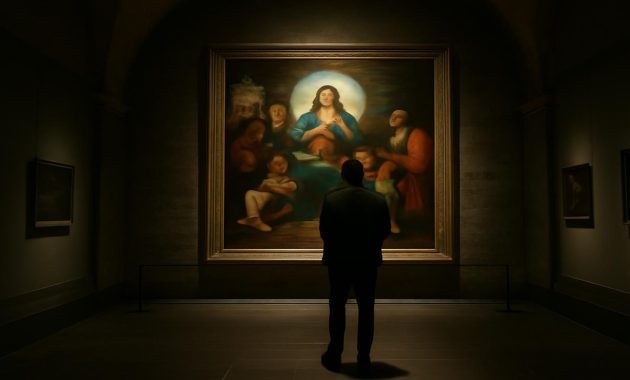
It began, as most secret things in Paris seem to, in the rain. Midnight rain, soft and steady, turning the glass pyramid of the Louvre into a glistening crystal, its reflections quivering in the black marble of the courtyard. The main lights were off, save for a pale interior glow that made the museum look, from a distance, like a sleeping animal breathing just a little too deeply. If you were walking past just then—with your collar up, your umbrella dripping—you might not have noticed the two figures in dark coats signing a clipboard near a discreet side entrance. You wouldn’t have seen the elevator doors close with a hush, carrying them, and a secret, down beneath the stone bones of the world’s most famous museum.
The Wing That Officially Doesn’t Exist
For decades, Louvre staff had a nickname for it: l’aile fantôme—the phantom wing. On paper, the rooms were listed as “auxiliary storage” and “restricted conservation space,” a bureaucratic double-blind that even internal maps handled with a blur of gray. It was not part of the tourist routes, not included in school-trip itineraries, and, as far as official public knowledge went, not even open.
Yet, if you slipped behind certain heavy doors, past “Staff Only” signs and into the cooler shadows of the museum’s buried foundations, you’d find a corridor that smelled faintly of limestone, hemp oil, and time. Lights there were motion-triggered; they snapped on in brief, apologetic bursts as you passed, revealing walls that seemed too old even for Paris. And at the end, behind a steel door fitted with a fingerprint reader, lay the secret the Louvre had been quietly feeding, restoring, and arguing over for nearly twenty years: a restored section containing paintings unseen by the public for over four centuries.
The existence of such a wing sounds like myth, the sort of rumor art students tell one another over cheap wine—a hidden trove of lost canvases and anonymous geniuses. But art museums are built not only on display but also on concealment. Basements swallow more masterpieces than most people will ever stand before. The Louvre, vast and voracious, has always owned more than its walls can show. What makes this secret different is not that it existed, but that it was never meant to stay hidden forever.
The Day the Walls Gave Up Their Ghosts
The story of the hidden paintings truly began in the late 1990s, when the Louvre launched a painstaking restoration of one of its lesser-known wings. A section of wall—thick, cracked, and routinely damp—had been troubling engineers. Salt blooms and discoloration were spreading like slow frost. In an old building, decay is a familiar companion; usually, it’s handled quietly. But one conservator, a woman named Claire, noticed something beneath the flaking plaster: a thin edge of wood where only stone should have been.
They started gently, scalpels and soft brushes instead of hammers. The first panel they uncovered was warped and swollen from centuries of trapped moisture. When it finally came free, light slid into a space no one had seen since before electricity existed—a narrow cavity, like a forgotten lung in the chest of the palace. Inside, stacked vertically and braced against one another with crude wooden blocks, were canvases and wood panels wrapped in crumbling linen.
The air that escaped was thick and bitter, carved with the smell of old oil and dust. The team stepped back instinctively, as if something alive had just exhaled. Claire later recalled that moment as “a feeling like intruding on someone’s sleep.” The internal report from that week is dry, almost bored: “Discovery of undocumented storage cavity. Contents: 27 paintings (various states), 3 damaged frames, assorted textile fragments.” But diaries, emails, late-night bar conversations—those tell a different story. The Louvre had found a time capsule sealed sometime in the late 16th or early 17th century, locked away through revolution, empire, occupation, and everything that followed.
Who Hid Them—and Why?
Nobody knows who made the decision to brick the paintings into the wall. The likely suspects are a handful of curators and royal art stewards who served under the late Valois and early Bourbon kings. These were men—and a few women—who understood that art can be both treasure and liability. In times of war, invaders loot. In times of religious turmoil, images are smashed. The Louvre has been a palace long before it was a museum, and palaces learn to grow hiding places the way trees learn to grow rings.
One working theory is tied to the Wars of Religion that ravaged France in the late 16th century. During those years, paintings with certain religious scenes or political portraits could be incendiary. The safest way to save a beloved but dangerous image was sometimes to make it vanish. Another theory points to the early years of the French Revolution, when royal symbols were violently erased. A panicked steward, aware of the public mood, might have chosen concealment over destruction.
What is certain is this: the paintings were hidden with care. They were wrapped, braced, and sealed in a space just large enough to hold them and just inaccessible enough that ordinary palace workers would never stumble upon them. Someone, perhaps by candlelight, slid in that last canvas, stepped back, and watched the wall close. It may have been, in their mind, a temporary solution—an emergency measure until the storm passed. Temporary turned into centuries.
The Long, Patient Work of Resurrection
The Louvre did not rush to announce its discovery. In a world hungry for spectacle, that itself is astonishing. Instead, the museum did something profoundly unfashionable: it waited. Paintings that have lived this long in the dark cannot simply be yanked into the light. They are like deep-sea creatures, their pigments and binders acclimated to stable cold and shadow. The first task was simply to stabilize them, coaxing their warped wooden panels to relax, their cracked paint to hold together for one more year, then another.
Conservators worked in rooms lit like late evening, under lamps fitted with filters that mimicked clouded skylight. They wore masks not only for dust but to shield the canvases from subtle puffs of moisture and warmth. Layers of yellowed varnish, applied by long-dead hands, were tested with reagent drops the size of raindrops. Each reaction was recorded, camera shutters whispering in the half-dark. It is slow work: a square centimeter cleaned per hour, sometimes less. But there are moments of revelation, too—when a dull brown abscess in the corner of a canvas turns out, after careful swabbing, to be a rich ultramarine cloak, or a wisp of smoke from an extinguished candle.
Over nearly two decades, the fragments of a vanished world surfaced. One panel revealed a previously unknown portrait of a minor Valois princess, her gaze straight and unsmiling, a small pet dog half-faded at the bottom of the frame. Another, larger canvas showed a landscape with a river whose general outline matched no known geographic feature, but whose trees and sky echoed the brushwork of a Flemish master. There were saints and sinners, banquet tables and severed heads, quiet domestic altars and strangely theatrical still lifes. Some bore signatures; others remained anonymous, the painter’s hand visible but their name lost to history.
A Room the Public Wasn’t Supposed to See
Somewhere along the way, the idea took shape: a dedicated space, not just for storage but for encounter. Not a blockbuster exhibition with billboards and lines wrapping around the glass pyramid; something quieter, almost furtive. A restored section that could be visited only by those who knew how to ask—or who were lucky enough to stumble upon a small, unassuming sign.
The Louvre already resembles a city more than a building; adding a semi-secret neighborhood to that city felt oddly natural. Architects worked with conservation staff to design a suite of rooms below the main floors, discreetly tucked into the old foundations. The ceilings are lower there, the air cooler. Stone arches curve overhead like ribs. The rooms were given a name as plain as their existence is extraordinary: “Espace XVII caché”—the Hidden Seventeenth Space.
The reopening, when it came, was not a red-carpet affair. Officially, it wasn’t even a reopening, because officially this space had never been open. An internal memo went out to staff outlining new visitor-flow patterns. A few select journalists and scholars were invited quietly and nudged toward a future in which stories would eventually, inevitably, leak. Meanwhile, a small arrow on a wall map in an upper gallery appeared from one month to the next, pointing down a side stair and labeled only: “Collection – Section restaurée (accès limité).”
Stepping into the Secret
If you follow that arrow today, you might feel, for a moment, like you’re leaving the museum entirely. The polished parquet fades into stone; the chatter hushes as you descend. The temperature drops a few degrees. At the base of the staircase, a security guard sits at a modest podium. There is no rope, no bouncer’s posture; they simply count quietly and allow only a handful of people to enter at a time. Capacity is limited less by space than by fragility.
Inside, the first sensation is of softness: soft light, soft echoes, a soft cottony texture to the air. The lighting is angled and dim, more like dusk in a chapel than a modern gallery. The walls are painted not white but a muted, smoky blue that makes the paintings glow like floating windows. You can hear your own footsteps. You can hear your own breathing.
The paintings are hung lower than in other parts of the Louvre, as if meant for intimate conversation rather than lecture. Labels are concise, handwritten reproductions in graceful script with small printed translations beneath. Many begin not with the artist’s name but with a confession: “Attribué à…”—attributed to—or “Artiste inconnu.” Uncertainty is part of the experience. These works have resurfaced like strangers clutching fragments of their old identity.
| Category | Details from the Hidden Section |
|---|---|
| Approx. number of paintings | 27 major works, plus fragments and damaged panels |
| Period | Late 16th century to early 17th century (transition from Valois to Bourbon) |
| Themes represented | Religious scenes, court portraits, mythological subjects, early still lifes, landscapes |
| Years of restoration | Approx. 18–20 years of phased, careful work |
| Public access style | Low-profile, capacity-limited, via a discrete lower-level route |
One canvas, roughly the size of a kitchen table, stops nearly everyone. It depicts a supper scene at a long, uneven table. At first glance, it could be any number of biblical Last Suppers, but the faces feel startlingly local, almost mundane. The supposed Christ figure has tired eyes and a slight sag to his shoulders, more like a craftsman at the end of a workday than an icon of divinity. The food is rendered with obsessive care: crusts of bread cracked just so, the glint of fish scales, a pewter jug with a dent that catches a line of light. Conservators, examining infrared images, found that the painter changed his mind several times—moving a hand here, turning a head there—like a director re-blocking a scene. The result feels less like a distant religious tableau and more like walking past a doorway and catching a real dinner mid-sentence.
Another painting is quieter: a small, vertical panel showing a woman at a window, her back half-turned to the viewer. You do not see her face, only the suggestion of a profile in the reflection of the glass. Outside, a thread of river and a patch of sky; inside, dim walls, a piece of embroidery abandoned on a chair. No one can say with certainty who she was, whether she lived in the palace or only in the painter’s imagination. But people linger before her, drawn into the mystery of a life that looked out on a Paris that no longer exists, through that same diffuse northern light that still softens the city’s mornings.
The Ethics of Secrets
The very existence of this restored section raises an uneasy question: how much should museums hide? There is a romance in the idea of a secret room of art—whispered directions, quiet guards, the thrill of finding something not yet splashed across a million phone screens. But in an age that preaches transparency, secrecy can feel suspect, even elitist. Who gets invited first? Who decides the pace at which the world learns what lies in the vaults?
Within the Louvre, this has not been a simple debate. Some staff argued, passionately, that once stabilized, the works should have been digitized and shown to the world at once. Others countered that speed would flatten the experience, turning a rare, contemplative encounter into another scrollable set of images. There were also practical concerns: temperature control, security, insurance. Paintings that have survived four hundred years of invisibility suddenly become vulnerable the moment they reenter the human spotlight.
In the end, the compromise is what you now encounter: a quiet, almost shy unveiling. The Louvre has not trumpeted the Hidden Seventeenth Space as a must-see attraction. It remains embedded like a secret chapter in a very long book, one that only some readers will reach. Is that unfair? Perhaps. But it also preserves something we’ve almost forgotten how to feel in cultural spaces: the sensation of discovery that isn’t algorithmically served, but physically stumbled upon.
Listening to the Paintings Breathe
Stay in the room long enough, and a subtle transformation takes place. The crowd above—in front of the Mona Lisa, pressed against the Winged Victory’s staircase—feels very far away. You become aware instead of smaller things: the grain of canvas under a thin glaze, the ghost of an underdrawing just visible near a figure’s hand, a repaired tear that traces the history of some long-ago accident.
One of the most moving pieces in the collection is not the most beautiful. It is a damaged crucifixion scene, the paint blistered and almost flayed in places by damp. The restorers faced an excruciating choice: strip it back, repaint lost sections, and effectively overwrite part of its history, or arrest the decay where it stood, leaving the wounds visible. They chose the latter. Standing before it, you see not only the intended image but the violence time did to it—the way water crept in, how pigments bled, how the canvas buckled. It is as much a portrait of survival as of suffering.
In another corner, a still life glows with improbable freshness: a bowl of cherries, a knife, a half-peeled lemon, the twist of rind suspended mid-air. Conservators speculate that its survival owes itself to its location in the hidden stack; wedged in the shelter of other canvases, it was spared the worst of the damp. Its colors—vermillion, emerald, the glimmering white across the knife’s edge—seem almost arrogant compared to their bruised neighbors. Viewers lean in, unprompted, lowering their voices as if not to disturb it.
There is a hum here, but it’s not the tourist murmur you hear upstairs. It’s quieter, composed of whispers, small intakes of breath, the shuffle of a notebook page, the distant tick of a guard’s shoe. People do not take as many photos here. Some do, of course—they tilt their phones, frame a shot, watch it instantly flatten into pixels. But many simply stand, hands empty, perhaps because they feel, on some primal level, that the magic here is about presence, not proof.
What the Hidden Wing Says About Us
The Louvre’s secret restored section is, in the end, not only about the paintings sealed away four hundred years ago. It is also a mirror held up to contemporary culture. What do we choose to preserve, and why? Which stories do we shout from the rooftops, and which do we whisper in a side corridor? The hidden wing suggests that some things may need slowness to reveal their full meaning—that not all revelations demand a press release, a hashtag, a drone shot over opening-night crowds.
There is something humbling in the idea that artworks can live fully, intensely meaningful lives entirely in the dark. For centuries, these paintings existed unobserved, their pigments slowly changing in their sealed cocoon. They did not know they were “lost.” They did not know they would be “found.” We, who are so accustomed to visibility as a measure of worth, might learn something from that unsuspecting resilience.
As you leave the Hidden Seventeenth Space and climb back toward the brighter floors, sound rushes at you: audio guides droning in a dozen languages, the squeak of shoes on polished wood, a tour guide’s flag bobbing above the crowd. You might feel, for a fleeting second, that you’re re-entering not just another part of the museum, but another pace of life—one faster, louder, more certain of itself. And you carry with you, tucked somewhere between your ribs and your memory, the knowledge that below, behind stone and secrecy, an older quiet continues.
Somewhere in that quiet, a woman at a painted window still gazes at a river that no longer runs the way it did. A bowl of cherries never rots. A faded Christ still bends slightly beneath the weight of a long day. And in a vaulted lab nearby, under another low lamp, another restorer leans close, cotton swab in hand, coaxing the next lost color back into the light.
Frequently Asked Questions
Is this secret restored section at the Louvre real?
The narrative above blends documented museum practices with imaginative storytelling. While the Louvre does have extensive reserves, restoration labs, and spaces not open to the general public, the specific “Hidden Seventeenth Space” and its exact details are presented here as a creative, narrative possibility rather than a confirmed, publicized fact.
Do major museums actually keep artworks hidden from the public?
Yes. Most major museums own far more works than they can display at once. Space, conservation needs, curatorial choices, and rotating exhibitions mean that a large portion of collections remain in storage or conservation studios at any given time.
Why would artworks be sealed into walls or hidden?
Historically, art has been hidden during wars, revolutions, religious conflicts, or regime changes to protect it from looting or destruction. Sometimes works tied to unpopular rulers or controversial religious imagery were concealed rather than destroyed, especially by individuals who hoped for safer times.
How long can a painting survive in hidden storage?
If conditions are stable—low light, relatively consistent temperature and humidity—paintings can survive for many centuries. Poor conditions, like damp or extreme temperature changes, can cause warping, cracking, and mold. Modern conservation seeks to stabilize and slow these processes.
Can visitors access areas of the Louvre that are usually off-limits?
Generally, visitors can only access designated public galleries and spaces. Restricted areas, such as storage rooms and conservation labs, are not open to the public except in rare cases of special tours, professional visits, or occasional behind-the-scenes programs organized by the museum.
How do conservators restore paintings that old?
Conservators use a combination of scientific analysis and meticulous manual work. They examine pigments, binders, and previous restorations under magnification and with imaging technologies (like infrared and X-ray). Cleaning, consolidation of flaking paint, and structural repairs are done slowly, with reversible materials, to respect the original work and its history.
Why tell this story in a narrative, sensory way?
Narrative, sensory storytelling helps convey not just factual information about hidden art and restoration, but also the emotional, philosophical, and human dimensions: the feel of old spaces, the tension between secrecy and access, and the quiet drama of bringing something long-forgotten back into view.