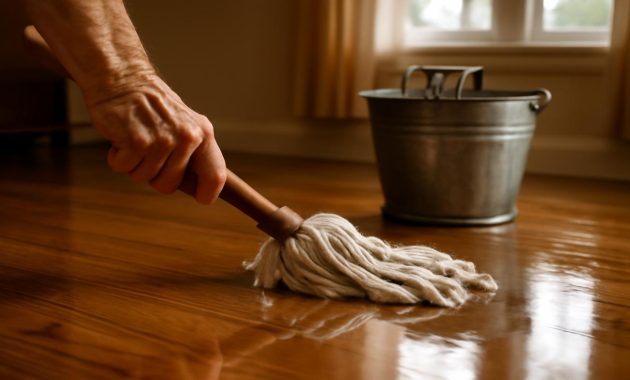
The first thing you notice is the smell. A sharp, clean tang that isn’t quite lemon, not exactly vinegar, but something in between—like sunshine on an old wooden porch after rain. The floor beneath your bare feet feels cool and almost silky, the boards glowing softly as if lit from within. It’s the same house, the same faded planks, but after the old mix has done its work, it feels like walking through a memory that has been quietly polished and returned to life.
The Scent of Saturdays and Bucket Water
Long before anyone talked about “eco-friendly cleaners” or “non-toxic solutions,” there was just my grandmother, a chipped enamel bucket, and a ritual that turned ordinary Saturdays into something almost ceremonial. Her house always smelled faintly of beeswax and boiled coffee, but cleaning days added another layer: warm water, vinegar, and a mysterious glug of something she poured from a reused glass bottle tucked away behind the flour tin.
I remember sitting on the stoop, watching her measure everything by feel. No plastic measuring spoons, no labels promising “ultra-shine technology.” Just a slow, practiced motion: a splash, a swirl, a dip of her hand into the bucket, testing the heat with the back of her fingers. She would nod, satisfied, and say, almost to herself, “That’s it. That’s how my mother did it.”
The floor, back then, was a quilt of old boards, each one with its own story—scratches from chair legs, faint grooves where boots had dragged in winter mud, round faded rings from summer lemonade spills. On cleaning days, the boards changed color, darkening with water and then drying to a quiet luster that made the whole house seem somehow more at peace.
I didn’t know it at the time, but that bucket held a recipe that had wandered down three generations of women, carried not in notebooks or printed manuals but in muscle memory and habit. An easy method, she always insisted. “Why make life harder than it needs to be? Floors just want to be loved a little.”
The Old Mix, Simplified: What Was Really in the Bucket
Years passed, and the world filled with spray bottles, neon-colored liquids, and promises of “instant shine.” I moved to the city, bought whatever was on sale, and wondered why my floors always seemed sticky, too glossy, or covered in a film that dulled under the light. The smell of those store-bought cleaners caught in the back of my throat, more chemical than clean.
One winter, after a string of headaches and a stubborn gray cast on my supposedly “hardwood-safe” floor, I called my mother and asked, “What did Grandma really put in that bucket?” There was a long pause, then the sound of her laughing softly down the line.
“You mean the old shine mix? You’re finally asking?” she teased. “It’s nothing fancy. That’s the secret.”
And so the curtain lifted—not on some complicated potion, but on a combination so ordinary it almost felt disappointing. Yet it worked in a way no bottle on a store shelf ever had for me.
The Core Ingredients of Her Floor-Shine Mix
Here’s the essence of what was in that battered bucket, in plain modern language, translated from eye-balling and memory into something you can actually measure:
- Warm water – The base of everything. Not scalding, not cold. Think bathwater for tired feet.
- White vinegar – For cutting through dullness, grease, and old soap residue.
- Mild liquid soap – Just enough to lift dirt without leaving suds behind.
- A small amount of natural oil – The quiet magic that feeds tired wood and coaxed out that soft glow.
- (Optional) A few drops of essential oil – Not part of her original mix, but something I’ve added for a subtle scent.
What surprised me most wasn’t the ingredients—it was the restraint. No overloading on soap, no drowning the floor in oil, no scrubbing like punishment. It was all in the balance, the same way she measured out recipes: “Just enough. Not too much.”
How to Mix It: The Easy Method, Translated for Modern Homes
The day I finally tried her method in my own apartment, I did it the way she might have wanted: with windows cracked open to let in the thin winter light, socks off, bucket on the floor, phone on silent. I wanted to see if it was just nostalgia—or if the method itself still held under the harsh, bright scrutiny of modern life.
Grandmother’s Basic Floor-Shine Recipe
Here’s the version I now use, tested on creaky old wood floors, modern laminate, and tile—always with a small patch test first, because floors, like people, each have their quirks.
- 4 liters (about 1 gallon) of warm water
- 1/2 cup white vinegar
- 1–2 teaspoons mild liquid soap (like a gentle dish soap or castile soap)
- 1 tablespoon natural oil (olive, linseed, or a light plant-based oil)
- 3–5 drops essential oil (optional: lemon, lavender, or eucalyptus)
She never would have called it “ratio,” but that’s what it is: mostly water, a quiet whisper of vinegar, almost no soap, and a careful spoonful of oil. The water carries away the dirt, the vinegar breaks up what clings, the soap loosens, and the oil settles back into the wood, leaving no greasy film—just that soft, honest shine.
Step-by-Step: The Ritual of the Bucket
- Fill the bucket with warm water first. The temperature should feel comforting to your hand, not hot enough to sting.
- Add the vinegar, letting it swirl and cloud the water for a moment.
- Stir in the soap, barely enough to create the suggestion of suds, not a foam party.
- Add the oil, drizzling it slowly and stirring until it disappears into a faint sheen floating on the surface.
- Optional scent: Drop in a few drops of essential oil and mix gently. The fragrance should be a whisper, not a shout.
Dip your mop or cloth, then wring it within an inch of its life. This is not a flood; this is a damp, respectful greeting from water to wood. My grandmother used an old cotton rag, folded and refolded until it fit her hand like a glove. I use a flat mop with a washable pad, but the motion is the same: long, patient strokes, following the direction of the boards, letting the rhythm settle your thoughts.
The Secret Isn’t Just the Mix—It’s the Way You Use It
What made my grandmother’s floors shine wasn’t just what was in the bucket. It was how she moved through the house, almost like she was listening to it breathe. She never sloshed, never rushed. She treated cleaning as if it were a conversation with something alive and aging but still beautiful.
Her Quiet Rules for a Shining Floor
- Never soak the floor. Wood, she’d say, remembers every flood. A damp cloth is love; a puddle is carelessness.
- Work in sections. She’d start near the farthest corner and move backward, step by deliberate step, never trapping herself.
- Rinse lightly, not obsessively. If the floor felt slightly tacky, she’d run over it once more with clean warm water and a well-wrung cloth.
- Let the floor dry with dignity. Windows open if the weather allowed, doors ajar, no one stomping through until it was completely dry.
- Add a dry buff, now and then. A clean, soft cloth or an old cotton T-shirt under her feet, and she’d glide across the room, laughing at her own impromptu dance.
The shine that followed wasn’t the glaring glassiness of a synthetic finish. It was subtler—a glow that appeared when sunlight slid across the room, or when a lamp turned on at dusk. The boards looked nourished, not coated.
A Mix Proven Over Decades
Decades later, the house is still there. The floors have seen grandchildren, pets, winter boots, and the occasional toppled glass of wine. They creak a little more, the edges of the boards have rounded with time, but that old shine is still there, sunken deep into the grain like a story told so many times it’s part of the wood itself.
When I visit now, I notice how different that floor feels from so many others—no strange stickiness, no waxy build-up, no strange plastic gloss. Just honest wood, well cared for, bearing its years with quiet pride.
It’s easy to look at these simple ingredients and think, That can’t be enough. We’ve been trained to believe that cleaning requires complexity: bright packaging, long words, miraculous claims. But if something has held up for half a century—through seasons of sun and snow, through spills and parties and rearranged furniture—doesn’t that count as proof?
What’s remarkable is not just that this mix works, but that it does so gently. No harsh fumes, no mystery residues, no worrying about a toddler crawling across the floor or a pet licking a paw. Just water, vinegar, soap, and oil—each doing its quiet part.
Finding Your Own Version of Her Old Mix
The first time I taught a friend how to mix it, we were both standing in her narrow kitchen, elbows nearly touching, the bucket wedged awkwardly between the table and the fridge. Outside, traffic hummed; inside, the space felt momentarily removed from the speed of the city.
We tested a small patch of her tired wooden floor. Years of cheap cleaners had left it dull and streaked. We soaked the mop, wrung it tight, and ran it slowly over a patch by the window. The boards darkened, then dried, and for the first time, the grain reappeared—pale streaks and knots, tiny swirls that had been hiding under residue.
“I thought I needed to refinish it,” she said quietly. “I thought I’d ruined it.”
But some things, like stories and floors, don’t really want to be replaced. They want to be understood, tended to, given a chance to show what’s still there beneath the surface.
Over time, I’ve adjusted the recipe for different homes and floors—less vinegar on delicate surfaces, a different oil on newer boards, sometimes skipping the oil altogether for tile or laminate. The heart of the method remains the same: start gentle, observe, and respond. The floor will tell you what it likes, if you’re paying attention.
Quick Reference: Mix Variations for Different Floors
| Floor Type | Adjustments to Mix | Notes |
|---|---|---|
| Sealed hardwood | Use full recipe, keep mop only damp | Avoid standing water; buff dry if needed |
| Old or delicate wood | Halve the vinegar, keep oil, extra-wring mop | Always test in a hidden corner first |
| Laminate | Use recipe but omit oil | Too much moisture can cause swelling |
| Tile / stone | Use full recipe or slightly more vinegar | Skip oil for textured tile to avoid slipperiness |
| Vinyl | Use recipe, omit oil if surface becomes slick | Check manufacturer’s care guide when possible |
The Quiet Joy of a Well-Shined Floor
There’s an unexpected pleasure in caring for something slowly. We live in a world of quick wipes and disposable everything, where effort is often framed as an inconvenience. But there is a kind of grounding that comes from moving across a room with a bucket and cloth, seeing the boards wake up under your hands.
Maybe that’s what my grandmother understood: that the shine on her floors wasn’t just about cleanliness. It was about presence. About standing in the middle of her home, sleeves rolled up, listening as the house answered back with its small creaks and sighs. About knowing that every mark on that floor had a story, and that keeping it gleaming was a way of honoring them all.
When I use her mix now, in my own place, I feel her there—not in a sentimental way, but in the calm practicality of the motions. Measure lightly. Don’t overdo the soap. Wring well. Move with the grain. Open the window. Let the floor breathe.
And when the light hits just right—late afternoon, usually, when the sun angles low and generous—I catch that same glow I saw as a child in her living room. Not the perfection of something new, but the radiance of something cared for, over and over again, in small, consistent acts.
This is the easy method she promised: not because it takes no time, but because it takes no fuss. No harsh chemicals, no complicated steps, no long list of warnings. Just a simple old mix that has quietly proven itself over decades, whispered from hand to hand, bucket to bucket, floor to floor.
Frequently Asked Questions
Can I use this mix on all types of floors?
Not all floors are the same. This mix works very well on sealed hardwood, tile, and many vinyl floors when used with a damp (not wet) mop. For old or delicate wood, reduce the vinegar and always test a small hidden area first. For laminate, skip the oil and be especially careful to avoid excess water.
Won’t the oil make my floor slippery?
Used in the tiny amount suggested and thoroughly diluted in warm water, the oil should not leave a greasy film or dangerously slick surface. If your floor feels slippery afterward, you likely used too much oil. Next time, reduce the amount or skip the oil and simply buff the dry floor with a soft cloth to bring out a shine.
Why is there so little soap in the recipe?
Too much soap leaves residue that attracts dust and makes floors look dull or streaky. The small amount in this mix is just enough to loosen dirt without sticking around afterward. If you see a lot of suds, you’ve probably added more than you need.
How often should I use this floor-shine mix?
For most homes, once a week or every two weeks is plenty for a full clean, depending on foot traffic, pets, and seasons. In between, sweeping or a quick vacuum is usually all that’s needed. Overwashing wood with water, even gently, isn’t necessary every day.
Can I store leftover mix for later?
It’s best to make only what you’ll use that day. The mix is simple enough to prepare fresh, and over time, oil and water can separate and the scent may fade. If you do keep a small amount for a short period, stir or shake well before using, and discard if it looks or smells off.
Will the vinegar damage my wood floors?
Used in the small, diluted amount described and only on sealed wood, vinegar is generally safe and effective for cutting through cloudy buildup. On unsealed or very old, fragile wood, reduce the vinegar by half and always test first. If you’re unsure about your floor’s finish, start with an even weaker solution and observe how it responds.
Do I need to rinse the floor afterward?
Most of the time, no full rinse is required if you stick to the recommended amounts and use a well-wrung mop. If the floor feels slightly sticky or you suspect you’ve used too much soap, a quick pass with clean warm water and a damp cloth or mop will remove any leftover residue and restore that soft, natural shine.