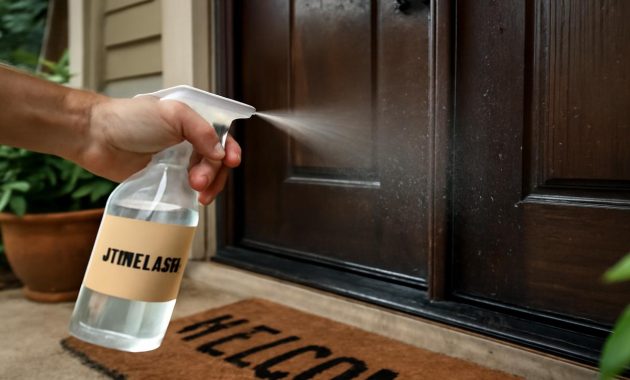
The first time I saw it, I thought my neighbor had finally lost it. She stood on her front steps at sunrise, bare feet on the cool concrete, a chipped blue spray bottle in one hand, misting her front door frame like she was blessing it. The sharp, tangy scent drifted over the hedge—vinegar. Not exactly what you picture when you think “morning ritual.” Yet there she was, calm as could be, spritzing the threshold with all the ceremony of a tea ritual. I watched from my window, equal parts amused and curious, wondering why on earth anyone would choose to perfume their entryway with salad dressing.
The Strange Little Ritual at the Door
Once you notice something, you start seeing it everywhere. A few days after I watched my neighbor spritz her doorway, I spotted a similar bottle tucked beside another neighbor’s porch plant. Then a friend casually mentioned, “Oh, I spray vinegar at my front door now. Keeps the ants away—and the bad vibes.” The way she said it, like it was the most obvious life hack in the world, made me pause.
So I did what any mildly obsessed, mildly skeptical person would do: I started asking questions.
“What does it actually do?” I asked my neighbor, the dawn sprayer, as we met by our mailboxes.
She laughed, the kind of laugh that says, You’re about to judge me, but I’m okay with that. “Depends who you ask,” she said. “Some people say it’s for energy, some say it’s for bugs, some for dogs, some for just cleaning the door. Me? It’s a bit of all of that.”
Okay, I thought. A folk remedy with a side of practicality. But the deeper I went, the more fascinating—and oddly comforting—the whole thing became. Spraying vinegar at your front door turns out to be one of those small human gestures that threads together science, superstition, and the simple desire to feel like we’re looking after our homes in an intentional way.
The Smell That Means Business
You can’t talk about vinegar without talking about its smell. It doesn’t creep in; it announces itself. Open a bottle near your front step and the air sharpens instantly: sour, tangy, a little nostril-stinging. It’s the opposite of subtle, which is part of why it works.
Vinegar is basically acetic acid diluted in water. Most household white vinegar is around 5% acetic acid—strong enough to sting your nose, stronger still to mess with the sensitive chemical signals that many small critters depend on. Ants, for instance, navigate by scent trails. They leave behind invisible highways of pheromones so their colony-mates can find their way to food and back home again. When you spray vinegar along a doorway threshold, you’re not exactly poisoning them; you’re erasing their map.
That’s one of the first reasons people swear by this ritual: fewer ants and other tiny trespassers crossing the line between “outside” and “inside.” The doorway is a kind of diplomatic border, and vinegar is the temporary ink you use to blur the line.
Step outside after you’ve sprayed some along the frame. The air feels cleaner, in a way that has nothing to do with floral fragrance. It’s sharper, colder, like you’ve opened a window in your home’s immune system. The smell fades, of course, but in that first hour it’s as if the house is exhaling something it’s been holding.
Why It Seems to Work on Bugs (and Sometimes, Dogs)
Ask around, and you’ll hear the same stories: fewer ants crossing the doorway, spiders less interested in building webs right over the front step, neighborhood cats and dogs thinking twice before lifting a leg near the welcome mat.
From a simple, grounded perspective, here’s what’s likely going on:
- Ants and small insects: Their scent trails get disrupted. Where there used to be a clear chemical line, now there’s overpowering acetic acid. Trails dissolve, ants scatter, the path is forgotten—for a while.
- Spiders and other crawlers: Vinegar doesn’t “kill” them from a distance, but they don’t love walking through acidic residue. The environment becomes less appealing as prime real estate.
- Dogs and cats: Most animals dislike the sharp smell enough to avoid areas that reek of it. If your front step has turned into a neighborhood restroom, regular vinegar spritzing can send a polite but clear message: not here.
Is it perfect? No. It’s not a hardcore pesticide or a one-spray-and-done solution. It’s more like drawing a chalk line that slowly fades in the rain and foot traffic—and then drawing it again when you feel like things are crossing boundaries they shouldn’t.
The Doorway as a Threshold, Not Just an Entry
Somewhere along the line, this simple household hack took on a life bigger than bugs and stains. Doors have always meant more to us than wood, glass, and metal. A front door is a mouth, a shield, a handshake. It’s where people pause before they enter your world, where you stand barefoot in summer to say goodbye after a long evening, where packages, news, and surprises arrive.
It’s also where, in many cultures, people do quiet, protective rituals. Salt across the threshold. Herbs above the frame. Mezuza on the sidepost. A broom turned bristles-up behind the door. It’s all different language for the same intention: Let what’s good come in. Let what’s heavy or harmful stay out.
Vinegar, in that sense, is just the modern, grocery-store-friendly version of that instinct. It’s cheap, accessible, and familiar. You don’t have to believe in anything mystical to feel the small satisfaction of taking a bottle, stepping outside, and tending to your boundary line.
Even people who frame it in spiritual terms—for “bad energy,” “negative vibes,” or “stale feelings”—are often doing something deeply practical: they’re cleaning. They’re wiping away fingerprints, dust, old cobwebs, marks from shoes and hands. They’re making the entrance new again, and with it, how they feel about walking through it.
The Emotional Quiet of a Clean Threshold
There’s a particular quiet that comes over you when you stand at your doorway with a cloth and a bottle of diluted vinegar. Maybe it’s early morning, the sky still soft, streetlights barely humming. You spray, you wipe, the wood or metal darkens then brightens as it dries. The scent is sharp, then settles into something mild.
In that simple act, you’re doing a few things all at once:
- Refreshing the space you cross every single day, often without noticing.
- Interrupting the autopilot pace of your routine with a small, sensory pause.
- Sending a message to yourself: This place matters. This entrance deserves attention.
Science has a dry way of describing this—behavioral cues, environmental priming—but what it feels like is more tender. After you’ve cleaned and sprayed, your door doesn’t just look better; it feels different to step through. And over time, that has a way of seeping into the mood of the home itself.
Not Just Folklore: The Practical Side of the Spray
Talk to people who swear by this habit and you’ll hear a rhythm to their reasoning. Some start from the spiritual side and discover the practical perks; others arrive from the cleaning aisle and, slowly, discover something gentler and more reflective hidden in the routine.
Here are some of the everyday, grounded reasons people keep coming back to their spray bottle at the door:
| Reason | What People Notice |
|---|---|
| Fewer insects crossing the threshold | Ant trails vanish, fewer tiny scouts sneaking in under the door. |
| Discouraging pets from marking | Dogs and cats avoid the strong smell, so the doorstep stays cleaner. |
| Simple, non-toxic cleaning | Smudges, light mildew, and grime on frames and knobs loosen and wipe away. |
| Freshening musty entryways | Damp or stale smells near the door are replaced by a cleaner, sharper scent that fades gently. |
| Creating a tiny daily ritual | People feel more grounded and “in charge” of their space by tending the same spot regularly. |
You don’t need a special brand. You don’t even need fancy equipment—a simple spray bottle, some white distilled vinegar, and a bit of water will do. Many people dilute it roughly half-and-half, especially if they’re spraying on painted surfaces or around sensitive noses.
How People Actually Do It
If you peeked through a hundred front windows at threshold-time (hypothetically, of course), you’d see a pattern in the way people use vinegar at their door:
- Spraying the bottom of the door and frame: A few quick mists along the base, threshold, and side edges where insects tend to slip through.
- Wiping as they go: Many follow the spray with a soft cloth, wiping in one direction—outward, from inside to outside—as if they’re quite literally pushing old residue away.
- Focusing on corners and cracks: Those dark little angles where dust, webs, and crumbs collect get special attention.
- Repeating after rain or heavy use: The ritual often returns after storms, seasonal changes, deep-cleaning days, or simply when “the house feels off.”
Is it partly symbolism? Absolutely. But the cloth still picks up dirt, the ants still pause when they hit that line, the door still looks brighter in the afternoon light.
Stories People Tell About Their Doors
Once you start asking people why they do it, the stories that spill out aren’t really about vinegar. They’re about feeling overwhelmed by life, about wanting a small thing to control, about making home feel safer and more intentional.
One woman described the first time she sprayed her threshold after a difficult breakup. “I didn’t know what else to do,” she said. “The whole house felt heavy, like every room was holding its breath. I read something online about vinegar at the door, and it sounded ridiculous. But I did it anyway. I sprayed, I wiped, I opened the door for a while and just stood there. It didn’t fix my life, obviously. But when I closed the door again, I felt like I’d at least done something. I’d drawn a line between before and after.”
Another person told me that she uses vinegar at the door as a seasonal marker. “Every spring and fall,” she said, “I clean the door, spray vinegar, wipe it down, and open all the windows. It’s like ringing a little, invisible bell that says, ‘Okay, new season, new chapter.’”
There’s something timeless about that gesture. Long before we had the language of “energy” and “vibes,” humans were already sweeping their thresholds, hanging herbs, washing steps, rinsing away footprints near the door on special days. Vinegar just happens to be what many of us have on hand now—a clear liquid that bridges the practical and the symbolic in one sharp breath.
What Vinegar Can’t Do (And Why That’s Okay)
It’s worth saying, plainly: vinegar at your front door won’t magically solve deep problems. It won’t fix a mold issue in your walls, replace real pest control if you have an infestation, or heal a relationship in trouble. It doesn’t turn your home into an impenetrable shield against anything painful or complicated.
What it can do is much smaller and, in its own way, still important:
- Discourage minor bugs and unwanted animal marking.
- Freshen and lightly disinfect a heavily touched area.
- Give you a sensory pause in your day—smell, touch, sound of spray and cloth.
- Mark a moment, a transition, or a gentle promise to yourself that you’re tending your space.
It’s not a spell; it’s a habit. A harmless, inexpensive, concrete habit that can feel oddly powerful when the rest of life feels abstract and overwhelming.
Bringing the Ritual Home (If You Want To)
If part of you is curious—if there’s a small, quiet voice wondering what it might feel like to make this odd little ritual your own—you don’t need much to start.
Imagine it: late afternoon or early morning, when the light pools softly around your door. You fill a simple spray bottle with a mix of white vinegar and water. You open the door and feel that small exchange of air—inside meeting outside. The hinges creak a bit. Somewhere down the street, a dog barks or a car door slams.
You spray along the threshold, watching tiny droplets cling to the metal strip at your feet, to the frame where the paint might be a little chipped, to the corners where dust has collected. The smell rises, sharp but clean, cutting through whatever else lingers there—last night’s cooking, damp shoes, the faint must of old wood.
You wipe. The cloth darkens slightly with the film you hadn’t noticed. A dead leaf caught in the corner comes free. A fine, invisible trail of crumbs disappears. It’s not dramatic; there’s no before-and-after montage. But when you step back inside and close the door, you feel a thin, quiet line between “then” and “now.”
Maybe, over time, you notice fewer ants marching over your welcome mat. Maybe the neighbor’s dog lifts his leg somewhere else. Maybe, on hard days, you find yourself reaching for that bottle like a small anchor, a way to say: I can’t control everything, but I can tend this threshold.
In the end, spraying vinegar at your front door is less about following a trend and more about rediscovering something very old: the human urge to honor the places where our lives begin and end each day. The doorway is where you leave home and where you return. It deserves, every now and then, a little mindful attention—and if that comes in the form of a simple spritz of vinegar and water, sharp and bright in the air, then maybe that’s exactly enough.
Frequently Asked Questions
Does spraying vinegar at the front door really keep ants away?
It can help, especially with light ant activity. Vinegar disrupts the scent trails ants use to navigate, so they often avoid or abandon paths sprayed with it. For serious infestations, though, vinegar is more of a support act than a complete solution.
Will vinegar damage my door or doorstep?
On most sealed, painted, or metal surfaces, diluted white vinegar (often 1:1 with water) is safe. It can, however, dull or etch natural stone like marble, limestone, or some concrete sealers over time. If you’re unsure, test a small hidden spot first.
How often should I spray vinegar at my front door?
Many people do it weekly, or whenever they notice ants, pet marking, or a musty smell. Others reserve it for seasonal deep cleans or for personal “reset” moments. There’s no strict rule—use it as needed.
Can I add anything to the vinegar for a better smell?
Yes. Some people add a few drops of essential oils like lemon, lavender, or eucalyptus to soften the sharp scent. Just be cautious if you have pets or allergies, and always keep the mix well diluted.
Is there any spiritual or energetic benefit, or is it all in my head?
That depends on what you believe. Many people experience a clear emotional shift when they clean and refresh their threshold, especially if they do it with intention. Whether you frame that as “energy cleansing” or simply the psychological effect of caring for your space, the result can feel genuinely calming and grounding.