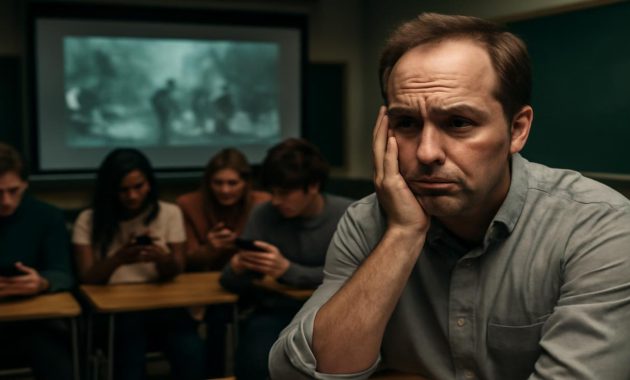
By the time the kid in the third row sighed loud enough to rattle the blinds, Ms. Alvarez had already counted twelve phones under desks, six blank stares, and one whispered, “How long is this, anyway?” On the screen at the front of the classroom, a gray sky was unfolding over a coastline, slow and patient, the kind of shot that used to make students lean in. Now, twenty-two minutes into a carefully chosen, critically acclaimed film, half the class looked like they were trapped on a long-haul flight with no Wi-Fi.
The moment the room gives up
It always starts the same way, teachers say. The room darkens, the projector hums to life, and for a few seconds, there’s a hush. The faces of fifteen- and sixteen‑year‑olds are briefly lit with the soft, flickering promise of another world. A landscape, a close‑up, a voiceover. A story is beginning.
Then, almost imperceptibly at first, the spell breaks.
Someone shifts in their chair. A backpack zipper whispers open. A phone screen glows under the desk like a firefly. The kid in the back yawns theatrically. Someone else checks the wall clock, twice. A hand goes up—not for a question about the scene, but to ask, “Is this going to be on the test?”
Ask around enough staff rooms, and you’ll hear a version of the same frustrated confession: some teachers can’t take it anymore. They don’t want to roll out the TV cart or click the projector on only to watch their students slowly slide into restlessness, boredom, or outright revolt. They remember when showing a movie was the ultimate classroom treat. Now, for many, it feels like walking into a storm your umbrella can’t handle.
“They can’t even watch a whole film,” one high school English teacher says, rubbing his temples as if the memory gives him a headache. “I mean it. Forty minutes in and they’re done. It’s like there’s a timer in their brains that goes off.”
It’s easy—too easy—to jump from there straight to diagnosis: attention spans are shot, kids are ruined by technology, everything is worse than it used to be. But if you stay in that dim classroom for a while, watching the small rituals of resistance and escape, another story starts to emerge, one that’s messier, more human, and uncomfortably familiar to any adult who’s ever half-watched a movie while scrolling on another device.
The slow scene versus the swipe
Watch a student watch a movie and you can almost see the negotiation happening behind their eyes. The scene lingers on a character’s face. Nothing “happens” for several beats. The teacher is still, quietly watching. The room is dark. Somewhere in a backpack, a notification buzzes like a mosquito.
When you live in a world where stories arrive in fifteen‑second bursts, a single unbroken shot can feel like a dare.
“I’m not saying they’re incapable of paying attention,” says a middle school history teacher who has largely given up on feature‑length films in class. “I’m saying the way we package stories now trains them to expect a different rhythm. When the movie doesn’t match that rhythm, they bounce.”
There’s something oddly physical about it—the way disengagement ripples down a row, how one shifting body loosens another, how a single phone out on a desk can trigger three more to appear, as if they’re all tethered by invisible string. Even the air changes: from warm, collective focus to a tense, restless hum.
Students describe it less like rebellion and more like a kind of itch.
“If I’m not doing anything with my hands, I start feeling weird,” one teenager explains. “Like, my brain is wandering, so I just…check something. I know I’m missing parts, but I feel like I can’t sit there and just watch.”
It’s tempting to label this as purely digital damage, but consider your own habits. How often do you watch a full movie at home without pausing, without checking your phone, without half-listening while doing something else? How long can you rest in a scene that doesn’t announce its significance right away?
In that sense, the classroom is less an exception and more a fluorescent‑lit mirror. The difference is that, for teachers, the reflection comes with thirty witnesses and a sinking feeling that something fundamental about learning—and about being with a story—is slipping away.
When “movie day” loses its magic
There was a time when rolling in the TV was greeted like a parade float. Students would whisper guesses about the film, trade theories about why they were “getting a movie,” and then settle in with the contentment of people who felt they were getting away with something academically sanctioned.
For many teachers, that memory still shapes why they turn to films at all. The right movie can expand a unit on the civil rights movement into something visceral and embodied; can turn abstract literary themes into faces, voices, and landscapes; can make a foreign language sound like music instead of a worksheet. At its best, a classroom film isn’t filler. It’s a doorway.
But doorways require people willing to walk through them.
“I’d plan for it,” one social studies teacher says. “Context, pre‑discussion, follow‑up activities. This wasn’t a free period. And they’d still ask, ‘Can we just skip to the battle scene?’ Or, ‘Can you summarize what happened so we don’t have to watch the whole thing?’ I started to dread it.”
It’s not that students hate movies. In fact, many of them devour films and shows outside of school. But there’s a strange dissonance between the stories they choose and the ones they’re asked to watch—an unspoken calculus of pacing, relevance, and emotional payoff that some classroom films don’t quite survive.
Even when the story is objectively gripping, school adds layers: the lights don’t fully go off, you’re surrounded by people who might judge your reactions, you might be quizzed on minor details later. The easy, immersive pleasure of movie‑watching at home is replaced by a self-conscious kind of viewing where attention has to compete with social performance and academic pressure.
In that environment, the first ten slow minutes of a film can feel less like a narrative choice and more like an obstacle course.
A table of tiny fractures
To understand why an uninterrupted two-hour film can feel overwhelming to so many students (and if we’re honest, adults), it helps to think less in terms of moral failure and more in terms of the dozens of small fractures in the way we experience time, story, and screens. None of these on their own doom a movie day. Together, they can quietly unravel it.
| Classroom Reality | Student Experience | Impact on Watching a Film |
|---|---|---|
| 90‑minute class period | Time sliced into bells, transitions, and tasks | A feature film rarely fits neatly, so viewing feels rushed or fragmented |
| Phones allowed or smuggled in | Constant pull of notifications and parallel conversations | Attention is split; key scenes dissolve into background noise |
| Assigned educational film | Feels imposed, with possible quiz or essay attached | Curiosity is replaced by calculation: “What do I need to know?” |
| Shared viewing with peers | Awareness of being seen reacting (or not reacting) | Emotional engagement can feel risky; sarcasm becomes safer |
| Traditional “press play and sit quietly” | Passive role, little sense of agency or purpose | Boredom creeps in; film feels like something to endure, not inhabit |
For teachers watching this unfold in real time, the emotional math is brutal. You spend hours choosing a just‑right film to deepen a unit. You advocate for its value to colleagues or administrators who might view films as lazy teaching. You imagine lively discussion afterward, connections made, perspectives widened.
Then the projector clicks on, the room darkens, and within half an hour, you’re whisper‑walking the aisles, gently tapping desks, making eye contact in the glow of half‑hidden screens, feeling not just disrespected but something more private and painful: the sense that what you love—a good story unfolding at its own pace—no longer lands the way it once did.
It’s not just the kids
There’s another layer to this that doesn’t get talked about much in the staff room: some teachers can’t sit still for a whole movie anymore either. They, too, find their fingers twitching toward their pockets during a slow scene. They, too, pause films at home to check an email, browse recipes, or skim headlines. They, too, have adjusted to a digital world that values presence everywhere and attention nowhere in particular.
So when a student whispers, “Can we skip this part?” it can trigger a complicated mix of irritation, recognition, and guilt.
“I get it,” admits one veteran teacher. “I really do. Long, quiet scenes are harder for me, too, than they used to be. But part of what I’m trying to teach is how to stay with something. How to let tension build. How to be patient with a story. How to be bored, even, and see what comes out of that. If we give up on that entirely, what are we losing?”
That question hangs over countless classrooms like a second projection: invisible, but intensely felt.
Because movies in school aren’t just content delivery systems. They’re opportunities to practice different kinds of seeing and feeling. To sit with ambiguity. To notice how a character’s silence can say more than a monologue. To feel history not as bullet points on a slide, but as a trembling hand reaching for a doorknob in a hallway that suddenly feels dangerously narrow.
When those opportunities slide past glazed eyes, it’s not just a lesson plan that breaks a little. It’s a belief that we can still gather in a room, turn toward a shared story, and surrender, together, to its unfolding.
Can we learn to watch again?
There’s a scene that one literature teacher keeps returning to, even though she’s stopped showing the full movie. In it, two characters sit on a porch at dusk. Not much is said. Crickets hum. The camera holds steady.
“Every time, without fail,” she says, “that’s the moment they start to fidget. But it’s also the moment that cracks the whole story open. You see everything in their faces. The history, the regret, the love they can’t name. If they can’t stay for that, they miss the point.”
So she tried something different. Instead of pressing play and hoping for the best, she paused the film just before that porch scene. She told the class, “Okay, this next part is going to feel slow. I want you to notice what the film does with silence. With light. With the way people look at each other instead of talking. You might be tempted to drift. See if you can stay with it.”
The effect wasn’t magical. Some students still squirmed. But afterward, they had words for what they had seen. They noticed the way the shadows lengthened across the porch. The way one character’s fingers tightened imperceptibly around a glass. The way a long pause made a simple line of dialogue feel like a confession.
“It was like giving them permission to find it hard,” she reflects. “And then inviting them to do it anyway.”
In classrooms where films still work, you often find not just a careful choice of movie, but an intentional choreography: breaking a film into purposeful segments, giving students roles—image tracker, sound watcher, character observer—so they have a reason to lean in. Allowing brief pauses for breathing and jotting notes before diving back in. Framing the act of watching not as passive consumption but as a kind of quiet labor.
This doesn’t fix everything. There will still be the kid in the third row who can’t resist the buzz in their backpack. There will still be days when even the most beautifully crafted scene can’t compete with the drama unfolding in a group chat. But slowly, stubbornly, it can shift the tone from “You have to sit through this” to “We’re going to try watching differently, together.”
What teachers are really tired of
When teachers say they can’t take it anymore, they’re not just talking about one ruined movie day. They’re naming a deeper fatigue with always having to out‑entertain, out‑stimulate, out‑pace a world of infinite, glowing distractions.
They’re tired of being told to add more clips, more animations, more gamification, as if the only way to reach young people is to mimic the speed and sparkle of the platforms engineered to hijack their attention in the first place. They’re tired of hearing that if students are bored, it’s automatically a failure of teaching, not a symptom of larger cultural forces.
Most of all, they’re tired of feeling like they’re asking for something unreasonable when they ask students to stay with a story for longer than a scroll, a swipe, or a skit.
Because beneath the classroom anecdotes and eye rolls is a quiet, stubborn conviction: that the ability to follow a long, unfolding narrative is not just a quaint, old‑fashioned skill. It’s part of how we learn to inhabit lives other than our own, to understand cause and effect, to tolerate uncertainty, to make sense of a world that rarely resolves itself in thirty seconds or fewer.
In a culture that prizes instant reaction, the act of giving your full attention to a full story starts to look, almost, like resistance.
What happens if we stop pressing play?
There are teachers who, out of sheer exhaustion, have sworn off films entirely. It feels simpler, they say, to stick to shorter clips or printouts or discussions. The risk of losing the room so dramatically is too high. The disappointment weighs too much.
Yet each time a classroom gives up on long‑form watching, something small goes missing from the ecology of learning in that building. Another space where students might have stretched their attention just a little farther disappears. Another chance to sit, collectively, in the dark—not in passive stupor, but in a shared act of looking—fades from the calendar.
Maybe the answer isn’t to romanticize the golden age of movie days or to resign ourselves to a future of nothing longer than ten minutes. Maybe it’s to tell the truth, out loud, to the kids themselves: that watching a whole film in a world built to shatter your focus is hard. That your teachers sometimes struggle with it, too. That this isn’t about blaming phones or glorifying the past, but about practicing a different way of existing in time together.
Imagine the scene: the lights dim, the projector whirs, and instead of simply commanding, “No phones, eyes on the screen,” a teacher says quietly, “This is two hours. It’s going to feel long. There will be slow parts. That’s where it asks the most of you. Let’s see what happens if we stay.”
Some students will roll their eyes. Some will still sneak glances into their laps. But a few might notice, for the first time in a long while, what it feels like to be fully inside a scene—a face, a line of dialogue, a gust of wind in tall grass—and not darting restlessly toward the next thing.
In the end, the story here isn’t simply that students can’t watch a whole film anymore and that teachers are fed up. It’s that we are all living through a shift in how we attend to the world, and classrooms are where that shift becomes painfully, beautifully visible.
The question is not whether kids are broken or teachers are outdated. It’s whether, in those dim, humming rooms, we can still carve out pockets of time where a story is allowed to unfold at its own pace, and where staying with it—through silence, through slowness, through the urge to look away—becomes part of what it means to be educated at all.
Frequently Asked Questions
Why do students struggle to watch a full film in class today?
Many students live in a media environment built around short, fast content—clips, reels, and rapid‑fire videos. A feature film, especially one that unfolds slowly, can feel unusually long and demanding by comparison. Social pressures in the classroom, the presence of phones, and the sense that it’s “for school” rather than for pleasure all add to the difficulty.
Is this just a problem with attention spans?
It’s partly about attention, but not only that. It’s also about habits, expectations, and context. Students are used to interactive, personalized media they can control. A shared, linear film with no pause or skip button feels different. The school setting, with its assessments and peer scrutiny, can further reduce their willingness to engage deeply.
Are teachers overreacting when they say they “can’t take it anymore”?
The frustration is real. Teachers invest time and hope in selecting films that can illuminate complex topics or spark empathy. When students disengage quickly, it can feel like a rejection not only of the material but of the teacher’s effort and values. It’s less overreaction and more accumulated exhaustion from constantly battling for students’ attention.
Should schools stop using full‑length films in lessons?
Not necessarily. Full‑length films can still be powerful teaching tools when used intentionally—framed carefully, broken into meaningful segments, and paired with active viewing strategies. Abandoning them entirely risks losing a valuable way to explore narrative, history, ethics, and emotion in depth.
What can help students stay engaged during a movie in class?
Practical strategies include preparing students for slow or quiet scenes, giving them specific things to watch for, pausing briefly for reflection, reducing phone access during viewing, and connecting the film clearly to their own questions and experiences. Treating watching as an active, shared practice rather than passive “time off” can make a significant difference.