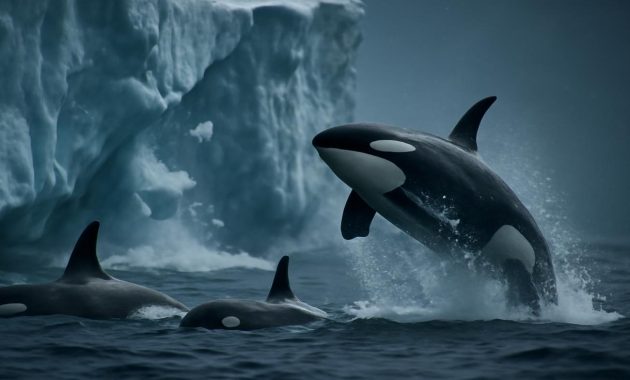
The crack comes first as a sound, not a sight. A pistol-shot echo ricochets across the bay, clean and sharp enough to slice the air itself. Every head on the research vessel snaps toward the white glare of the sea ice, where a long, dark fracture has just stitched its way across the surface like a lightning bolt. A second later, a black dorsal fin scythes through the water only meters from the new break, tall as a banner, glossy with meltwater. Someone on deck whispers, “They’re too close.”
When the Ice Remembers a Different Ocean
The orcas arrive on a low tide of silence, almost ghostly in their calm. There are five of them—a matriarch, a bulky male with a fin like a jagged sail, and three younger whales that weave in and out of the adults’ shadows. They travel in a loose arc along the edge of the sea ice, surfacing with the rhythm of practiced choreography: breath, glide, vanish.
From the deck, the air tastes of metal and salt. The wind presses cold fingers into every gap in your jacket. The ice shelf, which once stretched almost to the horizon, is now fractured, softened, scalloped around the edges like something left too long in the sun. These aren’t the crisp, vertical walls you see in old expedition photos; they’re slumped, slushy, and veined with melt pools the color of watered-down cobalt.
“Ten years ago,” says Marina López, a marine ecologist who has spent more seasons in polar waters than she can easily count, “those whales wouldn’t have been anywhere near this spot. Too much solid ice. Too dangerous. Too loud.” Her voice carries just enough over the wind. “Now? The ice is retreating, and the water is opening like a new highway.”
It’s not just that the orcas are here. It’s where they are—hugging the jagged, unstable lip of ice that scientists have been monitoring nervously for months. The ice is sloughing off in chunks the size of trucks, sometimes with no warning at all. And still, the whales sweep in tight, carving crescents through water that’s flecked with brash ice, the little shards clinking together with the soft, brittle sound of broken glass tumbling in waves.
Predators on a Thinning Edge
Orcas are not timid animals. In most oceans, they are the quiet tyrants of the food web: deliberate, strategic, endlessly curious. But there has always been a kind of unwritten truce between them and the thickest polar ice, that unforgiving ceiling of frozen ocean that can turn air into death for an animal that must breathe.
Now the truce is breaking down.
“They’re pushing the envelope,” says López, binoculars locked on the matriarch. “They know where the ice is thinning. They can feel it. They’re using the chaos to hunt.”
Far ahead, a lone seal is curled like a comma on a crumbling floe, its fur the color of old parchment. The floe is no bigger than a pickup truck and looks like it’s been chewed from all sides. The orcas fan out, black and white specters in a widening arc. They surface silently, exhale in quick huffs that dissolve into mist, then vanish again. The water around the floe begins to shudder.
Anyone who’s watched the famous “wave-washing” footage—where Antarctic orcas work together to knock seals from ice—knows the method. But here the script is changing. The ice itself is already half-gone. The floe lurches, not from the whales’ effort, but from the invisible melting below, from distant swells now reaching places they once could not.
“That’s the problem,” murmurs López. “The ice is no longer a constant. It isn’t a platform; it’s a trapdoor.” The seal seems to sense it too. It lifts its head, eyes wide, nostrils flaring. The orcas surge in a coordinated rush, sending a low wave that tips the floe like a platter. The seal slips. There is a brief, thrashing scramble. Then, only red threads in the wake, unwinding across the gray-green water.
To a hungry predator, a fragmented ice field is opportunity. To the scientists watching, it’s something closer to a warning flare.
Ice, Orcas, and an Unseen Tipping Point
Back inside the cramped, humming lab of the vessel, monitors glow with graphs and maps—a quiet, digital storm of data. Lines trend upward and downward in ways that have become a kind of language on their own: ice thickness shrinking, surface temperatures rising, the seasonal window of open water peeling wider each year.
On one screen, a satellite image shows the coastline in false-color. Once-solid expanses of sea ice look like shattered porcelain, splinters drifting away from land. The place where the orcas were just hunting glows in a sickly, swirling blend of blue and white, where ocean and ice are no longer cleanly separated.
“We used to talk about ‘ice edges’ as if they were neat borders,” says Dr. Kaito Tan, a cryosphere specialist whose hands are always cold from constantly handling ice cores and metal tools. “Now, it’s all gradients. Half-ice. Slush. Rotting floes. Our models weren’t built for this kind of in-between.”
The research team has been tracking orca movements via acoustic recorders anchored to the seafloor, eavesdropping on their clicks and whistles. Over the last five years, the data has traced a steady drift of orca presence closer and closer to sections of ice sheet that glaciologists describe, with uneasy restraint, as “structurally compromised.” In less clinical language: at risk of collapsing.
“The orcas are telling us something,” Tan says, gesturing to a cluster of dots on a map—each representing a recorded sighting or sound. “They’re finding new routes, new hunting grounds along these vulnerable seams. But for them to be here, the ice has to be failing first.”
He pauses, then adds quietly, “Predators are following the fracture lines of a warming world.”
In the past, the presence of orcas this close to the glacial face would have been a rare spectacle, a story carried back to port as a curiosity. Now it’s a pattern. Longer seasons of open water mean more time for orcas to explore, hunt, and learn the idiosyncrasies of a shifting coast. It also means more stress for ice that once relied on the insulation of long, unbroken winters.
What the Whales Are Really Chasing
Of course, from the whales’ perspective, it’s simple: food. New hunting corridors mean access to seals and fish that used to be safely tucked behind frozen barriers. As seasonal ice retreat accelerates and multiyear ice disappears, entire neighborhoods of the Arctic and Antarctic are being redrawn under their fins.
But layered into that simplicity is a chain reaction that reads like a climate domino effect. Less ice cover means darker ocean absorbing more heat instead of reflecting sunlight. Warmer water eats away at the ice from below. Thinner ice breaks more easily under the weight of snow, under the strain of tides, under the relentless push and pull of storms.
“What worries me most,” says López, “is that we’re watching behavior adapt in real time, faster than policies, faster than our models, faster than our response.” She glances back toward the open door, where the distant exhale of an orca’s breath can still sometimes be heard over the engines. “The whales will survive this longer than the ice will. The question is: what else won’t?”
Science in the Swirl of Melt and Mist
Out on deck again, the afternoon light turns watery and diffuse, filtered through low, bruised clouds. Snowflakes drift sideways, almost apologetic, melting as soon as they land on exposed skin. The ice face in front of the vessel looms—towering, scalloped, alive with tiny, constant movement. Meltwater rivers carve glistening blue veins down its sides, vanishing in sudden holes that gurgle ominously.
The team’s instruments click and whir. A drone lifts off, its small rotors whining as it angles toward the fractured ice, camera trained on the jumbled, treacherous interface where white gives way to liquid darkness. Hydrophones dangle from cables into the water, listening to the underwater chorus: the ping of glacier cracks, the distant grinding of ice, and, threading through it all, the conversational murmurs of orcas.
On a clipboard, someone has drawn an impromptu tally: Icequakes today: 14. Orca passes within 100 m: 9. It’s a small snapshot of a much larger story, but even in miniature, a pattern emerges—the whales and the breaking ice always arriving together, each one echoing the movements of the other.
In the cramped galley later, over steaming mugs that smell like burnt coffee and powdered milk, the conversation swings between the deeply technical and the deeply human.
“We keep talking about thresholds,” says Tan, cupping his hands around the mug. “But thresholds rarely look dramatic from up close. It’s subtle. More days of open water. More storms reaching further poleward. More predators exploring new boundaries. Then one season, you realize the old normal is gone.”
Across the table, López flips through photos on a tablet: drones-eye views of orcas threading their way through labyrinths of broken floes. The images are stunning in the way that tragedies often are—sharp blacks and whites set against luminous, dissolving blue.
“These will end up in reports,” she says. “In talks. In classrooms. Maybe on someone’s wall. But what they really are is a record of a vanishing border.”
A Shifting Map of Risk
For orcas, that vanishing border is a frontier of opportunity and danger. Collapsing ice shelves can send tsunamis of white and turquoise crashing into the sea, powerful enough to overturn small boats and stun marine life. Massive calving events can suddenly imprison whales in ice-choked cul-de-sacs of water, their only exit sealed by drifting chunks overnight.
“They’re gambling,” says López. “They gain access to prey, but they’re also threading through places that can change from navigable to lethal in a single tide cycle.”
The scientists have begun mapping these tightropes of risk—zones where thinning ice and increased whale activity overlap. Early results suggest these hotspots are growing, both in size and in duration. Where once a narrow channel might open for a few days in late summer, some now persist for weeks, even months, tempting both predators and the prey that cling to the last remaining ice.
The implications stretch beyond orcas and seals. The under-ice ecosystems, from algae to krill, are tuned to the rhythm of light and dark, freeze and thaw. As the timing of ice breakup stutters and shifts, entire food webs have to recalibrate or collapse. And all the while, the black fins keep circling, following opportunity through the cracks.
Signals from the Edge: What the Data Shows
On the wall of the lab, a simple printout offers a stark, almost brutal clarity. It’s a table of observations compiled from multiple expeditions over recent years—an attempt to pin down, in numbers, what the crew feels in their bones.
| Year Range | Average Ice Season Length | Orca Sightings Near Collapsing Ice* | Notable Changes |
|---|---|---|---|
| 2000–2005 | Long, stable; ice edge far offshore | Rare, mostly anecdotal | Limited access routes for orcas |
| 2006–2012 | Noticeable shortening of ice cover | Occasional, tied to warm years | First documented “risky” hunts near fragile floes |
| 2013–2018 | Earlier breakup, later freeze-up | Regular seasonal occurrences | Expansion of orca range toward glacial fronts |
| 2019–Present | Markedly shorter, with unstable shoulder seasons | Frequent, some within meters of major fractures | Behavioral shifts, new hunting strategies near failing ice |
| *“Near collapsing ice” refers to areas with documented structural instability, rapid melt, or active calving events. | |||
Each row is a small, sobering time capsule. The rise in orca sightings hugging dangerous ice isn’t just anecdotal field gossip; it’s measurable. And as the entries creep closer to the present, you can almost feel the tempo quickening.
“We like to think of climate change as background,” says Tan. “A backdrop on which biology plays out. But here, the backdrop is actively rearranging the stage. The orcas are improvising. The ice is disintegrating. And we are, frankly, just trying to keep up.”
Listening for the Future in Orca Echoes
The hydrophones don’t lie. In the crackling, eerie recordings that the team pores over at night, the whales’ calls bounce off the underbellies of thinning floes and hollowed-out shelves. Subtle changes in echo patterns hint at cavities where there used to be solid ice. Caverns. Tunnels. Weak points.
Some researchers now talk seriously about using orcas as inadvertent surveyors—living sonar devices whose movements and calls can help map sub-ice topography and structural change. If the whales begin to favor certain newly opened channels year after year, it may be because those corridors are widening, deepening, becoming more reliable. In other words: the ice there is dying faster.
“That’s the bittersweet part,” López says. “The behavior that excites us scientifically is often the same behavior that signals loss.”
Alarm Bells in Black and White
At dusk, the sky bleeds into a kind of indistinct gray, neither day nor night, as if the world has been smudged at the edges. The orcas are still there, their blows now ghostly in the dim light, rising in brief, white plumes that dissolve into the growing chill. Every so often, a chunk of ice peels away from the face with a deep, concussive roar, crashing into the sea in a blossom of froth and shattered blue.
The whales hardly flinch. They navigate through the chaos with an ease that is almost unnerving, pivoting around icebergs, slipping between ridges, vanishing into newly opened pools. Their presence is both thrilling and, to those who understand the context, quietly terrifying.
Researchers have started using phrases like “ecological alarm system” to describe what’s happening here. Not because the orcas are trying to warn anyone, but because their choices are readable signs—living indicators of where and how the frozen parts of the planet are coming undone.
“When apex predators rewrite their playbook,” says Tan, standing at the rail, his breath a thin cloud in the cold, “it means the rules of the entire ecosystem are changing. And when those changes are tied to ice collapse, it’s not just a polar story. It’s a planetary one.”
Collapsing ice shelves and thinning sea ice are intimately connected to sea-level rise, to altered ocean currents, to weather patterns that decide the fate of crops and coastlines thousands of kilometers away. The orcas, spinning their sleek arcs along the disintegrating edge, are weaving themselves into that story whether we’re ready or not.
What We Choose to Hear
In the end, the scene is deceptively simple. A pod of whales hunts along the rim of a bright, wounded world. Ice falls. Water churns. Snow flutters down and vanishes on contact with the sea. It could be mistaken for something timeless, a wild tableau playing out as it has for millennia.
But the researchers on this ship know better. They carry, in their hard drives and notebooks, the evidence that this is not just nature as usual. It is nature mid-pivot, forced into improvisation by a warming atmosphere and an ocean absorbing the excess.
As the vessel’s lights blink on and the sky fades to a soft, colorless dark, an orca surfaces startlingly close—so near you can see the fine spray beading along the smooth arc of its back, hear the wet slap of its tail as it dives. For a moment, there is a sense of shared presence, a fragile overlap between worlds. Then the whale is gone, and only the ripples remain, spreading outward until they merge with the restless skin of the sea.
In the quiet that follows, the alarms are not sirens or bells, but data points and dorsal fins, ice fractures and echoes in the dark water. The question is whether we will treat them as background noise—or as the urgent signals they are.
Frequently Asked Questions
Why are orcas moving closer to collapsing ice?
Orcas are following opportunity. As sea ice thins and retreats, new channels and hunting grounds open up along glacial fronts and unstable ice edges. These areas often hold seals and other prey that once found safety on thick, stable ice. The whales are adapting quickly to these new conditions, using their intelligence and cooperative hunting strategies to exploit the changing landscape.
Is this behavior dangerous for the orcas themselves?
Yes, it can be. Collapsing ice shelves and calving events create powerful waves and sudden ice movements that can trap or injure whales. Narrow leads of open water can close unexpectedly as winds and currents shift floating ice. While orcas are highly skilled navigators, they are increasingly operating in zones where conditions can turn hazardous within hours.
What does orca behavior tell scientists about climate change?
Shifts in orca distribution and hunting patterns act as biological indicators of environmental change. When orcas consistently appear in areas that were previously inaccessible due to thick ice, it suggests that the ice is thinning, breaking up earlier, or retreating faster. Their movements, combined with acoustic and satellite data, help scientists map where and how quickly ice is degrading.
How does collapsing ice affect global sea levels?
Sea ice itself, because it already floats, doesn’t significantly raise sea level when it melts. However, many of the collapsing ice shelves and outlet glaciers that orcas are now approaching buttress larger ice sheets on land. When these supports weaken or fail, land-based ice can flow more rapidly into the ocean, contributing to long-term sea-level rise that affects coastlines worldwide.
Can anything be done to slow these changes?
At the broadest scale, slowing the loss of sea and glacial ice requires reducing greenhouse gas emissions to limit further warming. Locally, improved monitoring, protected areas, and strict regulation of shipping and industrial activity in polar regions can reduce added stress on already fragile ecosystems. While orcas will continue to adapt as best they can, the pace and severity of change are ultimately tied to human decisions far from the ice edge.