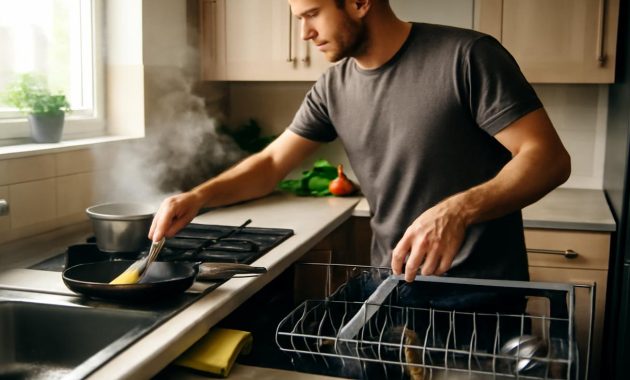
The first time you notice it, you’re not thinking about psychology at all. You’re standing in a warm kitchen that smells faintly of garlic and toasted cumin. A pot simmers on the stove. Someone you love—or maybe someone you’ve just met—is moving with quiet, almost choreographed precision. They stir the sauce, nudge the flame lower, slide the cutting board toward the sink, and with their free hand, sweep onion skins into the compost. A sponge appears. The counter gleams. Somehow, they are cooking an entire dinner, carrying on a conversation, and leaving almost no trace of chaos behind. By the time the food hits the table, the kitchen looks… surprisingly calm.
Maybe you’re one of these people. Maybe you’re not. Maybe you’re the kind of cook who surveys the kitchen afterward like an archaeologist of your own disaster: streaks of tomato on the cabinet, a leaning tower of pans, flour on your shirt, a spoon somehow in the plant.
Yet psychologists have been quietly fascinated by that first group—the ones who wash the knife after using it once, who return the spice jar to its exact place before moving on, who wipe the counter on autopilot while water boils. This isn’t only about neatness. When researchers dig a little deeper, they keep discovering the same pattern: people who clean as they cook tend to share a cluster of distinctive traits that ripple far beyond the kitchen walls.
The Invisible Choreography of the “Clean-As-You-Go” Mind
To watch someone who cleans as they cook is to watch a mind that naturally thinks in loops, not lines. They don’t just see the next step in the recipe; they see five steps ahead, all the little messes that could accumulate, the bottlenecks that might slow them down. It’s less about being obsessively tidy and more about living in a state of gentle, continuous course-correction.
Psychologists call this “proactive control”—the ability to manage tasks and environments before they become overwhelming. Instead of waiting until the kitchen looks like a culinary crime scene, these cooks make micro-adjustments: rinsing a bowl in the lull between stirrings, stacking ingredients in the same direction, returning the oil to its shelf before the next chop.
What’s striking is how often this quiet habit in the kitchen mirrors a deeper pattern of personality. Research into everyday routines shows that the people who naturally maintain order in motion—cleaning mid-task rather than post-task—tend to score high on traits like conscientiousness, self-regulation, and future-orientation. The kitchen just happens to be where you can see it most clearly.
Trait 1: A Deep, Almost Physical Sense of Responsibility
For these cooks, mess is not just an eyesore; it’s a promise they feel bound to keep. The pot they just used carries a subtle weight in their mind the moment it leaves the burner. A used knife is not just “dirty”; it’s a future obligation sitting quietly on the counter. Many of them will tell you: it’s not that they love cleaning—they simply dislike the feeling of owing something to the space they live in.
Psychologically, this maps onto a strong internal locus of control. They move through life assuming, “If something is out of order here, I’m at least partly responsible for setting it right.” When they spill flour, they don’t look around for somebody else to handle it later. Their first impulse is to grab a cloth. In relationships, this often shows up as reliability: paying the bill on time, showing up when they say they will, remembering the small favors they offered weeks ago.
In other words, the person who rinses the cutting board between vegetables is often the same one who quietly keeps family logistics from unraveling—and who feels strangely restless if they leave loose ends untied.
Trait 2: High Conscientiousness with a Gentle Edge
If you could sit inside their mind while they cook, you might hear a soft internal narration: Okay, the onions are in, I have three minutes before they brown, that’s enough time to rinse this bowl and put away the knife. This isn’t anxiety; it’s order. Tasks line up in their mental hallway, and they usher them through, one by one, never letting the doorway get too crowded.
Psychologists would say these people score high on conscientiousness: they’re organized, disciplined, and oriented toward follow-through. But here’s the subtle part: for many “clean-as-you-go” cooks, that conscientiousness is balanced by flexibility. They’re not scrubbing the blender in a panic. They’re weaving small acts of maintenance into the rhythm of cooking, almost like a background melody.
This blending of structure and ease is why sharing a kitchen with them often feels strangely calming. Their movements tell your nervous system, “We’ve got time. We’re on top of this.” They’re not just controlling the environment; they’re regulating the emotional climate.
The Quiet Art of Managing Stress Before It Arrives
The kitchen is one of the most revealing stress laboratories in the home. Time pressure, heat, sharp objects, unexpected problems—everything is there. The way someone handles that bubbling stew of micro-stressors says a lot about their inner landscape.
People who clean as they cook are, in a way, running a private stress-prevention campaign. Each wiped counter is a tiny reduction in visual noise. Each rinsed pan is a future argument with themselves they don’t have to have. Their brain understands, often without words: End-of-task chaos is heavier than mid-task maintenance.
Trait 3: Anticipatory Thinking and Micro-Planning
Cooking while cleaning requires a mental skill called “prospective cognition”—the ability to imagine the future and adjust the present accordingly. As they sauté and season, these cooks are constantly running quick simulations: If I leave this here, what happens later? They don’t just see the sauce; they see the sink that will be full if they let it be.
This trait shows up elsewhere in their lives: they pack chargers before trips without being asked, refill the gas the day before the commute, set alarms with a margin of error. They’re the ones who seem “lucky” because things rarely catch them completely off guard. But what looks like luck is usually the quiet habit of asking, “What will future-me thank present-me for?”
In relationships, this anticipatory way of thinking can be profoundly caring. A person who tidies while they cook is often the same person who knows you’ll be tired after your flight and leaves a clean bed and a glass of water by the nightstand. Their planning is rarely grand; it’s made of small gestures that accumulate into a feeling of being looked after.
Trait 4: Stress Regulation Through Environment Shaping
There’s a growing body of research suggesting that cluttered environments subtly raise stress hormones and drain cognitive energy. Many people feel this only after the fact—when they walk into the disaster-zone kitchen later and feel their shoulders rise toward their ears.
But the clean-as-you-go cook senses it sooner, almost like they have an emotional barometer calibrated to visual noise. The half-emptied packages, the sticky spoon, the splattered stove: these aren’t just objects; they’re future spikes in overwhelm. So they reduce them as they go, keeping the emotional weather mild and predictable.
This is what psychologists call “situation modification”—instead of fighting stress once it arrives, they alter the surroundings to keep stress from building in the first place. You see the same instinct when they dim harsh lights at night, choose a quieter route home, or answer difficult emails early in the day. They’re not avoiding life; they’re shaping it into something they can move through without drowning.
Present, Focused, and Strangely Grounded
If you watch someone who cleans as they cook, there’s something almost meditative about the way they move. They’re not glancing at their phone every ten seconds or abandoning the stove to check another tab on their laptop. Instead, they occupy the kitchen fully, treating the act of rinsing a bowl with the same quiet attention as tasting the soup.
Trait 5: Strong Attentional Control and Task Switching
Cooking demands a ballet of divided attention: heat levels, chopping techniques, seasoning choices, timing. Adding cleaning to the mix might sound like a recipe for overwhelm, but for these people, it’s the opposite. Their brains are particularly good at what psychologists call “task-switching”: moving attention smoothly between related activities without losing the thread.
They’re not trying to do ten unrelated things at once; they’re toggling between micro-tasks that all serve the same purpose—bringing a meal into the world without letting the space unravel.
In work and study, this can look like a talent for managing complex projects: answering a quick email while a file uploads, sorting paperwork between meetings, clearing their desk in the pause between calls. Not in a frantic flurry, but with a grounded sense of flow. Their attention is like a lens that can zoom wide to see the whole meal and narrow to focus on a stubborn bit of sauce on the pan.
Trait 6: Mindfulness in Motion
There’s another layer here that’s subtler. Many clean-as-you-go cooks are not aware of thinking about cleaning—or even of “trying” to be mindful. Yet their behavior resembles what mindfulness teachers often describe: being fully present with whatever your hands are doing.
They may notice the temperature of the water, the sound of the knife tapping the cutting board, the satisfying slide of a clean pan back onto its hook. These sensations are their own quiet reward. The kitchen becomes less a factory and more a small world where each motion has meaning.
This everyday mindfulness can buffer against rumination and worry. When your nervous system learns to settle into simple physical tasks—wiping, rinsing, stacking—it gets practice at letting go of spiraling thoughts. That doesn’t mean these people never overthink; it means they have built-in rituals that pull them gently back into their bodies.
The Social Echo of a Tidy Stove
It’s tempting to see kitchen habits as purely private quirks. But everyone who has ever shared a small apartment, a family home, or a student flat knows: kitchens are emotional ecosystems. The way one person behaves at the sink can change the atmosphere of the entire house.
So it’s no surprise that the psychology of cleaning-while-cooking doesn’t stop at the self. It spills into how these people see others, how they communicate, what they expect, and what they quietly offer.
Trait 7: Consideration and Unspoken Cooperation
Ask someone who cleans as they cook why they do it, and a surprising number will say something like, “I just don’t want anyone else to have to deal with the disaster later.” There is an underlying awareness that the kitchen is a shared space, even if they live alone. Future guests, future partners, future selves—they all count as “others” they’re trying not to burden.
This reflects a form of social conscientiousness: they see their actions as part of a larger chain of effects. The same person who would never leave a mountain of dishes is often the same person who stacks their plates neatly at a restaurant, answers messages they don’t strictly “have to,” and notices when someone else looks overloaded.
In everyday life, they may be the quiet organizers of group trips, the ones who remember who’s allergic to what, who washes the mugs in the office kitchen without announcing it. Their nurturing doesn’t always come through big speeches or grand displays. It’s in the way they leave spaces a little easier for the next person.
Trait 8: A Subtle Blend of Boundaries and Standards
Yet this care for others doesn’t mean they’ll tolerate chaos indefinitely. People who habitually clean as they cook often carry an internal standard for how a shared space should feel. When that standard is repeatedly violated, it can stir irritation or quiet withdrawal.
Psychologically, this is where we see the interplay of agreeableness and healthy boundaries. They’re willing to do more than their “share” up to a point—especially if it keeps the environment peaceful. But if they feel taken for granted, their patience thins. You might hear them say, “I don’t mind cleaning, but I need to feel like we’re a team.”
This is a valuable clue: just because they’re the neat one doesn’t mean they’re naturally controlling or martyr-like. Often, they’re simply the first to act on something everyone else senses but ignores: that a calmer kitchen makes life better. Their standards aren’t an attack; they’re an invitation into shared care.
A Snapshot of the “Clean-As-You-Cook” Personality
Of course, no single habit can define a person. But when psychologists step back and look at patterns, some consistencies emerge. People who clean as they cook frequently show a recognizable emotional and cognitive profile—one that can be surprisingly useful to understand, especially if you live with one… or are one.
| Observed Kitchen Habit | Underlying Psychological Trait |
|---|---|
| Washing dishes or tools between recipe steps | High conscientiousness and follow-through |
| Putting ingredients away immediately after use | Anticipatory thinking and future-orientation |
| Wiping counters during idle cooking moments | Stress regulation through environmental control |
| Keeping tools and surfaces organized mid-cook | Strong attentional control and task-switching |
| Leaving minimal mess for others to handle | Consideration, empathy, and cooperative mindset |
What If You’re the “Hurricane Cook” Instead?
All of this can sound uncomfortably like a value judgment, as if the people who clean as they cook are more disciplined, more caring, more mature. But psychology is rarely that simple. Messy cooks often bring their own valuable traits to the table: spontaneity, creative risk-taking, a tolerance for uncertainty that can lead to surprising new dishes—and, elsewhere in life, surprising new ideas.
If you tend toward “I’ll clean it all at the end,” it doesn’t mean you lack these eight traits; it may just mean they’re expressed differently. Maybe your anticipatory thinking shows up in your work, not your sink. Maybe your stress regulation is internal rather than environmental. Maybe you were raised in a household where the kitchen was rushed and chaotic, and you’re still unwinding from that script.
The interesting question is not, “Am I good or bad?” but “What happens to me—emotionally, mentally—when I try on this other rhythm?” When you pause mid-recipe to rinse the knife, how does your body feel? When you leave flour on the counter “for later,” what story does your brain tell yourself about what kind of person you are?
Because behind the soap and the sponge, there’s something more tender at work: the way we relate to ourselves in the middle of a task, not just at the end of it. Cleaning as you cook can be an act of self-kindness—protecting your future self from overwhelm. But so can letting the pans soak while you rest your tired feet after dinner, refusing to turn every moment into a productivity test.
In that sense, the kitchen becomes a mirror. Each chop, stir, rinse, and wipe reflects not just how we handle ingredients, but how we handle time, pressure, responsibility, and care. Whether you’re the one wiping the counter before the sauce is done or the one dancing through a joyful wreck of a kitchen, there’s value in noticing the pattern—and, maybe, gently experimenting with another way.
The next time you cook, watch yourself as if you were a character in a nature documentary: how do you move, anticipate, tidy or accumulate? Where does your attention rest? How do you take care of the space that’s taking care of you? Somewhere in that small domestic ritual lies a map of how you walk through the rest of your life.
FAQ
Is cleaning as you cook always a sign of being more organized in life?
Not always. It often overlaps with traits like conscientiousness and planning, but people can be very organized in work or study and still chaotic in the kitchen. Habit, upbringing, and how much someone values cooking all play a role.
Can someone learn to become a “clean-as-you-go” cook, or is it purely personality?
It’s a mix. Personality influences what feels natural, but habits are highly trainable. Many people become cleaner cooks simply by setting small rules, like always rinsing tools before starting the next step, or keeping a bowl for scraps nearby.
Does cleaning while cooking mean a person is more anxious?
It can, but not necessarily. For some, it’s about control driven by anxiety; for others, it’s about preventing stress and creating calm. The emotional tone matters: if it feels panicked or compulsive, anxiety might be involved; if it feels steady and soothing, it’s more about regulation.
What if partners have totally different cooking and cleaning styles?
This is common. Talking about expectations outside of the heat of the moment helps—deciding who handles what, or trading off: one cooks, one cleans. Understanding that these habits reflect deeper traits and comfort levels can make the conversation less personal and more collaborative.
Is there any psychological benefit to leaving the mess and cleaning later?
For some people, yes. It can be a way to protect creativity and flow, focusing fully on cooking first. As long as the cleanup does happen and doesn’t cause long-term stress or conflict, separating the two tasks can feel liberating rather than irresponsible.