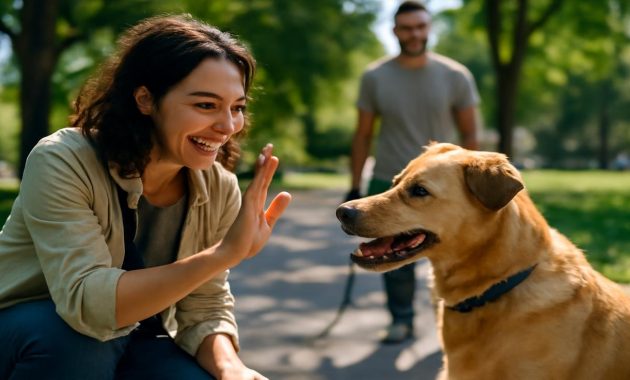
The woman in the yellow raincoat doesn’t see me watching her. She’s standing at a crosswalk on a drizzly Tuesday, grocery bag on one wrist, phone in the other hand, when a terrier trotts past on a taut red leash. Something bright flickers across her face. She lifts her fingers, almost shyly, and gives the dog a tiny wave, like she’s greeting a neighbor she hasn’t met yet.
The terrier doesn’t wave back, of course. He sniffs a lamppost, shakes the raindrops from his ears, and moves on with his human. The light turns green. The woman lowers her hand, glances around to see if anyone noticed, and walks across the street with a small, private smile.
If this scene feels familiar, that’s because it probably is. Maybe you’ve been the person in the yellow raincoat. Maybe you’re the one who literally says, “Hi, dog,” to unfamiliar pups in the street, or who wiggles your fingers from across a café patio hoping for a tail wag in your direction. It can feel like a harmless quirk, a tiny burst of joy in the middle of a busy day.
But psychologists will tell you something intriguing: that tiny wave at a stranger’s dog isn’t random. It tends to travel with a specific constellation of personality traits—subtle patterns in how we relate to the world, to other people, and yes, to the animals who share our sidewalks.
The Tiny Gesture That Says More Than You Think
You don’t need to be a psychologist to sense that people’s relationships with animals say something about them. But researchers who study personality and human–animal interaction have started to look more closely at the little behaviors we mostly overlook: who stops to pet a dog, who talks to them in baby voice, who apologizes when they accidentally step on a dog’s paw—and who waves hello from a respectful distance.
On paper, waving at random dogs is oddly specific. But that’s exactly why it’s interesting. It usually happens when you’re not obligated to interact. The dog isn’t yours. You don’t know the human at the other end of the leash. There’s no social script. You’re not asking to pet, you’re not striking up a conversation—you’re just acknowledging the little four-legged stranger passing by.
Psychologists sometimes call these “micro-approaches”: subtle, low-stakes bids for connection with another being. And when they pile up in a person’s daily life—waving at dogs, smiling at street musicians, chatting with cashiers—they begin to trace the outline of a personality. For many people, that simple dog wave quietly reveals traits like high openness, warmth, and a particular flavor of social courage that doesn’t always look like boldness, but more like gentle, persistent friendliness toward the world.
The Personality Sketch Behind a Dog Wave
When researchers map these micro-approaches onto well-known personality frameworks, such as the Big Five (openness, conscientiousness, extraversion, agreeableness, and neuroticism), a loose sketch emerges of the kind of person who’s most likely to wave at an unfamiliar dog.
| Trait | Typical Pattern in “Dog‑Wavers” |
|---|---|
| Openness to Experience | Curious, playful, attuned to small joys and sensory details. |
| Agreeableness | Warm, cooperative, quick to empathize with both people and animals. |
| Extraversion | Not always high; often “socially curious introverts” as well as outgoing types. |
| Conscientiousness | Tends toward respectful boundaries (waving instead of rushing in to touch). |
| Emotional Stability | Often use animal interactions as little emotional “grounding” moments. |
Of course, a tendency is not a destiny. If you never wave at dogs, that doesn’t mean you’re cold or uncurious. And if you wave at every living creature, it doesn’t automatically make you a saint. But the pattern is interesting: the dog-wavers of the world tend to be people who notice, who soften, who open up—often in the middle of otherwise busy, efficient days.
The Socially Curious, Soft-Edged Human
Imagine a person walking through the city at rush hour. Headphones on, bag slung over one shoulder, eyes locked on the crosswalk signal: the classic urban autopilot. Now add a dog to the scene—a golden retriever with that earnest, slightly goofy face that seems evolutionarily engineered to crack human composure. For some people, nothing changes. For others, something in them reflexively looks up, unplugs just a little, and responds.
Psychologists suggest that people who wave at unfamiliar dogs are often high in what’s called “affiliative motivation”—the drive to connect, even briefly, with those around us. They’re drawn not only to social contact, but to gentle, low-pressure, nonverbal kinds of contact. A dog, after all, won’t ask how your day is going or judge your small talk. It will just accept your wave, or ignore it without offense.
This micro-gesture can be especially common in people who hover between classic categories of introvert and extrovert. They might not want the full social weight of striking up a conversation with a stranger, but they still crave little exchanges of warmth. Waving at a dog, murmuring “hi buddy” under their breath, or sharing a fleeting grin with the dog’s guardian offers just enough connection to feel human, without the pressure of a full interaction.
When Empathy Spills Over
There’s also empathy—sometimes a lot of it. In studies, people who score higher on measures of empathy and compassion also tend to attribute more complex emotional lives to animals. They’ll say things like, “He looks tired,” or “She seems excited to be outside,” about dogs they’ve never met. The wave, in this light, isn’t just a greeting; it’s a tiny bow of recognition toward another being they perceive as having an inner world.
For many dog-wavers, the sight of a dog can soften an otherwise hard-edged moment. The day might be stacked with deadlines and logistics, but a quick glimpse of a wagging tail pries open a small window where they can feel tenderness, humor, or nostalgia—for a childhood pet, for a gentler version of themselves. People who cherish those micro-moments of tenderness, and seek them out again and again, are often the same ones raising their hands in little waves on city sidewalks.
Boundaries, Consent, and the Polite Animal Lover
One of the most interesting things about waving, rather than rushing in to pet, is what it suggests about respect. In a world where many dogs endure unsolicited hands descending on their heads, the dog-waver keeps a respectful distance. They acknowledge the presence of the dog without assuming the right to touch it. In psychological terms, that’s a form of conscientiousness and respect for boundaries—not only for other people, but for other species.
Ask a responsible dog guardian, and they’ll tell you how refreshing it is when strangers don’t simply lunge in. For some dogs, the street is overwhelming: noise, smells, moving feet, sudden movements. Being patted by strangers can be stressful. The wave, on the other hand, is like knocking lightly on the door instead of walking into someone’s house uninvited. You’re saying, “I see you,” not “I own this moment with you.”
The “Consent-Aware” Personality
Psychologists sometimes talk about “autonomy-respecting” personalities: people who are extra tuned-in to the comfort and boundaries of others. These folks might be the ones who ask before they hug, who notice when someone steps back in conversation and instinctively give them more space. When these same people meet dogs, that concern for consent can look like a wave instead of a reach.
In that way, the dog wave reveals something subtle but profound: an awareness that animals, too, have a right to their space and comfort. It’s easy to think of gentleness as an abstract moral quality. It’s harder, and more telling, when it shows up in the tiny choices we make on a noisy sidewalk when nobody’s grading us on our ethics.
Street Dogs, Sidewalk Therapy
There’s another layer to this, quieter and more personal. For some people, waving at strange dogs is a kind of emotional survival strategy. The day might be lonely. The city might feel indifferent. The inbox might be full of conflict. But dogs, padding past on their daily errands, carry a different kind of energy: uncomplicated, unstrategic, gloriously present.
Psychologists have long studied how interactions with animals can reduce stress, lower blood pressure, and soften feelings of isolation. What’s striking is that you don’t necessarily have to own a dog to feel some of that effect. Just noticing a dog—really noticing, with your full senses—is a tiny reset. The flash of white teeth around a tennis ball. The rhythmic click of claws on pavement. The way a long ear flips inside-out and stays that way, perfectly ridiculous, until a gust of wind sets it right again.
The People Who Reach for Joy
People who wave at dogs may be, in a sense, joy scavengers. They’re actively scanning the environment for moments that feel good: a dog’s silliness, a cat sunbathing in a window, a sparrow taking a dust bath under a park bench. Psychologists might call this “savoring” or “positive attentional bias”—a tendency to notice the uplifting details in life, sometimes as a counterweight to stress or worry.
If you look closely, you’ll see little rituals in their behavior. Someone walking home after a hard meeting might deliberately take the slightly longer route past a dog park, knowing that seeing floppy-eared chaos at the fence will lighten something tight in their chest. Another person might arrive at the train station five minutes early, just to sit on a bench where people regularly pass with dogs. The wave becomes both greeting and grounding: a reminder that while work, news, and obligations spin on, there are still wet noses and wagging tails trotting calmly through the storm.
Why Some People Don’t Wave (And Why That’s Okay)
It’s tempting to draw a moral line here: dog-wavers are good, non-wavers are cold. But personality science pushes back against that kind of tidy narrative. People who never wave at dogs may have entirely different, equally rich ways of connecting with the world. They might be the ones pausing to admire architecture, listening deeply to a piece of music on their commute, or sharing long, intimate conversations at home rather than scattering attention across every passing creature.
Some people are more cautious around animals, shaped by culture, upbringing, or past experiences. In certain communities, dogs are seen primarily as working animals or as potential threats, not as sidewalk companions. A person from such a background might walk right past a wagging golden retriever without a flicker, and yet be an extraordinarily devoted friend, parent, or partner. Personality is a mosaic, not a scoreboard.
What the “dog wave” does offer is a fascinating lens into one particular style of being in the world: the style of the gentle noticer, the quiet empath, the person who sprinkles small offerings of warmth into public spaces. It’s not better or worse than other styles—but it is distinct. And once you know to look for it, you’ll start seeing these people everywhere.
You’ll notice the teenager whose tough posture melts for a second when a scruffy mutt trots past. The elderly man who sits on the same park bench every morning, nodding regally at each passing dachshund. The office worker who steps aside to give a nervous dog more room on the sidewalk, then gives it a little air-wave, as if to say, “No pressure, friend, but I’m cheering you on.”
What Your Next Wave Might Mean
So what’s happening, really, in that fleeting second when your hand rises, almost of its own accord, toward a dog you’ve never met?
On the surface, it’s nothing: a tiny flick of fingers, a passing smile, the lightest of gestures in a world full of honking cars and buzzing phones. But look closer, and you’ll see it’s also a small act of orientation. You’re choosing, in that instant, to align yourself with friendliness over anonymity, with curiosity over numbness, with tenderness over efficiency.
You’re acknowledging that the street is not just a corridor for human agendas, but a shared space woven from many lives: the dog tugging at the leash, the person holding the leash, the pigeon scuttling around a dropped piece of bread, the child watching it all with wide, absorbing eyes. Your wave is a way of saying, “I see that this world is full of beings other than me, and that matters to me.”
Psychologists might translate that into traits and scales: high openness, strong affiliative motivation, empathy that spills over species boundaries, respect for autonomy. But outside the lab, standing on the corner in the rain, it just feels like something simpler: a wish to connect, however briefly, with the lives that move alongside our own.
The next time you catch yourself mid-wave, fingers fluttering foolishly at a beagle who is mostly interested in a discarded sandwich wrapper, notice the sensations. The slight quickening of your breath. The warmth in your chest. The way the edges of your day soften, even just for a heartbeat. That, psychologists would say, is your personality in motion—subtle, observable, and quietly beautiful.
And if you’re not a dog-waver? You’re still in this story. Because on some corner, in some city or small town, there is probably a person who will see your dog, or your neighbor’s dog, and lift their hand in that gentle, hopeful way. They may never know your name. You may never know theirs. But in the thin air between their fingers and your dog’s curious stare, something human is being expressed: that enduring urge to greet the world, even when we don’t fully understand it, even when it can’t wave back.
Frequently Asked Questions
Does waving at dogs really say something about my personality?
It does, in the sense that it’s part of a larger pattern of behaviors. People who wave at unfamiliar dogs often score higher on traits like empathy, openness to experience, and affiliative motivation. The gesture alone doesn’t define you, but it’s a small, telling piece of the puzzle.
If I don’t wave at dogs, does that mean I’m less kind or less empathetic?
No. Personality is complex and expressed in many different ways. You might show kindness through deep conversations, acts of service, or creative work rather than through interactions with animals. Not waving at dogs is just one behavior among many and doesn’t make you less caring.
Why do I feel happier after even a brief interaction with a stranger’s dog?
Interacting with animals can trigger the release of feel-good chemicals like oxytocin and reduce stress hormones. Even a short, non-contact moment—eye contact, a wave, a shared smile with the guardian—can act as a tiny emotional reset in your day.
Is waving better than petting a dog I don’t know?
In many cases, yes. Waving respects the dog’s space and comfort, especially if you don’t know its temperament or training. It also respects the guardian’s sense of safety and boundaries. If you’d like to pet a dog, it’s best to ask the guardian first and approach slowly only if they say it’s okay.
Can these small behaviors really be useful to psychologists?
Yes. Psychologists often study everyday micro-behaviors because they reflect underlying traits in natural settings, outside of formal tests. Patterns like who greets animals, who initiates small talk, or who notices environmental details can all contribute to a richer understanding of personality in real life.