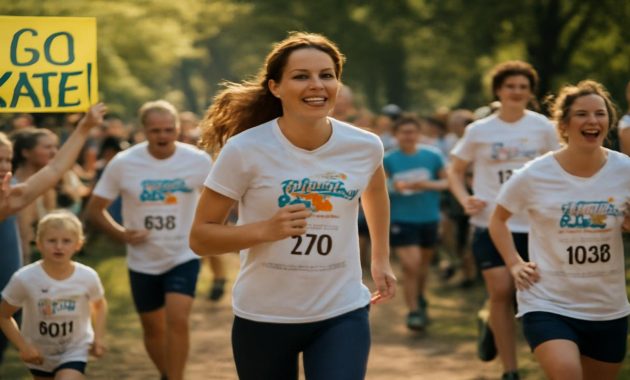
The morning air tasted like apples and rain, the kind that makes your lungs feel scrubbed clean. Along the path curling through the gardens, a soft chorus of trainers on gravel rose and fell—a hush of movement, a rustle of anticipation. And at the center of it all, framed by roses glowing in early light, was Princess Catherine, laughing as she ran.
A Princess in Running Shoes
There was no fanfare in that first moment, no trumpet or velvet gown. Just Catherine—ponytail tucked neatly back, running shoes laced, cheeks flushed with that shy, caught-in-the-sun kind of glow. For a heartbeat, the familiar royal image slipped away. What remained was a woman moving through the world with intention, one foot in front of the other, breathing deeply, running for something that mattered.
The event had been billed as a charity run—the “Run for Rose,” a whimsical name that sounded like a children’s book but felt, in reality, like a powerful pledge. The cause: supporting children’s health and early years development, symbolized by the bloom of a single rose. The idea was deceptively simple: gather people, lace up, and run together in a show of solidarity and joy. But the presence of Princess Catherine transformed it into something almost cinematic.
Runners clustered at the starting line: teenagers rolling their shoulders loose, parents stretching beside prams, older participants adjusting caps and sharing nervous jokes. A light mist hung low over the lawns, turning every breath into faint white clouds. Somewhere to the side, a violinist tuned a string, the delicate notes floating out like threads of silver. The scent of roses—soft, green, and faintly sweet—folded into the morning like a promise.
Then Catherine stepped forward, waving—not with the polished, distant tilt of a balcony gesture, but with an unguarded grin that pinched the corners of her eyes. It was that grin that pulled people in, dissolving the thin line between royal and crowd. She clapped along with everyone else during the countdown, mouthed “Ready?” to the people standing closest, and when the starting horn sounded, she surged forward with them, not before them. The moment the pack began to move, it felt less like an event and more like a shared heartbeat.
The Roses, the Laughter, and the Little Moments
The Run for Rose was designed to be gentle rather than punishing—the route looping through gardens and tree-lined paths rather than hard city streets. You could feel it in the way people moved. This wasn’t about shaving seconds off a personal best; it was about savoring the act of motion.
Clusters of runners formed and dissolved like shoals of fish. Some moved in comfortable silence, others chattered in little bursts of laughter. A father pointed out a climbing rose to his daughter—the petals the color of blush on porcelain—while an older woman in a bright yellow jacket jogged at her own measured pace, eyes fixed on the winding path ahead. Volunteers clapped and cheered along the sidelines, their voices rising in waves.
Catherine kept an easy, steady rhythm. She ran not like someone expecting cameras at every turn, but like someone who’d long ago discovered that the quiet of a good run can soothe the chaos of a crowded life. Her conversation with the runners around her was soft, punctuated by smiles and the occasional throw-your-head-back laugh. People relaxed in her presence, their nerves melting into something warmer—curiosity, pride, shared effort.
Here and there, the roses stole the show. They climbed trellises and stone walls, dotted along the margins of the path like brushstrokes on a living canvas—creamy whites, deep reds, scalloped pinks edged with darker rims, as if meticulously painted. Dew clung to petals and leaves, catching any stray light. Every so often, a gust of wind would tilt the blooms and send their perfume drifting through the runners like a blessing.
At one bend in the route, a little girl in a rose-patterned dress stood with her mother, tiny fingers wrapped around a hand-painted sign: “Run For Rose, Run For Hope.” When the princess passed, the girl’s mouth formed a perfect, astonished “O.” Catherine’s face lit up as she veered toward the edge of the path, slowed for a second, and reached out to tap the sign with two fingers, a tiny gesture that said: I see you. The girl’s giggle followed her like a bell.
The Cause in Every Footstep
The Run for Rose wasn’t just about roses or running or royal charm. It was about children—those already here, and those yet to arrive. Each step on that path represented something subtle but fierce: the belief that early years matter, that the invisible foundations of health, nurture, and play can shape lifetimes.
For Catherine, who has long tied her public work to child development, the event appeared to be a natural extension of a deeply personal mission. She didn’t stand apart from the cause; she ran in it. Her T-shirt was no different from those around her, save for the small rose emblem over the heart—a quiet signal that the day’s symbolic flower was also, in a way, a mirror of her role: something both delicate and resilient, rooted and reaching.
The runners knew whom they ran for: a niece struggling with chronic illness; a friend’s child learning to walk again after surgery; the memory of a baby lost too soon but never forgotten. Some had names written on their sleeves or in marker on their wrists. Others carried those names silently, breathing them in on every inhale, carrying them forward on every exhale.
As the route turned toward a shaded avenue lined with beech and lime trees, the temperature dropped just a little. Feet swished over fallen petals scattered like confetti. The crowd’s energy shifted—settling into a steady hum of endurance and commitment. Conversations faded and returned in waves. A boy in a red cap sprinted ahead, then slowed, then sprinted again, burning through a personal war between excitement and stamina. A group of nurses ran in loose formation, telling stories about night shifts and small victories.
Above it all, the sky opened gradually, the early mist lifting into pale blue. Somewhere far ahead of the main pack, a bird sang a fluid, liquid phrase that no one could quite place but everyone subconsciously absorbed. The run became a thread binding these seemingly ordinary elements—sky, breath, sweat, birdsong, roses—into a single shared story, one tied to the idea that a better world for children must be built from the ground, one quiet act at a time.
When Royalty Feels Remarkably Human
The most striking thing about watching Catherine run wasn’t the star power. It was the humanity. She slowed when others slowed, stopped at the hydration station like everyone else, accepted a paper cup of water with thanks, then laughed when a streak of it sloshed onto her sleeve. A few beads of sweat formed along her hairline, defying the polished images often frozen in headlines. Here, she was unmistakably human—breathing hard, occasionally adjusting her stride, taking in the morning like any other runner.
Somewhere along the second half of the route, a small stumble on uneven ground sent a ripple of concern through those watching. Catherine caught herself quickly, lifted her head, and grinned with a sheepish little shrug, as if to say, “It happens.” That tiny, unguarded clumsiness made her somehow even more beloved. Imperfection, it turns out, can be profoundly reassuring.
More than once, runners sidled up beside her, their apologies for interrupting quickly waved away. She listened, really listened, to stories told in the short bursts allowed by a jogging pace—a boy’s battle with leukemia, a teacher’s journey through burnout and recovery, a mother’s fear during a difficult pregnancy. You could see it in the way her brows pinched gently, the way her answers lingered longer than politeness required. Here was the powerful, grounding truth: influence is heaviest when it is shared lightly, hand-to-hand, step-by-step.
Children who had gathered along the route at viewing spots waved flags and handmade drawings. Catherine’s responses were small and genuine—thumbs-up, quick waves, a brief moment of eye contact that landed like a private acknowledgment. No scripted speeches, no podium—just conversation in motion, royal presence meeting everyday lives in the most ordinary, extraordinary way.
Joy, Measured in Petals and Heartbeats
Perhaps the most delightful part of the Run for Rose was the atmosphere—this intangible blend of celebration, purpose, and downright giddy happiness. It was in the small details. A woman pinned a single rose to the back of her cap; its petals bobbed with every step. A group of teenagers wore face paint, pink swirls curling like vines along their cheeks. A band near the final stretch strummed guitars softly, the music threading through the crowd like a gust of wind.
At the finish line, the world seemed to gather itself, then open. The path widened, lined with planters bursting with roses in every imaginable shade—sunset oranges, butter yellows, deep burgundy hearts. Volunteers clapped and called out names if they knew them, or simple affirmations if they didn’t: “You’ve got this!” “Almost there!” “Look at that sprint!”
Catherine didn’t sprint. She finished with the same controlled pace she’d held throughout, crossing the line with a flushed smile, one hand briefly pressed to her chest, as if thanking her own heartbeat for keeping time. The applause that rose to meet her wasn’t the sharp, piercing excitement usually reserved for celebrity arrivals. It sounded warmer—earned, somehow, by every shared mile.
Photographers captured the moment, of course, as they always do. But the real images that stayed with people were the unposed ones: Catherine doubling over slightly to catch her breath, then straightening, laughter threading through her words as she congratulated others. A teenager, breathless but beaming, later described how the princess had turned to her group and said, “You lot pulled me through that last hill.” The power dynamic shifted for a second—princess relying on the crowd, not the other way around.
Roses were handed out at the finish: one bloom per runner, a living medal. The stems were wrapped in soft green ribbon, the petals cool against overheated fingers. Catherine accepted hers like everyone else, tilting it to catch the scent, then holding it close as she moved through the growing cluster of finishers. For countless participants, that rose became a tangible symbol of the morning: beauty born of effort, fragility held safely in tired hands.
What the Numbers Don’t Fully Capture
After any charity event, statistics quickly follow: funds raised, participants counted, social media impressions tallied. The Run for Rose will be remembered in numbers, yes, but the story of the day is written in experiences—small, vivid, almost impossible to quantify moments.
Still, the impact can be glimpsed in a simple snapshot of the event:
| Aspect | Details |
|---|---|
| Estimated Participants | Thousands of runners of all ages and abilities |
| Primary Focus | Children’s health, wellbeing, and early years support |
| Event Atmosphere | Family-friendly, joyful, and nature-centered |
| Symbol of the Day | Single rose bloom for each finisher |
| Lasting Impression | A princess seen as a fellow runner, not a distant figure |
These simple elements, laid out side by side, suggest something bigger than the sum of their parts. A single rose held in a child’s hand. A shared glance at the starting line. The rhythm of feet on a path softened by leaves. The subtle courage of public figures choosing to show vulnerability—not in words, but in sweat, in effort, in the wobbly moment after a near-stumble.
What makes an event like this resonate long after the banners are packed away is the way it tugs at something deeply human: the wish to be part of a hopeful crowd, to move your body in service of something outside yourself, to feel, for a brief and luminous stretch of time, that your steps are weaving into a story that might just help someone else’s beginning be gentler.
Why Princess Catherine’s Run Mattered to So Many
There is a particular power in watching someone visible—someone scrutinized, photographed, analyzed—choose to show up in such an ordinary way. It challenges the distance we often place between public figures and our own lives. If a princess can own her breathlessness, her off-balance moments, her determination to finish a run for children she may never meet, then perhaps we, too, can lend our strength in smaller, quieter arenas.
For the runners who shared the path that day, the memory will likely remain stubbornly tactile. The feel of laces double-knotted with shaking fingers. The sound of early birds chattering in hedgerows. The way clouds peeled back to reveal a shy sun just as they turned toward the final stretch. The scent of roses pressed gently into palms, petals slightly cool and impossibly smooth after the rough work of running.
Princess Catherine’s Run for Rose delighted everyone not because it was grand or flawless, but because it was deeply, recognizably human. It turned the idea of royalty from something framed on a distant wall into something breathing right beside you, matching your pace, urging you on, then thanking you for being there.
In the days and weeks that follow, the photos will circulate, the quotes will be lifted, the highlights replayed. But if you strip away the captions and the commentary, what remains is a simpler, more resonant truth: on a soft, rose-scented morning, a princess put on her running shoes, and joined a crowd of strangers in moving, together, toward a kinder future for children.
And for everyone who was there—whether on the path or leaning over the barriers, rose in hand—that might just be the most beautiful story the day could tell.
Frequently Asked Questions
Why is it called “Run for Rose”?
The “Rose” in Run for Rose serves as a gentle symbol for children and early life—delicate yet resilient, needing care and attention to truly flourish. Each finisher receiving a rose turned that symbol into something tangible they could hold and remember.
What cause did Princess Catherine support with this run?
The event focused on children’s health and early years development, highlighting how crucial the first years of life are for emotional, physical, and mental wellbeing. Funds and awareness were directed toward programs that help give children a strong, nurturing start.
Did Princess Catherine run the full route?
Yes, she ran the route with the other participants, maintaining a steady pace and interacting with runners along the way. Her presence on the path, rather than only at the start or finish line, was a meaningful part of the day for many attendees.
Was the Run for Rose a competitive race?
The spirit of the event leaned more toward community than competition. While some runners naturally pushed themselves, the overall atmosphere was inclusive and supportive, welcoming families, beginners, and experienced runners alike.
Why did this event resonate so strongly with people?
It blended simple human experiences—running, nature, shared effort—with a powerful message about caring for children. Seeing a princess participate as an equal among runners made the cause feel personal, immediate, and real, leaving many with a lasting sense of hope and connection.