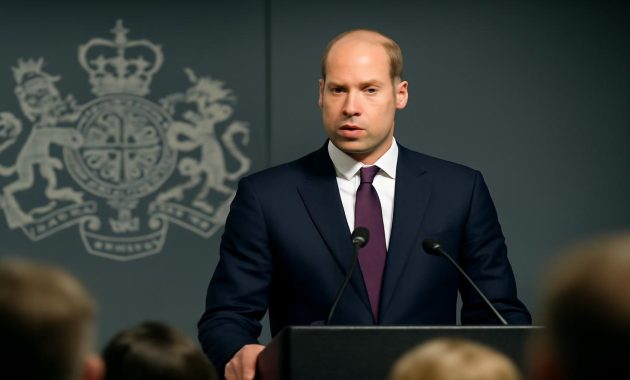
The rain had that soft, silvery quality that only London seems to know—more a presence than a downpour, glinting on camera lenses, blurring the edges of Buckingham Palace into something almost dreamlike. Prince William stepped out of the dark car, gave the briefest glance at the grey sky, and then did something that made royal watchers around the world lean a little closer toward their screens: he moved with the unhurried confidence of someone not just filling in, but stepping up. It was subtle—no proclamation, no new title—but in the quiet choreography of royal life, the change in tempo was hard to miss.
The Day the Air Felt Different
There are days in a royal calendar that are meant to be ceremonial: lined up long in advance, polished by staff, and sanded free of surprise. But recently, some of those days have begun to feel like something else entirely—like turning points.
On one of those gray English afternoons, the crowds outside a royal engagement were different too. There were the usual tourists, of course—phones up, elbows out, angling for a glimpse of the familiar figure of the Prince of Wales. But if you listened closely, you could hear a new word surface in the murmur of voices, in the rustle of flags and the low hum of conversation: “transition.”
It wasn’t shouted. It seldom is, when it comes to the monarchy. Instead, it floated quietly between people standing three rows back from the barricades, older women clutching Union Jacks and young Londoners in trainers and puffer coats, half-excited and half-skeptical. There was a sense—vague, not quite articulated—that something in the invisible machinery of the Royal Family was speeding up.
And in the middle of that shifting atmosphere, there was William: taller than most imagined, a familiar face carved now with the fine lines of midlife, and carrying himself with a kind of sober warmth. He smiled, shook hands, asked questions that sounded less rehearsed than they used to. He didn’t seem like a man waiting in the wings. He seemed like one already stepping into the spotlight, even as the official script insisted nothing had changed.
A Prince Between Past and Future
William has always been the bridge—the living thread that ties one of the most scrutinized pasts in modern history to an uncertain, impatient future. He is forever the little boy walking behind his mother’s coffin, and at the same time the middle-aged father of three children who already know what it means to live with cameras as constant companions.
For decades, his path was clear but distant. First there was his grandmother, Queen Elizabeth II, anchored like a mountain on the horizon—unyielding, constant. Then his father, Charles, who had himself spent more than half a century preparing, waiting, advocating for causes that sometimes sat awkwardly within the royal script. William watched them both. He learned the soft power of a visit, the weight of a handwritten note, the delicate calculus of saying enough without saying too much.
Yet the last few years have rearranged the emotional furniture of the monarchy. The death of his grandmother; his father’s health challenges; his wife Catherine’s own medical struggles—each has pushed William into a sharper, more exposed light. Instead of sharing the load of public duty, he has found himself, at times, carrying it.
Royal watchers have noticed the change not in grand gestures, but in the small ones: the solo engagements that used to be rare and are now routine; the meetings with world leaders; the carefully curated projects that bear his name not as a footnote, but as a driving force. There is a quiet, undeniable rebalancing of attention around him, like furniture being shifted in a room you thought you knew by heart.
The Gossip in the Gaps
The monarchy lives on ceremony but is fueled by speculation. In the pauses between official announcements, in the silence of palace corridors, in the blurred edges between health updates and “no comment,” imaginations fill the space. The question on many of those minds now is unsettling in its bluntness: is the transition of power happening faster than anyone expected?
To be clear, there has been no official declaration of an imminent handover. King Charles III remains firmly on the throne, and the monarchy is deeply allergic to visible panic. Yet as more duties slide quietly across the family table toward William, the conversation has turned from if to how quickly.
Hints appear at odd angles. Invitations bearing his crest instead of his father’s. Speeches where he doesn’t just echo palace talking points but sets a tone of his own—plain, sometimes even a little raw, especially when he talks about mental health, climate, homelessness, or the emotional toll of public life. He seems to be building not just a résumé, but a philosophy of kingship.
In drawing rooms, in podcasts, in late-night TV discussions, a new question is forming: are we watching not just a prince preparing, but a monarch-in-waiting being quietly accelerated toward the inevitable?
Seeing William Up Close
To understand why this matters so much, imagine following him through a day of engagements. The morning might begin in a bright, echoing community center where the air smells faintly of coffee and hand sanitizer. Children straighten their shoulders, grown-ups smooth their clothes, and volunteer staff steal nervous glances at the door.
When William walks in, there’s a ripple. Security first, then aides, then the man himself—no crown, no robes, just a dark suit and the cautious ease of someone who knows his presence will be over-analyzed from every angle. He’s told who to meet, where to stand, what the cause is. But lately, observers note, he seems intent on pushing just a little further, asking one more question, lingering at the margins instead of sticking only to the choreographed center.
Later, he might appear at an environmental summit, the room colder from overactive air conditioning, full of policy people in lanyards and world-weary expressions. Here, William doesn’t sound like a man reading lines: he speaks of coral reefs he’s seen, of African landscapes under heat and stress, of communities whose futures feel as fragile as the ecosystems he’s championing.
These are not random choices. They are the building blocks of a public image being carefully laid out: William the environmental advocate, William the mental health campaigner, William the modernizer who still speaks the language of continuity and tradition. If the crown is a story a nation tells itself, he is rewriting some of its paragraphs while keeping the overall plot intact.
A Family in Unsteady Light
Yet none of this happens in isolation. Royal life is not a solo performance; it’s a family drama, often reluctant, sometimes fractured, played under merciless lights.
William’s new visibility has unfolded alongside some of the most painful chapters of that family saga. His brother Harry now lives an ocean away, their estrangement endlessly dissected. His wife, Catherine, has faced health issues behind closed doors, while the world pressed its nose against the metaphorical glass, desperate for updates. His father navigates both the demands of monarchy and the vulnerability of a man confronting his own mortality in public.
Through all of it, William stands at a narrow intersection between public duty and private strain. There is a sense, as he appears at engagements sometimes alone, that the weight on his shoulders is not just ceremonial. Behind the small smiles and careful words, there’s a tightness in his jaw, a watchfulness in his eyes—signs, perhaps, of the sheer, human pressure of being the hinge on which an ancient institution turns.
Reading the Signals: How Power Quietly Shifts
For those who follow royal movements like others track stock markets, the last year has been rich with “data.” The clues are seldom dramatic; monarchy rarely does dramatic in public. But patterns emerge when you line them up.
| Sign | What It Suggests |
|---|---|
| Increasing solo high-profile engagements | Growing trust in William as the lead public face of the monarchy. |
| Representing the King at major state events | A soft rehearsal for future constitutional responsibilities. |
| Expanded role in the Duchy of Cornwall and royal finances | A test of his leadership in stewardship and strategy. |
| More speeches setting a long-term vision | Signaling how his reign could differ in tone and focus. |
| Media framing of William as “center of gravity” | Public expectations shifting toward him as de facto leader. |
None of this proves a fast-track coronation. The monarchy is famously sticky; it clings to procedure and precedent with both hands. But when seen together, these signals sketch an outline: William isn’t just next, he’s increasingly now.
In private, constitutional scholars whisper about what would happen if health crises deepen, if duties must be permanently delegated, if the King were ever to contemplate a scenario unthinkable under his mother’s reign: abdication. The word hangs in the air, not spoken aloud in official circles, but not entirely banished either.
And then there is the question of public appetite. After years of churn—Brexit, pandemics, protest movements, cost-of-living crises—many in Britain are weary of shock and craving stability. But they are also looking, more than ever, for relevance. Can a middle-aged man raised in palaces speak convincingly to renters crushed by bills, to young people drowning in climate anxiety, to communities grappling with injustice and inequality? William’s accelerated visibility feels, in part, like an answer being tested.
A Different Kind of King-in-Waiting
William, unlike his grandmother or even his father, is a creature of both glossy magazines and grainy smartphone footage. He grew up on front pages and in paparazzi chases, in the long shadow of global grief for Diana. He learned early that sympathy could sour into scrutiny, and that every stumble could be replayed in slow motion, again and again.
Yet this may be precisely what shapes him into a different kind of eventual king. When he speaks about mental health, he does so with the weight of someone who has been dragged through public trauma. When he advocates for environmental action, he can point not just to briefings but to muddy boots and field visits. When he softens the language of royal distance—admitting vulnerability, talking about pain—he dips a cautious toe into the language of modern leadership, where authenticity is currency.
In a world saturated with performative sincerity, his challenge will be to show that these are not just well-tailored talking points, but lived convictions. That task grows harder as speculation swirls about timing, succession, and power. Every move is double-read: is this William the son, helping out; William the prince, preparing; or William the almost-king, slowly being moved to the center of the stage?
The Emotional Math of a Nation Watching
Perhaps the most overlooked piece in all of this is how it feels for the people watching. Monarchy, for all its rules and histories, is at heart an emotional arrangement. A country projects its anxieties, memories, and hopes onto a single family, and then spends decades renegotiating that bargain.
For older generations, William may still be the child of tragedy, the boy they felt compelled to protect in their imagination even as cameras zoomed in on his grief. For many younger Britons, he is, frankly, optional—a distant figure whose relevance must be earned, not assumed. And for a global audience, he is both symbol and storyline: the man who will, inevitably, become King of a shrinking but still symbolically powerful monarchy in an age deeply suspicious of inherited privilege.
That’s why every image of him now seems layered. William leading a solemn remembrance ceremony is not just a prince honoring the past; he’s a rehearsal for a future king shouldering its memory. William visiting a school is not just an engagement; it’s a glimpse of how he might connect with a generation that lives online, demands transparency, and questions structures his ancestors took for granted.
In the rustle of bouquets handed over, the careful bows, the brief smiles, something larger is being tested: can an ancient institution feel modern enough, human enough, to justify its survival? William’s increasingly visible leadership is, in many ways, the monarchy’s most important answer to that question.
Between Choice and Destiny
There is an irony at the heart of all this. For most people, stepping into leadership is a choice: a job taken, a role accepted, a career move debated over late-night cups of tea. For William, it is an inevitability he’s been moving toward since the moment he opened his eyes.
And yet, within that inevitability, there is a spectrum of choices—about style, about pace, about how much of himself to offer to a public that can be both adoring and ruthless. The accelerated transition many now sense is not just about titles and timetables. It’s about a man working out, in real time and in front of the world, what kind of leader he can stand to be—and what kind of leader the world will accept.
So when he moves through the soft London rain, when he straightens his tie before a speech, when he listens to a veteran, a nurse, a teacher, a teenager on the edge of dropping out of school, the stakes are quietly monumental. One day, all of this will be filtered through the glitter of a coronation, through the gold of crowns and the weight of oaths. For now, it looks like a man in a navy suit doing his best to seem calm while history circles a little closer each week.
A Future Edging Closer
At some point—no one knows exactly when—the world will wake up to news that changes William’s life and Britain’s story in the same instant. A proclamation will be read, a series of rituals set in motion, and the Prince of Wales will become King.
What royal watchers are asking today is whether the emotional and practical transition toward that moment is already well underway—faster, perhaps, than tradition might prefer. The signs suggest a quiet yes: a slow but deliberate transfer of visibility, workload, and expectation toward the man who will, one day, embody the crown.
For now, the monarchy clings to its favorite tools: understatement and deniability. There are no timelines, no public talk of acceleration, no open acknowledgment that the pace has changed. But anyone who has watched William’s recent months with even casual attention can feel it: the air around him crackling just a little, like the static before a storm that may not yet have arrived, but is undeniably on its way.
And perhaps that is where the story sits tonight, under low clouds and city lights, with the Palace standing pale against the sky: in the in-between. A king still reigning. A prince no longer just preparing. A country weighing its complicated feelings about continuity and change. And a man—whose every step is recorded, replayed, and decoded—walking steadily forward into a role he did not choose, but seems increasingly unwilling to merely inherit. He appears, instead, intent on shaping it, even as it shapes him.
Frequently Asked Questions
Is King Charles III planning to abdicate in favor of Prince William?
There has been no official indication that King Charles III plans to abdicate. The Royal Family traditionally views the role of monarch as a lifelong duty. Speculation about an accelerated transition is largely based on Charles’s health, William’s growing prominence, and media commentary rather than confirmed plans.
Why is Prince William taking on more public engagements now?
William is stepping into a more visible leadership role partly due to the natural evolution of his position as Prince of Wales and heir apparent. Additionally, health issues within the family and shifting public expectations have led to him handling more high-profile duties on behalf of the King.
How is Prince William’s leadership style different from previous monarchs?
William emphasizes issues like mental health, environmental protection, and homelessness, and often speaks in a more open, emotionally aware tone than previous generations. While he respects tradition, he appears intent on making the monarchy feel more relatable and engaged with modern concerns.
Could the transition of power to Prince William happen suddenly?
Constitutionally, a transition can happen quickly if the reigning monarch dies or becomes unable to perform duties. In emotional and practical terms, however, transitions are gradual. What we are seeing now is that slower process of shifting expectations and responsibilities toward William.
What will likely define William’s future reign if and when he becomes king?
Based on his current priorities, William’s reign is likely to focus on environmental action, mental health advocacy, support for veterans and vulnerable communities, and a carefully modernized image of the monarchy. How successfully he balances tradition and change will define both his legacy and the institution’s future.