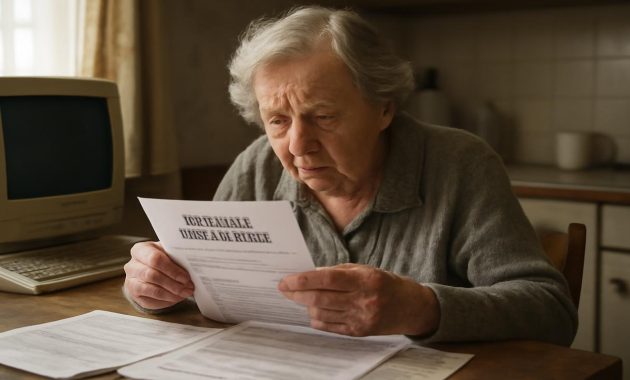
On a foggy morning in early February, the queue outside the post office in a small town begins to form before sunrise. Breath hangs in the air like smoke; wool coats are pulled tighter; canes click against the pavement. They are here for a promise, whispered through neighbors and crackling radios: pensions will rise from February 8. But the promise comes with a condition many of them only half understand—something about a certificate, an online form, a deadline. For those who have never touched a smartphone, the news feels less like hope and more like a trap.
A Certificate Hidden Behind a Screen
The announcement had sounded simple enough at first. Starting February 8, pensions would increase—a gesture, officials said, to help older citizens keep up with rising food prices, heating bills, and the quiet, constant erosion of savings. But the raise would only be applied to those who submitted a missing certificate confirming their eligibility.
The catch? For most retirees, this certificate existed almost entirely online.
“My pension will rise, they say,” mutters Elena, a 74-year-old former librarian, as she stands in line. “But first I must find it. This… certificate.” She pronounces the word as if it’s something slippery, impossible to grasp. Her neighbor’s grandson had tried to explain: log in, upload, verify. To Elena, the sentence might as well have been spoken in another language.
Over the past decade, governments and institutions have shifted steadily toward digital portals—sleek websites and apps designed, in theory, to simplify life. Bills can be paid with a thumbprint, documents submitted in seconds. Yet such conveniences can quietly split a population in two: those who can travel effortlessly through the digital world, and those left standing at the border, unable to pass.
For retirees like Elena, this certificate requirement didn’t feel like a neutral formality; it felt like a locked door with a keypad she could not read.
The Anger of the Offline
Inside a small apartment building on the edge of town, a group of pensioners gathers around a kitchen table stained with tea circles. The radio is on, repeating the same announcement: “Pensions will rise from February 8 for all retirees who have submitted the required certificate of entitlement.” The phrase repeats like a reminder—and for many, like an accusation.
“What certificate?” asks Daniel, a retired factory worker with thick glasses. “They never sent me anything by post. I only heard about it yesterday.” His hands tremble slightly as he taps the wooden table. “And then they say, ‘You can download the form.’ Download from where? From the air?”
His granddaughter tries to help, pulling out her phone, thumbs gliding over the screen. She types in his ID number, navigates a maze of menus. After several attempts, the site freezes. “It’s overloaded,” she sighs. “Too many people trying at once.” Daniel stares, helpless, as his future monthly income hangs on the spinning wheel of a loading icon.
The anger among those without internet access isn’t abstract. It is intimate and sharp, made of small humiliations: asking neighbors for help, showing private documents to strangers, feeling your dignity shrink every time you are told to “just do it online.”
For years, many retirees accepted that some services were simply out of their digital reach. Bank apps, messaging platforms, online shopping—those were novelties, not necessities. But now the stakes are different. Now, the digital divide is measuring out who will eat a little better, heat their home a little longer, and who will slip further behind.
Paper Lives in a Paperless Era
Walk into any home of someone who grew up before the internet, and you will see the traces of a paper-based life. Envelopes kept in drawers, yellowing receipts, notebooks filled with careful handwriting. The rhythm of bureaucracy was once slow but comprehensible: letters in the mailbox, queues at the office, ink stamps on forms, signatures neatly aligned with printed lines.
The pension certificate, for many, belongs to that world of paper. They expect it to arrive folded into an envelope, or to be handed across a desk by a clerk speaking their language, looking them in the eye. Instead, it sits on a remote server somewhere, waiting to be summoned by a series of clicks.
“If they want something from me,” says Maria, 81, “they should send it to me. A letter. A form I can hold. Not this… invisible thing.” She doesn’t have a computer, or a smartphone. Her old flip phone can barely send text messages, and she rarely uses it. “The postman used to bring me news. Now he brings almost nothing.”
In the past five years, many government offices have reduced in-person counters, replacing them with online help desks. Call centers play loops of recorded messages, nudging callers toward Websites. “You can handle most issues online,” the voice says, over and over. But for retirees who can’t, that phrase sounds almost cruel.
The certificate requirement feels like one more reminder that the world is drifting away without them. A world that once moved at the pace of bicycles and hand-written letters now sprints ahead at fiber-optic speed, and it is the elders—those who built so much of that world—who are left watching from the roadside.
Numbers on a Screen and Food on the Table
The pension increase itself, on paper, is modest. A few percent added to the monthly payment—enough to buy an extra bag of groceries, to cover part of an electricity bill, to make a winter coat last another year. But when your entire life is calculated in tight margins, percentages become deeply personal.
To understand how this digital barrier plays out in reality, imagine two retirees, both living alone on similar incomes.
| Aspect | Retiree with Internet Access | Retiree without Internet Access |
|---|---|---|
| Access to Certificate | Downloads, uploads or submits in minutes | Depends on others or must visit offices |
| Time Required | Less than 30 minutes | Hours or days of waiting, travel, and queues |
| Privacy and Dignity | Handles documents independently | Must reveal personal details to helpers |
| Chance of Missing Deadline | Low | High, due to confusion or lack of information |
On one side of the table, the process is just another mildly annoying task—something to be done while sipping coffee and scrolling through news. On the other side, it is a logistical and emotional ordeal, shaped by dependence, confusion, and fear of making a mistake.
“They say if I don’t submit this certificate, I won’t get the increase,” says Tomas, a widower who lives in a rural village. The nearest internet access point is a library 20 kilometers away; the bus comes twice a day. “The bus ticket alone is a good part of what I’m supposed to gain from this raise.” He laughs, but it’s a brittle sound. “It’s like paying for a key to open a door to a slightly bigger room.”
Behind each delayed or missing certificate is a story like this, where technology meets geography, income, and health. And as February 8 approaches, those stories pile up like snowdrifts, each flake a small administrative detail that, together, becomes a barrier.
Silence on the Wrong Side of the Digital Divide
If you walk through a city center, the digital world feels omnipresent. Screens light up from pockets, cafes glow with Wi-Fi signals, advertisements encourage you to “download the app,” “scan the code,” “log in now.” But just beyond the main streets—in older neighborhoods, in rural towns, in the last apartments on the top floors of aging buildings—there is another reality.
Here, the glow of screens is dimmer. The internet connection, if it exists at all, may be slow and unreliable. Some people share a single smartphone between family members, topping up data like they once rationed sugar. Others avoid technology not out of stubbornness, but out of fear: fear of breaking something, of being scammed, of pressing the wrong button and losing what little they have.
When officials insist that “everyone can easily submit their certificate online,” they are speaking from inside the well-lit world of stable connections and digital literacy classes. Outside that circle, the message sounds distant and hollow.
“They talk about equality,” says Elena, watching the evening news on her old television. “But this is not equality. This is selection.” She counts on her fingers: those with computers, those with smartphones, those with children who can help—then those without. “Who do you think will be left out?”
For people like her, the anger is not only about money. It is about being constantly reminded that they belong to an invisible class: the offline. When systems move online without fully accounting for them, their needs become inconvenient obstacles, brushed aside in the name of efficiency.
Between Pride and Dependence
One of the cruellest aspects of the certificate requirement is how it forces many older people into dependence at a stage of life when their independence is already under quiet attack—from unsteady legs, from fading vision, from memory that sometimes misfiles dates and names.
Standing in line at a municipal office, you can see this balancing act play out in subtle ways. A retiree clutches a folder of documents, refusing help from her daughter until she’s absolutely sure she can’t manage alone. Another man insists on signing every page himself, even though the clerk offers to fill in most of the form for him. Pride sits at the table with poverty and age.
The online certificate threatens that fragile pride. To ask a relative or neighbor for help means more than just sharing a password; it means exposing financial details, health records, personal history. It is, in a sense, an undressing of one’s private life in front of someone else’s bright little screen.
“My grandson is very kind,” says Maria. “He helps me with many things. But why should I need him to prove that I exist for my own pension?” Her voice cracks slightly. “I worked 40 years. I paid my contributions. Now I must ask a child to help me knock on the door of the house I built?”
This tension—between wanting help and resenting the need for it—flows quietly under the surface of many families. It intensifies when a policy, like the pension certificate, seems to take that private struggle and turn it into an official rule: be digital, or be left behind.
Could It Be Different?
It doesn’t have to be this way. The problem is not that governments are moving services online; that trend is here to stay, and in many cases it does make life simpler. The problem is when the digital route becomes the only realistic path, while alternatives shrink to thin, poorly signposted trails.
Imagine how this pension increase could have unfolded differently. Letters could have been mailed in advance, not as a courtesy, but as a guaranteed right. Local community centers and libraries could have been officially designated as “certificate points,” staffed with trained helpers—not just volunteers—with clear instructions and extended hours for the weeks leading up to February 8.
Mobile units—small vans equipped with laptops, printers, and internet—could have visited rural villages on a schedule, the way bookmobiles once brought stories to distant children. Radio announcements could have been paired with simple explanations in plain language, walking listeners through each step.
None of these ideas are futuristic. They are extensions of something societies once knew how to do well: meet people where they are.
Instead, in many places, the burden has fallen on the retirees themselves to close the gap—to beg for help, to travel far, to decipher websites not designed with them in mind. And so, as February 8 arrives, the line outside the post office grows. Some will succeed in submitting their certificate, through persistence and luck. Others will miss deadlines, or give up, and quietly watch as the promised raise passes them by.
The question echoing in those lines is not only “How do I get my money?” but “Do they still see me?” In a world that celebrates newness—new apps, new platforms, new ways of “streamlining processes”—it is easy to lose sight of those whose lives are built on older foundations, whose hands remember fountain pens more easily than touchscreens.
Listening to the People in the Queue
On that foggy February morning, as doors finally open and numbers are called, the scene looks deceptively routine. Forms shuffled, questions answered, documents stamped. But if you listen closely, you will hear stories between the clatter of keyboards and the hum of fluorescent lights.
There is the woman who walked 5 kilometers because the local bus service was cut years ago. The man who brought his neighbor along to translate the instructions on the screen. The couple who share a single pension and worry that if the certificate isn’t accepted today, they won’t be able to afford medicine next month.
Each of them has lived through eras of change—wars, recessions, technological revolutions. They are not strangers to adaptation. Many have already learned to use bank cards, to answer mobile phones, to adjust to a world faster than the one they grew up in. But adaptation requires not just willingness, it requires support.
When policy ignores this, it creates not merely inconvenience but quiet injustice. A pension increase that should have been a simple, universal measure of relief is transformed into a test—a test of connectivity, literacy, geography, and luck.
As they leave the building, some retirees clutch small slips of paper confirming that their certificate has been submitted, their raise approved. Others walk away confused, told to come back with another document, another proof, another trip through the maze. The cold air meets them at the door; the day goes on.
Somewhere, on a server in a data center humming with electricity, their names exist as lines in a database, marked “verified” or “pending.” But what those lines cannot capture is the strain of the journey to get there—the early alarms, the missed buses, the conversations with grandchildren, the shame of asking for help one more time.
The story of pensions rising from February 8 is not only a financial one. It is a story about whose voices are heard when systems are designed, whose limitations are quietly written off as collateral damage, and how easily empathy can be lost behind the sleek surface of “digital first” policies.
The people in the queue are not opposed to the future. They simply ask that the future remember them when it arrives.
Frequently Asked Questions
Will all pensions automatically rise from February 8?
No. The increase will only apply to retirees who have successfully submitted the required certificate of entitlement or similar verification document, as requested by the pension authority.
What is this “missing certificate” everyone is talking about?
It is typically a document used to confirm that a retiree is still eligible for their pension benefits—often confirming identity, residency, or life status. In many cases, it has to be submitted through an online portal or uploaded in digital form.
What happens if I don’t submit the certificate?
If the certificate is not submitted, the pension may not be increased, and in some cases, payments might be delayed or temporarily suspended until the required proof is received and processed.
Can I submit the certificate without internet access?
In theory, yes—by visiting pension offices, municipal centers, or authorized intermediaries. In practice, this can involve long travel, queues, and waiting times, especially for those in rural areas or with limited mobility.
Why are retirees without internet access particularly angry?
Because the process strongly favors those who are online and digitally literate. Retirees without internet access must depend on others, travel farther, or navigate unfamiliar bureaucratic steps, which can feel unfair, humiliating, and exclusionary.
What could be done to make the process more fair?
Authorities could send paper forms by post, extend in-person support, provide mobile registration units for remote areas, simplify language and steps, and guarantee an offline option equal in speed and reliability to the online process.
How can families help older relatives in this situation?
They can assist by checking official notices, helping to access and submit forms online, accompanying them to offices, explaining each step clearly, and respecting their privacy and dignity while handling personal documents together.