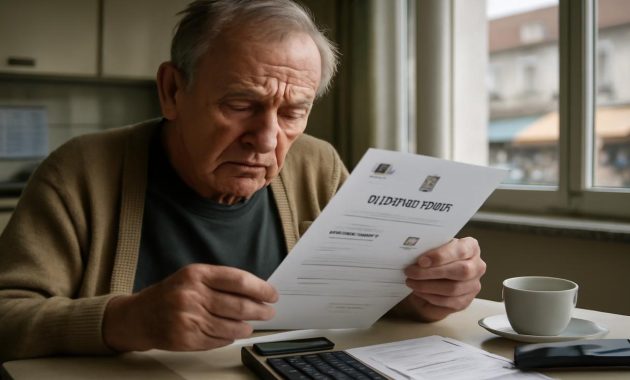
The letter from the pension office arrived on a Tuesday, thin as a leaf and just as quiet. No red stamp, no bold warning. Just your name, your address, and inside, a few rows of numbers and cautious words about “adjustments,” “projections,” and “indexation.” You sit at the kitchen table, the same place you’ve balanced bills and birthdays for decades, watching the steam curl from your mug while you try to make sense of what’s written there. It doesn’t look dramatic. No one is taking your pension away. But between the lines, there’s something else: a slow, silent slide. By 2026, it says, you could be looking at as much as €340 less over the year in real terms. Not because anyone cut it. But because prices kept climbing and your pension did not.
The Smell of Coffee and the Price of Everything
Imagine it’s early January 2026. The holiday lights have just been put away, and the world has the grey, half-awake look of a new year. You walk into your regular café, the one that still smells of warm croissants and ground beans, the little place where the barista knows your order without asking. Only now, there’s a new menu board. Your usual coffee is up by twenty cents. The croissant has nudged itself a little further out of reach, too.
You shrug at first. “It’s only a few cents,” you think. But a few cents here, a few there, over twelve months and across everything you buy, can quietly turn into something else. The cost of heat, the bus pass, the fresh vegetables that used to feel like a small weekly luxury—each one stretches a touch further out. If your pension doesn’t rise at the same pace, that gap between what comes in and what goes out widens, almost invisibly.
This is how a loss of up to €340 over a year can slip through the cracks. It rarely looks like a dramatic monthly cliff. It looks like tiny compromises: slightly cheaper bread, fewer outings, a postponed visit to the grandchildren, a new winter coat that becomes “next year, maybe.” It looks like learning to say no to yourself in smaller and smaller ways.
The Quiet Mathematics of 2026
On paper, it all looks so clean and reasonable. Pension adjustments are tied to complex formulas: inflation here, wage growth there, budget room somewhere in between. Politicians speak of balance and sustainability, and actuaries shuffle percentages on spreadsheets. They are all talking about you, but almost never to you.
Suppose your pension is modest but solid: around €1,200 a month. If inflation keeps nibbling at prices—3%, 4%, maybe more in a bad year—but your pension increase slows, pauses, or lags behind, then what doesn’t change in your income effectively shrinks. It’s the kind of loss that never appears as a minus sign on your bank statement—only as an emptier grocery basket.
When people say “up to €340 less in 2026,” they’re not usually talking about a line-item cut. They’re talking about purchasing power, about how far your money travels before it runs out of breath. And in that sense, the loss is very real. It’s the distance between the life you imagined your pension would protect, and the life you slowly adjust to living instead.
| Scenario | Monthly Pension (Net) | Annual Loss in Real Value (Approx.) | What It Feels Like |
|---|---|---|---|
| Low pension | €900 | €200 | Several months of utilities |
| Average pension | €1,200 | €280 | A full grocery month or two |
| Higher pension | €1,500 | Up to €340 | Annual travel money disappearing |
These are rough, illustrative figures, but they carry a human weight: less money that feels “spare,” more that feels already spoken for the moment it lands in your account.
The Human Side of Index Numbers
Statistics are strangely bloodless creatures. “Inflation at 3.5%,” the newsreader says, her voice as even as the numbers scrolling across the bottom of the screen. Yet to you, inflation is not a percentage; it’s a choice between fresh fruit and canned, between turning the heating up one notch or wrapping yourself in another sweater.
Imagine Anna, sixty-nine, who worked as a teacher and now lives alone in a small apartment overlooking a patch of city park. Her pension is neither lavish nor desperate, just enough to make things work when times are normal. Except that “normal” keeps drifting. The electricity bill swells. Her health insurance premium nudges upward. The cost of the bus into town creeps ahead as well. She notices that her pension “adjustment” letter for the new year is softer than the rise in her living costs.
By the time 2026 comes, Anna hasn’t lost a single euro on paper. But she has lost habits. She stops buying flowers for her windowsill every week. She stretches leftovers an extra day. She decides not to join her friends on that weekend trip because “it’s been an expensive month.” When she sits at her table in the evening, looking out at the trees, there is a sense of growing caution in her chest, like a tightening belt.
That belt—the one that tightens invisibly—is what this looming loss of up to €340 really is. It’s not the drama of poverty, but the slow erosion of comfort, ease, and the feeling that you are still fully participating in the life around you.
The Politics Behind the Quiet
None of this happens in a vacuum. Pension systems are political weather—shaped by elections, budgets, and debates that feel distant until they arrive as a few unexpected lines on your annual statement. Governments face rising costs, ageing populations, and competing promises. Somewhere in that crowded room, the voice that says “keep pensions truly in line with real life” doesn’t always speak the loudest.
There are discussions about shifting retirement ages, changing indexation rules, linking pensions more to wages or more to prices, smoothing adjustments over several years instead of reacting quickly. Each tiny policy lever can mean the difference between staying level with rising costs and quietly sliding behind them.
The silence is part of the story. A big, headline-making cut would trigger outrage. A technical change to an index formula, announced in a dry press conference two years before anyone notices, does not. The result can be exactly the same: less money in your life, less security in your days.
Feeling It in the Details of a Day
Think of your day as a series of small rituals and decisions. Morning coffee, breakfast, a walk if the weather allows, maybe a bus ride to meet a friend, an afternoon spent with a book or in the garden, an evening meal, the glow of a lamp as you settle in to watch the news. Every one of those moments contains hidden price tags.
The rise in the cost of bread might be modest, but bread is daily. The small increase in your transport pass hits every month. The rising insurance payment stands like a gatekeeper at the start of the year. None of them alone seems catastrophic. Together, they form something like a quiet tide. You don’t notice each wave, but you do notice when the shoreline changes.
By the time the calendar reads 2026, that difference of up to €340 in annual real spending power might look like:
- Three or four fewer dinners out with family.
- A pair of shoes postponed until the old ones are truly worn through.
- A decision to skip fresh fish for cheaper alternatives, week after week.
- A forgotten plan to visit a friend in another city because tickets have edged too high.
None of these choices makes a headline. But they shape the weather of your life. They alter how free you feel to say yes.
Invisible Stress, Visible Consequences
Money worries at this stage of life carry a particular flavor. When you were younger, a tight year could be met with the thought, “I’ll earn more later” or “I can always pick up extra work.” But in retirement, the levers you can pull are fewer. Your income is mostly fixed. The tools left are trimming, rethinking, and hoping.
That hope can be thin. You start checking your bank balance more often. You replay mental calculations before bed: energy bill, groceries, prescription costs, that dental appointment. The difference between security and stress may be less than a euro a day. Yet that sliver of difference can weigh heavily in your chest.
Studies quietly confirm what people already feel in their bones: financial strain is not just about numbers. It touches sleep, mood, and health. If up to €340 vanishes from what you can truly afford in 2026, the loss might not first appear in your bank account; it might show up in your shoulders, your heartbeat, your late-night thoughts.
Finding Your Own Voice in the Noise
You are not supposed to navigate this in silence. Pension systems can be abstract, but your experience of them is not. Your budget, your receipts, your rising bills are the most honest commentary on whether the system is keeping its side of the bargain.
Start in the most grounded way possible: with your own numbers and senses. Take one month and look closely. What did you spend on essentials—housing, utilities, food, insurance, medication? What’s left for everything else that makes life feel like more than survival? Compare it with a year or two ago. Where have prices crept up most? How close to the edge do you feel?
From there, questions begin to form—not rhetorical ones, but practical and political:
- Is my pension being adjusted in a way that matches real prices, or just an average that ignores my reality?
- Are there benefits, tax reliefs, or local supports I haven’t checked in years that might now apply?
- Who is making the decisions that will shape my 2026 income, and how can I make my voice part of that process?
Conversations matter. With family, so they understand the quiet shifts in your life. With other retirees, so you can compare notes and perhaps move from private worry to collective awareness. With representatives and organizations that exist, at least in theory, to protect pensioners’ interests. Policy may be written in offices, but it can be redirected by voices that refuse to be treated as numbers on a chart.
Small Acts of Protection in a Changing Landscape
There is power in the small, concrete actions you can take now, even while the bigger debates unfold above your head. None of them alone will erase a looming loss, but together they can soften its edges.
- Revisit your budget with 2026 in mind. Assume prices will rise and that your pension may not fully follow. Where would a shortfall pinch hardest? Planning now can reduce the shock later.
- Check for overlooked support. Reduced fares, energy subsidies, healthcare allowances—these often change quietly, just like pension formulas do.
- Trim where it hurts least, not where it hurts most. Cutting healthy food or social outings might appear logical, but they are also what keep you thriving. Look first at subscriptions, unused services, or recurring expenses that no longer match your reality.
- Ask for clarity. When the next letter from the pension office arrives, don’t just skim the numbers. If you don’t understand how your pension is being adjusted—and what that means for 2026—ask. Persist. You are entitled to clear answers.
This is not about becoming an accountant of your own life. It’s about reclaiming a bit of control in a system that can otherwise make you feel like a passenger watching the scenery blur.
The Story Behind the €340
By now, that figure—€340—may sound different than it did at the start. It’s no longer just a statistic buried in a news article. It might be the birthday gift you wanted to give but couldn’t. The weekend away with an old friend that stays a daydream. The extra margin that turns worry into calm.
When people talk about pensions “losing ground” by 2026, what they’re really describing is a future where older people are asked, once again, to quietly absorb the shocks of a changing economy. It’s a story as old as social security itself: the promise of stability tugged at by the demands of the day.
But there’s another story possible, too—one where that looming loss becomes visible enough, felt enough, and spoken of enough that it can’t be brushed aside as “technical adjustments.” One where the smell of morning coffee and the weight of the grocery bag are treated as economic indicators every bit as real as inflation charts.
Your pension is not a charity. It is, for most people, a long-owed return: decades of work, tax, caregiving, and contribution. A life paid forward, and then, finally, paid back. When that return is quietly diluted, something larger than money is at stake: the sense of respect that society owes to its older members.
So as 2026 approaches, the question is not only, “Will I lose up to €340 in real terms?” but also, “Will anyone notice if I do—my family, my community, my representatives, my country?” Because if enough people do notice, and speak, and push, then that quiet, creeping loss might meet something it has not yet counted on: resistance.
In the meantime, the kitchen table waits, and the thin letters will keep coming—calm, official, oddly distant. When you open the next one, you might still feel that familiar knot of uncertainty. But perhaps you will also feel something else stirring beside it: a sharper awareness of what those lines mean, and a quieter, steadier resolve not to let them pass entirely in silence.
FAQ: Pensions and the Looming Loss in 2026
Why are people talking about a loss of up to €340 in 2026?
Because many pension projections suggest that increases may not fully keep pace with rising prices. That means your pension can buy less, even if the number on your statement doesn’t go down. Over a year, that gap in purchasing power can add up to as much as around €340 for some pension levels.
Is my pension actually being cut?
In most cases, no one is directly cutting the nominal amount you receive. The loss is “real” rather than “on paper”: your income stays similar while the cost of living climbs, effectively shrinking what your money can do.
Who will be most affected by this?
People on modest or fixed pensions feel it most, especially if a large share of their income goes to essentials like rent, utilities, food, and healthcare. When your budget already has little room to move, even a small erosion can be painful.
What can I do to prepare for 2026?
Review your current spending, look for hidden or outdated expenses, and check whether you’re entitled to any additional support or benefits. Build a simple budget that assumes slightly higher prices and a cautious pension adjustment. And stay informed about any announced changes to pension indexation or benefits.
Can I influence pension decisions at all?
Indirectly, yes. Sharing your experience with family, joining pensioner or community groups, contacting elected representatives, and participating in public consultations or meetings can all help amplify the reality behind the numbers. Individual voices combine into pressure that policymakers find harder to ignore.
Should I change my long-term plans because of this?
It’s wise to review any larger plans—travel, big purchases, or commitments—with a slightly more conservative lens. That doesn’t mean abandoning them, but perhaps stretching timelines, looking for cheaper alternatives, or setting aside small cushions where possible.
How often should I review my pension situation?
At least once a year, ideally when you receive your new pension statement or adjustment letter. Compare it with your previous year’s figures and your actual living costs. If the gap between the two is widening, that’s a sign to revisit your budget and, if needed, seek advice or support.