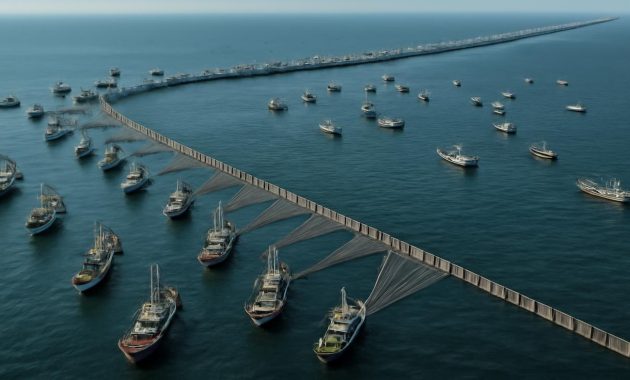
The first sign was the sound. A low, constant hum that began just before dawn—too mechanical for waves, too restless for wind. On the horizon, tiny silhouettes pricked the silver-blue edge of the sea, multiplying as the sun climbed. At first, the villagers along the scattered islands thought it was just another busy day in the South China Sea. Fishing fleets come and go. Nets are thrown and hauled. Diesel engines grumble and cough and fade. Life follows the tide.
But that morning, the sea didn’t sound like life following the tide. It sounded like something else—something marching.
A Wall That Floated In Overnight
By noon, the dots on the horizon had sharpened into hulls. Wooden, steel, fiberglass. Some were streaked with old paint; some still gleamed with the bright gloss of recent launch. At least a few hundred at first glance, then more as the haze lifted. Boats packed so tightly that from a distance the sea seemed almost paved.
Fishermen watching from their own decks counted in disbelief. Ten, fifty, a hundred—then gave up. Later, analysts would say the number was closer to 1,400 vessels, mobilised with the quiet efficiency usually reserved for military parades or space launches. But that morning, it was just an armada of small, ordinary fishing boats gliding into place with extraordinary purpose.
Nobody made a big announcement. There was no press conference, no grand declaration, just coordinates shared through official channels, quiet orders relayed to captains, and a choreography that had clearly been rehearsed on paper long before a single boat left port.
And then, almost as if guided by an invisible hand, those boats formed a line—a loose, living chain stretching and curving with the shape of the sea. A barrier, 200 miles long, had begun to materialise.
The Sea as a Quiet Battlefield
The South China Sea has been simmering for years—a place where maps blur into each other and maritime claims overlap like tangled fishing nets. It’s a sea of reefs and rocks, of tiny sandbars that become huge arguments. Warships pass, satellites watch, diplomats frown. But most days, what you actually see is something more modest: rust-streaked boats, sunburnt crewmen, and nets heavy with fish—or, increasingly, alarmingly light.
Yet as geopolitical tensions sharpened, something else began to appear on maritime radar: fleets of “fishing vessels” that did not always seem especially interested in fish. Ships that loitered together in tight formations, switched off their tracking systems, or followed suspiciously precise patterns—almost like units on patrol.
Analysts started calling this the “maritime militia”: civilians on paper, but organised and directed in ways that made them, effectively, an unofficial arm of the state. Not quite navy, not quite private. Something in between. Deniable, flexible, ever-present.
It was this vast, loosely assembled force that, on that quiet morning, started knitting itself into an artificial curtain on the open sea.
How Do You Build a Barrier Out of Boats?
To picture it, imagine tracing a 200-mile line across an ocean chart. Then, instead of building a wall of concrete or steel, you pepper that line with hundreds of moving dots—fishing vessels anchored or drifting in carefully spaced intervals. They are close enough to see one another, close enough to form a near-continuous presence, but far enough apart to plausibly claim they are just there for “normal activity.”
The barrier didn’t look like a dam or a fence. It looked like a dense constellation—flexible, shifting, but unmistakably deliberate. Underwater, long floating barriers, nets, and lines began to appear between some of the boats. Above water, flags fluttered: bright splashes of red and yellow, crisp characters, the occasional radar dish or military-style antenna that seemed out of place on a humble trawler.
Over the first 48 hours, the formation tightened. Vessels rotated in and out, like soldiers pulling shifts. Fresh boats arrived; others slipped away toward distant ports, their work for the day done. The effect was seamless. Where one hull left a gap, another slid into place, the “wall” pulling taut again, stretching across disputed waters, shadowing known shipping lanes, hovering near reefs that had already transformed into concrete outposts.
| Aspect | Details |
|---|---|
| Approximate number of vessels | ~1,400 fishing boats mobilised in coordinated formation |
| Barrier length | Roughly 200 miles across contested waters |
| Primary roles | Physical presence, surveillance, deterrence of foreign vessels |
| Tactics used | Anchoring in key areas, forming dense clusters, use of floating barriers and coordinated movement |
| Impacted parties | Neighboring coastal communities, regional navies, commercial shipping, marine ecosystems |
The Day the Local Boats Turned Back
In a sleepy harbor a few dozen miles away, a Filipino fisherman named Elias started his morning the way his father and grandfather had: with instant coffee, a cracked plastic mug, and a wary look at the sky. Storm season was close, and the weather had been strange lately—winds arriving from the wrong direction, waves stacking at odd angles, fish migrating in unexpected patterns. But storms, at least, were familiar. You could smell them. You could read them.
That day, what waited offshore wasn’t a storm. It was a line.
As Elias and his crew approached their usual fishing grounds, the horizon gradually resolved into a forest of masts and hulls. Boats were anchored in places that should have been open water. Men on deck watched them approach, some with binoculars, some with phones lifted at eye level, quietly filming. A loudspeaker crackled from one of the larger vessels. The message was curt, the language foreign to Elias’s ears, but the intent was unmistakable: Turn back.
“We just stared,” he would later tell a visiting journalist. “It didn’t look like fishing. It looked like a fence that could move.”
He tried skirting around it, but the wall flexed. A handful of boats edged closer, closing the gap, engines revving low and threatening. No collision, no direct contact—just an insistent, silent push. The message, again: These waters are not for you.
By the time Elias finally turned his own bow toward home, the sun was high, and his nets were empty. Behind him, the 200-mile barrier lay across the water like a long, thin shadow.
The Politics Hiding in Plain Sight
On satellite imagery, the pattern was unmistakable: a thickening line of tiny white specks tracing a controversial route across one of the most contested seas on the planet. Intelligence analysts traced hull numbers, cross-checked registries, zoomed in on deck equipment. Many of the vessels had the usual fishing gear: winches, reels, nets. But others carried little more than rusted cranes and unmarked crates. Some radiated powerful radio signals. Some stayed for weeks in the same exact spot, even when fishing would have demanded they move on.
It was, in every sense, a strategic statement disguised as routine livelihood.
By mobilising civilian fishing boats instead of warships, China had built something that was simultaneously less threatening and more insidious. A navy patrolling these lines would have set off alarms in every capital around the region. But a long ribbon of fishing boats? That’s messier. Harder to condemn outright. Easier to call “normal.” If another country’s ship tried to challenge them, any incident could be framed as an accident, a misunderstanding, a clash between simple fishermen just trying to make a living.
This is what some defense scholars call “gray zone tactics”—actions that are neither open war nor simple peace. They sit in the blurry zone in between, slowly shifting facts on the ground (or, in this case, on the water) without triggering the kind of clear-cut aggression that demands an equally clear-cut response.
What does sovereignty look like when it’s enforced not with gunboats, but with rope, diesel, and stubborn presence? Increasingly, it looks like this: a horizon filled with the same small, practical boats that have worked these waters for generations, now repurposed into pieces of a much larger game.
The Human Cost Behind the Strategy
To understand the quiet violence of that transformation, you have to step back onto the docks—not in China’s vast coastal cities, but in the smaller, scattered communities that ring the disputed seas. In Vietnam, the Philippines, Malaysia, Indonesia, local fishermen have been navigating these waters for centuries by memory and starlight. They know which reefs sound hollow under the hull when waves pass by, which shoals glitter with sardines when the moon is thin.
Those unwritten maps are now being overwritten by coordinates filed in government offices far away. Each new line of boats, each floating barrier, each “temporary” fishing shelter poured in concrete upon a reef, redraws what is possible for coastal people whose lives have always been drawn with salt and tide.
Elias isn’t alone. Stories echo across the region: a Vietnamese captain whose nets were slashed after he refused to leave a spot his father fished in the 1970s; a Malaysian crew chased for hours by vessels that shone bright searchlights into their wheelhouse; Indonesian fishers who report seeing unusual, almost militarised discipline among certain “fishing” fleets—uniform jackets, matching radios, movement that followed invisible orders rather than the shifting will of the sea.
The result, for many, is a slow suffocation rather than a single dramatic loss. Each trip out becomes a longer detour around new no-go zones. Each season they must steam farther to find waters that are still open, still safe, still reasonably full of fish. Fuel costs rise. Catches fall. The margins—already razor-thin—erode.
When the Sea Becomes a Fence
There is something viscerally unsettling about an ocean that behaves like a border wall. Water is supposed to be open, shifting, indifferent to lines on paper. Waves don’t stop at invisible checkpoints; currents don’t respect national narratives. And yet, more and more, the South China Sea behaves like a partitioned space, with unofficial corridors and guarded pockets of “ours” and “theirs.”
The 200-mile barrier of fishing boats is both symbol and instrument of that shift. It doesn’t completely block passage—large vessels can still sometimes thread through; warships can shadow the line from a distance. But it sends a powerful message about who can linger, who can drop a net, who can claim familiarity with this water.
Look closely, and this barrier is not just physical. It’s informational. Every boat in that chain is a sensor: eyes on the horizon, cameras in hand, radios crackling. They note who passes and how close. They photograph flags and hull numbers. They pass those observations back up a chain of command that rarely shows its face, feeding a vast, quiet picture of movement across the sea.
It is also ecological. Nets strung along parts of the line catch not only fish but drifting debris, turtles, sometimes dolphins. Anchors scrape across coral that has already been damaged by dredging and construction. Sediment rises; reefs suffocate. The very richness that made these waters worth contesting—teeming fisheries, wild coral gardens—begins to thin under the pressure.
What Happens When a Barrier Feels Normal?
The most disquieting part may not be that the barrier appeared, but that it could, in time, start to feel ordinary. Humans have a remarkable ability to adapt to new limits. A channel once considered part of a community’s backyard sea becomes an area they just “don’t go anymore.” Maps get redrawn quietly in schoolbooks. Shipping companies adjust routes. Military planners incorporate the new “reality” into training exercises.
The sea, once understood as a shared, fluid commons, hardens into something else: a chessboard where each square is contested not by the movement of waves, but by the slow, deliberate placement of assets—reefs turned into airstrips, lighthouses turned into radar sites, and fishing boats turned into beads on an invisible string of control.
When that happens, the original outrage—the shock that “nobody saw it coming”—dims into the background hum of yet another fait accompli. The wall of boats, once an improbable sight, becomes as unremarkable as a line on a map.
The Future Written in Saltwater
Late in the evening, when the sun leans low and the sea turns the color of bruised metal, the barrier takes on a strange, spectral beauty. White wakes trail behind shifting boats like threads of lace; the glow of deck lights winks on one by one, forming a dotted necklace across the horizon. From a distance, it could be mistaken for a floating town, a temporary, drifting city whose streets are made of currents and tides.
On one of those boats, a young crewman might be scrolling through videos on his phone, watching clips of city life hundreds of miles inland. He might not think of himself as a piece of an enormous, controversial puzzle—just a worker on a long, demanding trip, waiting for his next watch. The orders to move, to anchor, to hold a line arrive through his captain, not as grand strategy but as a simple instruction: go here, stay there, wait.
On a smaller boat miles away, a rival fisherman from another country might be staring at the same line of lights, calculating fuel, arguing with himself about whether to risk slipping through a gap. He weighs the old map in his head against the new reality in front of his eyes. This is where the fish are. This is where trouble is. At some point, he turns his bow either toward home or into the thin spaces between hulls, accepting whatever may come.
Between those two men lies the heart of this story: an ocean becoming less like a wild, shared space and more like a quiet battlefield, where the instruments of power no longer always look like guns or missiles, but like everyday tools of work. A trawler. A net. An anchor line pulled tight, stretched not just across miles of contested water, but across the future itself.
Frequently Asked Questions
What is meant by a 200-mile artificial barrier made of fishing boats?
It refers to a long, coordinated line of fishing vessels positioned across disputed waters. While each boat can claim to be acting independently, together they create a continuous presence that functions like a barrier—deterring other countries’ ships from fishing, surveying, or freely navigating in that area.
Are these boats actually part of the military?
Officially, most are registered as civilian fishing vessels. However, many analysts believe that a portion of them operate as a “maritime militia”—crews that receive direction, support, or incentives from state authorities to patrol, monitor, and assert territorial claims while maintaining civilian cover.
Why would a country use fishing boats instead of warships?
Using fishing boats allows a country to project power and enforce its claims without the overt aggression of deploying warships. It blurs the line between civilian and military activity, making any incident easier to frame as a misunderstanding rather than a deliberate military provocation, and it complicates how other nations can respond.
How does this affect local fishermen from neighboring countries?
Local fishermen often find themselves pushed out of traditional fishing grounds as these barriers and dense fleets occupy more space. They may face harassment, dangerous encounters at sea, longer trips to find viable waters, higher fuel costs, and shrinking catches—threatening their livelihoods and food security.
What are the environmental consequences of such a barrier?
Concentrated fishing pressure, use of nets and floating barriers, and frequent anchoring can damage reefs, deplete fish stocks, and disrupt marine ecosystems. Combined with construction on reefs and increased sediment, these activities accelerate the degradation of one of the world’s most biodiverse marine regions.
Is this kind of tactic unique to the South China Sea?
The specific scale and intensity seen in the South China Sea are unusual, but the broader idea of using civilian or quasi-civilian vessels for strategic purposes appears in other regions as well. However, the combination of dense fishing fleets, overlapping territorial claims, and major-power rivalry makes this case particularly stark.
Can anything be done to reverse or limit this kind of maritime barrier?
Responses range from diplomatic negotiations and legal challenges to international monitoring and joint patrols by affected countries. Transparency, documentation of incidents, and pressure through regional institutions can help, but the slow, incremental nature of these tactics makes them difficult to fully roll back once they’ve become part of the seascape.