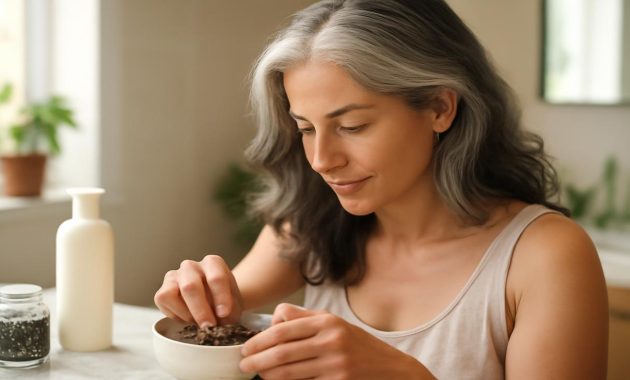
The first time Elena noticed the streak, it wasn’t under the unforgiving lights of a bathroom mirror, but out in the garden, in the easy honesty of late afternoon sun. She bent to pull a weed beside the thyme, and a loose strand fell across her nose—soft, silver, and startling against the dark brown she’d claimed as part of her identity for decades. By evening, the strand had multiplied in her mind. By morning, she was standing in the drugstore aisle, fingers tracing rows of boxes promising “eternal chestnut,” “youthful mahogany,” and “100% grey coverage,” each one a quiet pact with chemistry.
For years, that was the ritual: the gloves, the smell that stung the back of her throat, the waiting, the rinsing, the strange guilt that came with watching the water run ink-dark down the drain. Then, one winter, Elena’s scalp began to itch. Not the “maybe I didn’t rinse well enough” itch, but a persistent, angry reminder that her body was done being negotiated with. And so, one evening—tired, raw, and oddly curious—she went online and typed the words that would change everything: “natural way to restore hair colour after grey.”
When Grey Hair Meets the Internet’s Favorite Miracle
Hidden among the usual tips—more iron, more vitamin B, manage your stress, accept aging with grace—something different began to appear. Posts. Videos. Home-shot, badly lit clips of people in bathrooms and kitchens holding up… conditioner bottles. Not fancy salon products, not obscure imported oils. Just simple, cheap hair conditioner, the kind you’d toss into your basket on autopilot.
The claim was as bold as it was bewildering: “My natural hair colour is coming back. I’m reversing my greys… with conditioner.” Some showed before-and-after photos—yellowy-grey strands in one frame, softer, darker, more pigmented hairs in another. Not midnight black or dye-job red, just… their old colour, back again, they insisted, as if it had been hiding under the surface, waiting patiently for something gentler.
Elena watched them all. Women in their forties clutching plastic combs. Men in their sixties, running fingers through salt-and-pepper beards suddenly more pepper than salt. A grandmother from Lisbon holding up a tiny jar of white cream like a relic. The story was always the same: “I stopped dyeing. I started using this cheap conditioner trick. Months later, my natural hair colour is returning.”
Depending on where you clicked, the tone swung wildly. Some spoke in the language of small miracles. Others rolled their eyes so hard you could almost hear it through the screen. It was either a quiet revolution in a bottle or the internet’s latest nonsense dressed up as hope. But in between the extremes lived something more complicated—and more human: a question we rarely ask with genuine curiosity.
What if your hair isn’t done telling its story yet?
The Cheap Conditioner Trick Everyone Argues About
The trick, as people describe it, sounds almost disappointingly simple. No secret potion. No alchemy. Just this:
- Stop using permanent or semi-permanent chemical dyes.
- Switch to a basic, silicone-light or silicone-free conditioner—cheap, unassuming, nothing fancy.
- Use it often. Really often. Sometimes daily. Sometimes as an overnight mask.
- Massage it into your scalp instead of just sliding it over the ends.
- Stick with it for months, not weeks.
The idea isn’t that the conditioner itself contains pigment. That’s where the critics are quick to pounce. “Conditioner is not hair dye,” they say. “It can’t change melanin.” Technically, they’re right. But this isn’t exactly about turning grey white hair into midnight black. It’s about something stranger, subtler—a shift that seems to happen not across all hair, but in scattered strands, usually at the roots, sometimes in the temples, sometimes at the nape, where the hair grows thick and stubborn.
People who swear by it describe the first changes in almost sensory terms. They talk about how their hair begins to feel different first—less wiry, less fragile, more like the hair they remember from younger years. Then, slowly, almost shyly, a darker sheen appears at the roots. Not a dramatic line of demarcation like you’d get from dye, but a kind of soft shadow, a whisper of pigment.
“It was like watching colour seep back into an old photograph,” one man wrote in a comment thread. “Not fake, not painted on—just… returning.”
Is it science? Is it placebo? Is it a coincidence timed with a change in diet or stress or sunlight? Or is something quietly real happening beneath the scalp, beneath the arguments, beneath the need to be either amazed or dismissive? The only honest answer is: it depends who you ask—and how you define “real.”
Between Folklore and Follicles
Long before internet hacks, people massaged oils, herbal rinses, and strange concoctions into their hair, believing they could coax colour, shine, or thickness back from the edge. Black sesame seeds. Amla. Rosemary steam. Onion juice. Most of these traditions weren’t about painting colour onto hair; they were about feeding the scalp, nudging the roots, persuading the body to remember an earlier version of itself.
The conditioner trick borrows from that old instinct: not to force, but to ask. Because simple conditioner—especially the kind without a cocktail of suffocating silicones and perfumes—does one achingly basic thing well: it softens and hydrates. The hair shaft, yes, but also the skin it springs from.
Our scalp, like soil, changes with age. Drier. Thinner. Less elastic. Follicles that once worked like tiny factories slow down. Cells that manufacture melanin—the pigment that colours our hair—begin to fall silent. For some, that silence is permanent. For others, it’s more like a pause. And this is where the stories begin to diverge into either quiet wonder or chilly skepticism.
Those who’ve seen their colour return don’t talk about waterfalls of youth. It’s always patchy, uneven, incomplete. A scattering of darker strands where there was once uniform pale grey. Enough to notice, but rarely enough to erase the passing years. In other words, not enough to sell as a miracle—but exactly enough to feel like one.
What’s Actually Happening Under There?
Imagine your hair follicle as a tiny, crowded workshop. Inside, two things are being assembled at once: the hair shaft (the actual strand) and the pigment that colours it. As we age, factory workers go on break and don’t always come back. Some do. Some don’t. Genetics dictate a lot of this, but environment, nutrition, hormones, and stress whisper instructions at the door too.
The harsh chemicals in permanent dyes can act like a loud, disruptive neighbour to this workshop—especially when used often, over many years. Ammonia, peroxide, PPD: they break through, swell the hair shaft, strip pigment, and replace it with artificial colour. In the process, they can irritate the scalp, inflame the skin, and nudge already-tired follicles closer to retirement.
When people ditch those dyes and switch to simple conditioner, they’re doing more than swapping colour for cream. They’re removing an ongoing attack and replacing it with a daily act of softness. That massage, that slip of fingers across the scalp, that decision to let the head breathe… it all adds up.
Is that enough to wake pigment cells back up? Large-scale science hasn’t answered that fully yet. There are a few clues tucked into unrelated studies: we know that hair can, in some rare cases, regain pigment after illness, stress, or even certain medications are discontinued. We know that oxidative stress—an invisible storm of cellular damage—plays a role in greying. We know that reducing inflammation and damage sometimes allows the body to resume old functions, like tiny factories restarting after a blackout.
So when someone says, “My greys are reversing after months of using only conditioner,” what’s true? It could be that they never had completely shut-down follicles in the first place—just half-asleep ones, still capable of producing pigment under kinder conditions. It could be that they are, quite simply, the lucky exception. Or it could be that they’re seeing what they want most to see: hope, made visible, strand by strand.
Miracle or Nonsense? The Debate Gets Personal
Scroll through any forum where this trick is discussed, and you’ll find two camps staring each other down.
In one camp stand those who speak with the fervor of the newly converted:
- “I thought I’d be dyeing my hair until I died. I haven’t touched a box in two years, and my natural brown is creeping back along my hairline.”
- “I don’t care what the science says, I see what I see. My greys are softer, darker, fewer.”
In the other camp are those who value precision over wonder:
- “Grey hair is dead tissue. You can’t ‘turn it back’ with conditioner.”
- “If colour returns, it’s because some follicles hadn’t fully lost their pigment-making ability yet. Conditioner is not the hero here—time is.”
Both camps, in their own ways, are right—and missing something. The truth is that hair isn’t just a biological fact; it’s a biography. For many of us, the colour of our hair is tangled up with how we see ourselves in the mirror, how we move through rooms, how we are seen by others. When that colour changes, it isn’t just a shift in pigment—it’s a shift in story.
Calling the conditioner trick a miracle ignores the quiet complexity of the body. Dismissing it as nonsense ignores the quiet complexity of human experience. Somewhere in the middle lies something more interesting: how a daily, tactile, caring ritual can alter not only our appearance, but our relationship with time.
What People Actually Do: Rituals, Not Recipes
Across different versions of the story, certain patterns repeat. No one is just slapping on conditioner and walking away. They’re building tiny rituals—small, unhurried moments that anchor their days.
| Ritual Element | How People Describe It |
|---|---|
| Scalp massage with conditioner | 3–5 minutes in the shower, fingertips circling slowly, focusing on temples and hairline. |
| Overnight conditioning | A thin layer combed through damp hair, wrapped in a soft scarf, washed out in the morning. |
| Dye detox period | 6–12 months of no chemical colour, even when roots feel unbearable. |
| Gentler washing habits | Less frequent shampooing, more co-washing (washing with conditioner only). |
| Lifestyle tweaks | Better sleep, more whole foods, reduced stress—often adopted at the same time. |
Some light candles when they apply their conditioner, turning it into a tiny ceremony. Others use the time to check in with their bodies, pressing fingertips along the scalp, feeling for tension. The trick becomes less about colour and more about contact: hand to head, person to self.
The people who notice the most change are almost always the ones who stick with this for a long time—not a week, not a month, but seasons. They grow out their roots. They endure the awkward in-between. They watch the weather of their hair shift the way you watch a sky slowly darken before rain. Gradual. Uneven. You don’t know which cloud will finally break.
The Quiet Gift of Letting Grey Stay
Here’s the part that rarely makes it into the viral headlines: many people who try the conditioner trick eventually decide not to chase their old colour at all. Somewhere along the way—while massaging, waiting, observing—they fall in love with the hair they actually have.
They notice the way silver threads catch sunlight differently, cool and luminous. They feel the relief of no longer scheduling their lives around dye jobs. They discover that softness can be more flattering than saturation, that shine matters more than shade, that confidence changes the whole equation.
For these people, any return of natural colour is a curiosity, not a salvation. An interesting footnote in a larger story about listening to their bodies instead of fighting them. Sometimes, yes, they see patches of darker hair emerging at the nape or temples. Sometimes they don’t. But they keep conditioning. Keep massaging. Not for the promise of reversal—but for the pleasure of care.
So… Should You Try It?
If you’re reading this with a bottle of conditioner already in your shopping cart, here’s the most honest advice anyone can give you:
- Don’t do it for a guarantee. Do it for an experiment.
- Give it time—longer than feels reasonable. Hair grows in months, not days.
- Notice everything, not just colour: texture, shine, comfort of your scalp, the way you feel in your own skin.
- Allow for multiple truths: your experience might not match anyone else’s.
For some, grey hair is a quiet horror they never quite prepared for. For others, it’s a badge—a soft, silver flag of wisdom. Most of us fall somewhere in between, tugged by vanity on one side and acceptance on the other. The cheap conditioner trick, in all its mess and muddle and controversy, sits right at that crossroads.
Is it miraculous? Not in the way marketing uses the word. Is it nonsense? Not if you listen closely to the lives it touches. It’s something else entirely: a small, daily, tactile way of asking your hair, “What happens if I’m gentle with you?” And then waiting long enough to hear the answer.
Listening to Your Own Reflection
One spring morning, about a year after Elena boxed up her last dye kit, she leaned over her kitchen sink to clip a stray basil stem for breakfast. The light caught her hair at an angle she hadn’t seen before—soft, frizz-tamed waves pulled back with a cloth band. Along her hairline, what had once been a harsh stripe of silver now blended into something warmer, like the faded wood of an old table. Here and there, at the roots, tiny shadows of her old brown flickered.
She touched them. Not with triumph or disbelief, but with a sort of gentle amusement. “So you’re still in there,” she murmured to her reflection in the window. “Good to know.”
But as she rinsed conditioner off her hands in the sink, she realized something quiet and important: whether her hair chose to be silver, brown, or something in between, her ritual would stay. The slowing down. The massage. The choice to nurture instead of override. The colour, in the end, felt more like a side effect than the point.
Maybe that’s the real shift happening now, as millions toy with this trick, argue about it, swear by it, or laugh it off. Not a mass reversal of grey across the world, but a more subtle, more powerful reversal: moving from controlling our bodies at all costs to caring for them at any colour.
Perhaps the miracle isn’t that some strands darken again. Perhaps it’s that we’re finally learning to meet our aging selves in the mirror with curiosity instead of complaint, fingertips dipped in conditioner, ready to listen.
FAQ
Can conditioner really reverse grey hair?
Conditioner itself does not contain natural pigment and cannot “dye” grey hair back to its original colour. However, some people report that after stopping chemical dyes and using conditioner regularly on their scalp, a portion of their hair regrows with more of its natural colour. This likely reflects follicles that were not completely “switched off” in terms of pigment production, rather than a magical property of conditioner.
How long does it take to see any changes?
For those who report changes, it usually takes several months—often six to twelve—of consistent use and no chemical dye. Hair grows slowly, and any shift in pigment will only appear in new growth at the roots.
What kind of conditioner works best for this?
People tend to favor simple, affordable conditioners that are light on heavy silicones and harsh fragrances. The focus is on hydration and scalp comfort rather than fancy active ingredients. There is no single “best” brand; consistency matters more than the label.
Is this method safe?
For most people, using regular conditioner on the hair and gently on the scalp is safe, especially compared with frequent chemical dyeing. However, anyone with sensitive skin, dermatitis, or allergies should patch-test new products and consult a dermatologist if irritation occurs.
Will this work for everyone with grey hair?
No. Genetics, age, health, and the degree of pigment loss all play major roles. Some people will see no change in colour at all, even with diligent care. Others may see partial darkening or scattered pigmented strands. Improvements in softness, shine, and comfort of the scalp are more common than significant colour return.
Can I still use temporary or natural dyes while trying this?
You can, but any additional colouring—especially if it involves strong chemicals—may irritate the scalp and make it harder to know what changes are truly coming from your own follicles. Many people who experiment with this approach choose a “dye detox” period to give their hair and scalp a clear break.
Is this just placebo?
Placebo—our expectations shaping what we notice—is likely part of the story, especially when changes are subtle. At the same time, there is evidence that hair pigment can sometimes return after stress or damage is reduced. For now, science doesn’t fully explain every personal report. The safest way to approach it is as a gentle self-care experiment, not a guaranteed cure.