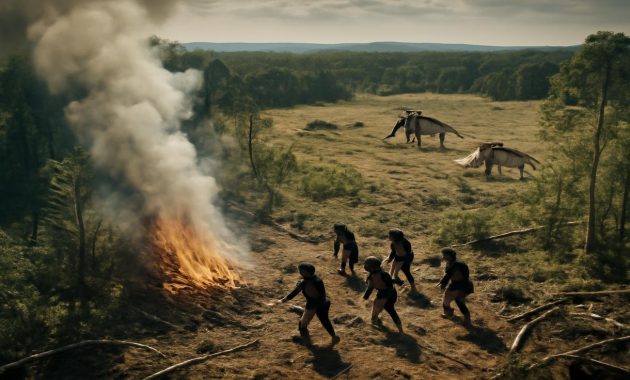
The first time you hold a stone tool in your hand, the kind a human chipped into shape fifty thousand years ago, the air around you seems to thin. Your thumb finds the worn groove where another thumb once rested. You imagine the sharp, rapid taps of one stone on another, the burst of flint, the small puff of dust, the particular smell of freshly broken rock—a scent that hasn’t changed since mammoths roamed river valleys. It feels intimate, almost tender. The story we like to tell is simple: once, long ago, humans lived lightly on the Earth, moving softly through forests and along coasts, taking only what they needed. Only later, with cities and engines and smokestacks, did we become a planetary force.
But the land, it turns out, has a longer memory than our stories.
The Ghosts Under the Grass
On a cool morning in southern Africa, a team of paleoecologists walk across a grassland that, at first glance, appears untouched. Golden stalks lean in the wind like a slow wave. A distant jackal flickers across the horizon. There is almost nothing here to suggest human presence—no roads, no wires, no buildings. And yet, buried a few feet under the soil, the record tells another story.
In sediment cores pulled from old lake beds, scientists are finding pollen grains, charcoal flecks, and microscopic fossils that read like a time-lapse diary of ecological change. Layer by layer, they can see how ancient plants and animals shifted in response to climate swings, volcanic eruptions, and something else—something that doesn’t fit the usual pattern.
Thousands of years before the first city walls were raised in Mesopotamia, before wheat fields rolled across Europe, animals began vanishing. Giant sloths in the Americas, enormous marsupials in Australia, elephant-like beasts and towering birds in many parts of the world disappeared in pulses. The climate was warming at the end of the last Ice Age, yes, but many of these species had survived earlier warmings. This time, something different was walking the Earth: us.
For decades scientists argued over the role of ancient humans in these extinctions. Were we merely witnesses to a changing planet, or executioners with spears and fire? Newer evidence—refined dating methods, ancient DNA, more precise climate reconstructions—is slowly shifting the balance. Again and again, researchers find that when humans arrive in a new landscape, the ecosystem bends, sometimes breaks, around them.
More Than Just Hunters
The old stereotype paints ancient humans as simple hunter-gatherers: wandering bands tracking herds, plucking berries, sleeping under the stars and leaving almost no trace. But as scientists climb cliffs to read charcoal layers, scan seafloors for old shorelines, and analyze soot trapped in ancient ice, a different picture comes into focus.
People were not just taking what nature gave them; they were remaking nature to better fit their needs. In Australia, for example, evidence of widespread, repeated burning goes back tens of thousands of years. These weren’t random wildfires. The timing and pattern suggest deliberate use of flame to open dense forests and coax out grasslands that attracted game—a kind of early landscape engineering sometimes called “fire-stick farming.”
In the Amazon, long believed to be a primordial wilderness, archaeologists are revealing geometric earthworks hidden beneath the canopy, vast patches of unusually fertile “dark earth,” and ancient orchards of fruit and nut trees arranged in patterns that look suspiciously like design, not chance. Coastal wetlands show signs of carefully tended shellfish beds. In eastern North America, the pattern of species in certain forests hints at long-term human preference for particular nut-bearing trees, subtly boosting some species while suppressing others.
None of this looked anything like industrial agriculture. There were no tractors, no synthetic fertilizers, no buzzing grid of power lines. But the ecological consequences could still be profound. When you consistently burn, plant, favor, and hunt, the composition of plant and animal communities tilts. The world that later Europeans and modern scientists would call “natural” was, in many regions, already a long co-creation between people and place.
Reading the Planet’s Old Scars
One of the most revealing tools in this unfolding story is something as unassuming as a cylinder of mud. Researchers on small boats lower long, hollow tubes into lake bottoms or bogs, then drag them back up carrying layered rings of history. Each millimeter can represent years, even decades, of settled pollen grains, ash, and dust.
When they examine those layers, certain patterns jump out. Sharp spikes in charcoal, for instance, mark an uptick in fire. After some of these spikes, the pollen record changes: fire-sensitive trees decline, fire-adapted grasses expand, shrubs take over. Sometimes the climate data suggests no obvious drought or lightning-related cause. So what changed?
Often, the answer aligns almost eerily with archeological evidence of human arrival or population growth. As people spread into new territories after the Ice Age, the landscape around them frequently shifted, not just through direct hunting and gathering but through intentional burns and habitat modification. In parts of Europe, dense forests retreated centuries before widespread farming, hinting at long periods of low-level human disturbance—cutting, burning, encouraging open woodlands rich in game.
Ancient bones tell a similar tale. In South America and Australia, the timing of megafauna collapse—the loss of enormous herbivores and predators—lines up closely with human arrival. While changing climate certainly played a role, models that include even modest hunting pressure by humans often recreate the pattern of extinction far more accurately than climate alone. When the big plant-eaters vanish, the entire vegetation structure can flip, sometimes permanently.
It’s a bit like pulling engineers out of a dam. You might not see the effect immediately, but over seasons and centuries, water carves new channels, floods some valleys, dries others. Ancient humans, it seems, were already tugging at crucial keystones in the ecological arch.
The Surprising Weight of “Small” Impacts
One of the strangest lessons from this research is just how influential a relatively small number of people can be when their actions line up with ecological leverage points. Even simple technologies—fire, stone-tipped spears, later bows and arrows—allowed ancient communities to push past the natural limits imposed on most predators.
Unlike other carnivores, humans were flexible. If large prey became scarce, they could switch to smaller animals, shellfish, or plants. They could share tips about new hunting spots, store knowledge in stories, and pass it down. Over generations, this capacity meant sustained pressure on vulnerable species with slow reproduction rates—mammoths, giant kangaroos, flightless birds taller than a person.
We also tended to favor the largest animals first, the way a modern fisher might seek the biggest fish. But big animals have outsize roles in ecosystems. They knock down trees, spread seeds, shape riverbanks. Remove them, and entire landscapes reorganize. Grasslands may give way to shrublands; nutrient flow from rivers or coasts into inland areas can shrink. Fire regimes change when there are fewer huge herbivores to eat the fuel.
If we try to imagine this impact in more modern terms, it helps to think in scales of influence, not just population size. A small group of people regularly burning sections of savanna at the right (or wrong) time can transform thousands of hectares over decades. Repeatedly harvesting particular shellfish sizes from a reef nudges evolution toward earlier reproduction and smaller average size. Planting or favoring a few tree species along migration routes of game animals can, over many generations, redraw the map of a forest.
| Ancient Human Activity | Ecological Effect | Modern Parallel |
|---|---|---|
| Regular landscape burning | Shift from closed forest to mosaic of grassland and scrub; altered fire regimes | Prescribed burns, agricultural clearing |
| Selective hunting of large animals | Megafauna decline or extinction; reshaped vegetation and nutrient cycles | Overfishing of large predatory fish, trophy hunting pressure |
| Tending wild plant species | Higher abundance of useful trees and shrubs; early domestication pathways | Agroforestry, backyard gardening shaping urban ecosystems |
| Managing coastal resources | Changes in shell size, reef structure, and shoreline ecology | Modern shellfish aquaculture, reef gleaning |
None of these shifts involved fossil fuels or concrete. Yet taken together, over continents and millennia, they represent a surprisingly heavy footprint for people living by firelight.
Rethinking “Pristine” Nature
Walk into a national park today and you’ll often see signs describing the area as “untouched wilderness.” The implication is that this is what the world looked like before we interfered. But in many places, that’s an illusion created by a much more recent disruption—the removal or displacement of Indigenous communities who had tended those landscapes for generations.
In parts of North America, for instance, the suppression of traditional Indigenous burning after European colonization led to thicker, more uniform forests and a buildup of fuel that has fed increasingly catastrophic wildfires. What was once a patchwork of open woods, meadows, and regularly tended undergrowth became choked and brittle. The very “wildness” some early conservationists prized was, ironically, the result of forgetting that humans had long been part of the ecological equation.
Similarly, the Amazon’s apparently “untouched” deep forests often conceal legacies of human design beneath their leaves. When scientists map species distributions, they see certain useful trees—like Brazil nut, cacao, or palm species—clustered in patterns best explained by ancient trade routes and settlement sites. Even far from any known ruins, the forest composition whispers evidence of human preference.
Recognizing this does not mean that every corner of Earth was always heavily managed or that all Indigenous practices were benign. There were likely local collapses and overuses long before the modern era. But the emerging picture is one of entanglement rather than separation. Human and non-human histories are braided together far earlier than we once believed.
That realization disrupts a comforting narrative: that there was once a clean dividing line between nature “over there” and humans “over here.” Instead, we find continuous negotiation. Land and people in conversation, sometimes gentle, sometimes harsh, but rarely absent from one another.
The Long Roots of the Anthropocene
Scientists have a word for the age in which human activity becomes a dominant force shaping Earth’s systems: the Anthropocene. There’s a lively debate about when, exactly, this age began. Some argue for the mid-20th century, when nuclear tests left a signature in sediments worldwide and plastic, concrete, and fertilizer use exploded. Others push the start back to the Industrial Revolution, with its coal smoke and mass manufacturing. A few suggest an even earlier threshold: the Columbian Exchange, when European arrival in the Americas triggered a vast swap of species, diseases, and crops between hemispheres.
Yet the deeper we look into the past, the more we see faint Anthropocene shadows stretching back. Ancient humans were not changing the chemistry of the entire atmosphere like we are today, but they were certainly changing local climates through deforestation and fire. They were rearranging biogeography by escorting plants and animals across mountains and seas. They were already amplifying extinction rates beyond background levels in many regions.
Perhaps it’s less useful to search for a single switch-flip moment and more honest to imagine a long incline—a gradual ramp of influence that steepened as our technologies and numbers grew. On that ramp, the last century is the near-vertical rise at the end, but the slope begins far earlier, somewhere in the smoky glow of the first controlled fires and the quiet crunch of an overhunted shoreline.
This perspective doesn’t excuse our current trajectory. If anything, it raises the stakes. We’ve always had the power to tilt ecosystems; now we have the power to flip them wholesale. And we’ve lost some of the humility and intimacy that came from living close enough to the land to feel its immediate response.
Lessons in Living With, Not Above, the World
Once we accept that ancient humans left a bigger ecological footprint than scientists once thought, a tempting conclusion is cynicism: humans have always wrecked things, so why bother trying to do better now? But that’s not the only story threaded through the evidence.
The same records that show our capacity for damage also show deep reservoirs of knowledge and care. Fire, for instance, wasn’t always a blunt instrument of destruction; for many Indigenous cultures it was, and still is, a scalpel wielded with precision—used at specific seasons, intensities, and frequencies to nourish particular plants, clear undergrowth, and maintain biodiversity.
Preindustrial land use in some regions appears to have increased local diversity by creating a mosaic of habitats—open clearings, young regrowth, mature forest, wetlands—that allowed more species to coexist. Traditional fishing practices built around taboos, seasonal closures, or sacred no-take zones functioned as early forms of adaptive management, giving animal populations time to recover.
What changes when we revise our image of the past is less our sense of human guilt than our sense of human possibility. If people once reshaped landscapes with simple tools and deep attention, perhaps we can now reshape them again with more sophisticated science and a revived humility. Not to chase some mythic “pristine” state that may never have existed, but to design for resilience, beauty, and fairness.
It also means listening much more carefully to Indigenous communities whose knowledge systems have always assumed that humans and ecosystems co-create one another. Reintroducing cultural burning, supporting Indigenous-led conservation, and weaving traditional ecological knowledge into modern policy are not nostalgic gestures; they are practical strategies grounded in thousands of years of feedback from the land itself.
Walking Forward With a Longer Memory
Imagine you are sitting again with that ancient stone tool in your palm. Its edges are still sharp enough to cut. Its weight is modest, but not nothing. You realize that the person who made it lived in a world already touched by generations before them—forests thinned in places, animals more wary, certain plants unusually abundant near camp. Their choices, like yours, fell into a web of consequences spun long before they were born.
We are heirs to that web, whether we acknowledge it or not. The discovery that ancient humans left a larger ecological footprint than once believed doesn’t let us off the hook for the brutal acceleration of the last few centuries, but it does strip away illusions. There was never a version of humanity entirely separate from nature. There was only this: a clever, fire-using primate negotiating, sometimes clumsily, with the rest of life.
The question now is what kind of negotiators we want to be. We cannot go back to Ice Age savannas or pre-Columbian forests. But we can decide, consciously, what to cultivate: Which species to make room for, which rivers to un-dam, which fires to light and which to let die out. We can choose whether our footprint is a stomp, a scar, or something more like a careful track on a well-loved path.
Somewhere, thousands of years from now, someone may read the layers we leave behind: the composition of our soils, the bones of the animals we favored and discarded, the seeds of the plants we spread, the chemical fingerprints of our choices. They will know us not just from our machines and our buildings, but from the shapes of forests and coastlines, the absence or presence of certain songs at dawn.
We have always been world-makers. The difference today is that we know it, and that knowledge is both a warning and an invitation.
Frequently Asked Questions
Did ancient humans really cause extinctions?
In many regions, yes. Evidence from fossils, dating methods, and climate records suggests that the arrival of humans often coincided with the decline or extinction of large animals, especially species with slow reproduction. Climate change played a role, but human hunting and habitat modification frequently tipped vulnerable populations over the edge.
How is ancient human impact different from modern impact?
Ancient impacts were usually local or regional, driven by tools like fire and simple hunting technology. They reshaped ecosystems but did not alter the entire planet’s climate or chemistry. Modern impacts are global in scale, amplified by fossil fuels, industrial agriculture, and rapid population growth, affecting oceans, atmosphere, and biodiversity worldwide.
Were Indigenous land practices always sustainable?
Not always and not everywhere. There were likely cases of overuse and local collapse in the past. However, many Indigenous cultures developed sophisticated, place-based systems of management—such as controlled burning, rotational harvesting, and sacred no-take zones—that supported long-term ecological resilience.
Does recognizing ancient human impacts weaken arguments for conservation?
It actually strengthens them. Understanding that humans have always shaped ecosystems helps us move beyond the myth of “untouched wilderness” and toward a more realistic goal: actively and responsibly managing landscapes to support biodiversity, climate stability, and human well-being, often in partnership with Indigenous knowledge holders.
What practical lessons can we learn from ancient ecological footprints?
Key lessons include the power of small, repeated actions; the outsized influence of targeting large species; the importance of fire as a management tool rather than just a threat; and the value of diverse, mosaic landscapes. These insights can inform modern restoration, climate adaptation, and conservation strategies that work with, rather than against, ecological processes.