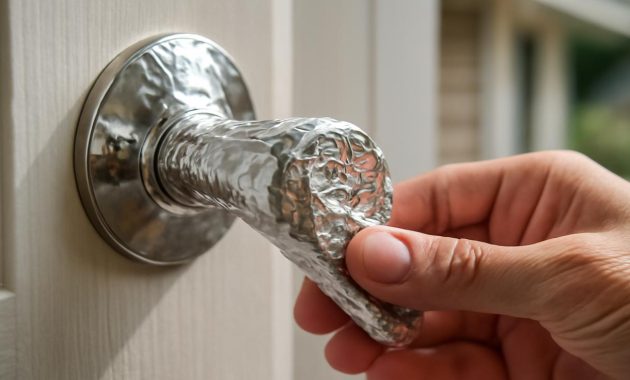
The first time I saw it, I thought the house was sending a distress signal. The front door of an otherwise ordinary brick bungalow flashed in the afternoon sun, its handle wrapped in a crinkled sheath of aluminum foil. A gust of wind shifted the trees, and the foil winked like a strange, silvery eye. My first instinct was that something had gone wrong—some kind of makeshift repair or perhaps a forgotten art project. But then I started seeing it again. And again. Down other streets, on apartment doors, on garage side entries. More and more people were wrapping their door handles in aluminum foil—and as odd as it looked, the reason turned out to be surprisingly, almost elegantly, practical.
The Shimmering Secret on the Doorknob
If you’ve ever walked your neighborhood at dusk, you know how revealing that soft, angled light can be. You suddenly notice things you pass a hundred times without seeing: the ivy threading its way through a fence, a cat watching from a darkened window, a dent in a mailbox that looks like it has a story. Lately, in many places, that list now includes something else: door handles that shimmer with a thin, metallic wrapping.
Aluminum foil is not the kind of material we’re used to seeing outside the kitchen. We associate it with baked potatoes and folded leftovers, cradling the memory of last night’s dinner. It rustles with that precise, papery crackle when unrolled, catching light in a thousand tiny peaks and valleys. So when it appears on a front door, it feels out of place—like a spatula left in the garden.
And yet, once you understand the logic, it starts to make sense. People wrap door handles in foil for a constellation of reasons—some rooted in old habits, some in new anxieties, some in plain, thoughtful practicality. The more you look at this strange silver habit, the more it turns into a quiet little story about how we adapt, how we try to feel safer, cleaner, and a little more in control of our lives.
Protection, But Not the Kind You Think
The most immediate, tactile thing about a door handle is that it’s touched. Over and over again, by friends, family, delivery folks, and occasionally by people you’d rather didn’t come too close at all. During recent global health scares, the humble doorknob was suddenly promoted from unnoticed household hardware to a kind of microscopic crossroads, where invisible travelers—germs, bacteria, viruses—might be coming and going.
For some people, foil wrapping became a quick, cheap way to manage that anxiety. A door handle covered in foil becomes a kind of disposable skin. When it feels questionable, you can tear it off with a soft metallic hiss, crumple it into a small shining ball, and throw it away. No permanent wipe-down required, no special product needed—just a new strip of foil from the kitchen drawer. As a temporary barrier, it’s brutally simple and immediately reassuring.
The texture itself contributes to that feeling. Where a bare metal or brass handle can hold fingerprints and smudges like ghostly signatures, foil wears its use openly. It dents, creases, and shows every touch. For some, there is a certain satisfaction in seeing that wear accumulate and then disappear when the foil is replaced, like shedding an old skin.
Night Watchers and Shiny Deterrents
But cleanliness is only one part of the story. Step out onto a quiet street after midnight and imagine the scene from a different angle—not from the neighbor’s porch, but from the perspective of someone who isn’t supposed to be there at all.
For people worried about break-ins, foil on a doorknob has been talked about as both an early-warning trick and a subtle deterrent. The idea is almost childlike in its simplicity: wrapping a doorknob in foil can make it easier to notice if someone has tried to tamper with the handle. The foil shifts under pressure; it tears, flattens, and holds the memory of fingers and tools. In the morning, a disturbed or damaged foil wrap can signal that someone tested the door in the night.
It’s not a foolproof method, of course, and it’s no replacement for good locks or proper security. But there’s a psychological component here that’s hard to ignore. For a would-be intruder creeping through the dark, a gleaming foil-wrapped handle can look like a trap, or at least like a sign that whoever lives here is paying attention. The reflective glint may catch the beam of a flashlight or a passing car’s headlights, dragging unwanted attention toward the doorway.
In that way, the foil becomes both a tiny improvised sensor and a quiet message: we see you, even when we’re asleep.
The Surprising Science of Shiny Surfaces
Stand close to a foil-wrapped handle in the early morning sun and you can feel it radiate a faint warmth. The foil has a thin, metallic chill at first touch, but it changes quickly, responding to the temperature around it. While aluminum foil isn’t magic, it does have a few physical properties that turn out to be handy when wrapped around a piece of hardware that lives halfway outside.
Aluminum is a superb conductor of heat. That means it responds quickly to changes in temperature, and in some cases, it can help equalize cold or hot spots on a metal handle exposed to the elements. On a scorching day, an unshielded dark metal handle can become startlingly hot, almost branding the palm for a second. A layer of foil acts like a reflective jacket, bouncing a portion of the sun’s radiation away and keeping the handle somewhat cooler than the naked metal beneath.
In winter, meanwhile, foil can act as a sacrificial surface, taking the brunt of frost, sleet, or the crystallizing edge of freezing rain. Instead of ice welding itself directly to the door hardware, it clings to the foil. Peel the foil off, and you’re sometimes left with a cleaner, more manageable surface beneath. For people in particularly harsh or changeable climates, it’s a small, low-effort hack that can make early-morning exits a little less unpleasant.
Then there’s the question of tarnish. Brass and certain metals discolor over time, especially when exposed to moisture and the oils from our skin. That patina can be beautiful to some, but others prefer to keep their fixtures bright and untarnished. A foil wrap, even a temporary one used during painting, sanding, or messy yard projects, can preserve that original shine.
The Painter’s Shortcut and the DIY Mindset
If you’ve ever painted a door, you know one particular kind of dread: that moment when the roller or brush comes just a bit too close to the handle. Taping hardware before painting is a meticulous job—too much tape, and it bunches; too little, and paint sneaks under the edge. Painter’s tape has its own specific smell, a faintly chemical whisper that lingers on your fingertips after you peel it.
Aluminum foil solves this problem with a kind of rough practicality that makes DIYers practically giddy. You don’t have to measure or cut anything perfectly. You simply tear off a piece, press it gently around the curve of the handle, and mold it into place with your thumbs. It hugs every curve, edge, and screw, shaping itself to the hardware like a custom-made shell. When you’re done painting, you fold it away, and most of your clean-up goes with it.
Foil is cheap, easy to find, and weirdly satisfying to work with. It carries the flexible memory of your fingers—the smoothed seams, the pinched corners, the quick little folds you make without thinking. For people who love quick fixes, the foil-wrapped handle becomes a symbol of clever improvisation. No trip to the hardware store. No fussy taping job. Just a strip from the roll, and the problem is solved.
Sometimes, this habit lingers past the project itself. The foil left from a weekend painting job might not be removed right away. A week later, the door opens and closes, the foil handle still in place, a small metallic reminder of how we often leave temporary solutions to do long-term work.
A Small Ritual in a Noisy World
There’s another, quieter reason people wrap their door handles in foil, though they don’t always talk about it directly: it feels oddly comforting. We live in a world where so many of the systems that affect our lives—digital networks, health infrastructures, global supply chains—are invisible and beyond our control. In that context, the act of physically wrapping a door handle starts to look like a ritual.
Think about the motions: walk to the kitchen, pull open the drawer, the clatter of utensils shifting as you move them aside. The short, crisp tear as you pull foil from the roll. The way the sheet curls and springs slightly as you carry it to the door. You smooth it down, smoothing your own thoughts with it. It is something you can do with your hands, right now, to change something about the boundary between inside and outside.
Sometimes, we participate in small habits not because they are scientifically flawless solutions, but because they grant us a moment of agency. You know this foil will not stop the world from intruding. It won’t fix the big things. But it will keep paint off the handle. It might keep a bit of grime at bay. It might show you, in the morning, that someone tried the door when you were sleeping. Small comforts, yes—but real ones.
| Reason | What People Hope To Achieve | How Foil Helps |
|---|---|---|
| Hygiene & Cleanliness | Reduce contact with dirty or frequently touched surfaces | Creates a disposable layer that can be replaced quickly |
| Security Awareness | Detect or discourage tampering at night | Shows tears, dents, or disturbances if someone tries the handle |
| Weather & Wear | Protect hardware from frost, intense sun, and tarnish | Acts as a sacrificial shield against the elements |
| Painting & DIY | Keep paint and dust off door hardware | Molds easily around handles, then peels away with the mess |
| Peace of Mind | Feel a sense of control over home boundaries | Offers a simple, tactile ritual that can be repeated as needed |
Limitations, Myths, and the Line Between Clever and Risky
Of course, where there are household hacks, there are also rumors that stretch beyond what a strip of foil can reasonably do. You may have heard whispered claims that aluminum foil on a doorknob can completely stop break-ins, or that it’s some kind of high-tech signal blocker by itself. This is where it helps to step back and let common sense in through the door.
Foil is thin, soft, and easily torn. It will not turn a weak lock into a strong one, nor will it serve as a reliable piece of security hardware. It can’t replace deadbolts, cameras, or proper lighting. It also doesn’t sterilize anything; it simply adds a layer that can be changed. Germs don’t magically die on foil faster than on other surfaces without proper cleaning and disinfection. If you wrap a dirty handle in foil, the dirt doesn’t disappear; it just gets covered.
There are practical concerns, too. In some cases, poorly applied foil could snag clothing or scratch softer surrounding materials. In very humid or salty environments, trapping moisture against certain metals for long periods could even encourage corrosion rather than prevent it. And for people with heightened sensitivity about contamination, constantly replacing foil can slide from useful routine into an exhausting compulsion.
So the foil wrap lives in a middle ground: effective for quick tasks, handy during projects, occasionally helpful for peace of mind—but not a miracle solution. Like so many improvisations, it works best when you understand both what it can do and what it simply can’t.
What This Odd Habit Says About Us
Stand in front of a house with a foil-wrapped handle and take in the scene for a moment. The garden might be wild or meticulously trimmed. There might be children’s shoes by the doorstep or a bicycle leaning lazily against the wall. The foil glints there on the handle, a small scrap of kitchen-wrapper technology pressed into service on the threshold between public and private space.
In a way, it’s a perfect symbol of modern home life. We repurpose what we have. We move ideas between rooms—something meant to cover a casserole now guards the entrance. We look at an ordinary object and ask, What else can you do for me? When the world feels uncertain, we double down on these small, manageable experiments. A little more protection here, a quick barrier there. A small act that may never be noticed by anyone else, but which changes the way we feel when we reach for the door.
There’s also an undercurrent of quiet creativity in this habit. It reflects the way people trade tips informally: a neighbor mentioning it over the fence, a family member sharing a story, an online post that sparks curiosity. Some will try it once and abandon it. Others will weave it into their routines, renewing the foil like a seasonal decoration, a glinting reminder that they’re doing what they can, in their own way, to tend to their threshold.
And so, more and more, as you walk through neighborhoods or down apartment corridors, you may notice that faint metallic flicker on the edge of your vision—a handle wrapped in silver. It’s an odd sight, yes. But beneath the crinkles and reflections lies something very human: our impulse to protect, to adapt, and to take comfort in even the smallest layers between ourselves and the unpredictable world on the other side of the door.
Frequently Asked Questions
Does wrapping a door handle in aluminum foil actually improve security?
It can help you notice tampering if the foil is clearly disturbed, dented, or torn, and it might make a door look less inviting to someone sneaking around. However, it does not strengthen your lock or physically prevent entry. It should only be seen as a minor awareness tool, not a primary security measure.
Is aluminum foil on door handles good for hygiene?
Foil can act as a disposable barrier, which some people find reassuring. If you replace it regularly and still clean the underlying handle, it can be part of a hygiene routine. But it does not disinfect by itself, and dirty foil is no cleaner than a dirty handle.
Can aluminum foil damage my door hardware?
Short-term use, like during painting or bad weather, is unlikely to cause harm. Long-term wrapping in humid or salty environments could potentially trap moisture against the metal and encourage corrosion on some finishes. It’s wise to remove the foil periodically, clean the handle, and let it dry.
Why do people use foil instead of tape when painting doors?
Foil is faster and more forgiving than tape. You can mold it snugly around the curves and crevices of a handle without careful cutting or aligning. When you’re finished painting, you just peel it away, taking stray drips with it.
Is this trend just a fad or a genuinely useful practice?
It’s a bit of both. Some uses—like protecting hardware during painting or messy projects—are genuinely practical and time-tested. Other uses, like relying on it for security, belong more to the realm of psychological comfort than robust protection. Whether it becomes a habit or a one-time experiment depends on what you’re hoping to achieve.