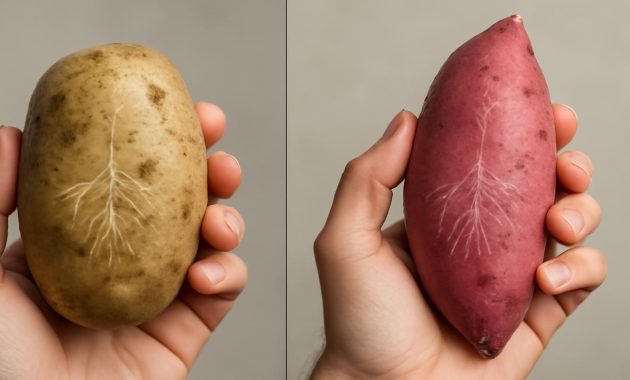
The first time I saw a sweet potato flower, I had to check the tag twice. The vine had crept gracefully across the garden bed, its heart-shaped leaves catching the late afternoon light. And there, tucked between the green, was a pale purple bloom that looked suspiciously like something I’d seen before—on the morning glory tangled around the old fence nearby. I stared, then laughed out loud. All my life I’d lined up sweet potatoes right next to the regular potatoes in my mind. Same name. Same role on the dinner plate. Surely they were botanical cousins, at least. But that little purple flower was quietly telling me: you’ve got this all wrong.
The Potato Family Myth We All Quietly Believe
In grocery stores, the illusion is perfect.
There they sit, side by side in their earthy bins: dusty brown Russets, blushing red potatoes, smooth yellow Yukons, and just a few steps away, a pile of copper-skinned sweet potatoes. Their shapes overlap—stubby, knobby, elongated, some comically lopsided. Under fluorescent light, they all look like variations on the same underground theme. The price tags often whisper the same word: “potatoes.”
It’s such an ordinary scene you barely notice it. You bag a few of each, already imagining them mashed, roasted, turned into fries or folded into stews. Some dishes even mix them together, as if their shared destiny in the oven must reflect a shared origin in the soil. It feels obvious: sweet potatoes must be a sweeter version of potatoes. How could they not be related?
But here’s the quiet twist lurking beneath their skins: that assumption is mostly a trick of language and habit. Sweet potatoes and regular potatoes are no closer kin than you and a distant stranger who just happens to share your last name. They grow underground, yes; they’re both starchy; they’re both called “potato” in everyday speech. Yet, in the great family tree of plants, they live on very different branches, separated by evolutionary pathways that stretch back millions of years.
The Strange Case of Two “Potatoes” from Different Worlds
To see how different they really are, you have to step back from the grocery aisle and walk into the garden—slowly, as if you’re meeting them for the first time.
Imagine kneeling beside a bed of regular potatoes—those belong to the genus Solanum in the nightshade family, Solanaceae. The plants stand upright and leafy, with compound leaves that look like clusters of smaller leaflets joined along a central stem. When they bloom, their flowers are star-shaped and familiar, cousins in form to tomatoes, peppers, and eggplants: a tiny yellow cone of stamens in the center, petals that can be white, purple, or pink like a washed-out sunset. If you’ve ever seen a tomato flower, a potato flower feels like its quieter sibling.
Now walk a few rows over to the sweet potatoes—those belong to the genus Ipomoea in the morning glory family, Convolvulaceae. The plant here doesn’t stand quite so primly. It sprawls and wanders, vines snaking along the soil or twining lazily up whatever support they can find. The leaves are broad, often heart-shaped, sometimes lobed like a clover that grew wild and exuberant. And then there’s that flower: funnel-shaped, soft and trumpet-like, with colors that echo dawn—pink, lavender, white with a purple throat. It looks so much like a morning glory because, botanically, that’s exactly what it is: a starchy-rooted cousin of the ornamental vines people plant just to watch them bloom.
Two plants. Two families. One word: “potato.” No wonder things get confusing.
How We Ended Up Calling Them Both “Potato”
If you trace the confusion back far enough, you find a story tangled in ships’ logs, colonization, and the chaos of language crossing oceans.
Regular potatoes (Solanum tuberosum) have their roots—literal and historical—in the Andes of South America. Long before Europeans ever saw a potato, Indigenous peoples in that region had been cultivating and celebrating them for thousands of years. They come in a riot of colors there: purples and blues, reds and golds, spotted and streaked varieties that put our supermarket selection to shame. When Spanish explorers encountered these tubers in the 16th century, they carried them back across the Atlantic. From there, potatoes spread through Europe and eventually around the world, becoming so essential that when crops failed, entire societies reeled.
Sweet potatoes (Ipomoea batatas), on the other hand, likely originated in Central or South America but followed their own winding path. There is evidence they were cultivated in the Americas for more than 5,000 years. Polynesian voyagers may have carried them across the Pacific centuries before European contact. When the Spanish and Portuguese began their own voyages, sweet potatoes joined the global exchange, spreading into Africa, Asia, and the Pacific with surprising speed. In many regions today—like parts of Africa and the Pacific Islands—sweet potatoes are more central to daily life than the “regular” potato ever became.
The naming tangle began with language. The word “potato” itself came from the Spanish “patata,” which mashed together two Indigenous words: “batata” (for sweet potato) and “papa” (for regular potato). Over time, in English, “potato” landed firmly on the starchy Andean tuber, while “sweet potato” was used to distinguish its sweeter, morning-glory cousin. We hung the word “potato” around both plants like a shared family name, and the misunderstanding settled quietly into our kitchens.
In some places, it only got messier. In the United States, orange-fleshed sweet potatoes are sometimes labeled “yams,” even though true yams are something else entirely—a different plant family again, native to Africa and Asia. So you can stand in front of a supermarket shelf and see “potatoes,” “sweet potatoes,” and “yams” all cozily side by side, yet all three may belong to different botanical lineages. The produce aisle starts to feel like a badly organized family reunion where no one is actually related.
What’s Happening Underground: Tubers vs. Storage Roots
To a shovel, perhaps, a root is just a root. But plants are more particular, and this is where the deeper differences reveal themselves in the dark, cool soil.
Regular potatoes grow tubers. These are swollen stems, not roots, that form underground. If you look closely at a potato, you can see its identity as a stem hiding in plain sight. The “eyes” scattered across the surface? Those are nodes—buds from which new shoots can sprout. It’s like a compact stem that decided to pack itself with starch and wait patiently beneath the surface. Plant a piece of potato with an eye, and an entire new plant can unfurl from that dormant bud.
Sweet potatoes, however, grow storage roots. These are true roots that swell as they store nutrients. They don’t have “eyes” in the same way, and their branching pattern is different. When you cut open a sweet potato, you’re slicing through a modified root, a thickened extension of the plant’s underground search for water and minerals. To propagate them, farmers usually plant cuttings of the vine—called slips—rather than burying chunks of the root, because those roots aren’t designed to sprout new plants the way tubers are.
This difference—tuber vs. storage root—sounds technical, but it’s a fundamental distinction in plant anatomy and development. Even the way they break in your hands hints at it: a potato often snaps like a crisp stem, with a distinct grain; a sweet potato tends to fracture and tear more fibrously, like a dense root dragged from stubborn soil.
| Feature | Regular Potato | Sweet Potato |
|---|---|---|
| Plant Family | Nightshade (Solanaceae) | Morning Glory (Convolvulaceae) |
| Genus & Species | Solanum tuberosum | Ipomoea batatas |
| Edible Part | Tuber (swollen stem) | Storage root (true root) |
| Flowers | Star-shaped, like tomato/eggplant | Trumpet-shaped, like morning glory |
| Growth Habit | Bushy, upright plants | Vining, sprawling plants |
| Typical Flavor | Mild, earthy, less sweet | Sweet, sometimes floral or nutty |
The Quiet Chemistry That Makes Them Taste and Nourish Differently
Of course, you don’t need a botanical textbook to feel their differences. The kitchen tells its own clear story.
Press a knife into a raw regular potato: the blade sinks with a faint squeak, the flesh pale and slightly damp, releasing a clean, earthy scent that clings to the cutting board. You can already imagine it frying into crisp golden squares or melting into cloudlike mash. Potatoes are built on starch, especially a type called amylopectin, which gives them their fluffy or waxy textures depending on the variety.
Now cut into a raw sweet potato. The sound is deeper, a soft crack as it yields. The flesh is dense and vibrant—orange, purple, or cream—sometimes leaving a faint sticky residue on your fingers from its natural sugars. Bake it, and the kitchen fills with a caramel warmth that needs little help from butter or brown sugar. That sweetness isn’t a trick; sweet potatoes carry more natural sugars and tend to have more fiber than regular potatoes, as well as higher levels of beta-carotene (especially the orange-fleshed ones) that the body can convert into vitamin A.
Both can be nourishing in different ways. Both can be turned into junk food or sustenance, depending on how we cook them. Yet the way they behave in the oven or pot reflects their divergent chemistries—starches, fibers, pigments, and phytochemicals tuned by different evolutionary pressures in different corners of the world.
You might notice that sweet potato fries never quite crisp up like their regular potato counterparts without some kitchen acrobatics. That’s partly because of their higher sugar and moisture content and different composition of starches. They’re built differently, from the cellular level up, and your recipe has to negotiate with that reality.
Nightshades, Morning Glories, and the Company They Keep
Plant families are like extended clans—who you show up with says a lot about who you are.
Regular potatoes share their family, the nightshades, with some big names: tomatoes, peppers, eggplants, and tobacco. Many of these plants carry alkaloids, chemical compounds that can be either medicinal or toxic depending on the dose and context. That’s part of why potato leaves and green potato skins are not safe to eat—they contain higher concentrations of solanine, an alkaloid the plant uses as a defense against pests and disease.
Sweet potatoes, meanwhile, keep very different company. As a proud member of the morning glory family, they rub shoulders with ornamental vines cherished for their flowers, like Ipomoea tricolor, whose sky-blue blooms open to greet the sun, and the wild bindweeds that farmers curse as they coil through their crops. This family is less famous for edible members, which makes the sweet potato something of an odd, delightful outlier: a morning glory that decided to stash dinner underground.
These family ties matter in practical ways. They affect what pests are likely to attack, what diseases they get, how farmers rotate crops, and even how plant breeders try to improve them. You can’t cross a sweet potato with a regular potato to make some mythical hybrid “super tuber”—they’re simply too far apart genetically, like trying to cross a sparrow with a trout. Their shared common name masks a distance that the plants themselves never forget.
Why This Difference Matters Beyond Trivia
At this point, it might be tempting to shrug and say, “Interesting, but so what? They taste good. Isn’t that enough?” But seeing the true distance between sweet potatoes and regular potatoes changes how we relate to them—and, in a quiet way, how we see the whole living world.
For farmers, the distinction shapes everything from planting schedules to pest management. Rotating a field from potatoes to sweet potatoes isn’t the same as rotating from potatoes to tomatoes; the families, and therefore the disease risks, differ. For nutritionists and home cooks, understanding that sweet potatoes and regular potatoes aren’t two versions of the same thing opens up more creative space on the plate. Instead of swapping one for the other as if they were near-identical twins, you can begin to treat them as separate characters with their own strengths, flavors, and stories.
But there’s a deeper shift, too. Once you learn to look past the supermarket labels, the world begins to reveal its complexity in small, beautiful ways. A “potato” stops being a generic starch and becomes a clue. You notice the flowers, the leaf shapes, the way vines stretch or stems stand. You begin, perhaps, to ask more often: what else in my kitchen is quietly unrelated, despite the names and habits that make them seem alike?
Nature doesn’t organize itself by grocery aisle or recipe book. It arranges life by lineage and evolution, by subtle anatomical tweaks and ancient genetic experiments. We’re the ones who slap on names based on convenience, taste, or the shape of something sitting in a crate. Recognizing the gap between those human categories and the plant’s own reality can be oddly freeing. It reminds us that the world is not obliged to match our assumptions.
Standing in the Garden, Seeing Them Clearly
Now imagine yourself back in the garden, late in the day when the light softens and the soil still holds the sun’s warmth. You move from the straight, leafy rows of regular potatoes to the wandering vines of the sweet potatoes, feeling the shift not just in plant form but in story.
On one side: the Andean tuber that reshaped European agriculture, slipped into stews and soups from Ireland to India, and became the backbone of comfort food in countless households. On the other: the vining root that traveled the Pacific with ancient navigators, that now colors plates in deep oranges and purples from West Africa to Japan to the American South.
You run your fingers along a regular potato plant, its sturdy stem and rough leaves. Somewhere below, tubers expand quietly, waiting. A beetle scuttles across the soil, unaware of the global history nodding above its head. Then you trace a sweet potato vine as it snakes away from the raised bed, its leaves casting little heart-shaped shadows. Its roots are thickening somewhere below, turning sunlight and water into dense, sweet stores of energy.
They’re both “potatoes” by our naming, yet they’re as different as two strangers who happen to share a coat and a job description. One is a nightshade, one a morning glory. One builds tubers from stems; the other swells its roots. One wears a star-shaped flower; the other unfolds a trumpeted bloom.
Once you see it, you can’t unsee it. Every time you stand in a grocery store and reach for a bag of potatoes and a couple of sweet potatoes, you’ll know you’re holding two different lineages of plant ingenuity—two separate experiments in how to hide food beneath the ground, wrapped in stories that began continents and millennia apart.
And somewhere, perhaps, a morning glory on a backyard fence will open its purple throat to the sun, and you’ll think, with a small, private smile: you and my sweet potato fries are family.
FAQ
Are sweet potatoes and regular potatoes from the same plant family?
No. Regular potatoes belong to the nightshade family (Solanaceae), while sweet potatoes belong to the morning glory family (Convolvulaceae). They are not closely related botanically.
Why do we call them both “potatoes” if they’re not related?
The shared name comes from a historical mix-up of Indigenous words when Spanish explorers encountered both crops. Over time, “potato” stuck for the Andean tuber, and “sweet potato” for Ipomoea batatas, even though they’re from different plant families.
Is the part we eat the same type of structure in both plants?
No. In regular potatoes, we eat tubers—swollen underground stems. In sweet potatoes, we eat storage roots—true roots that have enlarged to hold nutrients.
Can you cross sweet potatoes with regular potatoes to make a hybrid?
No. Because they belong to different plant families and are genetically distant, they cannot be crossbred. Any “hybrid” you hear about is usually just a culinary or marketing description, not a real botanical cross.
Are sweet potatoes healthier than regular potatoes?
They’re different rather than universally “better.” Sweet potatoes are richer in beta-carotene (especially orange-fleshed types) and often have more fiber and natural sugars. Regular potatoes are excellent sources of vitamin C, potassium, and energy. Healthiness depends on portion size, preparation method, and your overall diet.
Are yams the same as sweet potatoes?
In many North American stores, orange sweet potatoes are labeled “yams,” but true yams are a different plant altogether, from the genus Dioscorea. Botanically, yams, sweet potatoes, and regular potatoes all belong to separate families.
Do they grow the same way in the garden?
Not quite. Regular potatoes grow on bushy plants that form tubers along underground stems. Sweet potatoes grow on sprawling or vining plants that form thickened storage roots. They prefer slightly different growing conditions and are managed differently by gardeners and farmers.
Originally posted 2026-03-05 00:00:00.