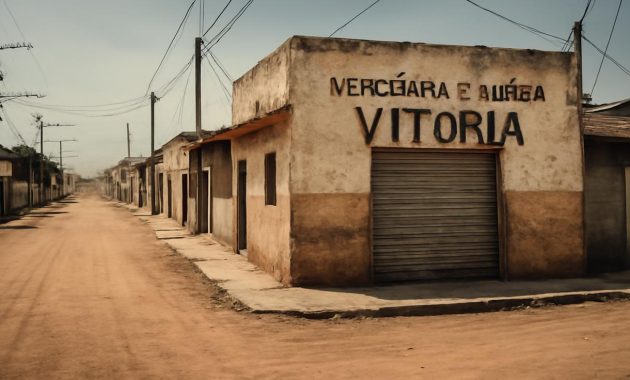
The bus door folds open with a hiss, and hot air pours in like someone opened an oven. Dust hangs in the light, shimmering over the cracked street of a place that appears on no travel list and on very few maps, even in Brazil itself. Children in flip-flops race past the bus, chasing a punctured soccer ball. A woman in a sun-faded dress shields her eyes and scans the passengers as they step down one by one. She’s not looking for relatives. She’s looking for opportunity—something new, someone new, any sign that life here might finally tilt in a different direction.
The Invisible City in the Backlands
Welcome to a small city in Brazil’s semi-arid interior, where the numbers sound like a misprint. Here, 93% of people depend on Bolsa Família—the federal cash transfer program designed to fight poverty. Only 29 residents hold formal employment contracts. And if you walk through downtown at midday, when town centers usually pulse with retail noise and office chatter, you’ll find something far quieter than you might expect from a place called a “city.”
The sun hammers the square. A stray dog naps in the sliver of shade thrown by a leaning lamppost. A grocery store, a pharmacy, a single clothing shop with three mannequins in the window; their plastic eyes stare out over a street almost empty of customers. A motorcycle hums past. A radio somewhere plays an old forró tune that rises and falls like a tired breath.
There are no billboards advertising new housing developments, no cranes lifting glass towers into the blue. Instead, one-story homes, many still unpainted cement, stretch along the hillside. In the courtyards, laundry flaps on lines, and plastic water tanks squat on rooftops. This is not a place of visible bustle; it’s a place that appears to be waiting—for rain, for work, for something.
A Life Measured in Transfers
Ask almost anyone on these streets where their main income comes from, and the answer is nearly always the same: “Bolsa.” Not “salary.” Not “business.” Just “Bolsa.”
In this city, Bolsa Família is not so much a program as it is an ecosystem. The monthly transfer—modest by any standard—moves through town like blood through veins. It buys rice, beans, cooking gas, sandals, a sack of cement to slowly add one more room to a house. It pays off the tab at the little corner market where the owner, who also relies on the program, has been advancing credit since the last payment ran out.
When deposit day comes, the dusty square transforms. Lines form outside the lottery house and ATMs before sunrise. The queue snakes along the sidewalk: women in cotton dresses, men in baseball caps, elderly people leaning on canes, teens holding the plastic cards that connect them, quietly, to Brasília and to a national promise that no Brazilian should starve.
It is a monthly ritual, half-celebration, half-surrender. Because as much as the transfers sustain life here, they also underline a harsher reality: in this city, work—formal, stable, documented work—is almost mythical.
The 29 Who Have a Work Card Signed
In a city of several thousand, only 29 people have formal employment contracts. Twenty-nine. You could fit them all in a small classroom. They are the teachers with permanent posts, a few municipal civil servants, perhaps one or two employees at the health clinic and the notary office. If you gathered them in the town hall and asked them to raise their hands, the gesture would be painfully small compared to the number of hands that remain resting on laps.
For everyone else, the word “job” means something different. It might be a morning helping unload a truck in exchange for a cash note and a meal. It might be a season picking fruit on a farm several towns away. It might mean “doing a little bit of everything”: sewing, cutting hair, selling popsicles from a cooler on wheels, making homemade snacks to sell door to door on hot afternoons.
Almost none of this appears in official statistics. On paper, the city is a near-vacuum of economic activity. In reality, there is movement, ingenuity, survival—just not in a form that gets counted when a bureaucrat in the capital clicks through a database.
A City of Uncounted Work
Walk a few blocks from the main square, and you’ll hear the buzz of an old sewing machine behind a half-open door. Inside, a woman is stitching school uniforms for the next term. She’s paid by the piece; there is no contract, no paid leave, no pension contribution. Across the street, a man in a plastic chair sharpens knives using a rigged-up grinding wheel powered by a salvaged motor. On weekends, he grills meat in front of his house and sells skewers to neighbors.
This is the real economy here: a patchwork of informal jobs that appear, disappear, and reappear like mirages. People plant small plots of beans and cassava when the annual rains arrive. They sell surplus eggs, homemade sweets, secondhand clothes. A few try their hand at raising goats or chickens. Money flows in short, irregular bursts, always padded, always stabilized by the predictable drip of Bolsa Família.
There is a paradox in this. The program is often described in distant political debates as a “handout.” But here, in the city where nearly everyone depends on it, Bolsa Família is less a parachute and more a platform. It is what allows people to say yes to a small risk: to buy ingredients for pastries they hope to sell, to pay the fare to search for day labor in a bigger town, to keep a child in school instead of sending them to beg on the roadside.
Without it, the informal economy would not disappear—it would collapse inward, like a tent without poles.
How a City Lives on a Card
Imagine the local economy as a circle drawn in the dust. At the top: the federal government, sending Bolsa payments onto millions of prepaid cards. At the bottom: the families in this city, queueing under the sun. Between them stands a handful of businesses that keep the circle turning.
One grocer estimates that more than 80% of his monthly sales happen in the ten days after Bolsa payments land. The rest of the month, he watches shelves in the front of the store, where the instant noodles and cheapest rice sit, empty and then slowly refill. The rhythm of his inventory is not driven by seasons or holidays. It is driven by the calendar of a social program.
To make this more concrete, imagine a simplified snapshot like this:
| Indicator | Approximate Value | What It Means on the Ground |
|---|---|---|
| Population dependent on Bolsa Família | 93% | Almost every household structures its month around the transfer date. |
| Residents with formal work contracts | 29 people | Formal wages are rare, and benefits like pensions or paid leave are exceptions. |
| Registered companies with active operations | Almost none | Most businesses are tiny, informal, and operate from homes or street corners. |
| Main income source for households | Cash transfers and informal work | People combine Bolsa with odd jobs, seasonal work, and small trade. |
| Typical monthly spending pattern | Spike just after payment day | Shops, pharmacies, and street vendors live by the Bolsa calendar. |
These are not just figures; they shape daily decisions. If a family knows the transfer is coming, they might dare to buy medicine today and pay off the credit in two weeks. A teenager might say yes to a free course in a nearby town because there is enough for the bus fare this month. It’s a slow, fragile negotiation with poverty, with one eye always on the balance left on a plastic card.
Growing Up in a Place Without Jobs
In the afternoon, school lets out and the dusty streets fill with uniforms. Children walk in groups, kicking at stones, laughing, arguing about soccer teams and pop songs. The school itself is modest but bright: white walls, a few flowering trees in the yard, a patchy soccer field that turns into a mud pit when it finally rains.
Inside the classrooms, posters insist that education is the path to a better life. For many of these students, Bolsa Família was tied to their presence here; attendance is one of the conditions. The idea is simple and powerful: break the cycle of poverty by investing in children today so they can work better jobs tomorrow.
But what does “tomorrow” mean in a city with only 29 formal contracts?
Ask a teenager what they want to be, and you’ll hear dreams that would fit in any city: nurse, mechanic, lawyer, influencer, football star. Some plan to leave as soon as they can, heading for the state capital or the industrial cities further south. Many have cousins or parents who have already gone, sending back money and phone pictures of shiny shopping malls.
Others, though, hesitate when you ask. They look at their parents, at the houses built room by room with Bolsa and seasonal wages. They know that leaving is not just a choice; it’s a gamble with bus fares, rent, and the risk of trading one kind of precariousness for another. For them, the future feels like a dusty road lined with possibility and potholes in equal measure.
The Weight and the Gift of Staying
For the families who remain, staying is both a burden and a kind of resistance. Life here is slow, but it has its rhythms: the weekly market where farmers from nearby rural areas bring cassava and green papaya; the church services that spill out onto the sidewalk; the festivals that animate the square with colored flags and live bands when cash from holiday bonuses and extra transfers briefly swells wallets.
The city’s older residents remember a time before Bolsa Família, when the “lean months” between harvests meant real hunger and children leaving school early to help search for work. The program, for them, is not a political slogan. It is a line that divides “before” and “after.” Before: empty plates, pawned possessions, shame in asking neighbors for food. After: no abundance, but fewer nights going to bed with nothing in the pot.
Still, they worry. Worry about what happens if the rules change, if the government shifts, if the political winds in Brasília blow against them. In a place with so little formal economic activity, a budget line drawn hundreds of kilometers away can feel as powerful—and as unpredictable—as the weather.
What Development Looks Like From a Dirt Road
It’s easy, from the vantage point of a larger city or from another country entirely, to argue in the abstract about social programs, work incentives, and “dependency.” But here, in this Brazilian city of 93% Bolsa beneficiaries and only 29 formal workers, those ideas look different when you can trace them through faces, streets, and afternoons measured by the length of shadows.
Development is not a graph here; it is the slow appearance of tiled floors instead of bare cement, of refrigerators replacing clay pots, of smartphones in the hands of mothers checking school messages. It is the clinic that, while understaffed, now sees fewer cases of child malnutrition than in the past. It is the school where more girls finish high school instead of dropping out at 12 or 13.
And yet, the enormous gap remains: an economy that still does not know what to do with its people beyond absorbing them into informality and supporting them with cash transfers. The potential is visible—the creativity of a woman who starts a tiny catering business out of her kitchen, the energy of a teenager who repairs motorcycles in the shade of a mango tree—but opportunity is thin on the ground, like the soil itself.
Imagining Another Future
Standing on the hill above the city at sunset, you can see the layout clearly. The grid of streets, the cluster of official buildings, the slender line of green following a creek, the distant ripple of dry hills. It is small, but it is not empty. It holds stories, and skills, and a quiet stubbornness that has kept people rooted here in spite of drought, distance, and neglect.
Imagine this same place with a different set of numbers. Imagine 93% of the population not only receiving Bolsa, but also earning from local cooperatives that process regional products—like goat cheese, honey, or fruit pulp—for sale beyond the town. Imagine more than 29 people with contracts: solar panel installers in a region blessed with sun, digital workers linked to remote job markets, teachers in vocational schools that teach trades linked to real demand.
Bolsa Família, in this vision, does not disappear. It becomes what many of its own beneficiaries already see it as: a floor, not a ceiling. A guarantee that nobody will fall below a basic dignified life, while other policies—investment, training, infrastructure—build ladders upward.
For now, though, as night falls and the lights flicker on over the square, the city lives in a suspended in-between. Children do homework on kitchen tables. Adults calculate what’s left until the next deposit. And the stray dog curls back under the lamppost as if anchoring the town in its familiar, fragile routines.
This Brazilian city is not a statistic in a report. It is a mirror, reflecting a question that echoes far beyond its dusty streets: what does it mean to build an economy where social protection is not the whole story, but the beginning of a different one?
FAQ
What is the Bolsa Família program?
Bolsa Família is a Brazilian federal cash transfer program aimed at reducing poverty and inequality. It provides monthly payments to low-income families, usually tied to conditions like children’s school attendance and basic health checkups.
Why are so many people in this city dependent on Bolsa Família?
The city has very few formal jobs and almost no registered economic activity. With limited industry, services, or agriculture capable of providing steady income, most residents rely on Bolsa Família as their primary or only reliable source of money.
Does dependence on Bolsa Família mean people do not work?
No. Many people work informally—selling goods, doing day labor, farming small plots, or providing services like sewing or haircuts. They just do not have formal contracts, so this work often doesn’t appear in official statistics.
Why are there only 29 formal workers in the city?
Formal jobs require registered businesses, steady demand, and the ability of employers to pay taxes and benefits. In this city, the local economy is too small and fragile to support many such positions, so only a handful of roles in schools, public offices, and essential services offer contracts.
Is Bolsa Família enough to live on?
The payments help families cover basic needs, but they are modest. Most households combine Bolsa Família with some kind of informal income. The program reduces hunger and extreme poverty, but it does not replace the need for decent, regular work.
How does Bolsa Família affect the local economy?
In this city, the program drives most local spending. Shops, pharmacies, and street vendors depend on the surge of purchases that follows transfer days. Without it, many small businesses would struggle even more or close altogether.
What would help transform the city’s situation in the long term?
Beyond continuing social protection, the city would benefit from investment in infrastructure, support for small producers and cooperatives, vocational training linked to real job opportunities, and incentives for sustainable local businesses. In short, policies that turn survival into dignified, stable work.