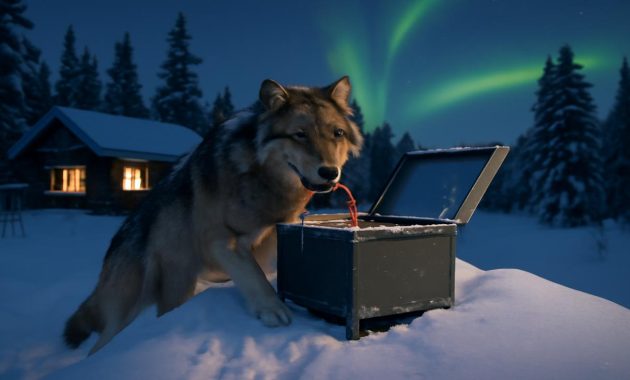
The first thing you notice is the silence. Not the easy quiet of a winter forest, but a taut, listening kind of silence, as if the trees themselves are holding their breath. Snow hangs in thick folds on the branches, the air is so cold it makes the inside of your nose sting, and somewhere ahead, you know, a wolf is watching you.
It is northern Canada in late winter, that washed-out time when the sky is the color of bone and the sun never quite climbs high enough to feel warm. A scattering of scientists, bundled in Arctic-grade parkas and frost-crusted balaclavas, are gathered around a metal structure that looks oddly out of place—part cage, part safe, part moon-landing prototype. A custom-built, research-grade feeding station. The kind that’s supposed to be wolf-proof.
At least, that’s what the engineers said.
The bait inside—deer meat, rich and red and glistening in the numbing air—is meant to do one simple thing: lure wild wolves close enough for remote cameras and sensors to study them. Their behavior, their problem-solving skills, the way they navigate a world increasingly filled with human-made puzzles: fences, roads, oil pads, garbage dumps. The contraption is the product of months of design meetings, computer simulations, arguments over latch mechanisms and stress tolerances, and, finally, a satisfying pile of signed-off paperwork.
But on this particular morning, as they approach the site on snowshoes, the tracks leading in are not what they expect. The scientists stop. No one speaks. Something is wrong. The cage door is still locked. The steel bars are intact. The snow around it is churned like it’s been carefully excavated rather than trampled. And the bait? It is gone.
The Wolf That Read Blueprints
Stories about clever wolves are a kind of northern currency. Trappers tell them by firelight; rangers swap them over thermoses of coffee in pickup trucks idling on gravel roads at dawn. But this story—this scene—will not pass quietly as campfire folklore. It will make its way into notebooks and conference halls and scientific papers, because what happened here is not a fluke of brute force. It is something else.
The lead researcher, a biologist who has spent more winters with wolves than with people, walks a slow circle around the station, breath smoking in tight bursts. The prints show a single animal at first, then the hesitant approach of another, then more—ghostly signatures in the granular snow. No blood, no sign of chewing on the metal, no bent bars. Just a tale in white: approach, pause, backtrack, circle, dig, test, return.
“This doesn’t make sense,” someone says, but soft, as if speaking louder might somehow erase it.
Wolves, like ravens and some primates, have long been suspected of a kind of flexible intelligence that doesn’t fit neatly into lab tests. They are pattern-readers. They know the difference between a hunter’s gait and a hiker’s. They can tell the sound of a truck that slows for roadkill from one that doesn’t. But the bait station was specifically designed to thwart all the usual tricks. No leverage points for teeth, no exposed bolts, no gap beneath the base.
Except, as it turned out, there was a weakness. A place where the packed snow under one corner, warmed faintly by the midday sun over several days, had settled and refrozen into a thinner crust. A place where the station’s weight shifted just enough to create a hairline gap—too small, the humans thought, to matter. The wolf disagreed.
The Feast Beneath the Fortress
The cameras, discovered later, tell the story frame by frame. The first arrival, a lanky gray male with winter-tufted fur and amber eyes, circles at a distance. He is wary—not of the meat, but of the geometry of metal and scent of human hands that still cling to it.
He does not lunge. He does not pace back and forth in frustration. Instead, he sits. He watches. Snowflakes cling to his muzzle, melt, and refreeze into tiny beads of ice. He shifts his weight from one paw to another, then begins to walk in a looping, almost lazy pattern around the base of the structure, nose low, testing every seam.
When he finally begins to dig, it isn’t in the obvious place—at the front gate, where the meat is visible between narrow bars. He backs away from the tempting sight line and works instead at one of the rear corners, where the metal meets snow in what looks, to human eyes, like a snug, unyielding seal.
But to a nose that can map the world in molecules, something is different there. Air moves. Scent escapes.
Snow flies in controlled bursts. He stops frequently, head tilted, checking. The digging is not the frenzied tunnel-building of an animal desperate or panicked. It is almost methodical. Twenty minutes pass. Then forty. The cameras mark time in grainy leaps: a flurry of snow, a pause to listen, an experimental nudge of a paw against the base. Finally, the entire station shudders—just a fraction of an inch, but enough.
The wolf lowers his head and, slowly, impossibly, works his muzzle into the newly widened shadow seam. His ribs flatten as he exhales. The angle is awkward, the entry point blind. Still, after several attempts, his jaws close on meat.
A steel fortress, defeated not by strength, but by patience and a nose that can detect physics where human eyes saw only engineering.
Science in the Snow
By the time the research team reviews the footage back at their field station—a squat building that smells of wet wool, coffee, and the faint chemical tang of ethanol preservative—the surreal has settled into disbelief tempered with awe.
On the whiteboard, under a hastily sketched rectangle representing the bait station, someone writes: “WOLF 1 – ENGINEERS 0”. No one erases it for weeks.
This is more than an amusing upset. It’s an experimental result. The station wasn’t a random contraption; it was built to test cognitive limits. Could wolves, given enough time, solve manufactured problems that mirror the growing complexity of human-wildlife encounters? Could they identify and exploit design flaws? The team had built three prototypes, each with different latch systems, base types, and access points. All were supposed to be secure.
But one wolf, somewhere in the northern cold, had nudged the bar a little higher.
In notebooks and digital logs, the team starts assigning informal difficulty ratings to their stations, like puzzle boxes in a mental gym for carnivores. It becomes clear they need a way to keep track of what, exactly, happened and how unusual it is. Around the same table where they had once debated metal gauges and weld strength, they now sketch out a small summary of their unexpected data point.
| Observation | Details |
|---|---|
| Location | Remote boreal forest, northern Canada |
| Feeding Station Type | Steel-frame, ground-anchored, “wolf-proof” prototype |
| Wolf Behavior | Extended inspection, perimeter circling, targeted digging at structural weakness |
| Time to Access Bait | Estimated 45–60 minutes of intermittent effort |
| Method of Access | Creating a gap under one corner and extracting bait through a narrow seam |
| Outcome | Complete removal of bait with no damage to structure or locks |
The numbers may be clinical, but the mood in the room is not. There’s laughter, yes, but it’s the kind that slips quickly into quiet thought. Someone jokes that they should’ve invited the wolf to the design meetings. Someone else, more subdued, admits that if a lone animal can do this in the middle of nowhere, the implications for conflict zones near communities and garbage sites are significant.
Wolves that can read the language of human structures—weak points, hinges, pressure points—are living, evolving challenges in an age where we like to think we can fence off, secure, and control almost anything.
The Mind Behind the Eyes
Out on the land, the wolf is simply doing what wolves have always done: experimenting with survival. But in the academic world, scenes like this tug at a bigger, older question: what does it mean to be “intelligent” if you are not human?
For decades, tests of animal cognition favored species that fit neatly into our laboratories and our expectations—those that could be rewarded with treats in boxes, that could be taught to push levers and tap screens. Wolves are not generally keen on lab life. Their intelligence is sprawled across distance and time, written into how they move, hunt, raise pups, and negotiate the invisible politics of their packs.
Imagine, for a moment, looking at a forest the way a wolf might. Where we see a solid line of trees, a wolf sees wind corridors, scent highways, the faintest imprint of a moose passing at dawn. Where we see a metal box in the snow, a wolf reads gradients of smell and minute drafts of air, the shiver of unstable weight, the subtle invitation of a flaw.
People often talk about “outsmarting” animals—as though intelligence were a one-way ladder with us on the top rung. But out here, in the cold brightness of a Canadian winter, that metaphor starts to crumble. There is no top rung, just different ways of solving problems. Ours tend to involve tools and planning meetings; theirs involve hyper-attuned senses, patience, and a willingness to test reality over and over again.
The wolf that opened the feeding station did not solve a puzzle in an abstract sense. He followed a thread of scent and physics through the world until something gave. To call it “instinct” alone is to miss the nuance; to call it “reason” in the human sense is to flatten it. It is something integrated—experience, curiosity, and the relentless pressure of hunger braided together.
When Wild Minds Meet Human Designs
The surreal part of all this is not simply that a wolf outwitted a piece of human technology. It is that we keep being surprised when wild minds meet our designs halfway and then step over them.
Canada’s northern landscapes are increasingly stippled with the signatures of industry and research: seismic lines cut through forest, ice roads laced over frozen muskeg, cabins and camps and landfills and remote-monitoring equipment. Each of these, intentionally or not, is an invitation to interaction.
Ravens learn the schedules of garbage trucks. Bears test the tensile limits of “bear-resistant” dumpsters. Foxes have figured out how to time their dashes across busy winter roads between freight trucks. So when a wolf treats a bait station like a problem to be solved rather than an impenetrable wall, perhaps the real surprise is that we’re… surprised.
In the weeks following the discovery, the research team revises their designs. They modify the bases, extend the anchoring system, and add sensors to catch even subtler shifts in how wolves interact with the structures. It becomes less about building a perfect vault and more about having an ongoing conversation with the animals themselves: you try this, we counter that, you respond again.
Somewhere in this back-and-forth is a lesson about coexistence. If our infrastructure is going to share space with creatures that can map its weaknesses, then the solution isn’t a bigger lock; it’s a deeper understanding.
Seeing the Wolf Clearly
Wolves in Canada live at the edge of human imagination as much as at the edge of our towns and traplines. Depending on who you ask, they are monsters, symbols, pests, sacred beings, economic threats, or ecological saviors. They carry an almost unreasonable load of story on their shoulders.
Moments like the feeding-station heist have a way of cutting through those myths. On the video screens, there is no villain or hero, no moral arc—just an animal working patiently at a problem and then, once solved, slipping back into the dark margin of trees with a hard-earned meal clamped in its jaws.
It leaves the scientists in that rare and humbling posture: speechless not because they have no words, but because the usual ones—data, metrics, IQ, “wolf-proof”—suddenly feel too small. The animal at the center of their study refuses to stay within the tidy lines they’ve drawn for it.
In the field notes, alongside measurements of paw size and estimated age, someone adds a line that would never make it into a formal paper: “This one is thinking about us.” It’s not entirely scientifically precise, but out there in the field station’s yellow-tinted lamplight, it feels true.
Because if the wolf can learn to read our constructions, then it is, in some way, studying us. Learning the shapes of our presence, the predictable and the flawed. Knowing when to keep its distance and when to exploit an oversight. That is not just survival; it is adaptation to a human-saturated world.
What the Wolf Leaves Behind
By the time spring begins to gnaw at the snowpack and the first meltwater threads its way under the ice, the feeding station is repaired and redeployed. New cameras. New anchors. New faith, perhaps slightly more cautious than before.
The wolf is long gone. Maybe he is running the ridgelines after caribou, paws punching through softening crust. Maybe he is teaching pups their first hunting games, or simply dozing in the shallow bowl of a south-facing slope, fur tipped with thawing frost. Wherever he is, he will never know he shook a roomful of people far away, made them redraw their blueprints, and humbled an entire research project with a single, silent act of persistence.
Yet the mark he leaves is not just in altered metal and updated diagrams. It’s in a subtle shift in how we talk about wild intelligence. After the story of the wolf and the “wolf-proof” station spreads through scientific circles, questions begin to sharpen. How often do we underestimate the animals around us? What behaviors do we miss simply because our equipment wasn’t built to see them? How many of our so-called solutions to human-wildlife conflict rest on the assumption that the other side won’t keep learning too?
Out in that quiet clearing, under a wide, pale Canadian sky, the snow will fill in the story eventually. Tracks will blur, the scent of metal and blood will fade, and spruce shadow will reclaim the ground. But if you stand there on a windless day and really listen, you might notice the same charged stillness the scientists felt: the sense that something is watching, evaluating, waiting for your next move.
In a world where we wrap our ingenuity in steel and call it final, a single wolf reminded us that the conversation is not over. Not even close.
Frequently Asked Questions
Did the wolf actually “outsmart” human-made equipment?
Yes, in a practical sense. The feeding station was designed and tested to be secure against wolves, with no obvious access points. The wolf identified and exploited a subtle weakness at the base, gaining access to the bait without damaging the structure. That behavior surpassed the expectations of the engineers and biologists who designed it.
Was this behavior just instinct, or does it show real problem-solving?
It likely involved both. Instinct provides the drive to investigate food sources and dig, but the wolf’s targeted inspection, repeated testing, and focus on a single weak point indicate flexible problem-solving, not just random digging. The sequence of actions suggests learning and adjustment in real time.
Is this kind of intelligence common in wild wolves?
While this specific scenario was unusual, wolves are known for their ability to adapt quickly to new situations. They routinely learn to navigate human-made obstacles, distinguish between different types of human activity, and adjust hunting strategies. The event is remarkable not because wolves are rarely clever, but because their cleverness is rarely recorded so clearly.
What does this mean for managing human–wolf conflicts?
It underscores that static, one-time solutions—like simple fences or “animal-proof” containers—may not be enough in the long term. As wolves learn and adapt, management strategies must also evolve. Effective coexistence strategies need to assume that wolves can and will test and sometimes overcome our designs.
Are scientists changing their research methods because of incidents like this?
Yes. Episodes where animals defeat experimental designs push researchers to improve their equipment and, more importantly, to ask better questions. Rather than just trying to keep animals out, many teams are now designing studies that deliberately test cognitive limits and learning abilities, turning these “failures” into opportunities to understand wild intelligence more deeply.