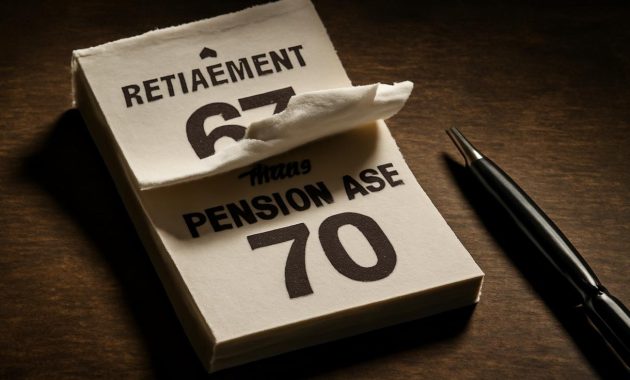
On a grey Tuesday morning, the news finally stopped being a rumour. It crackled through radios, scrolled across phone screens, and slipped into office chat threads with the same dull inevitability as rain over a British coastline: the UK government had officially announced a new state pension age. The familiar number, 67, was no longer the finishing line. Retiring, as generations had quietly imagined it, had been pushed further down the road.
A New Line on the Horizon
For months, perhaps years, it had felt like background noise. Policy reviews. Think-tank whispers. “Demographic pressures,” commentators said. “Fairness to future generations.” But there’s a difference between hearing the words and feeling them press into your life.
Imagine you’re standing on a windswept clifftop. For decades, you’ve pictured your retirement like that view: a clear edge where solid ground gives way to wide-open sky and unclaimed time. Holidays, gardening, grandchildren, maybe that long-postponed course in pottery or photography. You’ve been walking towards that cliff edge for most of your working life, counting down the miles: 55, 60, 65, and then, more recently, 67.
Now someone has quietly moved the horizon. The cliff is still there, but it’s further away, hazy in the distance. You’re being asked to keep walking—an extra few years of Monday mornings, targets, alarm clocks, and commuter trains. For some, that will feel manageable, even inevitable. For others, it will feel like a great unraveling of a promise they thought was unspoken but shared: work hard, pay in, and one day the country will let you rest.
The brutal part isn’t just the number. It’s the way it cuts into stories people were already telling themselves about their future. Retirement is not just a financial event; it’s an emotional and psychological threshold. And thresholds, once shifted, can make the ground beneath your feet feel less certain.
The Anatomy of a “Brutal” Reform
Officially, the argument is almost clinical in its logic. People are living longer. The ratio of workers to pensioners is shrinking. The welfare state is under strain. To keep the system sustainable, the state pension age must rise. On paper, it’s arithmetic. In real life, it’s blood and bone.
To understand why this change feels so stark, you have to picture the people it lands on. A delivery driver in his early 60s whose knees already throb by mid-afternoon. A care worker who lifts other people’s bodies for a living and collapses on the sofa each evening, wondering how much longer her own back will hold out. A retail worker whose smile is as much part of the uniform as the name badge, even on days she aches with tiredness.
For someone in a desk job with flexibility and decent health, an extra two or three years might feel like a nuisance, a reshuffling of spreadsheets and a delayed dream. For someone whose livelihood has always been physical, or precarious, it can seem closer to a sentence: work until your body gives way, and hope the pension arrives before you’re too exhausted to enjoy it.
That clash between policy logic and lived experience is where this reform earns its “brutal” reputation. In press conferences, the language is tidy—“aligning with life expectancy,” “maintaining fiscal balance.” At kitchen tables, it sounds more like: “So I have to keep going. Even when I thought I’d be done.”
The Numbers Behind the Shock
It’s worth pausing on the arithmetic, though, because numbers, for all their coldness, shape the terrain the rest of us must walk across. The UK’s population is ageing. More people are drawing a pension for longer. At the same time, the workforce is under pressure, battered by economic shocks, stagnant wages, and shifting industries. The national budget feels like a hand-me-down coat: every year it has to stretch further, cover more, patch more tears.
Adjusting the pension age becomes, in that light, a lever that governments cannot resist pulling. They will point to other countries doing the same, to charts showing upward curves, to actuarial tables and long-term projections. But what gets lost is that not all years of life are equal. Adding three years to average life expectancy doesn’t magically add three years of good health for everyone, or three years of secure, meaningful work.
| Cohort / Scenario | Old State Pension Age | New State Pension Age | Extra Years of Work |
|---|---|---|---|
| Born in early 1960s | 66–67 | 68 | 1–2 years |
| Born in 1970s | 67 | 68–69 | 2 years+ |
| Born after 1980 | 67 | 69–70 (projected) | 3 years+ |
| Average manual worker | 67 | 68–69 | 1–2 years, often in declining health |
These figures are illustrative, but they draw the outline of reality. The “extra years of work” don’t just exist in a spreadsheet. They are lived one early alarm at a time.
The Sound of the News in Real Lives
Picture a break room in a warehouse when the announcement drops. Someone flicks the volume up on their phone as a talking head spells out the shift. None of the men and women around the table look surprised; most just look tired. They’ve joked for years that they’ll be “working till they drop.” Now the joke tastes a little sour.
One man, in his late fifties, shrugs and says, “Knew it was coming.” Another, already nursing a persistent shoulder injury, stares at the floor. He was counting the years to 67 like a lifeline. Now that rope has been tugged out of reach.
In a quiet suburban kitchen, a woman reorganises the family budget on a pad of lined paper. She’d planned to step back from full-time work when her state pension kicked in, to help with childcare for her daughter’s young children. Now there’s a gap—years where she will still need to earn, even as her energy thins. The cascading effects ripple outward: her daughter wonders how she’ll juggle work and nursery fees; the grandchildren’s days will be shaped by whoever can step in. Policy decisions about pension ages do not live in isolation. They creep into lunchboxes, bus routes, GP waiting rooms.
Even those in their 30s and 40s feel the ground shifting. Retirement has always been an abstract shape for them, but this announcement sharpens it. The number keeps moving, like a goalpost on wheels. The unspoken message is clear: don’t count on the state to carry you into old age in comfort. Plan harder, save more, work longer. If that’s even possible.
The Emotional Ledger
Beneath the practical worries—How will I manage physically? Will my job still exist for someone my age?—there’s a quieter grief. Many people had a mental picture of their later years, stitched together from their parents’ and grandparents’ stories. A garden shed filled with tools and half-finished projects. Afternoon naps without guilt. A train journey to the coast on a weekday, just because the sky is blue. These were small, ordinary dreams, but powerful ones.
The new pension age doesn’t erase them, but it shoves them further down the calendar. For some, that delay may mean they arrive at them with less vitality, more medication, more creaks in their bones. Time, always finite, has been reordered. There is a sense of having been quietly robbed—not of money in hand, but of a season of life that felt promised.
Nature, Time, and the Myth of Endless Work
Walk through an ancient British woodland in late autumn and you feel the truth of natural cycles. Leaves don’t cling to branches out of duty; they fall when it’s time. Fields are not harvested year-round; they rest, lie fallow, rebuild. Even the sea obeys a rhythm of tides: retreat, advance, retreat. We accept this in nature without argument. Yet, somewhere along the way, we began to treat human lives differently—as if our only real value lies in how long we can stay productive in the narrow economic sense.
The new pension age cements that mindset. It says, quietly but firmly: your duty to work stretches further now. Your season of rest will come later. And it raises a deeper question that no spreadsheet can answer: how long is it reasonable to ask a human being to stay in the harness?
For some, work is not the harness but the heartbeat—a source of identity, purpose, social connection. They will choose to carry on long after their pension begins, dipping in and out of projects, mentoring, volunteering. But choice is the key word. Choosing to keep working into your late 60s or 70s is different from being forced to because the safety net has been moved out of reach.
Stand on a shingle beach at dusk and look at the tide line. You can see where the sea has been, where it rested for a while before retreating. That line, too, shifts with storms and seasons, but it’s still visible, still something you can point to. Retirement used to feel like that—a clear line, even if the exact number changed slightly. With each new reform, it becomes more like a smear on wet sand, blurring as you approach.
Whose Longer Life Are We Talking About?
When politicians say “we’re all living longer,” it’s worth asking: who is “we”? On average, life expectancy has risen, yes. But averages disguise inequalities. A professional who spends most days at a computer and has access to good healthcare may live significantly longer, and in better health, than someone who has spent 40 years in heavy industry, cleaning, logistics, or care work. Pushing the pension age up treats those lives as interchangeable.
There is a quiet injustice in asking people who are already worn down by their jobs to work longer because someone else, in a different part of the country and a different class bracket, is expected to enjoy another decade of active retirement. Policy loves averages; justice demands that we look closer.
Finding Agency in the Midst of Change
So where does that leave you, here and now, digesting the news that the state pension age is rising again? You can’t magic the legislation away. You can’t rewind time or un-announce the policy. But you can reclaim some ground in how you respond, both practically and emotionally.
On the practical side, this is the moment to treat your future self like someone you love instead of a stranger you’ll meet one day. That might mean taking an honest look at your finances, not to spiral into anxiety, but to map what you can control. Workplace pensions. Personal savings. Side incomes. Even small adjustments made steadily over time can widen your options later.
It might also mean thinking about your working life not as one unbroken stretch, but as a landscape with varied terrain. Are there ways to pivot into less physically demanding roles as you age? Can you begin to build skills now that will allow you to scale back hours later while still earning enough? None of this is easy, especially for those already stretched thin. But in a system that keeps moving the official finish line, building your own alternative routes becomes a quiet, necessary act of resilience.
Protecting More Than Your Bank Balance
Financial planning, for all its importance, is only one piece. Just as vital is tending to your health and sense of self long before your pension letter arrives. The body you will carry into your late 60s and 70s is being shaped today by sleep, movement, stress, food, and the tiny daily choices that are easy to dismiss because they don’t scream for attention. The mind you will inhabit in retirement—curious or dulled, open or withdrawn—is also being formed now.
In the face of a later pension age, small routines can become acts of quiet defiance. A walk in the park before or after work that reminds you the sky is still there, that birds still annotate the day with song. A hobby that isn’t monetised, that exists just because it makes you feel more alive. Conversations about ageing and work with your friends, your parents, your children—bringing into the open what policy announcements so often leave in the shadows.
Redrawing the Story of Later Life
The state pension age going up is a blunt, structural shift. But it doesn’t have to be the only story you tell about your later years. There is room—even within the constraints of reform—for a different narrative, one that sees ageing not just as depletion but as ripening. A phase where you carry more experience, perhaps more clarity about what matters and what doesn’t.
Imagine, for a moment, your future self at 68 or 69, in this new landscape. What would it take for that person to feel not just worn down, but grounded? Is it fewer hours of paid work, paired with more time outdoors? More freedom to say no? Stronger relationships? A sense of contribution that isn’t measured only in productivity graphs? When the official retirement age recedes, the need to ask these questions becomes more urgent, not less.
Across the country, in small ways, people are already experimenting with new shapes of later life: phased retirements, portfolio careers, community projects, intergenerational living. The government can move the pension age, but it cannot fully script how people respond, how they adapt, how they refuse to let the value of a human life be reduced to the last possible year of labour.
Goodbye to Retiring at 67—But Not Goodbye to Dignity
“Goodbye to retiring at 67” sounds like a door slamming. In policy terms, it is. A clear, hard line has been redrawn. Yet beyond the announcements and the headlines, there is still the quieter work of ordinary people insisting on dignity: in their jobs, in their homes, in the way they greet each extra year not just as a burden but as a chapter they deserve to live on their own terms as far as they can.
Change has come, and it is indeed brutal for many. But within that harshness is a call—to rethink, to plan, to push for fairer nuance in future reforms, and to hold on fiercely to the idea that a society is judged not only by how long its people work, but by how well they are allowed to rest.
FAQs on the New UK State Pension Age
What exactly has the UK government changed about the state pension age?
The government has officially confirmed that the state pension age will rise beyond 67, bringing forward or extending previous plans. In practice, this means many people will have to wait longer to receive their state pension, depending on their date of birth and the final schedule of the reform.
How can I find out my own new state pension age?
Your state pension age depends on when you were born and the detailed timetable of the reforms. The most reliable way is to use the state pension age calculator provided by official UK government services or check your online pension forecast, which is updated as new legislation is confirmed.
Will I get less money because the pension age is higher?
The weekly state pension amount you’re entitled to doesn’t automatically drop because the age goes up. However, you will start receiving it later, which means fewer total years of payments over your lifetime, especially if your health or life expectancy is below average.
What if I’m in poor health and can’t work to the new pension age?
If ill health or disability makes it hard to keep working, you may be able to access other forms of support such as sickness or disability benefits, occupational pension schemes that offer early retirement for medical reasons, or employer adjustments. It’s important to seek advice from a trusted welfare, legal, or financial adviser as early as you can.
How can I prepare financially for a later retirement age?
Consider increasing contributions to workplace or personal pensions if that’s affordable, reviewing your spending and savings habits, and thinking about how you might adjust your working life over time—such as shifting roles, reducing hours later, or developing additional income streams. Even modest changes, made consistently, can improve your resilience against further increases.
Does this change affect private and workplace pensions too?
Not directly. Private and workplace pension schemes set their own rules for when you can start drawing benefits. However, many people choose timings based on when they expect their state pension to start, so the new age may influence how you plan to use other pensions.
Is there any chance the pension age will go up again in future?
Yes. Reviews of the state pension age are built into the system, and future governments may raise it further as demographics and public finances change. That uncertainty is one reason many advisers encourage people, where possible, to build up independent sources of retirement income and to stay informed about policy developments.