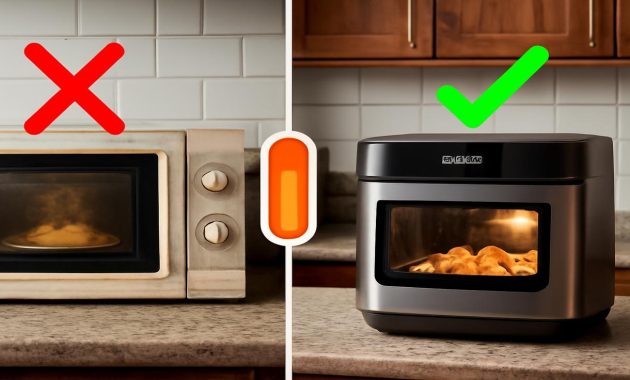
The first time Emma noticed it, the kitchen sounded different. No impatient hum. No rattling turntable. Just a low, confident whir, like distant wind under a door. On the counter, a sleek black rectangle glowed softly. Her old microwave sat unplugged in the corner, a boxy relic gathering dust beside a tangle of rarely used appliances.
Steam curled up from the pan inside the new oven—though “oven” didn’t quite capture whatever this thing was. A fan whispered, lights flickered warm gold across the food, and in less than ten minutes, the raw salmon she’d slid onto the tray came out perfectly cooked: crisped skin, buttery flesh, bright and intact.
Her teenage son wandered in, phone in hand. “Is dinner ready? Didn’t you just put that in?”
She handed him a fork. “Try it.”
He took one bite, then looked back at the device. “That was… fast. And not gross. So are we done with the microwave now?”
Emma glanced at the unplugged box on the side counter and smiled, realizing something quietly extraordinary had happened. She had not used the microwave in over a week—and she hadn’t missed it once.
The quiet moment many homes are having
In kitchens across cities and suburbs, in compact studio apartments and sprawling family homes, this same quiet shift is underway. Not a loud revolution—with cardboard boxes and triumphant social media posts—but something softer. A microwave that simply stops being used. A new device that quietly does its job better, faster, cleaner. And one night, in the middle of reheating leftovers that somehow taste like they were just cooked, someone thinks: Do I actually need that microwave anymore?
The answer, more and more often, is no.
Call it the rise of the hybrid oven, the air-fry–convection combo, the smart countertop cooker. Different brands, different designs, same idea: a compact machine that merges powerful heating elements with a strong fan, moving hot air fast and precisely around your food. Some add steam. Some add sensors. Some connect to an app that quietly counts down while you’re in the next room.
What matters isn’t the branding. It’s the experience: hot food that doesn’t dry out, quickly cooked meals that don’t taste like rubber, and the slow creeping suspicion that the microwave—the once magical, humming heart of weeknight survival—might have quietly become obsolete.
This shift doesn’t feel like replacing one machine with another. It feels like reclaiming how food should taste, without having to sacrifice the convenience that modern life demands.
The old familiar hum and its hidden compromises
For decades, the microwave was our weekday savior. You could see it in every rental listing and break room, in student dorms and nursing homes: that boxy guarantee that no matter how late you worked or how tired you were, something hot could be ready in minutes. It democratized speed, put “just zap it” into the national vocabulary, and taught generations of kids how to feed themselves without turning on a flame.
Yet for all that ubiquity, there was always a quiet compromise.
Food went in promising. It came out… changed. Pizza turned soggy and limp, crust collapsing under a damp, sad weight. Leftover chicken grew stringy, as though each second of heat wrung out another drop of moisture. Vegetables, once bright and crisp, emerged tired, their color dulled and their texture somewhere between mush and squeak.
Nobody expected the microwave to cook well. Its job was to cook fast. So we adjusted ourselves around it. We lowered our expectations. We endured rubbery cheese and chewy edges because we were, in some way, trading taste for time.
Then these new devices arrived—convection ovens, air fryers, combi-steam ovens, high-speed smart cookers—and began to quietly erode that trade-off. They offered both.
The new heartbeat of the modern kitchen
The first thing you notice, standing in front of one of these new ovens, is the air.
Not the faint chemical tang of overheated plastic or the instant blast of microwave heat, but something gentler: warm circulating air that carries scent. Garlic drifting out as thin slices of potato curl into crisp, golden chips. A faint whisper of rosemary from a tray of vegetables, roasting instead of steaming in their own trapped moisture.
The sound is different too. Instead of the blunt on-off pulse of a magnetron, you hear a steady fan, modulating subtly as the machine adjusts its temperature. Some units preheat in well under five minutes, lighting up with a soft chime when they’re ready, like a polite invitation instead of a command.
The difference is less about technology and more about what ends up on your plate.
- Leftover roast chicken, once doomed to dryness in the microwave, emerges with crisp skin and juicy meat in under ten minutes.
- Frozen vegetables, so often a compromise, roast into caramelized, almost sweet bites that you find yourself actually craving.
- Yesterday’s pizza? The cheese re-melts, the crust crackles, and you wonder how you ever accepted that floppy, damp alternative.
Most of the magic comes down to high-velocity hot air and, in some models, a touch of steam—elements that heat food from the outside in, browning and crisping while still protecting moisture. It turns out that when food is treated like food, not like an object that simply needs its molecules rattled, your entire relationship with “quick meals” begins to change.
| Task | Microwave | Modern Hybrid / Air-Fry Convection |
|---|---|---|
| Reheating pizza | 1–2 minutes, soft and soggy | 4–6 minutes, crisp crust, melted cheese |
| Crisping leftovers | Fast but rubbery or dry | Slightly longer, crisp outside, moist inside |
| Frozen fries / nuggets | Hot but pale and limp | Golden, crunchy, “oven-fry” texture |
| Roasting vegetables | Uneven, often watery | Even browning, caramelized edges |
| One-pan dinners | Mostly not possible | Sheet-pan or basket meals in 15–25 minutes |
The numbers on the clock don’t lie: for small portions and simple tasks, these devices often match or beat the microwave, especially when you factor in taste. Five extra minutes feels less like waiting and more like anticipation when the reward is food that smells like dinner instead of merely “heated.”
Faster, cleaner, simpler: how habits quietly shift
Upgrading hardware is one thing. Changing habits is another. Yet kitchens are behavioral spaces. A new tool becomes part of your life only when it slides so easily into your routine that one day you catch yourself using it without thinking.
At first, you might reach for the new oven only for specific tasks: air-frying fries, roasting vegetables, crisping up wings for a game night. The microwave still handles coffee reheats, oatmeal, those quick “just warm it up” moments.
Then little shifts start to happen.
You discover you can reheat soup in a shallow bowl without it splattering, the top bronzing just slightly. You throw together a sheet of chopped vegetables and a piece of fish, set the timer, and walk away. You notice that the inside stays remarkably clean, thanks to a non-stick interior or a quick wipe-down post-cooking. No crusted-over explosions. No mysterious overboiled sauces fused to the top panel.
One evening, you toss some leftover potatoes and sliced sausage onto the tray, roast for ten minutes, and suddenly dinner is not a compromise but a small, fragrant triumph. The kids wander in because it smells like cooking, not like warmed plastic.
The difference is not only in what you cook, but how you feel while cooking. You’re no longer just reheating; you’re assembling small meals, nudged gently back into a relationship with raw ingredients. Cherry tomatoes that might have shriveled in the fridge become blistered, sweet jewels on toast. That half-forgotten broccoli stalk crisps into a snack you eat straight from the pan.
Kitchens begin to look different too. The counter once crowded with a toaster, microwave, and a couple of “we should use that more” gadgets now has a single, versatile device that does most of their jobs better. The microwave, stripped of its central role, quietly drifts toward the edges—toward the garage, the donation pile, the back of a high pantry shelf.
Energy and the invisible cost of convenience
Behind this shift is another story, one that doesn’t sizzle or steam: energy. Traditional full-size ovens are powerful but often inefficient for the small-batch, everyday cooking most of us do—preheating a huge metal box just to roast a handful of asparagus. Microwaves are efficient in one narrow sense, but can leave you reheating and adjusting, cycling through those 30-second bursts until the middle is finally hot and the edges not entirely wrecked.
Modern hybrid devices sit in a sweet middle ground. Smaller cavities mean faster preheat times and more concentrated heat. Strong fans ensure even cooking, so you don’t have to keep opening the door to stir or rotate. In many households, this translates to using the main oven less, and replacing repeated microwave cycles with a single, smartly controlled blast of hot air.
The savings don’t show up as fireworks on your electricity bill, but they accumulate quietly, like coins in a jar. Less energy, less waste, fewer forgotten vegetables dying in the drawer because cooking them feels like too much work. Convenience, it turns out, can be kinder to both your schedule and your power usage when it’s designed more thoughtfully.
From “heating food” to “actually cooking” again
There’s a moment you might recognize if you’ve ever upgraded an everyday tool—trading in a dull, plastic-handled knife for a well-balanced steel one, or replacing a rickety bike with something that glides. You begin by using it the same way you always have, then slowly discover it can do much more.
That moment is unfolding now in small, quiet ways as households explore what these new devices can handle.
- A young couple in a tiny apartment learns they can bake small loaves of bread without turning their kitchen into a furnace.
- A retiree roasts a single chicken thigh and a handful of carrots for lunch, skipping the big oven entirely.
- A harried parent slides in a tray of marinated tofu and sliced peppers, coming back 15 minutes later to something that smells like it took an hour.
The line between reheating and cooking blurs. When you can turn pantry odds and ends into something freshly browned and fragrant in the same time it used to take to stare at a spinning plate of leftovers, convenience stops being the enemy of good food.
Perhaps that’s what makes the quiet retirement of the microwave so striking. For years it symbolized the supremacy of speed over everything else. Now, as faster, cleaner, tastier options emerge, the idea of what “quick food” looks and tastes like is being rewritten.
So what does saying goodbye actually look like?
Most people don’t toss their microwave out dramatically. It’s more subtle. They unplug it when rearranging the counter. They cart it into a spare room while deep-cleaning and then feel no urgency to bring it back. Guests come over, scan the kitchen, and ask, “Wait, where’s your microwave?”
The answer tends to be a small shrug and a quiet confession: “I stopped using it. This thing does everything I need.”
Of course, not everyone will make the switch right away. Some love the microwave’s particular quirks: the lightning-fast melting of butter, the instant steaming of a sponge, the quick thaw when you’ve forgotten to take something out of the freezer. For some, it’s not just an appliance, but a symbol of a certain era—a badge of independence in that first apartment, the reassuring box that saw you through long nights of instant noodles.
But even in those homes, the center of gravity is shifting. The microwave, once the main character, is becoming a supporting actor. The faster, cleaner, more versatile device on the counter is quietly taking over the lines.
Standing in your own kitchen, listening
If you stand in your kitchen tonight and listen closely, you might notice it: the small, evolving symphony of modern cooking. Less of that impatient beep beep beep cutting through the evening, more of that low, steady rush of air. Fewer plastic containers fogged from the inside, more baking sheets slicked with a little oil and scattered with real, textured food.
It doesn’t mean we’re all becoming chefs. It doesn’t mean life is slowing down or that we suddenly have hours to tend to bubbling pots. What it means is that our appliances are catching up to what we always secretly wanted: food that tastes like someone cared, prepared in the narrow spaces between emails and carpools and late-night study sessions.
Goodbye, then, to the age of resigned compromise—the era of “it’s fine, it’s just reheated.” The farewell to the microwave isn’t angry or dramatic. It’s more like gently closing the door on something that served us well, while recognizing that the world has moved on.
On a quiet weeknight, with rain sliding down the windows and a small, efficient oven humming on the counter, you pull out a tray of roasted vegetables, their edges crisp, their centers soft and sweet. You toss them with leftover grains, a crumble of cheese, perhaps a fried egg on top. It took 15 minutes, start to finish. The kitchen smells like a promise kept.
You sit down with your bowl, warm in your hands, and realize you haven’t heard the familiar microwave beep in days. You don’t miss it. Something better, tastier, and strangely more human has taken its place.
FAQ
Do I really need to get rid of my microwave?
No. Many households keep their microwave for specific tasks like softening butter, quickly steaming items, or defrosting. The shift happening in many homes isn’t always about throwing the microwave out, but about using it far less because a modern hybrid device covers most everyday cooking and reheating needs better.
Are these newer devices actually faster than a microwave?
For some tasks, like boiling water, a microwave can still be quicker. But for reheating meals, crisping, roasting, or cooking small portions, modern air-fry and convection-style ovens often match or beat the microwave on total time once you factor in fewer do-overs and much better results in texture and taste.
What about energy use compared to a regular oven?
Most countertop hybrid ovens are smaller and heat up faster than full-size ovens, which means they often use less energy for everyday tasks. Instead of preheating a large cavity for a small meal, you’re heating a compact space efficiently with strong air circulation.
Can these devices replace a full-size oven too?
For singles, couples, or small households, many people find they use their full-size oven far less, or almost not at all, once they have a good hybrid or air-fry convection device. For large families or big holiday meals, a full-size oven can still be useful, but for daily cooking, a modern countertop cooker often becomes the main workhorse.
Is the food really that different from microwave cooking?
Yes. Microwaves heat by exciting water molecules inside the food, which can lead to rubbery textures and soggy surfaces. Modern hybrid ovens use hot, circulating air (and sometimes steam) to brown, crisp, and caramelize food. The result is closer to traditional oven cooking—crispy where it should be, tender where it matters, and far more flavorful.