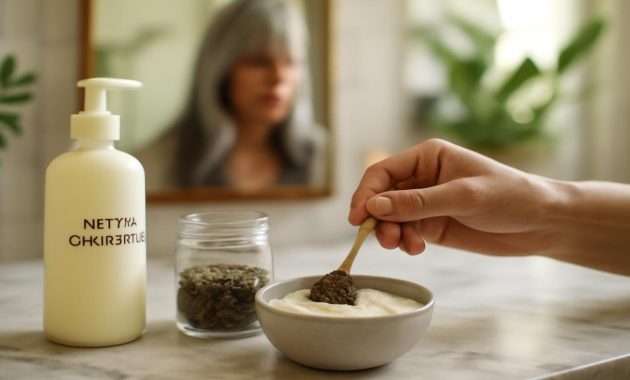
The first silver hair arrived on a Tuesday. You remember because you saw it glinting at you from the bathroom mirror like a tiny, unapologetic moonbeam. You plucked it out, maybe laughed, maybe swore under your breath. Then a few more appeared. Then whole constellations at your temples, threading through your parting like frost creeping across a windowpane. Somewhere along the way, colour stopped feeling like a choice and started feeling like maintenance—root touch-ups, late-night panic before social events, the faint sting of chemicals at your scalp. Yet, lately, a quiet question has been taking root in the back of your mind: what if there was another way? What if “goodbye hair dye” didn’t have to mean “hello, I give up,” but instead “hello, something gentler, slower, more you?”
The moment the bottle starts to feel heavier
It often sneaks up on you. One day you’re tossing a box of dye into your shopping basket without much thought. The next, you’re standing in the hair-care aisle, staring at those glossy promises of “total grey coverage,” and you feel a flicker of resistance. You turn the box over. Ammonia. Peroxide. A list of ingredients that reads more like a lab report than a beauty ritual. You remember the faint chemical fog in your bathroom and how your scalp tingled too long after rinsing.
At home, the ritual unfolds the way it always has—old T-shirt, plastic gloves, that unmistakable scent. But something is different. As you massage the dye into your roots, you can’t help wondering what it’s asking of your hair, and of you. The effort to stay the same shade you were at twenty-five is starting to feel like a small, regular betrayal of the person you are now.
The mirror becomes a quiet confessional. Every four weeks, six weeks, eight if you’re really stretching it, you do the same dance. Maybe you’ve started to dread rain, humidity, or that sharp partline that reveals stark grey at the roots. The colour looks lovely for a week or two, then it dulls, fades, exposes the truth beneath like worn paint on an old door. And still, you keep buying, because what’s the alternative—just “going grey” overnight?
The whisper of a different way
It usually starts with a half-joking comment to a friend. “I wish there was a way to keep some colour without all the dye.” Or maybe you’re scrolling on your phone late at night, when an article about natural hair care catches your eye. That’s where you first read those four quiet, hopeful words: conditioner add-in for greys.
The idea feels almost too simple. Not a dramatic dye job, not a one-time miracle fix. Just a small spoonful of something, stirred into the conditioner you already use, running through your strands in the shower while the steam curls around you. No stinging, no room that smells like a salon. No timers ticking down as you watch your roots slowly darken with chemicals.
This add-in doesn’t shout. It doesn’t promise that you’ll wake up tomorrow with your twenty-year-old hair. Instead, it whispers: Let’s work with what’s already there. It leans on the biology of your hair, not a brute-force repainting of every strand. It respects time. It respects change. And, in a world hooked on instant results, there’s something surprisingly magnetic about that gentleness.
How a simple conditioner add-in can nudge colour back
To understand why this little ritual can matter, you have to zoom in—for a moment—on what’s happening between your scalp and each strand of hair. As we age, the pigment-producing cells in our hair follicles, called melanocytes, slow down. Think of them as tiny, overworked artists who gradually put down their paintbrushes. Traditional hair dye barges in and covers the canvas from the outside, whether the artists want to paint or not.
The conditioner add-in works differently. Formulated to support the environment of the scalp and hair fibre, it gradually encourages conditions where pigment can be better preserved or subtly enhanced. It doesn’t force colour where there’s absolutely none left, but it can deepen what remains, soften the contrast between greys and your original shade, and gently shift that stark “line of demarcation” into something more blended, more nuanced, more lived-in.
Used consistently, it acts a bit like compost in a garden. You don’t see a transformation overnight, but over weeks and months, your hair can look richer, more dimensional, less brittle. Those bright, wiry silver strands? They may soften in both texture and tone, echoing more of your underlying colour without looking flat or artificially uniform.
Turning your shower into a quiet experiment
There’s a small, intimate pleasure in turning something as ordinary as washing your hair into a ritual of quiet rebellion. No more appointment bookings, no anxious countdown to your next dye session—just a small change in your routine, repeated often enough to start telling a new story.
Imagine it. You step into the shower, the water warm and steady, a kind of moving shelter. Your favourite conditioner sits on the ledge, only now there’s a new companion beside it: a bottle or jar of your chosen grey-blending add-in. It doesn’t look dramatic. No neon colour, no “warning: powerful chemicals” label. It’s just… there. Calm. Assured.
You squeeze your usual amount of conditioner into your palm, then add a measured amount of the treatment. As you mix them together with your fingers, it feels like stirring cream into coffee—soft, simple, restorative. You smooth the mixture through your hair, from mid-lengths to ends, massaging a bit at the roots. The fragrance is subtle, maybe herbal or slightly earthy, the kind of scent that makes you breathe slower, not flinch.
For a few minutes, while the mixture rests in your hair, you stand under the water and feel the day loosen its grip on your shoulders. You’re not waiting on a timer, panicked about stains on your towel or the bathroom tiles. You’re letting the process be what it is: gradual, unhurried, as patient as tree rings forming year by year.
What changes—and what doesn’t—over time
The first week, you probably won’t notice much. Maybe your hair feels a little softer, a little less frizzy. Then a few weeks pass, and under a certain light—by a café window, in your car’s rearview mirror—you catch something unusual. The greys around your temples don’t flash quite as brightly. They’ve taken on the faintest whisper of your natural tone, as though your hair were remembering itself.
By the second month, the sharp contrast between your pigmented hair and the lighter strands has softened. Instead of a stark salt-and-pepper that catches your eye in every photo, you start seeing a more gentle harmony of shades. A friend might ask if you’ve “done something” to your hair. They can’t quite place it. It just looks… healthier. Less tired. More “you” in an undefinable way.
What doesn’t change, though, might be just as important. You don’t wake up one day suddenly unrecognizable. You don’t feel like you’re hiding under a blanket of opaque, uniform colour. You still see the story of time in your hair—only now it reads more like poetry and less like a before-and-after ad.
From control to collaboration with your hair
The most radical part of saying goodbye to conventional hair dye might not be the products themselves, but the shift inside you. For so long, hair care has been framed as control: cover, correct, fix, erase. Every root that grows in “wrong” becomes a problem to solve. Every new grey becomes evidence in some quiet courtroom that you’re losing a battle.
When you move to something gentler—a conditioner add-in that works with your existing colour, not against it—you step out of that battlefield. You stop fighting your hair and start collaborating with it. The goal is no longer “make this disappear.” The goal becomes “help this look and feel its best,” even as it changes.
You’re no longer chasing the exact shade of your younger self. Instead, you’re nourishing the hair you have now, inviting back some depth and warmth where it’s fading, while allowing a new kind of beauty to surface. There’s power in that surrender, in choosing subtlety over spectacle.
Making it practical: a gentle grey-blending routine
Switching from dyes to a conditioner add-in isn’t complicated, but it helps to approach it like a slow transition, not a cliff jump. That includes a bit of planning, a bit of patience, and a willingness to watch for small, almost secret signs of change.
| Step | What You Do | What You Notice Over Time |
|---|---|---|
| 1. Pause the dye cycle | Let your roots grow in for a few weeks before your next scheduled dye session. | You see your true pattern of greys, especially around the hairline and part. |
| 2. Introduce the add-in | Mix the conditioner add-in with your usual conditioner 2–3 times per week. | Hair feels more hydrated; greys look slightly softer in tone. |
| 3. Be consistent | Keep using the mixture regularly, focusing on areas with the most visible greys. | Contrast between greys and natural colour begins to gently blur. |
| 4. Adjust as you go | Increase or decrease how often you use it, based on how your hair responds. | Colour looks more balanced and natural, without obvious regrowth lines. |
| 5. Support from the inside | Take care of overall nutrition, stress, and scalp health alongside your new ritual. | Stronger, shinier hair that better reflects light and appears richer in tone. |
Some people notice changes in as little as four to six weeks, while for others it may take a few months. Like watching seasons shift, the magic is in paying attention to the quieter cues—the way your hair feels under your fingers, the confidence that creeps back into the way you tuck it behind your ear in public.
Reframing “ageing” as “unfolding”
Hair holds stories. Childhood braids. Teenage experiments with fringe and bleach. The too-short cut you swore you’d never repeat. Wedding updos, post-breakup chops, the first ponytail streaked with grey. When we panic at those silver threads, we’re often not reacting to colour at all—we’re reacting to what we think it says about our place in the world.
But stand in a forest long enough, and you realize something simple: nothing stays the same shade forever. Leaves ripen, deepen, pale, and fall. Bark cracks and silvers; stones grow lichen-soft at the edges. Nothing about that is loss. It’s texture. It’s history. It’s proof of having existed under sun and snow and wind.
Allowing your hair to shift, while supporting it with a gentle, restorative conditioner treatment, is a way of honouring that natural progression. You’re not pretending time isn’t passing. You’re curating how it shows up on your head, the way someone might polish an old wooden table rather than painting it over. The grain still shows. The years still speak. But there’s care in it. Intention. Respect.
People may still ask, eventually, if you’re “going grey.” You might smile, run a hand through your hair that now falls in soft, multi-tonal waves, and answer, “I’m letting my hair be itself—just better cared for.” It’s not about reversing age. It’s about refusing the idea that your only options are full-colour disguise or hard-edged surrender.
Small acts of care that ripple outward
When you start treating your hair more gently, something interesting often happens: that care spills into other parts of your life. Maybe you start reading ingredient labels on your skincare. Maybe you carve out ten quiet minutes at night just to brush your hair mindfully, massaging your scalp as the day unspools from your thoughts.
You may find yourself lingering a little longer by the window as you dry your hair, watching the way the light catches it. There’s less urgency now, less tension around “hiding” anything. You push a silvered strand back from your forehead and see it not as an intruder, but as part of the whole scene—a streak of frost on a field that’s still fertile, still growing.
It’s a small revolution, choosing to retire the harsh dyes and replace them with a quiet, persistent conditioner ritual. But revolutions don’t always look like protests and proclamations. Sometimes they look like a person standing alone in a bathroom, rinsing their hair and thinking, I’m allowed to change how I show up in the world, without disappearing myself.
Goodbye hair dye, hello long conversation with your hair
There will still be temptations. A big event comes up and you’ll consider reaching for the old familiar box, just to “polish things up.” You’ll see glossy ads with women whose hair looks like a single, seamless panel of colour and wonder, briefly, if subtlety is worth the patience.
And then one day, you’ll catch your reflection somewhere unexpected—shop window, train door, the front-facing camera you accidentally open—and instead of flinching toward your roots, you’ll lean in. Your hair will look like it belongs to you, not to a version of you that’s slowly slipping out of reach. The greys will be there, but softened, threaded into the deeper tones like clouds in a late-evening sky, not harsh fluorescent lights cutting through darkness.
You’ll run your fingers through it and feel not straw, but softness. Not damage, but resilience. A quiet gratitude may settle in your chest—for your body, for your years, and for the simple alchemy of a conditioner, a gentle grey-loving add-in, and time.
You didn’t stop caring. You didn’t “let yourself go.” You simply chose a version of care that doesn’t demand you erase the evidence that you have lived. In that choice, every wash becomes a small, daily vow: I am still changing, and I can change kindly.
Frequently Asked Questions
Does a conditioner add-in really restore my natural colour?
It doesn’t turn back the clock in a dramatic way, but it can gently support and deepen the tones you already have. Over time, many people notice that greys look softer and less stark, and that their overall hair colour appears richer and more blended.
How long does it take to see results?
You may notice small changes in softness and shine within a couple of weeks. Visible shifts in tone and blending of greys usually appear gradually over 4–12 weeks of consistent use.
Can this completely replace my usual hair dye?
For some, yes—especially if you’re comfortable with a natural, multi-tonal look. For others, it becomes a way to stretch out the time between dye sessions or to transition away from permanent dyes more gently.
Will it work if my hair is fully grey or white?
If all pigment is gone, it won’t recreate your original colour, but it may still improve shine, reduce dullness, and give a slightly warmer or cooler cast, depending on the formula. The biggest visible changes tend to appear when some natural pigment remains.
Is this method safe for sensitive scalps?
Conditioner-based treatments are generally gentler than traditional dyes, especially those free from harsh chemicals. However, if you have a sensitive scalp or allergies, it’s wise to patch-test the product first and introduce it slowly into your routine.
Can I use it with coloured or highlighted hair?
Yes, many people use grey-blending conditioner treatments on previously coloured or highlighted hair. They can help soften regrowth and improve the look of fading colour, though results will vary depending on your starting shade and hair condition.
What if I decide I want to go back to normal dye later?
You can. Using a gradual conditioner add-in doesn’t lock you into a permanent choice. It simply gives you another, gentler option—one you can continue, pause, or combine with other methods as your preferences evolve.