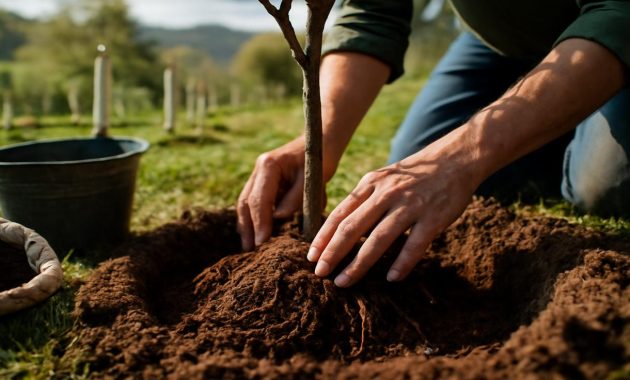
The first bee arrives before the sun has quite committed to rising. You hear it before you see it—a faint, uncertain buzz that wobbles through the cool air like someone clearing their throat at the start of a concert. The orchard is still mostly brown and gray, trees bare, earth sleeping. But if you’ve planted with intention, the stage is set. Underground, at eye level, high in the half-silhouetted branches, everything is quietly bracing for the cue: spring.
The Living Secret Behind Every “Effortless” Spring Orchard
Ask any old gardener in a town where fruit trees still matter, and you’ll hear the same thing: an orchard isn’t just rows of trees, it’s an ecosystem you choreograph. The most enviable spring orchards—the ones that look like a watercolor painting and hum like a beehive—are never accidents. They’re built on a layer of essential plantings that most newcomers overlook in their rush to buy more fruit trees.
It isn’t only about apple, pear, plum, or cherry. The real magic is happening underneath and between them, in the low, persistent plants that wake early, lure pollinators, feed the soil, and quietly defend against pests. Gardeners who swear their spring orchards “just explode” with blossoms are usually the same ones tucking herbs between tree roots, sowing clover in the aisles, or sneaking in early bulbs the way a chef slips anchovies into a sauce—subtly, but decisively.
If you’re planning or reviving an orchard, consider this your backstage pass. These are the companion plantings that experienced orchard keepers lean on year after year, the quiet cast that guarantees your show opens strong every spring.
The Quiet Groundcover That Feeds the Whole Orchard
Walk into a flourishing spring orchard and look down. The soil will tell you whether the person who planted it thought beyond the trees. You’ll notice a softness underfoot, not bare dirt baked into a crust, but a living carpet—something green, textured, and humming with tiny life.
Leguminous groundcovers are the unsung heroes here. White Dutch clover, crimson clover, birdsfoot trefoil, even vetch in some wilder orchards—these plants grab nitrogen from the air and hand it directly to the soil, where your fruit trees can use it. They turn what could be a dead, muddy aisle between rows into a living pantry.
In early spring, when the fruit trees are just hinting at bud swell, those clovers are already awake, catching the first warmth, rooting deeper. Their blossoms arrive right on time for hungry pollinators who haven’t yet found much else. Stand quietly and you’ll see them: bumblebees with sleepy wings, tiny wild bees tracing determined paths from clover bloom to clover bloom, drifting upward to your pear blossoms and back down again in a lazy, vital loop.
You don’t need to plant a monoculture carpet. In fact, most orchard keepers who swear by groundcovers favor simple mixes. A sprinkle of low-growing clover here, some creeping thyme around trunks, self-heal or yarrow in the aisles. These stay mowable, step-able, and forgiving. The result is soil that stays cooler in summer, less compacted in wet seasons, and gently, steadily nourished without a chemical fertilizer bag in sight.
How to Use Groundcovers Without Creating Chaos
Think in rings and paths. Around each tree, leave a small open space for mulch and trunk breathing. Beyond that, sow your clover or mix lightly and consistently so it doesn’t become patchy. Mow high if needed, allowing flowers to bloom at least part of the season. You’re not looking for a golf course; you’re aiming for a living rug that breathes, blooms, and feeds.
The Pollinator Magnets That Turn Blossoms into Fruit
Spring in an orchard is a sensory overload: the sweet, uncertain perfume of apple blossoms, that faint almond note from peony-like plum flowers, the sharp green smell of sap pushing into new wood. It’s gorgeous—but without pollinators, it’s also a dead end. Flowers without bees are like open doors to a house nobody enters.
Gardeners who consistently get heavy fruit set tend to surround their trees with what looks, at first glance, like a cottage garden gone rogue: tufts of lavender shimmering with wings, patches of borage with star-shaped blue flowers, tangles of phacelia curling like old script, calendula beaming orange disks into every corner of the orchard.
These “pollinator strips” do more than pretty things for the human eye. They create a dependable food corridor. When early cherry blossoms open before dandelions, your bees can still find nectar in the first flowering bulbs and herbs. When apples bloom later, they’re joining a party that’s already in motion, not trying to start one from scratch.
| Plant | Best Role | Bloom Timing |
|---|---|---|
| Clover (white/crimson) | Groundcover & nitrogen fixer | Spring to early summer |
| Borage | Pollinator magnet, dynamic accumulator | Late spring through summer |
| Lavender | Pollinators & pest deterrent | Late spring to mid-summer |
| Daffodils | Early color, rodent deterrent | Very early to mid-spring |
| Comfrey | Nutrient pump & mulch source | Late spring onward |
If you’ve ever watched bees in an orchard planted this way, you know the difference. Instead of a few hesitant foragers, the air has a visible density to it—dozens of insects weaving invisible patterns between support plants and blossoms. In a cold, late spring, those extra attractors can mean the difference between light and heavy fruit set.
Designing a Bloom Calendar for Your Orchard
Think of bloom times as an unbroken chain. Start early with bulbs—crocus, snowdrops, daffodils—threading them along paths and under tree canopies where they’ll soak up light before the trees leaf out. Follow them with flowering herbs like chives and thyme, then the workhorse annuals: phacelia, borage, cosmos, calendula. The goal is simple: no week in spring without something in bloom, no corner of the orchard completely silent.
The Tough Herbs That Guard the Roots
Bend down to the base of a thriving orchard tree and you’ll often notice a little circle of intention: a fragrant ring of herbs, a cluster of bulbs, a patch of something that seems too deliberate to be a weed. This “guild” around each tree—the tight-knit community of companion plants—is where so much of the orchard’s resilience lives.
Herbs like chives, garlic chives, oregano, thyme, and lemon balm play multiple roles under and around fruit trees. Their strong scents can confuse or repel some pests that home in on fruit and foliage. Their flowers bring in the beneficial insects that prey on aphids, caterpillars, and mites. Their roots help break up dense soil, improving drainage right where the tree needs it most.
Some gardeners swear by planting garlic or alliums at the drip line of their trees, claiming they see fewer borers and fungal problems. Whether that’s correlation or causation, there’s no question that a living, aromatic understory does more good than a ring of lifeless mulch alone. On a damp morning after rain, the smell of wet thyme, crushed underfoot as you check buds, can be its own small reward.
Building Simple Tree Guilds
You don’t need a complex permaculture design to start. Around each young tree, think layers: a ring of daffodils or other bulbs to deter rodents and add early color; a scattering of chives or garlic chives closer to the trunk; low-growing thyme or oregano to fill the gaps. As the tree matures, you can add tougher perennials like comfrey a bit farther out, where their deep roots won’t compete too aggressively but will mine nutrients and draw them upward.
The Powerhouse Perennials That Feed the Soil
Fruit trees live a long time. To keep them productive, you need a support system that’s just as perennial, plants that show up year after year without nagging. In most seasoned orchards, you’ll find at least one of these workhorses: comfrey, yarrow, or lupine.
Comfrey, in particular, has a near-mythic reputation in orchard circles. Its roots drill deep, pulling up minerals that shallow-rooted plants can’t touch. The leaves, huge and generous, can be chopped and dropped right at the base of the tree, where they decompose into a kind of slow-release fertilizer. On a warm day, you can hear the subtle patter as comfrey leaves are laid down, building a soft, dark mulch that looks almost forest-made.
Yarrow works in quieter ways: it draws beneficial insects, tolerates neglect, and weaves itself into the orchard floor. Lupines flare in spring with vertical spires of color, fixing nitrogen along the way. Together, these perennials act as a biological savings account: nutrients stored, released, cycled, and stored again, right where your fruit trees can reach them.
This approach reduces how often you need to haul in compost or fertilizers from outside. The orchard begins to feed itself. When you walk through in early spring, you’re not just seeing color—you’re seeing slow, steady nutrition in motion, above ground and below.
Keeping Perennials in Balance
The key is placement. Comfrey and lupines belong just beyond the immediate root zone of young trees, where they can be cut and carried in as mulch. Yarrow, smaller and better behaved, can tuck in closer. Once established, these plants may spread, but in the context of an orchard, that’s often a blessing. If they roam too much, a sharp spade and a few minutes of digging in cool spring soil will restore the balance.
The Bulbs and Early Flowers That Wake the Orchard
There is a particular kind of silence in late winter—the kind where even the birds seem to be waiting. Then, one day, you see it: a flare of yellow between two bare trunks, small but electric. A daffodil. Followed by another. And another. Suddenly the orchard is not a stoic grid of sleep, but a place with pulse again.
Bulbs are the emotional early risers of the orchard, but they serve real practical purposes too. Daffodils, for instance, are famously unappetizing to rodents and can act as a subtle fence around tree trunks that might otherwise be nibbled in hungry months. Crocuses and snowdrops announce themselves even earlier, feeding the earliest pollinators when very little else is on offer.
When gardeners tuck bulbs beneath their fruit trees, they’re doing more than decorating. They’re staking a claim on the season, telling the orchard, “We start now.” That early hit of color seems to reset the mind, too: this is no longer a cold, muddy field but a living system about to leaf out in earnest.
Layering Color Without Competing
The beauty of bulbs is their timing. They grab sunlight before the trees fully leaf out, then retreat underground as summer shade thickens. Plant them in clumps near tree bases, along paths, or in accidental-looking drifts through the orchard. Mix early (snowdrops, crocus) with mid and late (daffodils, tulips where safe from deer) so that each walk through the orchard in spring reveals something new waving at ankle height.
Designing Your Own Flourishing Spring Orchard
If you stand at the edge of an established, thoughtfully planted spring orchard, you can read its story in layers. The tall scaffolds of trees, shaped and pruned by someone’s patient hand. The mid-level shrubs and perennials, bustling with insects. The ground layer, soft and dappled, smelling faintly of clover and thyme. The eye doesn’t catch each individual player at once, but the body feels the whole: alive, balanced, generous.
Designing your own version doesn’t require a massive property. Even a handful of backyard fruit trees can benefit from these essential plantings. Start with the simplest questions:
- What’s under my trees right now—bare soil, grass, mulch, or living companions?
- Do I have flowers blooming before, during, and after my fruit tree blossoms?
- Where are my nitrogen fixers and nutrient accumulators?
- Which herbs or bulbs could quietly guard and beautify my tree bases?
From there, you can layer in the classics that veteran orchard keepers swear by: white clover and low mixes for the ground, pollinator strips of borage and phacelia, herb rings of thyme, chives, and oregano, nutrient pumps like comfrey and lupines, and ribbons of bulbs marking the earliest start to the season.
Over the next few years, you’ll notice the difference. Blossoms will seem thicker. Pollinators will arrive earlier and in greater numbers. Soil will hold moisture more willingly, then drain in heavy rains without sulking into mud. Pest problems may not vanish, but they’ll feel less like invasions and more like manageable fluctuations in a larger, stable community.
And one morning, as you step into the cool hush of your orchard and hear that first uncertain bee tracing its way through the light, you’ll recognize the feeling that experienced gardeners talk about with an almost conspiratorial smile. Your trees aren’t flourishing by luck. They’re held up by a whole cast of supporting plants—unassuming, essential, and very much alive beneath your feet.
Frequently Asked Questions
Do I need all of these companion plants for a successful orchard?
No. You don’t need every single plant mentioned, but you do need the functions they provide: groundcover, nitrogen fixation, pollinator support, nutrient accumulation, and some pest deterrence. Choose a few from each category that suit your climate and space.
Will groundcovers compete with my fruit trees for water and nutrients?
If chosen and managed well, low-growing groundcovers like clover actually support trees more than they compete. Avoid tall, aggressive grasses right at the trunk, keep a small mulch ring immediately around the base, and mow or cut groundcovers as needed to keep competition in check.
Is comfrey safe to plant near young trees?
Yes, but give it a bit of distance from newly planted trees. Place comfrey at or just beyond the drip line so it doesn’t crowd young roots. You can always chop and drop its leaves as mulch closer to the trunk.
How soon will I notice a difference after adding these plantings?
You’ll see visual changes—the look and feel of the orchard—within the first season. Pollinator activity and improved soil structure usually become noticeable after one to two years. Better fruit set and overall tree vigor often show more clearly by the third season.
Can I convert an existing lawn under my trees into this kind of planting?
Yes. Start by sheet mulching patches of lawn (using cardboard under mulch) to kill the grass, then sow clover, herbs, and perennials into those cleared zones. Work in stages so you don’t disturb tree roots too aggressively in one go. Over time, you can replace most or all of the lawn with a living, diverse orchard floor.