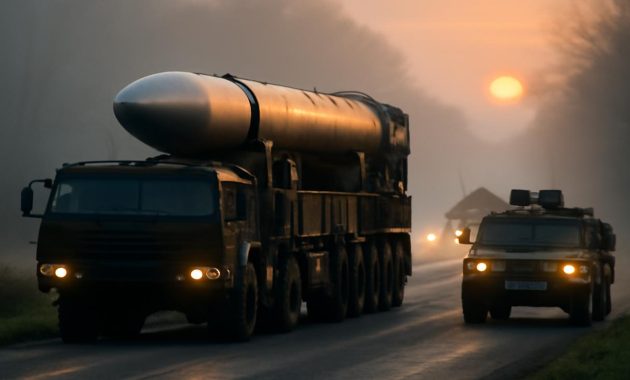
The news slipped into the world like the low rumble of distant thunder: France is preparing a new land-based missile, able to strike targets 2,000 kilometers away. It’s a sentence that feels both abstract and heavy, like reading a weather report that quietly predicts a storm of historic proportions. On paper, it’s about range, deterrence, strategy. But behind those clean military terms, there are landscapes, people, and unspoken fears stretching across a continent that thought it had left this chapter of history behind.
A Quiet Morning, A New Era
Imagine an early morning on a French training ground. The air smells faintly of fuel and damp earth. A thin mist clings to the low hills, softening the hardened angles of concrete bunkers and steel fences. Somewhere beyond the horizon, city streets are waking up with coffee and croissants; school bells and commuter trains. But here, in this quieter corner of France, engineers and officers are rehearsing the future.
They move around a long, camouflaged vehicle with practiced calm. It looks almost ordinary at a distance, like a heavy truck you might see on a highway. Up close, the details emerge: cables, hydraulic supports, heavy panels concealing what is no longer just an idea on a blueprint, but something tangible—a land-based missile system designed to reach 2,000 kilometers into the distance.
For decades, Europe’s strategic story has been told largely through treaties, reductions, and the shared dream that the continent could somehow step away from the edge. Now that story is bending again. France, one of the few nuclear powers in Europe, is taking a step that feels like a hinge in time: back toward ground-based missiles with ranges that can span multiple borders, seas, and histories.
The official explanations are coolly rational: deterrence, sovereignty, strategic autonomy, response to a changing security environment. When French officials speak, they use controlled language, built to fit neatly into press releases and parliamentary hearings. Yet beneath each polished statement lies something more primal and unsettling: the acknowledgment that the world has shifted in a way that demands, once again, the ability to reach far and strike hard.
The 2,000-Kilometer Line on the Map
Take a map of Europe—paper, if you have it, so you can feel the texture under your fingertips. Place a finger on a point somewhere in mainland France. Now, draw a circle with a 2,000-kilometer radius. What fits inside that circle is not just geography; it is history, politics, memory, and unease.
From French soil, 2,000 kilometers takes you deep into Eastern Europe, into North Africa, across parts of the Middle East. It grazes cities that have become shorthand for conflict and tension in the headlines. It overlaps NATO borders, neighbors, rivals, and fragile zones in between. It folds together old alliances and fresh anxieties.
To speak of “range” is to speak of distance as if it were neutral—a simple number. But 2,000 kilometers, in lived reality, is the width of family histories, trade routes, faiths, languages, and decades of fragile peace. That circle crosses countries where grandparents still remember sirens and shelters, where ruins from the last great war still peek through modern glass and steel. Now, silently, that circle becomes the new measure of French reach.
In technical terms, this missile project is about providing France with a survivable, mobile, land-based component of its broader deterrent posture. In human terms, it is about the idea that no adversary, present or potential, should ever feel truly safe in threatening French or European security. Strategists call this stability. Ordinary people might call it living under a longer shadow.
From Treaties to Tension: The Road Back to Ground-Based Missiles
To understand why this development matters so deeply, you have to go back to a different Europe, one divided by iron and ideology. During the late Cold War, nuclear-tipped missiles dotted the continent like invisible landmines in the sky. The United States and the Soviet Union deployed intermediate-range systems that could reach targets in minutes, leaving almost no time to think, much less to negotiate.
The 1987 Intermediate-Range Nuclear Forces (INF) Treaty was a kind of miracle in that tense era. It banned ground-launched ballistic and cruise missiles with ranges between 500 and 5,500 kilometers. Missiles were not just capped, but actually destroyed. For many Europeans, this felt like the slow exhale after decades of holding their breath.
But treaties, like weather patterns, change. In 2019, the United States formally withdrew from the INF Treaty, accusing Russia of violations. The treaty unraveled. The old legal ceiling that once kept certain weapons off the European landscape dissolved into memory. Space re-opened—political space, strategic space, and very literal ground space—for new systems.
France, though not a party to the INF Treaty itself, lived for decades within the security architecture that it helped shape. The country’s nuclear deterrent relied heavily on submarines and air-launched systems—a mix designed to be survivable, credible, and politically controlled. The absence of land-based longer-range missiles on the European mainland was part of a shared understanding of what “stability” looked like.
Now that understanding is changing. Russia’s invasion of Ukraine, escalating missile deployments, and renewed great-power rivalry have created a climate in which many European capitals are rethinking what it takes to remain secure. French leaders have watched cruise missiles and drones arc over cities not so far from the EU’s borders, and the message they have drawn is stark: the ability to strike back, from secure and dispersed positions on land, matters again.
Steel, Circuits, and Stories: Inside the New Missile
Walk, in your mind, along the cool floors of a French aerospace facility. The air smells faintly of metal dust and cleaning solvents. Around you, technicians in pale coats and protective glasses lean over components that look almost delicate: guidance systems, heat shields, propulsion modules. This is where abstract policy becomes weight in the hand, where strategy is soldered and bolted into shape.
The land-based missile France is preparing is not an isolated marvel but part of a lineage. The country already operates advanced cruise missiles from aircraft and ships, like the MdCN and SCALP/Storm Shadow family, capable of precise, long-distance strikes. Adapting that expertise to a land platform means more than just mounting an existing missile on a truck—it means rethinking survivability, mobility, launch procedures, and integration into a broader command network.
While exact specifications remain closely guarded, the broad outlines are becoming clear: a road-mobile launcher, designed to move quickly, hide in forests or warehouses, and disperse across the countryside, reducing the risk that a single pre-emptive strike could neutralize French capabilities. The missile itself likely blends stealthy flight profiles with precision guidance, able to thread its way through layered air defenses and reach distant targets with brutal accuracy.
Beneath those capabilities lies a philosophy: make it hard to find, hard to stop, and certain enough in its strike that no adversary can gamble on ignoring it. In military doctrine, this is the anatomy of deterrence. In the quiet of a design office, it is lines of code and stress tests. On the ground, if the unthinkable ever happens, it is a roar, a trail of fire, and a long, irreversible arc across the sky.
In the modern strategic landscape, missiles are not just weapons but messages. Every test, every deployment, speaks to allies and rivals alike. It says: we are ready; we are not helpless; we are thinking not in days, but in decades.
How This New Missile Fits into France’s Deterrent Posture
To see where this new system fits, it helps to zoom out and look at France’s broader strategic picture. France has long insisted on maintaining its own independent nuclear deterrent—a “force de frappe” not subordinated to any other state, even allies. This independence is at the core of how French leaders understand sovereignty.
Until now, that deterrent has rested largely on two pillars: ballistic missile submarines hiding in the depths of the ocean, and air-delivered nuclear weapons carried by fighter aircraft. Both have strengths—stealthy submarines are nearly impossible to track, and aircraft offer flexibility and signaling options short of actual use. But they also have vulnerabilities: airfields can be targeted, and the complexity of any launch decision is immense.
A land-based missile system adds a third dimension. It offers a platform that can be moved, hidden, and dispersed across national territory. In some scenarios, it could be conventionally armed, providing long-range precision strike without crossing the nuclear threshold. In others, it might be woven into nuclear planning as a way to complicate any enemy’s calculations.
French officials emphasize that this development is not about aggression, but about ensuring that no hostile power can attempt coercion or blackmail. In a world where missiles and drones have become the language of sudden, sharp violence, Paris is making sure it can speak that language fluently, if forced.
To understand the balance France is trying to strike, consider a simple comparison.
| System Type | Typical Role | Key Strength | Main Vulnerability |
|---|---|---|---|
| Submarine-Launched Missiles | Strategic nuclear deterrence | Extreme stealth, high survivability | High cost, complex operations |
| Air-Launched Missiles | Flexible nuclear or conventional strike | Adaptable targeting, visible signaling | Reliant on airfields and air superiority |
| Land-Based 2,000km Missiles | Rapid long-range response, deterrence | Mobility, dispersal, persistent presence | Potential target for pre-emptive strikes if located |
This emerging triad is not just a toolbox; it is a statement that France intends to remain a central security actor in Europe, not reliant solely on American guarantees or on the shifting moods of alliances.
Echoes Across Europe
When a country like France announces a major new missile program, the sound does not stop at its borders. It carries, like distant thunder, into the capitals of its neighbors. In Berlin, Warsaw, Rome, Madrid, and beyond, policymakers weigh what this means—not only for deterrence against adversaries, but for the internal balance of security within Europe.
Some see it as overdue. In the shadow of war on the continent’s eastern flank, with missiles used daily as tools of terror and leverage, they argue that Europe must harden itself. A stronger French long-range capability, in this view, is not a provocation but a necessary adaptation, a way to ensure that Europe is not simply a protected territory but a capable actor.
Others worry that each new missile, each extended range, nudges everyone a little closer to a new normal where arms build-ups feel routine. They remember protests against nuclear deployments in the 1980s, streets filled with banners and chants pleading for a different path. For them, the idea of new, longer-range land-based missiles on European soil awakens old fears—that one day, Europe might once again become the chessboard on which distant powers move their pieces.
France stands at a crossroads between these views. Its leaders talk of “strategic responsibility,” of building strength in order to bolster peace. The paradox is as old as warfare itself: preparing for conflict in the hope that this very preparation will keep conflict at bay.
In this tension between fear and necessity, between memory and strategy, Europe watches France’s next moves closely. Every test firing, every budget line, every quiet deployment will be read not just as national policy, but as an evolving chapter in the continent’s shared security story.
A Historic Turning Point—or a Return to Form?
Is this truly a “historic turning point,” or simply the latest adjustment in a never-ending cycle of armament and disarmament? It depends on where you stand, and how long a memory you have.
For those who grew up after the Cold War, in an era when Europe’s main debates were about currency, borders, and digital privacy, the idea of new long-range land-based missiles feels like a grim throwback. It suggests that the fantasy of a post-military Europe was just that—a fantasy.
For older generations, this may feel more like a return to a familiar but unwelcome reality: power, in the end, still rests partly on the ability to project force. The tools have changed—more precise, more networked, more bound up with satellites and algorithms—but the underlying logic remains stubbornly similar.
And yet, there is something undeniably new here. This time, it is not Washington and Moscow alone writing the script. European states, France most notably, are carving out their own roles, their own capabilities, their own red lines. The unipolar moment has dissolved. Multipolarity, with all its complexity, is the new landscape.
France’s 2,000-kilometer missile sits at the intersection of these timelines: part echo of a past many hoped was over, part preparation for a future that is still opaque, shifting, and fast-changing.
Living Under the Long Shadow
It is easy, in the glow of strategic analysis and political speeches, to forget the simple fact that most people do not live their lives in the language of deterrence or range bands. They live them in quieter registers: commutes, family dinners, arguments about bills and dreams about holidays by the sea.
And yet, somewhere underneath, the existence of weapons like these shapes the air they breathe, even if they never see them. The knowledge—vague but persistent—that a single decision, made far away in a room of polished wood and secure phones, could set one of these machines in motion, colors the way a society understands risk and safety.
Some may never think about it at all. Others might feel a faint, constant hum of unease. Still others may find a paradoxical comfort: better, perhaps, to live in a country that can defend itself decisively than in one that must always ask others for protection.
For the young engineer tightening a bolt on a launcher’s frame, this is not just about abstractions. It is about craft, precision, the pride of contributing to something that seems, in the official rhetoric, to safeguard her nation. For the farmer whose field lies maybe a few valleys away from a hidden deployment site, it may simply be an unseen presence, a rumor carried by distant truck noise at night.
This is how historic turning points often arrive—not with fanfare and clarity, but as quiet adjustments to what is possible, to what is thinkable, to what sits just over the curve of the earth, unseen but profoundly real.
Questions We Carry Forward
France’s preparation of a land-based missile with a 2,000-kilometer reach is more than a technical milestone; it is a mirror reflecting the world we are drifting into. A world less bound by treaties, more shaped by regional tensions and fast-evolving technologies. A world where the line between defense and threat, between stability and escalation, feels ever thinner.
Whether history will remember this as the moment Europe quietly re-armed its soul, or as a prudent adjustment that helped prevent greater catastrophes, depends on choices yet to be made—by leaders, by citizens, by the generations watching this landscape shift beneath their feet.
For now, in that misty training ground, the crews continue their drills. Engines growl, hydraulics hiss, and a long, sealed canister tilts slowly toward the sky. Inside it lies not just hardware, but a question: what kind of future are we building, when our safety depends, once again, on the reach of our missiles?
FAQ
Why is France developing a 2,000km land-based missile now?
France is responding to a changing security environment: the collapse of the INF Treaty framework, the return of large-scale war to Europe’s borders, and the rapid spread of long-range missile and drone capabilities. Paris wants to ensure it has an independent, credible, and modern deterrent that does not rely solely on submarines and aircraft.
Is this missile nuclear or conventional?
French officials emphasize flexibility and deterrence, and details on warhead options are deliberately vague. It is likely that the system will at least be able to carry conventional precision warheads, with potential integration into broader nuclear planning as part of France’s strategic posture.
Does this violate any international treaties?
No. The INF Treaty, which once banned certain ground-launched missiles, is no longer in force, and France was not a direct party to it. Current arms control agreements do not prohibit France from developing this kind of land-based system, though the move does contribute to a broader trend of rearmament.
How does this affect other European countries?
European allies see both reassurance and risk. Reassurance, because a stronger French long-range capability can contribute to Europe’s collective security; risk, because new missile deployments can fuel regional arms races and raise tensions with rival powers who feel more directly threatened.
Could this missile ever actually be used?
In French doctrine, the primary purpose of long-range strike systems—especially those tied to deterrence—is to prevent war by making the costs of aggression unmistakably high. The hope is that the missile’s very existence means it will never need to be launched in anger. Yet its credibility depends on the understanding that, in extremis, France would be willing to use it.
Originally posted 2026-03-05 00:00:00.