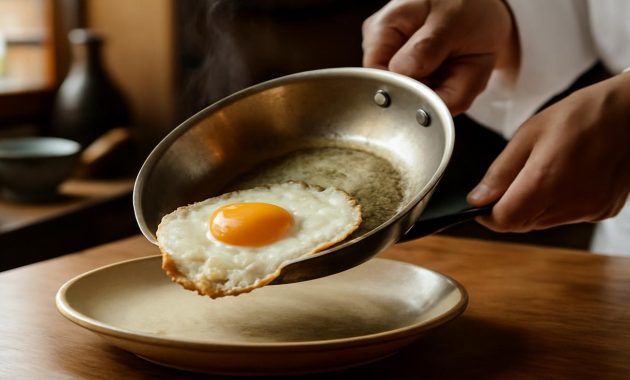
The first time I saw him do it, I thought I’d misunderstood. No oil bottle, no butter dish, no nonstick spray in sight. Just a small, well-worn pan, a bowl of beaten eggs the color of late-afternoon sunlight, and a Japanese chef with the calm focus of someone who has flipped more omelets than I’ve had hot dinners. He tilted the pan, the eggs shimmered, and then—like a silk scarf slipping off polished wood—they slid out without leaving so much as a golden stain behind.
“Again,” I said, leaning over the counter, trying not to sound desperate. “You didn’t use any oil?”
He smiled, the kind of quiet smile that says you’ve just asked the right question. “Almost none,” he said. “You’re thinking about oil. I’m thinking about the pan.”
The Pan That Changed Everything
The kitchen smelled faintly of dashi and toasted sesame from an earlier lunch service. Outside, traffic hummed, but in here, time moved differently. He placed the pan back on the flame, and I finally saw it clearly: the surface wasn’t shiny-new like the pans in store displays. It had a luster more like river stones that have been smoothed by years of water—subtle, dark, alive with use.
“This is not nonstick,” he said, almost defensive, as if offended on its behalf. “This is carbon steel. Or, at home, sometimes cast iron. They remember what you cook.”
He ran a fingertip gently along the inside. “You don’t fight eggs with oil,” he added. “You teach the pan to love them.” The statement would have sounded ridiculous if the evidence wasn’t right there in front of me, resting on a wooden board: that perfect, glossy rolled omelet, no ragged edges, no torn bits, no crusted patches clinging to metal.
We’re raised on the myth that a good egg demands a flood of fat: butter, oil, maybe even two kinds if we’re feeling luxurious. Supermarket shelves bulge with avocado oil, grapeseed oil, canola blends boasting high smoke points and “nonstick performance.” But this chef’s trick wasn’t about adding more—it was about adding almost nothing and getting more in return. It was about transforming the pan itself into something that helps the egg let go.
The Secret Is Not in the Fridge
He lowered the flame until it was barely visible, just a soft blue halo around the burner. “Most people,” he said, “turn heat too high, then add more oil when the egg sticks. It’s like trying to fix a bad conversation by shouting louder.”
He slid the pan off the heat and let it rest for a moment. “You want the pan and the egg to meet in the middle. Not too hot, not too cold. That’s the first part. The second part is seasoning. And the third is respect.”
I laughed. “Respect for an egg?”
He shrugged lightly. “If you cook thousands of them, you start to listen.”
This was the first shift in perspective: the idea that the tool, not the ingredient, was the real star. We chase new oils like trends, convinced that the right bottle will save breakfast. But here was a man who could make an egg slide like a dream with barely a dot of neutral oil—just enough to awaken the pan’s memory.
“The oil is not the hero,” he said, as if reading my thoughts. “It’s the key that opens a door that’s already built.”
Teaching a Pan to Remember
He set a second pan on the counter—identical in shape, but raw, almost silvery, too clean. “New pan,” he explained. “This is what most people cook with.” He tapped it gently with a chopstick. It rang with a thin, bright note, like a bell that hadn’t yet found a home.
“You put eggs here, they stick. You blame the egg. Or you blame the oil. But really, it’s like asking a stranger to hold your secrets.”
He poured in a small puddle of oil—just a teaspoon or so—and moved it around with a folded paper towel, coating every inch of the surface, even up the sides. Then he put it on low heat. Not medium. Not high. Just low, like a quiet conversation.
“Seasoning,” he said. “Slowly. The oil and the heat work together to change the surface. The pan learns.”
In that moment, I understood: the Japanese chef’s trick for eggs isn’t really about eggs at all. It’s about transforming an ordinary metal pan into something closer to a living object—one that holds onto layer after layer of fat, polymerized by gentle heat, until it becomes naturally nonstick. Not chemically coated. Not pretreated in a factory. Seasoned, at home, over time.
He let the pan sit on the flame for several minutes, the smell of warm metal and faint oil rising like a memory. Then he turned off the heat, wiped out the excess oil, and set it aside.
“Once is good,” he said. “Ten times is better. A hundred times—then the egg flies.”
Why Your Eggs Are Sticking (And His Aren’t)
There’s a quiet physics at play in every fried egg. A cold pan and hot egg? Disaster. A blazing pan and cold egg? Rubber. Too much oil? Greasy halo, flavor lost. Too little oil on bare, unseasoned metal? The dreaded welded-on crust that requires soaking and scraping.
He listed the mistakes he sees again and again, counting them off on his fingers like small kitchen sins:
- Pan too hot: The egg seizes, proteins grab, and sticking is inevitable.
- Pan not seasoned: Bare metal grips like a handshake that lasts too long.
- Too much stirring, poking, flipping: Interfering with the moment the egg wants to release.
- Cold pan, sudden high heat: Uneven expansion, hot spots, bitter browned patches.
“You want to know when the pan is ready?” he asked. He added the tiniest smear of oil—almost invisible—and tilted the pan. The oil moved slowly, like a bead of mercury, gliding rather than dragging. He held his hand a few inches above the surface. “You should feel gentle warmth, not aggression.”
Then came the test. He poured in a thin layer of beaten eggs, holding his breath for a moment. The egg hit the pan with a whisper, not a sizzle. Little bubbles formed around the edges, but nothing stuck. He waited a second or two, then nudged the edge with a chopstick. The egg pulled away in one silky sheet.
“Now,” he said, “it’s ready to listen.”
The Gentle Dance of Heat and Timing
If there was one thing he kept repeating, it was this: “Low heat, more patience.” Western recipes often tell you to preheat a pan until a drop of water dances wildly on the surface. He shook his head when I mentioned this.
“That’s too much for eggs,” he said. “You want a quiet dance, not a rock concert.”
He walked me through his rhythm:
- Heat the pan empty on low until it’s warm—not scorching.
- Add the smallest smear of neutral oil, just enough to gloss the surface.
- Swirl to coat, then wipe off any visible excess with a folded towel.
- Let the pan sit another few seconds so the oil and metal meet as equals.
- Pour in the eggs, slowly, watching how they spread.
“If they race to the edges too fast,” he explained, “the pan is too hot. If they sit heavy and dull, too cold.” There’s a middle ground where the eggs loosen gradually, setting into tender curds or a custardy layer that lifts with almost no encouragement.
I realized that in my own kitchen, I’d been treating eggs like an afterthought: something to rush through on a weekday morning, heat cranked high, pan still smelling like last night’s dinner. His approach felt almost ceremonial, but not fussy—just attentive.
When he finally folded the omelet, it moved as one body, no tearing, no clinging. It made that soft sound of cooked egg brushing metal—more whisper than scrape. Then it slid, almost lazily, onto the plate.
The Trick, Distilled
What he was teaching me wasn’t a single “hack” but a small, coherent system. Yet if you had to pin his trick to a single sentence, it might be this:
Forget about drowning your eggs in oil; teach your pan, control your heat, and let the seasoning do the lifting.
To make it clearer, he helped me break it down into pieces that even a half-awake home cook could follow. We jotted them into a small notebook, but they translate cleanly into a simple visual format as well.
| Step | What to Do | Why It Matters |
|---|---|---|
| 1. Choose the pan | Use carbon steel or cast iron; avoid scratched nonstick. | These pans build a natural nonstick surface over time. |
| 2. Season it | Heat with a thin coat of oil on low, wipe, repeat often. | Creates a smooth, bonded layer so eggs release easily. |
| 3. Preheat gently | Warm the pan on low until it feels gently hot above the surface. | Even heat prevents sudden sticking and burnt spots. |
| 4. Micro oil | Add just a film of oil, then wipe off visible excess. | Activates the seasoning without greasiness. |
| 5. Cook with patience | Pour in eggs, let them set slowly, nudge only when they start to release. | Allows the egg to form a gentle crust that naturally lets go. |
A Japanese Chef’s Quiet Rebellion Against Oil
In a world obsessed with “better” ingredients and new superfoods, there was something quietly rebellious in the way he cooked. He didn’t brag about cold-pressed anything. There was no proud drizzle of expensive olive oil over the final dish. He didn’t sell the idea of health, or indulgence, or trend. He sold control, attention, and time.
“When I was young,” he said, “I used so much oil for eggs that the plate looked like a small ocean. I thought more oil meant more safety.” He shook his head slightly, amused at his younger self. “Then my teacher took away the oil bottle and said, ‘Make it slide anyway.’”
The method he showed me isn’t written on the menu. Diners just see the result: tamagoyaki that unwinds in soft layers, sunny-side-up eggs that arrive looking almost lacquered, runny yolks trembling within a barely set white that never once stuck, torn, or broke in the pan.
At home, we tend to accept that something will be left behind: a crust, a torn edge, a patch that must be scraped. His approach flipped that assumption. In his kitchen, the egg leaves gracefully, taking nothing with it, like a polite guest who tidies their dish before standing up from the table.
“The pan should look almost clean when the egg is gone,” he said. “That’s how you know you’ve listened well.”
Trying It in Your Own Kitchen
The real test of any kitchen trick is not whether it impresses you in a restaurant, but what happens when you drag your own battered pan from the cupboard and try it yourself on a foggy Sunday morning. I did exactly that.
My pan was an old cast-iron skillet, the one I usually reserve for roasted vegetables and the occasional steak. It wasn’t glamorous, but it had history. I gave it the treatment he’d shown me: a teaspoon of oil, wiped thin, heated on low until the metal relaxed into warmth. I repeated that cycle several times over a week, whenever I had a few spare minutes—seasoning not as a grand project, but as a quiet habit.
On the day of reckoning, I cracked two eggs into a bowl and beat them until the color turned a soft marigold. I set the pan on low, waited until holding my hand above it felt like hovering over a cup of hot tea, added the faintest glaze of oil, and poured the eggs in.
The sound was right this time: not a harsh hiss, but a soft greeting. The edges curled just slightly, the center thickened slowly. I fought the urge to prod and poke. When I finally coaxed the edge with a rubber spatula, the egg moved in one quiet sheet. Not a miracle, not yet—but a clear step in the right direction.
By the fourth attempt, they really did slide—first reluctantly, then with growing confidence. I found myself using less and less oil, until what I added felt more like a gesture than an ingredient. The pan, exactly as the chef had promised, seemed to “remember.”
What You Gain When You Use Less
There’s an unexpected side effect to this way of cooking: flavor shifts. When you stop leaning on heavy oil or butter to fix sticking, you start to taste the egg itself. Its sweetness. Its faint minerality. The way a fresh egg from a local farm carries the ghost of the field, the feed, the air.
“If you use too much oil,” the chef had said, “it’s like putting on too much perfume. You forget what you really smell like.”
With his method, the eggs took on a light, almost clean richness, not the heavy lip-coating films I’d grown used to. They tasted like morning light over a quiet street, like soft linen, like the beginning of the day rather than the leftover weight of last night.
There are practical gains, too: less mess on the plate, less splatter on the stove, fewer used-up paper towels. The pan, once seasoned properly, asks for very little in return. A quick wipe, a moment of heat to dry it completely, a tiny ghost of oil rubbed in as you put it away. It becomes a relationship: you care for it, and it cares for your eggs.
It’s also oddly freeing to stop thinking about which new oil to buy. There’s no need to stock half a dozen varieties just to get a simple breakfast onto the plate. The chef used a neutral oil with a high smoke point, but always in such tiny quantities that the specifics barely mattered. The real work was in the pan and the heat, not the label.
Perhaps that’s why this trick feels quietly radical. It pushes back against the idea that the solution is always something you don’t yet own. Instead, it suggests that what you already have—an ordinary pan, a quiet flame, a handful of eggs—might just need to be used differently, and more attentively.
Listening to the Egg
On my last day watching him cook, I asked if he ever still burned eggs, or had one stick stubbornly to the pan.
“Of course,” he said, without hesitation. “When I rush. When I get cocky. The egg is honest. It tells you when you’re not paying attention.”
He cracked another egg, let it spill its golden center into a waiting bowl, and beat it with chopsticks, the sound like rain tapping against a window. The pan warmed, the oil shimmered, and once again, the egg hit the surface and settled into its gentle dance.
“Forget the oils,” he added, not unkindly. “Or at least, forget that they are the answer. You can have the most expensive oil in the world and still tear an egg to pieces. Or you can use almost none at all, if you respect the pan.”
On the plate, the finished eggs looked simple. Nothing towering or dramatic, no wild garnish, no trickery. Just a soft, golden fold, ready to be broken open.
And when I slid my fork in, the omelet parted without resistance, gliding as easily as it had left the pan, proof of a small, quiet truth: the most satisfying kitchen magic doesn’t always come from buying something new. Sometimes, it comes from paying very close attention to what’s already in your hands.
FAQs
Do I need a special Japanese pan to use this method?
No. A Japanese rectangular pan is traditional for rolled omelets, but the core trick works with any good carbon steel or cast-iron pan. What matters most is proper seasoning and gentle heat, not the exact shape.
Can I use stainless steel for eggs with this technique?
You can, but it’s less forgiving. Stainless steel doesn’t season as deeply as carbon steel or cast iron. If you use stainless, be extra careful with low heat, a very light film of oil, and waiting until the eggs naturally release before moving them.
Do I ever need butter if my pan is well seasoned?
You don’t need butter for nonstick performance once the pan is well seasoned, but you can still use it for flavor. Many cooks add a tiny bit of butter at the end, or mix it into the eggs instead of using it as lubrication for the pan.
How do I clean a seasoned pan after cooking eggs?
Let the pan cool slightly, wipe it out with a soft sponge or cloth, and use a little hot water if needed. Avoid harsh soap and abrasive scrubbers. Dry it on low heat and rub in a whisper of oil before storing to protect the seasoning.
What if my eggs are still sticking even after seasoning?
First, lower the heat—most sticking comes from too much heat too fast. Second, be patient and wait a little longer before trying to move the egg; it will release more easily once a thin crust has formed. Finally, repeat light seasoning sessions over time; each one improves the surface and makes future cooking easier.