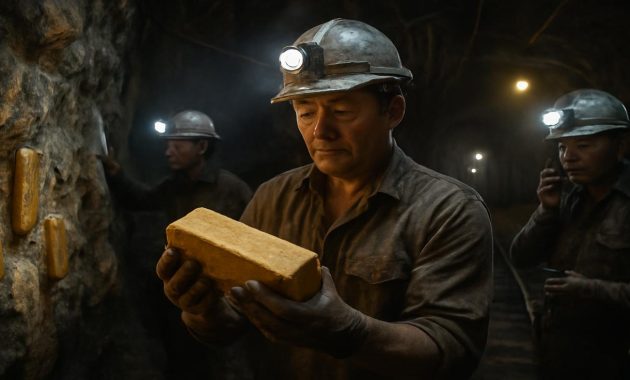
The elevator shuddered as it began its slow descent, a metal box lowering three strangers and a secret into the dark. Above us, the winter light of northern Finland faded to a pale memory. Below, over a kilometer of rock waited—layer upon layer of time, pressure, and, if the rumors were true, an answer to one of the great mysteries of the twentieth century. The engineer beside me clenched a thermos in white-knuckled hands. The geologist hummed under his breath, a nervous, tuneless sound. And I watched the digital depth counter blink from 300 meters… 600… 900… wondering what it feels like to stand face to face with history that someone once tried very hard to bury.
A quiet mine, a loud discovery
The story didn’t begin with gold. It began, as these things often do, with numbers that refused to behave.
For months, a research team working in this remote underground lab—originally a deep mine converted into a geological observatory—had been studying heat flow in the Earth’s crust. They were here for the science of rocks and radioactive decay, not treasure. Their sensors were meant to track subtle temperature gradients, shifts in pressure, traces of groundwater moving through fractures. The work was quiet, meticulous, the kind that rewards patience over drama.
Then one afternoon, an intern—whose name no one will forget now—noticed a stubborn anomaly. A thermal sensor in one of the oldest tunnels kept returning readings that didn’t match the surrounding pattern. Something down there was staying colder than it should have been, as if a pocket of the Earth had simply refused to warm with its neighbors.
At first, it was dismissed as a calibration issue. Broken sensor. Loose wiring. The universe of tiny technical flaws that can wreck a clean data set. But when they replaced the sensor, the anomaly stayed. When they placed a second sensor beside it, both instruments agreed: something in a blind side-passage, 1,120 meters underground, was pulling heat away from its surroundings like a buried ghost.
They started with the obvious explanation—voids, water, some odd mineral congregation. Still, one of the senior geophysicists joked in an email: “If it’s not a cavern, it’s either a crashed UFO or a vault. Call me when you find the gold bars.” The punchline wouldn’t be funny for long.
The tunnel that forgot it was finished
We stepped off the elevator into a low, dimly lit corridor that smelled of iron, dust, and something older—a mineral tang that clung to the back of the throat. Our helmet lights cut narrow cones through air heavy with tiny suspended particles. Far above, a kilometer of rock pressed down. The mine had been industrial once, rich with ore and dynamite and the resonance of heavy machinery. Now it was half-lab, half-ghost.
“The strange readings started from that spur,” said Anja, the site’s lead geologist, pointing down a narrower tunnel veering away from the main shaft. “Old workings. Nobody’s gone this way in… maybe 40 years.”
The tunnel wall bore scars of hand drilling, then more modern blasting. Cables dangled like abandoned vines. When the mine transitioned into a research facility, some sections were sealed, mapped, forgotten. This one, though, had slipped into a kind of bureaucratic twilight—marked on old blueprints, overlooked on new ones.
The team had reopened the passage weeks before my visit. At first, they expected to find some quirk of geology. A cavern filled with cold water, perhaps. Instead, ten meters into the side tunnel, they came upon a wall that didn’t belong there—flat, smooth, too regular. It was not bedrock. It was not ore. It was human work.
“We thought it might be a survey plug,” Anja said as we walked, our boots crunching grit. “But the rock face rang wrong when we tapped it. Hollow, like someone had poured concrete into the Earth’s throat.”
The door in the rock
The “wall” appeared in the glow of our lamps at the end of the spur: a seamless, pale-grey surface just slightly recessed from the irregular rock around it. Up close, you could see the faint curve of a steel frame hidden just beneath the cemented face, and three drill marks made during the initial rediscovery. Someone had patched the Earth here with intent.
“We drilled a tiny borehole first,” Anja said, pointing to the thumb-width circle near the edge. “We expected rubble. Got metal.”
Behind the wall, ground-penetrating radar had sketched the outline of a roughly rectangular cavity—no more than a few meters across—containing something dense enough to distort their imaging software. It wasn’t a cavern. It was a room. A box inside rock.
When they finally cut through, the air that escaped was flat and stale, a breath that might have been exhaled decades earlier. The cavity beyond was pitch black, but their instruments screamed density. They brought in cameras, lights, a structural engineer to make sure the roof would stay where a roof belongs. And then they saw it: neat stacks of dull-yellow bars, arranged with almost obsessive care on steel shelving that had barely rusted in the dry, sealed air.
Gold. Dozens of bars, maybe hundreds. The kind of thing you expect to see in old photographs of central bank vaults, not in a forgotten hole halfway to the mantle.
The language stamped into gold
Up close, the bars didn’t glitter. They sat under the lab’s harsh LED lights like dense blocks of matte sunlight, each one the weight of a newborn, each one inscribed. You could run fingers across the markings and feel the raised edges of letters, numbers, and crests in the metal.
Every bar told a story in code: serial numbers, purity, year, origin. And in these marks lay the twist that turned a strange find into geopolitical dynamite. Because each bar bore the same crest—a stylized eagle clutching a shield—and beneath it, a language that made the air in that chamber feel suddenly thinner.
Polish. Each bar was stamped with markings identifying it as property of the Bank of Poland, dated mostly from the 1930s. Above some of the numbers, worn but unmistakable, were the words reserved for national reserves, not private hoarding. This was not some eccentric’s underground stash. This was state gold. A nation’s savings, lost in the confusion of invasion and occupation, now resurrected from the deep.
For those who know their history, the discovery carried a ghostly echo. At the outbreak of World War II, Poland’s gold reserves became a desperate chess piece. As German forces advanced, the Polish government scrambled to move its bullion out of reach—by train, truck, ship—through Romania, across the Black Sea, deeper into allied territory. Some of it made it safely to France, to the United Kingdom, to Canada. Some vanished in the chaos, slipping out of records, into rumor.
For decades, whispers of “the missing Polish gold” haunted treasure hunters and historians alike. Tales of trains loaded with bullion disappearing into mountain tunnels. Convoys lost in the fog of war. Vaults emptied and never seen again. Most of those stories were easily dismissed: exaggeration, miscounting, confusion in the archives. But here, lit by headlamps a kilometer underground, stood one part of that myth made brutally solid.
A nation beneath the surface
You might imagine that the first response to such a find would be pure elation: the thrill of discovery, the gleam of wealth. In the control room above, where I later listened to voice logs of the team’s first reactions, there was surprisingly little shouting. Mostly there was silence, punctuated by short, stunned phrases.
“That’s a state crest.”
“This is… this is sovereign gold.”
“We need to call someone.”
The word “someone” quickly expanded into a crowd: local authorities, national government, international lawyers, historians, security agencies. What began as a scientific oddity had just become a diplomatic storm. Because every bar in that chamber came with a question that could not be postponed: Who owns treasure that was clearly meant never to be found—or at least never to be linked—again?
Poland’s modern government was notified in strict secrecy. So were Finnish authorities. Documentation began immediately: cataloging each bar, photographing every stamp, measuring, weighing, logging. A small army of people who had never planned to set foot in a mine found themselves donning hardhats and descending to stare at metal and memory.
Outside, rumors leaked before any official announcement. Talk of “a major underground discovery” spread across online forums, then into tabloids, then into mainstream media. Gold, someone wrote. War gold. The phrase “find of the century” attached itself to the story like burrs to fabric and would not shake off.
Why here, why this deep?
We like our mysteries clean, but the Earth prefers mess. There is nothing straightforward about how a chamber full of Polish gold bars ended up more than a kilometer beneath Finnish bedrock. Yet certain details, when viewed from the right angle, begin to assemble into something like a story.
During the late years of the war and the early years of the Cold War, this region passed through overlapping nets of influence and secrecy. Mining companies, intelligence services, military planners—they all loved the same things: remote locations, deep tunnels, and events that never made the news. Add to that the pressure of postwar settlements, reparations, and shifting borders, and it’s not hard to imagine someone, somewhere, deciding that the safest place for certain “sensitive assets” was far below the surface, where treaties and auditors rarely travel.
Anja showed me a hand-drawn map they’d found in a dusty box of mine archives: a faint pencil line running off the main shaft, ending in a square. No label, no notes. Just a shape like a secret someone meant to remember and then, perhaps mercifully, forgot.
“This section was blasted during an expansion that never really took off,” she said. “Then the mine changed ownership. Records got messy. So if someone had… persuaded a few people to excavate a small side chamber…” She shrugged. “It wouldn’t have taken much to lose track of it after a decade or two.”
The chamber itself was modest: reinforced rock walls, steel beams, shelving welded in place and bolted to the floor. No personal items. No documents. No hint as to whether those who hid the bars here intended to return for them. The only voice in the room belonged to the metal, and it spoke in weight and silence.
Gold by the numbers: what they found
Gold is emotional. But ultimately, it is also arithmetic. Once the initial shock receded, the teams involved did what humans always do when faced with a hoard: they counted.
| Detail | Approximate Figure |
|---|---|
| Total number of bars | ~1,200 |
| Average weight per bar | 12.5 kg (standard “Good Delivery”) |
| Total weight | ~15,000 kg (15 metric tons) |
| Purity range | 99.5% – 99.8% |
| Primary minting years | 1936–1939 |
On world markets, fifteen metric tons of gold represents a fortune—not on the scale of a giant central bank, but immense enough to shift headlines and budgets. For Poland, a country whose twentieth century is scarred by occupations and partitions, the symbolism far outweighs the numbers.
These bars were minted in the anxious years before catastrophe, when governments fortified their reserves against storms they could already feel in the wind. They passed through hands that signed decrees, crossed borders under cover of darkness, became invisible in a blur of advancing armies and collapsing regimes. Now here they were, inert and incorruptible, outlasting every ideology that once claimed them.
Who does the Earth answer to?
If this story were a simple treasure hunt, it could end with dusty gold wheeled triumphantly into daylight, flags waving. Reality is far more intricate—and far more human.
International law is not built for secrets buried this deep. There are precedents for shipwrecks, looted art, seized bank accounts. But what about state property hidden on foreign soil, likely transported in breach of treaties that no longer exist between governments that have long since fallen?
In private, officials admit it is as much a moral question as a legal one. The markings on the bars are unambiguous. They belong, at least historically, to one nation. But their journey here may have involved actors from several others—occupiers, postwar administrators, even private intermediaries with complicated allegiances.
Poland’s modern representatives have been careful in their language, calling for “transparent cooperation” and “historical justice” rather than immediate repatriation. Finnish authorities, for their part, have emphasized security and due process. While negotiations are ongoing behind closed doors, the bars themselves have not moved. They remain where they were found, behind reinforced access and more cameras than some banks can boast.
Looking at them through thick glass on my second day underground, I found myself thinking of something Anja had said over coffee in the canteen.
“People talk about ownership as if the Earth cares,” she mused, stirring sugar into a chipped mug. “But this mountain doesn’t know borders. It doesn’t know wars. It just held what we put inside it and kept quiet.”
In a sense, she’s right. The planet is indifferent to the drama of our currencies and flags. Yet that indifference is exactly what makes discoveries like this so unnerving. The rock does not lose the receipts we misplace. It does not conspire with us to forget. It simply waits.
When myths grow coordinates
There is a moment, standing that deep underground, when all the debates and calculations fall away and what remains is more intimate: the feeling of being in the presence of something that wasn’t supposed to resurface.
The air in the vault feels slightly cooler than the rest of the mine, whether from the mass of metal or the power of suggestion. Touching the reinforced glass, you sense both the fragility and the stubbornness of human plans. Someone once believed that this was the safest possible place for this gold. They dug, poured, stacked, sealed, and left. They trusted stone more than treaties, silence more than signatures.
Maybe they intended to come back when the world calmed down. Maybe they never had that chance. Maybe they vanished into the same darkness that swallowed entire armies that decade. We may never know. But generations later, an intern noticed a temperature anomaly, and history—which does not move in straight lines—looped back on itself.
The phrase “find of the century” gets thrown around too easily in our time of constant spectacle. Yet in this case, it may be justified—not just for the monetary value, but for the way this discovery pierces the membrane between myth and evidence. One nation’s lost wealth, murmured about in archives and memoirs, has acquired coordinates, mass, and serial numbers.
It turns out the Earth is not just a backdrop to our stories. It is an active archive, a reluctant librarian of secrets we thought were perfectly hidden. The question now is not just what to do with the gold, but what to do with the knowledge that the ground beneath our feet might be holding other, as-yet-unnoticed chapters of our shared past.
FAQ
Was the discovery officially confirmed?
Yes. While initial work occurred under strict secrecy, both Finnish and Polish authorities have since acknowledged that a significant quantity of gold bars—identified as pre‑war Polish state reserves—was found in a former mine now used as a research facility.
How deep were the gold bars actually found?
The chamber containing the bars lies just over 1,100 meters below the surface, accessible via a main mine shaft and a short side tunnel that had been closed and largely forgotten for decades.
Is there any danger associated with the underground vault?
Structurally, the chamber is considered stable, reinforced by surrounding rock and additional supports added after the find. The primary “danger” now is security-related, which is why the area is tightly controlled and access is limited to authorized personnel.
Who owns the gold from a legal standpoint?
Formal ownership is still being negotiated. The bars are clearly marked as historical property of the Bank of Poland, but because they were hidden on Finnish territory under unclear circumstances, international law experts and both governments are working through the legal frameworks before any transfer is made.
Will the public ever be able to see the gold?
There are discussions about eventually displaying a small number of bars in a museum setting once ownership and security considerations are fully resolved. For now, the hoard remains underground, documented in detail but off-limits to the general public.
Are there plans to search for more hidden caches?
The discovery has inspired renewed interest in re-examining old mine records and underground infrastructure, both in this region and elsewhere. However, systematic searches are complex and expensive, so efforts are currently focused on reviewing existing anomalies rather than launching large-scale treasure hunts.
Could this discovery affect Poland’s modern economy?
In pure monetary terms, even 15 tons of gold is modest compared to modern national reserves. Symbolically, however, the find is enormous, reinforcing narratives of resilience and historical restitution and potentially influencing how the country tells, and funds, its own story in years to come.