The first time it happened, you were barefoot in the shower, half-awake, shampoo in your hair… and the water stopped going down. At first it was just a lazy swirl around the drain, then a slow rise around your ankles, and suddenly you were standing in a greyish puddle that didn’t smell like a spa day. You sighed, maybe cursed under your breath, promised yourself you’d “deal with it later,” and you already knew: this wasn’t the first time, and it probably wouldn’t be the last.
If your drains clog all the time, you’re not alone. It’s one of those small domestic annoyances that keeps coming back like a bad sequel. The gurgling sink, the bathtub that turns into a shallow pool, the kitchen drain that smells suspiciously like last week’s dinner. But what if clearing them didn’t have to be a battle with toxic products, expensive plumbers, or medieval-looking tools? What if there was a simple method that actually worked — something fast, effective, and oddly satisfying?
When a Slow Drain Starts to Mess with Your Head
There’s a peculiar kind of irritation that comes with a slow drain. It’s not dramatic enough to feel like an emergency, but it’s just annoying enough to silently erode your patience. You run the bathroom tap to wash your face and the basin fills up faster than it empties. You’re brushing your teeth and suddenly you’re spitting into a little toothpaste lake. In the kitchen, rinsing a plate becomes a tactical operation: angle, speed, water-on, water-off.
Let’s be honest: part of you feels slightly judged by your own plumbing. You swear you don’t lose that much hair in the shower. You’re pretty sure you scrape your plates before rinsing them. And yet, here you are, on your knees, poking at the drain with a sad plastic fork because that’s the only “tool” within reach.
Most people follow a familiar pattern. First, denial: “It’s fine, it’ll go down eventually.” Then, improvisation: boiling water, a bit of dish soap, maybe that random bottle of chemical drain cleaner you bought three years ago and never finished. When that fails, frustration kicks in and you imagine a moustached plumber giving you a lecture about food scraps and hair traps, while you hand over your hard-earned money.
But what if, instead of waiting for the drain to fully rebel, you had a routine — a straightforward, almost ritual-like method that you could use in minutes, without needing a toolbox the size of your wardrobe? That’s where things start to look different, and surprisingly, more… masculine. Not in the tough-guy, power-tool-advert sense, but in the quietly competent, “I’ve got this” way.
The Simple Method Most People Ignore
Let’s talk about the method first, then the mindset behind it. Because at its core, unclogging a drain is just applied common sense. And yes, it really can be simple, fast, and oddly satisfying.
Here’s the straightforward routine that tends to work in most homes. You don’t need to be a DIY hero for this — just a bit focused for 15–20 minutes.
Step 1: The Visible Offenders – Get Hands-On
Take a breath, grab a pair of rubber gloves, and start by removing whatever you can actually see. Hair? Food bits? That weird jelly-like stuff that looks like it came from a sci‑fi movie? That’s your first enemy.
For bathroom drains, if there’s a hair catcher or metal grid, lift it carefully. You’ll probably find a slimy, tangled nest of hair and soap scum waiting underneath. It’s not glamorous, but it’s extremely effective to just pull it out. In the kitchen sink, check the strainer and plug area, and clear out any obvious debris.
It’s surprising how often we skip this step and go straight to “magic solutions.” But a lot of clogs are mostly mechanical: stuff blocking a hole. Remove the stuff, and suddenly the “miracle” begins before you’ve even opened a bottle.
Step 2: Boiling Water – The Quiet Workhorse
Once the visible junk is out, put a kettle or large pot of water on the stove. Get it properly boiling. While it heats, you can wipe around the opening of the drain to clear any remaining gunk on the surface.
When your water is at a rolling boil, slowly pour it directly down the drain in two or three stages, waiting a few seconds between each pour. This helps dissolve fat, congealed soap, and some of the slime film that narrows your pipes over time. In many cases, this alone already makes a dramatic difference — especially for kitchen sinks stuffed with grease and oil residue.
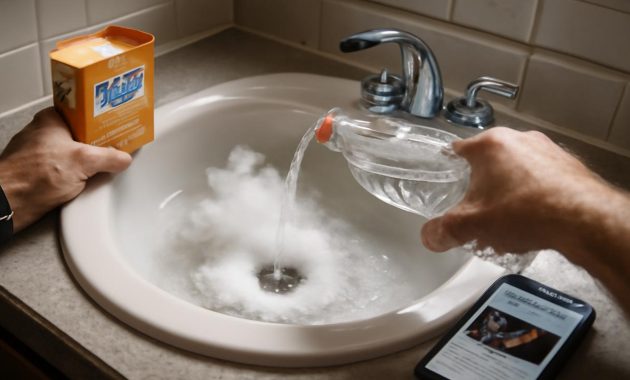
Step 3: The Classic Duo – Baking Soda and Vinegar
Now to the part you’ve probably seen in a thousand “life hack” videos — except it actually does work when you do it right. You’ll need:
- About 1/2 cup of baking soda
- About 1 cup of white vinegar (or cleaning vinegar)
- A plug or a small plate to cover the drain
Pour the baking soda directly into the drain. If it clumps near the top, you can gently push it in with the handle of a spoon or a chopstick — nothing sharp, nothing metal that might get stuck. Then, pour the vinegar in slowly. You’ll hear the fizz immediately, like a tiny volcano in your pipes. That bubbling is the reaction loosening up grime and build-up further down.
Cover the drain loosely (with the plug or a plate) and let the mixture work for about 15 minutes. This isn’t Hollywood; you won’t see the pipes glow or the clog magically leap out. But inside the dark, narrow space of your plumbing, that fizz is quietly attacking soap residues, mineral deposits, and organic slime.
Step 4: Flush It Like You Mean It
After 15 minutes, boil another pot or kettle of water. Then, just like before, pour it down in stages. This hot flush pushes the now-loosened sludge further through the pipes and out of your life.
If the water runs clearly and disappears quickly, you’re done. If it’s still a bit slow, repeat the baking soda and vinegar step once more, followed by boiling water. For stubborn cases, you may need one extra move: a plunger.
Step 5: The Plunger, Used the Right Way
A lot of people own a plunger. Strangely few people actually know how to use it well. Here’s the simple version:
- If it’s a sink with an overflow hole, cover that hole with a damp cloth to create pressure.
- Place the plunger firmly over the drain so it seals completely.
- Run a bit of water so the plunger cup is submerged; this improves suction.
- Push down slowly, then pull up sharply, several times in a row.
You’re not trying to slam the clog down the pipes; you’re trying to loosen it by changing pressure. After 10–15 plunges, lift it away and see how the water behaves. Often, you’ll hear a satisfying gurgle as the last resistance breaks.
This entire routine — visible debris, boiling water, baking soda and vinegar, then a plunger if needed — is your “simple method.” No drama, no panic buying of aggressive chemicals that burn your eyes. Just method, patience, and a small dose of determination.
Why This Method Works Better Than Panic and Chemicals
If you walk down the cleaning aisle of any supermarket, you’re bombarded with neon promises: “DISSOLVES CLOGS IN 5 MINUTES!” “EXTRA POWER FORMULA!” “INDUSTRIAL STRENGTH!” The labels sound closer to rocket fuel than something you want near your hands, lungs, or pipes.
And yes, these ultra-strong chemical cleaners can be effective. They’re also harsh — on your plumbing, on the environment, and on you. Over time, repeated use may damage older pipes, especially plastic or metal ones already weakened by age and corrosion. There’s also that moment when you pour them in and feel slightly nervous about what happens if it splashes.
The boiling water + baking soda + vinegar + plunger routine works on a different principle. It’s a combination of heat, mild abrasion, natural chemical reaction, and mechanical pressure. In other words: it helps you loosen what’s stuck and keep things flowing, without overkill.
Is it as aggressive as the strongest chemical drain openers? No. Does it handle every nightmare-level clog? Not always — sometimes you really do need a professional. But for regular household blockages — hair, soap, grease, food residue — it’s often more than enough. And crucially: it’s something you can repeat regularly without harming your pipes or breathing in something that smells like an industrial accident.
| Method | Best For | Pros | Cons |
|---|---|---|---|
| Boiling water + baking soda + vinegar | Regular hair, soap, and light grease clogs | Gentle on pipes, low cost, safe to repeat often | May need more time or repetition for heavy clogs |
| Plunger | Local blockages near the drain | Fast, reusable, no chemicals | Requires proper technique; may not work for deep clogs |
| Chemical drain openers | Severe, stubborn clogs (last resort) | Strong and fast when effective | Harsh, can damage pipes, unpleasant fumes |
| Professional plumber | Recurring, deep, or mystery clogs | Expert diagnosis, long-term fix | Costly; requires scheduling and waiting |
The Masculine Side of Taking Care of Your Space
There’s something quietly powerful about handling these things yourself. Not in a macho, “I refuse to call anyone for help” sort of way, but in that calm competence that comes from knowing you can manage your own environment.
Masculinity, at its best, isn’t just about muscles or style; it’s about responsibility. It’s about stepping up instead of stepping back when something needs fixing. The drain might be a small thing, but it’s symbolic. It’s your home saying, “Hey, are you paying attention?” And your answer, with a pair of gloves and a kettle of boiling water, is a calm, “Yes. I am.”
There’s also a certain sensory experience to it. The hiss of the boiling water as it hits metal. The faint, sharp scent of vinegar mixing with the neutral powder of baking soda. The hollow glug-glug-glug that tells you the water is finally rushing down freely. Even the gross part — lifting out a mass of hair or food — has a strange, practical satisfaction to it. You’re confronting the problem in its rawest form and removing it with your own hands.
In a world where so many things are abstract — screens, notifications, endless digital noise — there’s something grounding about a problem that’s right there, physical and solvable. Your drains clog. You clear them. End of story.
How to Stop Living in a Constant Battle with Your Drains
Of course, the best victory is the one that doesn’t need to be fought every month. Once you’ve cleared your drains, the next move is simple: make sure they stay clear as long as possible. Not with complicated systems, just with a few small habits that add up.
- Use a hair trap in the shower. A cheap, simple mesh or silicone trap catches most of what would otherwise form that infamous slimy hair-rope monster inside your pipes.
- Scrape plates before rinsing. Food scraps, rice, coffee grounds — they don’t belong in your drain. The trash or compost bin is a much better destination.
- Don’t pour grease down the sink. Hot oil turns into cold, solid fat in your pipes. Let it cool in a container and throw it away instead.
- Give your drains a monthly “spa day.” Boiling water and a baking soda + vinegar routine once a month helps prevent build-up from ever becoming a full-blown clog.
- Pay attention to early warning signs. If water starts draining slower than usual, don’t wait until it’s completely blocked. Acting early is usually one simple session, not a weekend project.
Think of it like fitness for your home. You don’t wait until you’re completely out of breath going up the stairs to start moving more. You keep up small, regular habits so you don’t hit crisis mode. Your drains work the same way.
When It’s Time to Call in Reinforcements
Even the most capable, hands-on person hits limits. You can be smart, prepared, and practical — and still face a clog that laughs in the face of your boiling water and plunger. That’s not failure; that’s plumbing.
Here are a few signs it might be time to bring in a professional:
- Multiple drains clog at once. If your shower, sink, and toilet all start misbehaving, the issue may be deeper in the main line.
- There’s a bad smell you just can’t shake. Persistent sewage or rotten odors can mean something more serious than a bit of soap scum.
- Water backs up in strange places. If flushing the toilet makes water rise in the shower, your system is trying to say something’s very wrong.
- You’ve tried the basic method a few times with no change. At that point, continuing to experiment may waste time — or risk damage.
Calling in a pro isn’t surrendering your masculinity card. It’s using judgment. The same way you might handle your own fitness routine but still see a coach when you want expert guidance, a good plumber can diagnose issues you can’t see and protect you from bigger headaches later.
Knowing when you can handle it and when to ask for help is a quiet, underrated form of strength. You’re not trying to prove anything; you’re just making smart decisions about your home.
Owning Your Space, One Small Fix at a Time
In the end, this isn’t just about drains. It’s about how you live in your own space. The kind of man you are when no one is watching. Do you ignore problems until they overflow — literally and metaphorically — or do you meet them head-on while they’re still manageable?
The simple method for clearing clogs fast is more than a hack; it’s a habit. A small ritual of care. You roll up your sleeves, you face the grime, and you leave your bathroom or kitchen better than you found it. You’re not waiting for someone else to sort things out. You’re capable, practical, and a little more at ease each time you do it.
Next time you feel the water swirling a bit too slowly around your feet, don’t just sigh and look away. See it as an invitation. Fill the kettle, grab the baking soda, and turn a small annoyance into a quick victory. Your drains will thank you. And so will the version of you who likes walking into a home that actually works — because you made it that way.
FAQ
How often should I use the baking soda and vinegar method?
For prevention, once a month is usually enough for most households. If your drains see heavy use (large family, lots of cooking, or long showers), you can safely do it every two weeks.
Can I use this method on any type of drain?
Yes, it works well on most bathroom and kitchen drains. Be cautious with very old or fragile plumbing; in that case, use slightly cooler (not boiling) water to avoid stressing the pipes.
Is boiling water safe for plastic pipes?
Most modern plastic pipes can handle occasional boiling water, especially if you pour in stages. If your plumbing is very old or you’re unsure, use hot (but not fully boiling) water to be safe.
What if the drain is still clogged after I try everything?
If you’ve removed visible debris, used boiling water, baking soda and vinegar, and a plunger without improvement, the clog may be deeper in the system. That’s the moment to call a professional plumber.
Are chemical drain cleaners ever a good idea?
They can be a last resort for severe clogs when you can’t get help immediately. Use them sparingly, following the instructions exactly, and never mix them with other cleaners or with the baking soda and vinegar method.
Why do my drains clog so often?
Frequent clogs usually mean buildup over time: hair and soap in bathrooms, grease and food scraps in kitchens. Simple habits like using hair traps, scraping plates, and doing a monthly hot-water flush make a big difference.
Can I prevent bad smells as well as clogs?
Yes. Regularly flushing with hot water and using the baking soda and vinegar routine helps reduce odor-causing buildup. Also, avoid letting food, coffee grounds, or standing water sit in the sink for long periods.