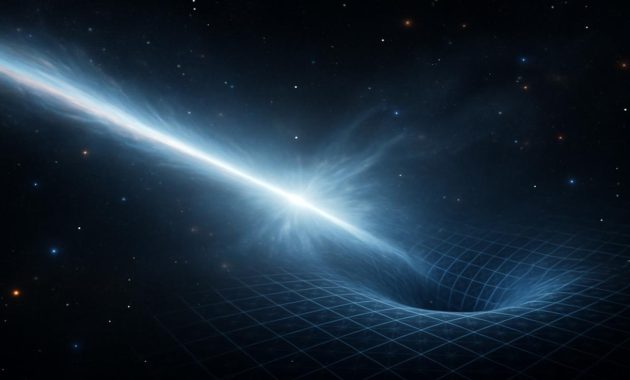
The desert sky above Namibia looks almost too big to be real. On a moonless night it becomes a black ocean, pierced by hard, cold stars. Far from city lights, the Milky Way doesn’t just hang overhead—it spills, a river of ice and fire. In this quiet, four enormous shapes stand like mechanical animals on the plateau: telescopes with square shoulders and long metal limbs, waiting in silence. Then, without warning, the sky flashes.
Invisible to your eyes, a single gamma-ray photon—born in some cataclysmic event millions of years ago—slams into the upper atmosphere above you. It triggers a brief cascade of particles moving faster than light can travel through air, igniting a blue whisper of Cherenkov radiation. For a few billionths of a second, the desert lights up with a ghostly glow. The telescopes turn their glass eyes to the flicker, and in that fleeting flash of blue, they reach out to test the mind of Albert Einstein.
Einstein’s Speed Limit in a Restless Universe
More than a century ago, Einstein made a bold claim: the speed of light in a vacuum is constant. No matter who you are, how fast you’re moving, or where you are in the universe, light’s top speed doesn’t budge. From that constant, he built a radically new way of understanding space and time: relativity. It told us that time dilates, rulers shrink, and gravity is not a force but a warping of spacetime itself.
But Einstein didn’t just describe gravity; he laid down rules that every particle and every wave must follow. The universe, under his watch, became an exquisitely consistent machine. So consistent, in fact, that many physicists suspect it can’t be the full story.
Out at the razor edge of theory, where quantum mechanics and gravity collide, some ideas predict that spacetime might not be perfectly smooth. Perhaps, at unimaginably tiny scales, it has a grainy, foamy texture. If that’s true, then high-energy light—gamma rays—might feel that roughness ever so slightly, changing their speed as they cross the cosmos. The difference would be tiny, almost insultingly small. But after traveling millions or billions of light-years, the effect might be just big enough to catch.
That’s the core of a new gamma-ray study that has quietly, but firmly, pressed Einstein’s theory once again to its limits. And so far, the old clockmaker is still winning.
When Distant Catastrophes Become Cosmic Clocks
To test Einstein with gamma rays, you need more than a fancy telescope. You need a lighthouse on the other side of the universe—something bright, violent, and fast. Fortunately, the cosmos is disturbingly good at that.
There are blazars: galaxies whose central supermassive black holes are devouring matter so ferociously that they shoot out relativistic jets of particles and light. When one of those jets happens to aim precisely at Earth, the galaxy becomes a searchlight, its gamma-ray beams flickering on timescales of minutes or seconds.
There are gamma-ray bursts: the explosive deaths of massive stars or the mergers of neutron stars, short-lived but unimaginably intense. In a few seconds, a gamma-ray burst can outshine an entire galaxy. These violent events release photons of different energies nearly at the same instant. If the universe is playing tricks with those photons—slowing some ever so slightly while letting others race ahead—we might see the difference when they arrive.
The new study, using years of data from ground-based gamma-ray observatories, treated these far-off explosions like celestial stopwatches. Scientists carefully measured the arrival times of photons across a range of energies, hunting for tiny, systematic delays. If higher-energy gamma rays consistently arrived a bit earlier or later than lower-energy ones, that would be a smoking gun: a sign that the speed of light depends on energy and that spacetime might be more complicated than Einstein thought.
Gamma Rays and the Blue Ghosts of the Atmosphere
From the ground, we don’t see gamma rays directly. When a high-energy photon plunges into our atmosphere, it collides with atoms and molecules, spawning a shower of secondary particles. These particles move so fast that, in air, they outrun light’s local speed—like a jet creating a sonic boom, but in light. The result is a brief, faint cone of blue Cherenkov radiation.
Cherenkov telescopes, such as those used in Namibia, Chile, and the Canary Islands, are designed to catch these ghostly flashes. Huge mirrors focus the blue light onto ultra-sensitive cameras that capture the quick streaks of particle showers. From those streaks, scientists reconstruct the path, energy, and arrival time of the original gamma-ray photon.
Each recorded flash is a message: an encoded note from a violent event somewhere in the deep universe. Thousands, even millions, of such flashes from a single object can be pieced together into a time series—a cosmic heartbeat. And hidden in the rhythm of that heartbeat might be the slightest hint that light is not as rigid and unyielding as Einstein claimed.
Listening for a Stutter in the Speed of Light
The core question behind this new analysis is deceptively simple: does high-energy light travel at exactly the same speed as low-energy light over cosmological distances? If the answer is no, then something fundamental must give way. Perhaps spacetime itself has a “preferred” grain or structure. Perhaps Lorentz invariance—the idea that the laws of physics are the same for all observers—is not exact, but only an approximation.
To look for such a stutter in light’s speed, researchers turned to extremely fast flares from distant sources. Imagine a blazar that suddenly brightens. In an instant, it spits out a burst of gamma rays across a wide range of energies. Near the source, high- and low-energy photons are emitted essentially together—like runners starting a race from the same starting line.
Now stretch that racetrack to hundreds of millions of light-years. If the universe treats all energies equally, those photons will cross the finish line together too. But if higher-energy photons are slowed by quantum-grainy spacetime, they should lag; if they’re sped up, they should arrive first. The delay would be tiny, but collective. Over many flares and many sources, a pattern might emerge.
The new gamma-ray study searched for precisely that pattern and pushed the limits further than ever before. They found…nothing. No systematic energy-dependent arrival delay. No sign that the universe is tweaking the race mid-course. Within the incredible sensitivity of their measurements, light behaves as Einstein said it should.
What “Nothing” Really Means in Physics
At first glance, this sounds almost disappointing. No new physics. No crack in the cosmic wall. Einstein remains, infuriatingly, correct. But in high-energy astrophysics, a clean “nothing” is a very particular kind of something.
What the researchers really measured is a lower limit—an energy scale at which any possible breakdown of Einstein’s rules must occur, if it occurs at all. Many theories of quantum gravity predict that spacetime foaminess would show up around the Planck scale, an energy so high that our particle accelerators could never hope to reach it. By failing to find a deviation up to an astonishing energy threshold, this study effectively says: if spacetime is grainy, it’s smoother than many speculative theories allowed.
That trims the thicket of ideas. Some versions of quantum gravity that once seemed plausible now look much less likely. Others need to be tuned, revised, or abandoned altogether. With each new “null result,” the universe is quietly, stubbornly, shaping the story we tell about its deepest workings.
Table: How This New Test Stacks Up
To see why this kind of result matters, it helps to compare it with earlier attempts to catch light breaking the rules. Previous studies used gamma-ray bursts, active galaxies, and even solar flares. They all chased the same ghost: an energy-dependent speed of light.
| Study Type | Typical Source | Distance Scale | Key Goal |
|---|---|---|---|
| Early Gamma-Ray Burst Tests | Short, intense explosions | Billions of light-years | First limits on energy-dependent light speed |
| Blazar Flare Monitoring | Active galaxies with jets | Hundreds of millions of light-years | Look for delays in rapid flares |
| Solar & Nearby Transients | Solar flares, magnetars | Up to thousands of light-years | High time precision over shorter paths |
| New High-Energy Gamma-Ray Study | Distant blazars & extreme flares | Hundreds of millions–billions of light-years | Tightest limits yet on Lorentz invariance violation |
On a phone screen, those rows compress into a quiet progression: from rough estimates to ever sharper constraints; from cautious, first attempts to today’s deeply refined cosmic chronometers. Each line of that table represents years of watching, waiting, and sifting through starlight and cosmic noise.
The Craft of Timing a Photon
Behind the simple statement “no difference in arrival times” lies a careful choreography of hardware and math. The telescopes must know the exact time a photon’s shower arrived to fractions of a microsecond. Their clocks are synchronized with GPS and refined by internal calibration pulses. Every tiny instrumental quirk—the flexing of metal in heat, the aging of electronics, the slow drift of mirrors—is measured and corrected.
On top of that, nature itself adds confusion. The astrophysical source might not emit all energies at once; some are produced in different zones, or delayed by magnetic fields and shock fronts. To claim that any delay is due to spacetime rather than the fireworks inside a distant jet, scientists need nuanced models of the source’s physics. They run simulations, generate fake flares, inject hypothetical energy-dependent delays, and see whether their analysis can reliably pull those signals back out.
Only when the instrument is tamed, the source behavior modeled, and countless statistical tests passed, can researchers stand up and say: “If there were a deviation this big, we would have seen it. We didn’t. So it must be smaller.” It’s like listening for a whisper in a storm, learning the character of every gust and raindrop until you can say with confidence: if someone was talking, this is how quietly they’d have to speak.
Einstein Survives—So What’s Breaking, Then?
The universe doesn’t always behave as our equations expect. Galaxies rotate faster than their visible matter can explain—so we invoke dark matter. The expansion of the universe speeds up when it should slow—so we add dark energy. Quantum fields seethe with fluctuations, but gravity politely pretends not to notice, leading to a vacuum energy problem that famously doesn’t add up.
Many theorists hoped that subtle violations of Einstein’s rules might be the first loose thread we could pull to unravel these deeper mysteries. If Lorentz invariance bent slightly at high energies, for instance, it might point the way toward a theory that unifies quantum mechanics and gravity. So far, though, the cosmos is not giving up that thread.
The new gamma-ray study tightens the leash on how much Lorentz invariance can possibly be violated. That doesn’t mean the universe is simple; it means whatever’s going on is more subtle than some of our more eager imaginations allowed. Gravity still refuses to fully merge with quantum theory in our equations, yet tests like this show that any fix cannot simply throw Einstein under the bus.
This is the paradoxical beauty of modern physics: the pillars hold, even as the roof beams tremble. The more precisely we confirm relativity, the stranger it becomes that we can’t stitch it seamlessly to the quantum world. The better Einstein’s ideas perform, the more dramatic and elusive the missing pieces of the puzzle must be.
The Coming Generation of Cosmic Testbeds
If this study is a firm “not yet” to new physics at these energies, it’s also a promise of what’s to come. On the horizon are even more sensitive instruments: the Cherenkov Telescope Array (CTA), next-generation space-based gamma-ray observatories, and an expanding global network of detectors searching not only for light but for neutrinos and gravitational waves.
Imagine the same kind of test performed not just with gamma rays, but with multiple messengers at once: light of many energies, neutrinos traveling ghost-like through matter, and ripples in spacetime from colliding black holes. In such a universe-wide experiment, every violent cosmic event becomes a lab bench, every photon and particle a probe of the deepest laws nature obeys—or bends.
In that sense, Einstein’s theory is not a relic; it’s an active participant in the future. Each test is a challenge hurled across a century, to see if his equations can withstand energies, distances, and sensitivities he never could have imagined. So far, they do. But the questions driving us—What is spacetime really made of? Why does gravity behave so differently from the other forces?—remain stubbornly unanswered.
Under the Same Sky
Back on that plateau in Namibia, the night rolls on. Faint clouds pass like ghost ships, barely dimming the river of stars. The telescopes wait, then whirl, then wait again. Somewhere, in a distant galaxy you will never see with your naked eyes, a black hole is feeding, a jet is twisting, and a flood of gamma rays is spilling into space at almost the speed of light, aimed—by a cosmic accident—toward this quiet desert.
Those photons set out long before humans understood what a photon was, long before Einstein puzzled out his equations, long before Earth even had names for its continents. They crossed the emptiness between galaxies, threaded their way past clusters of dark matter, and slipped through intergalactic gas so thin it might as well not exist. Through it all, they kept pace with each other to a degree that defies ordinary intuition. They honored a speed limit written into the fabric of the vacuum itself.
When they finally arrived, the planet beneath them had grown noisy with radio chatter and data links, with satellites and observatories and quietly humming servers. They triggered blue ghosts in the air and sharp spikes in instrument readouts, and from those signals we learned—again—that our best description of the universe is, at least for now, still standing.
And yet the feeling that maybe, just beyond our current reach, the story bends remains impossible to shake. Somewhere at the edges—at higher energies, at smaller scales, in stranger objects not yet found—reality might still reveal an imperfection in the script. For now, the universe has offered only a calm, consistent answer: light is loyal to Einstein. The search continues anyway, under the same enormous sky.
FAQ
Why use gamma rays to test Einstein’s theory?
Gamma rays are the most energetic form of light. Because of their high energy, some theories predict they would be most affected by any subtle quantum structure in spacetime. Over vast distances, even an incredibly tiny change in speed could accumulate into a measurable delay, making gamma rays excellent probes for testing whether the speed of light truly is constant.
What is Lorentz invariance and why does it matter?
Lorentz invariance is the principle that the laws of physics are the same for all observers moving at constant speeds relative to one another. It’s a core feature of Einstein’s special relativity. If Lorentz invariance were violated at high energies, it would signal new physics beyond relativity and might offer clues about how to unify gravity with quantum mechanics.
Does this new study prove Einstein is absolutely correct?
No scientific theory is ever “proven” in an absolute sense. This study shows that, within its sensitivity range, no deviations from Einstein’s predictions were found. That strengthens our confidence in relativity and constrains where and how any new physics could appear, but it doesn’t rule out the possibility of deviations at even higher energies or in different conditions.
How does this research affect theories of quantum gravity?
The null result rules out or tightly constrains many models that predict noticeable energy-dependent changes in the speed of light. Any viable theory of quantum gravity now has to be compatible with the very strict limits set by these gamma-ray observations, which significantly narrows the theoretical playing field.
Will future telescopes be able to find a deviation from Einstein’s theory?
Future observatories, such as more sensitive Cherenkov telescope arrays and multi-messenger networks, will probe higher energies, more distant sources, and finer time scales. They may detect tiny deviations or push the limits even further. Either outcome—finding a crack in relativity or confirming it more tightly—will teach us something profound about how the universe is built.