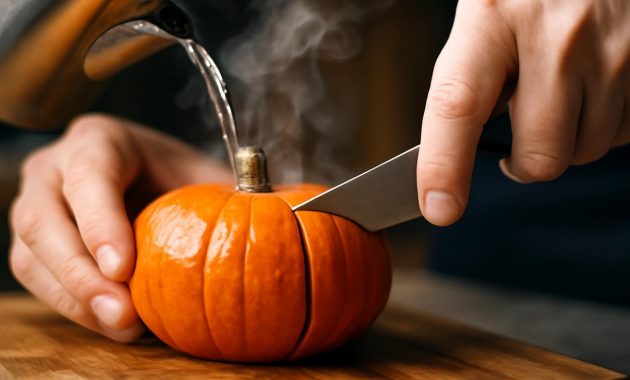
The first cold snap of the season always seems to arrive overnight. You go to bed in late-summer air, and you wake up in a house that suddenly smells like wool sweaters and dry leaves. On your kitchen counter sits a pumpkin you bought in a burst of autumn enthusiasm—round, stubborn, and beautiful. You had imagined that by now it would be something comforting: a soup, a pie, a pan of roasted cubes caramelizing at the edges. Instead, it’s still there, smug and whole, because every time you try to cut into a pumpkin, it feels like a minor battle with a medieval weapon.
The Moment You Meet a Pumpkin and Realize It’s Basically a Boulder
There’s a particular sound a knife makes when it meets a pumpkin that’s not ready to cooperate—a tight, protesting squeak, followed by a dull, dangerous thunk as the blade sticks halfway in. Your hand tightens on the handle, your other palm braces the orange shell, and you suddenly remember every warning you’ve ever heard about kitchen accidents.
If you’ve ever tried to slice into a raw pumpkin or hard winter squash, you know this dance. The rocking, the sawing, the worried glance toward your fingers. The way you lean your body weight into the knife as though you’re trying to crack a vault instead of make dinner. You might even find yourself negotiating with the pumpkin out loud: Just a little give, that’s all I’m asking.
Most of us accept this as part of pumpkin season: delicious payoff, slightly terrifying prep work. We sharpen our knives, steady our cutting boards, and hope for the best. But what if the pumpkin wasn’t actually the problem? What if the problem was that we’d been trying to cut through something that didn’t want to move—when all it needed was a little heat and patience?
The Quiet Little Trick Hiding in Your Kettle
Here’s where the story changes. Not with a new gadget or a specialized pumpkin-sawing contraption, but with something much simpler: hot water.
It sounds almost too easy, like one of those kitchen myths your neighbor swears by. Yet there’s something quietly brilliant about it. Instead of wrestling your way into the pumpkin while it’s rock-hard and unyielding, you let heat soften the outer flesh just enough to cooperate. Not to cook it. Not to turn it to mush. Just to nudge it from “stone” to “sliceable.”
The first time you try it, you might feel a little skeptical. You set the pumpkin in your sink or a heat-safe basin. You fill a kettle or large pot and bring the water to a near-boil—steaming, almost rolling, the kind of heat that curls into the air and fogs the window above the sink. Then, carefully, you pour.
The sound of hot water hitting pumpkin is strangely gentle. No hiss or sizzle, just a soft rushing and the mild tap-tap of water against hard rind. The pumpkin goes from cool to warm under your fingertips, its skin taking on a faint, darker sheen. You let it sit like that, bathing in heat, for several minutes while the warmth slowly seeps into its dense flesh.
What happens inside is a quiet transformation. Heat loosens the rigid structure of starches and fibers in that very outer layer, relaxing them, making them just a fraction less stubborn. You’re not steaming it through; you’re just persuading it to give in at the surface where your knife first needs to bite.
How the Hot Water Trick Actually Works (Without Turning Pumpkin into Porridge)
From the outside, the process looks deceptively simple. But if you were to zoom in—way in—on the pumpkin’s cells, you’d see the real magic. The firm texture of raw pumpkin comes from tightly packed plant cells, their walls stiffened by cellulose, hemicellulose, and pectin. Raw, cold, and dense, they hold together like tiny bricks in a fortress.
When you pour hot water over the outer surface, that heat begins to relax some of the pectin and slightly soften the cell walls. It’s a gentle, surface-level nudge, not a full breakdown. Think of it as loosening a tight knot instead of pulling it apart. The result: the very outer portion of the pumpkin becomes less resistant, letting your knife slip in more easily without the dramatic effort.
This is key—because you’re not trying to par-cook the pumpkin. You don’t want waterlogged or mushy flesh. You want just enough softening to make that first cut safer and saner, while still preserving the firm texture you need for roasting, carving, or dicing.
Step-by-Step: Turning a Stubborn Pumpkin into a Willing Participant
Once you know the logic, the method becomes almost meditative. It’s the kind of small seasonal ritual that makes cool-weather cooking feel less like a chore and more like a quiet conversation between you and the ingredients.
Your Hot Water Pumpkin-Slicing Ritual
Here’s a simple process you can follow at home:
- Choose your pumpkin or squash. This works beautifully on dense winter varieties: sugar pumpkins, kabocha, butternut, kuri, acorn, and similar hard-skinned types.
- Wash the exterior. Give it a quick scrub under cool water to remove dirt. You’re about to pour hot water over it, so it’s a good moment to start clean.
- Set it in a safe place. A clean sink or large heat-safe bowl works well. Make sure it’s stable and won’t roll.
- Heat the water. Bring a kettle or large pot of water close to boiling. You want it very hot, but it doesn’t have to be a violent, rolling boil.
- Pour carefully. Slowly pour the hot water over the pumpkin, rotating it if you can so the water covers as much of the surface as possible. Aim for even coverage.
- Let it sit. Leave the pumpkin in its hot bath for about 5–10 minutes. If the water cools quickly, you can drain and repeat once more for very thick-skinned varieties.
- Dry and test. Lift the pumpkin out carefully (it will be warm), pat it dry with a clean towel, and place it on a stable cutting board. With a sharp knife, test a small cut near the top. You should feel noticeably less resistance.
- Proceed with cutting. Slice through from the stem downward, using a steady rocking motion. The knife should travel more willingly; that terrifying stick-and-wrench moment is dramatically reduced.
For many people, the difference is both physical and psychological. When the first cut is smoother, your whole body relaxes. Your grip softens, your movements become more precise, and suddenly you’re not bracing for disaster—you’re just cutting a vegetable.
The Small Safety Revolution on Your Cutting Board
In home kitchens, danger rarely announces itself loudly. It lurks in the almost-slips: a damp cutting board, a dull knife, a moment of impatience. Pumpkins and hard winter squash bring all those risks together. Their roundness encourages rolling. Their density invites excessive force. Their slick outer skin shrugs off weaker blades.
When you combine those factors with a hurried cook and a sharp knife, it’s not hard to imagine how a quiet evening can end in a tense drive to urgent care. The hot water trick doesn’t just make pumpkin easier—it makes it safer. Less resistance means you’re less likely to wrench the blade sideways or slam it down with uncontrolled power.
It subtly changes your posture at the cutting board too. Instead of leaning and straining, you stand more upright, more balanced. Your hands can focus on guiding the knife, not wrestling it. You’re less tempted to use risky shortcuts—like pounding the handle with your palm or twisting a stuck blade free.
And then there’s the emotional side of safety. Once you’ve used hot water to tame your first pumpkin, you’re far more likely to cook with these hefty, nutrient-rich vegetables more often. They no longer represent a hazard; they become approachable, even inviting. Food that feels safe to prepare is food we come back to again and again.
Quick Comparison: Before and After the Hot Water Trick
Here’s a simple overview to show how the hot water trick changes your pumpkin prep experience:
| Aspect | Without Hot Water | With Hot Water |
|---|---|---|
| Effort Required | High: lots of force and sawing | Moderate: smoother initial cuts |
| Knife Control | Lower: blade easily sticks or slips | Higher: blade moves more predictably |
| Risk of Injury | Increased due to force and instability | Reduced: less force, more stability |
| Time to First Cut | Fast attempt, slow struggle | Slight prep, smoother cutting |
| Texture After Cooking | Good if cut successfully | Equally good: softening is only surface-deep |
Beyond Convenience: A Different Way of Being in the Kitchen
It’s easy to treat tricks like this as simple hacks—a way to shave a few minutes off prep time or avoid one more frustration. But there’s something deeper here too, a quiet shift in how we relate to the food we cook.
Pumpkins and their kin are, by design, storage miracles. They were built by nature to endure months in a cool corner, nourishing humans long after tender summer vegetables have vanished. Their hard skins, dense flesh, and tough stems aren’t flaws; they’re survival strategies. When you pour hot water over a pumpkin, you’re not defeating it so much as meeting it halfway.
There’s a certain tenderness in that: recognizing that a little bit of extra attention, a small pause of heating and waiting, transforms stubbornness into cooperation. It slows you down in a good way. While the hot water does its quiet work, you find yourself listening—to the kettle’s low rumble, to the ticking of the stovetop cooling, to the barely audible change in the air as steam rises around you.
Kitchen work that used to feel adversarial softens. Instead of forcing your will on the pumpkin, you’re trading: heat for ease, patience for safety. That exchange ripples into the rest of your cooking. You might find that once the pumpkin is neatly halved, scooped, and cubed, you’re more inclined to handle it with care—tossing it thoughtfully in oil and spices, roasting it until the edges brown and blister, blending it into a soup that tastes deeply of the season you’re standing in.
Little Variations You Can Try
Once you’re comfortable with the basic idea, you can adapt the hot water trick in subtle ways:
- Partial soak: For smaller squash, you can rest just the section you plan to cut into a bowl of very hot water for a few minutes instead of pouring water over the whole vegetable.
- Two-stage warming: If the skin is extremely hard, pour hot water, rest 5–10 minutes, then repeat once more before cutting.
- Combined with knife sharpening: A freshly honed knife plus a warmed pumpkin is a dramatically different experience from a dull blade on a cold one.
- Stem-first strategy: After warming, start by cutting around and removing the stem, then slice downward; the softened top area often gives you a safer entry point.
All these tiny choices accumulate into something you can feel: a kitchen that works with you, not against you.
From Dread to Delight: What This Means for Your Autumn Table
Imagine this: instead of passing by whole pumpkins and hard squash at the market with a quiet sense of dread, you pick them up with curiosity. That bumpy kabocha you always admired from a distance? Into the basket. The pale, elegant butternut your friend keeps raving about? That too. You know now that once you get home, your kettle will do some of the hardest work.
Maybe you turn the hot water trick into a tiny ritual of seasonal cooking. The first truly chilly evening, you warm the kitchen not just with the oven, but with steam and anticipation. The pumpkin sits in its improvised bath while you line a baking tray, measure spices, or chop an onion. There’s a deep, quiet satisfaction in preparing a food that once sustained entire winters—a sense of participating in something enduring and old-fashioned, updated with a little modern ingenuity.
By the time you sit down to a bowl of pumpkin soup silky with cream, or a tray of roasted cubes dusted with smoked paprika and salt, the memory of that once-intimidating, rock-hard globe feels distant. You didn’t conquer it; you coaxed it open. The knife moved easily. Your hands felt steady. There was no drama, only the feeling that this is how it should be: a cook, a vegetable, a small, simple trick that quietly makes everything better.
And once you know, you can’t quite go back. Every pumpkin from now on carries a secret you share: beneath that armor is something tender, and all it takes to reveal it is a little heat, a little patience, and the decision to make the work gentler—for the pumpkin, and for yourself.
FAQ
Does the hot water trick start cooking the pumpkin?
No. The hot water only softens the very outer layer of flesh and skin. It does not cook the interior or change the final texture when you roast, steam, or simmer the pumpkin.
How hot should the water be?
Use water that is just off a boil—steaming and very hot, but not necessarily a violent rolling boil. This level of heat is enough to soften the surface without breaking it down.
Will this work on all types of squash?
It works best on hard-skinned winter squash and pumpkins: sugar pumpkins, kabocha, butternut, kuri, acorn, and similar varieties. It’s not needed for softer summer squash like zucchini.
How long should I leave the pumpkin in hot water?
Generally 5–10 minutes is enough. For very tough or large pumpkins, you can drain and repeat once more if the skin still feels extremely hard when you test it with a knife.
Is this method safe for the pumpkin’s flavor and nutrients?
Yes. Because the water contact is brief and mostly at the surface, there’s minimal impact on nutrients or flavor. Once you cook the pumpkin as usual, it tastes and behaves the same—just with safer, easier prep.
Do I still need a sharp knife if I use hot water?
Absolutely. The hot water trick makes cutting easier, but a sharp, stable knife is still essential for control and safety. The two together make a big difference.
Can I use this trick for carving Halloween pumpkins?
Yes. A brief hot water treatment can make carving easier, especially the initial opening of the top. Just avoid overdoing the heating so the pumpkin stays firm enough to hold its shape.