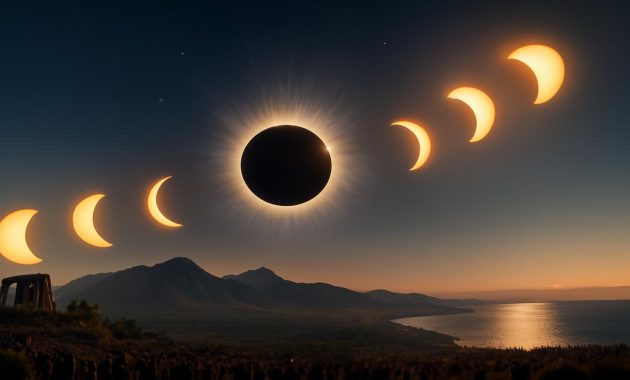
By the time the first sliver of Sun is bitten away, most people won’t have noticed. A child will be chasing a ball down a hot sidewalk. A line cook will be flipping onions on a grill. A commuter will be staring at a phone, thumb scrolling past headlines about the very thing that is now, quietly, beginning. The day will not end with a bang, or even with a shout, but with a soft, slow dimming that creeps into the corners of our attention. And then, over the course of a few uncanny hours, daylight itself will be taken apart and rebuilt in front of millions of stunned faces.
The Long Shadow on the Move
The longest total solar eclipse of the century does not arrive like a movie premiere or a fireworks show. It arrives as a shadow, sharp-edged and silent, sliding across the spinning Earth at thousands of kilometers an hour. High above, the Moon slips perfectly between our planet and the Sun, casting a moving cone of darkness—the umbra—onto the surface below. Anyone standing within that narrow path will see noon turn to midnight in a matter of minutes. Those farther out, in the broader penumbra, will witness the Sun turned to a crescent, daylight strangely thinned but never extinguished.
For this particular eclipse, astronomers have been watching the numbers for years. Orbital mechanics—those elegantly predictable dances of gravity and momentum—have conspired to place the Moon at just the right distance, and the path across Earth at just the right angle, to stretch totality to an unusual length. In some regions, the Sun will be fully covered for more than six and a half minutes. In the language of eclipses, that is lavish. That is a feast.
The path of totality will carve a looping arc across the globe, touching remote deserts, busy coastal cities, and sleepy agricultural towns. Morning markets will darken mid-sale. Afternoon playgrounds will fall suddenly quiet. In some areas, people will have traveled thousands of kilometers, lugging camera gear and folding chairs, to stand directly beneath the Moon’s shadow for a few fleeting minutes. Others will simply walk out the front door, blinking up in disbelief as the light turns strange.
On weather maps, meteorologists will track a very different concern: clouds. A single stubborn bank of gray sky can block years of anticipation. In one town, a stubborn sheet of overcast may hide everything; in another, a gap will open by luck at exactly the right moment, revealing a cosmic spectacle to a few hundred startled observers while a neighboring city sees only darkness, not the delicate, carved edge of the eclipsed Sun.
When the Air Starts to Taste Different
If you’ve never stood beneath a solar eclipse, it is not the darkness that surprises you first. It is the quality of the light and the way the world around you reacts. As the Moon moves slowly over the Sun, the brightness drops not like a dimmer switch, but in a way your brain isn’t used to parsing. Colors seem desaturated, as if someone has turned down the saturation knob on reality. Shadows sharpen into unnaturally crisp outlines, tracing every leaf and fence post with surgical precision.
The air, too, starts to feel different. Temperature sensors will record a cool-down of several degrees as the Sun’s energy is choked off. You may feel it on your skin, a faint chill threading through the breeze that hadn’t been there minutes before. Birds will grow uneasy. Diurnal songbirds may fall oddly quiet, while crickets begin to test their evening chorus ahead of schedule. Pets will pace or look toward their owners with a kind of confused questioning, responding to cues written deep in their biological clocks.
People will notice these changes in their own ways. Someone on a farm road might lean against a fencepost and sniff the air, remarking that it smells, somehow, like late evening even though the watch on their wrist insists it is early afternoon. On a city rooftop, a group of friends might fall silent at the same moment, all struck by a sudden sensation that feels part weather change, part theater curtain dropping. The hum of traffic shifts, too; drivers instinctively flick on their headlights as the daylight slides toward dusk.
In the last minutes before totality, time seems to compress. The Sun, which has been slowly eaten away for more than an hour, now shrinks to a thin, trembling crescent. If you hold your hands together, overlapping your fingers, or stand under a tree, tiny crescent-shaped suns will appear in the pinhole gaps—an accidental art installation scattered across sidewalks and walls. People with eclipse glasses lift them and lower them in nervous rhythm, glancing from the sky to the faces around them. Conversations fragment into breathless updates: “Look at it now.” “It’s almost there.” “Is it getting colder to you?”
The Moment the Stars Come Out at Noon
Then, in a rush of quickening shadows and racing heartbeat, the last bright bead of sunlight—the so-called “diamond ring”—flashes and vanishes. Eclipse glasses are tugged off, and a collective inhalation sweeps along the path like a wave. Above, where the Sun once blazed, there is an impossible sight: a hole in the sky.
The Moon is not a glowing disc now but a black, perfectly round void. Around it spills the Sun’s corona, the ethereal outer atmosphere usually washed out by daylight. It pours into the sky in feathery, pearly plumes, stretching and twisting in patterns sculpted by the Sun’s magnetic fields. No photograph ever fully captures its texture, the livid white set against an oddly indigo twilight that fades into the still-blue horizon.
Planets appear first—bright, insistent points. Venus may shine like a dropped jewel near the Sun, while Jupiter winks into existence higher up. For a few long minutes, the sky is an upside-down map: night in the middle, day around the edges. Streetlights blink on, confused. On rivers and lakes, the water reflects a 360-degree sunset, every horizon dressed in soft oranges and purples while overhead a dark dome reigns.
For the longest total eclipse of the century, this surreal twilight stretches on longer than many living people have ever experienced. In past eclipses, totality may have lasted two or three minutes—a gasp, a single exhale of wonder before the light returned. Now, in some locations, there is time to move through phases of emotion: the initial shock, the swelling awe, then a settling into something quieter, more contemplative. You can look up, look away, look back again. You can turn slowly, taking in how your own familiar landscape is transformed by this borrowed night.
Many will cry and not quite know why. The brain understands orbital alignments and celestial mechanics; the chest, however, reacts to something older. For as long as humans have walked under the sky, we have assigned meaning to these rare ruptures in the daily cycle. Eclipses have been feared as omens, woven into myths of dragons and devouring wolves, recorded on stone and bone and parchment. To stand there, under this version of the same event, is to be threaded into a story that has outlived empires.
Scientists Waiting in the Dark
While most of the world tilts its face upward in naked astonishment, a different kind of anticipation hums in research tents, observatories, and makeshift field labs scattered along the path of totality. For solar physicists, atmospheric scientists, and a surprising cast of other researchers, this eclipse is not only a spectacle; it is an experiment window written into the sky.
“There’s nothing like totality,” one astrophysicist might say into a camera, minutes before the lights go out. “We can launch satellites, we can orbit space telescopes, but the combination of alignment, duration, and scale we get from a long total eclipse is still unique. It’s like the universe has agreed to hold still for a moment while we take a closer look.”
During totality, high-resolution telescopes equipped with filters and polarizers will probe the Sun’s corona, looking for fine structures and dynamics that reveal how heat and energy move through those ghostly loops and streamers. Understanding the corona is not an abstract exercise: it is key to unraveling the mysteries of solar storms and space weather that can disrupt power grids, satellites, and even airplane routes.
Elsewhere, teams will release weather balloons into the dimmed atmosphere, tracking how temperature, wind patterns, and turbulence respond to the sudden drop in solar energy. By observing how quickly the lower atmosphere cools and then reheats, scientists can refine climate and weather models that predict everything from afternoon thunderstorms to heat waves. Radio operators will listen for changes in the ionosphere—the charged upper layer of the atmosphere that reflects some radio waves—as it reacts to the temporary “night.”
Even ecologists and animal behaviorists will be out with notebooks and recording devices. How do pollinators navigate when the Sun vanishes? Do nocturnal animals tentatively emerge, then retreat in confusion when daylight snaps back? In some regions, farmers have volunteered their fields and barns, allowing researchers to monitor livestock responses. Cows may head for the barn, chickens may roost early, dogs may whine at doors. Each response is a small data point in the larger story of how life on Earth is wired to the cycles of light and dark.
Citizen scientists, too, will play a role in this long eclipse. Apps will invite participants to log temperature readings, sky brightness levels, and even their own emotional reactions. Amateur astronomers will point their carefully collimated telescopes toward the blackened Sun, capturing images that, when stitched together across the path, can create a detailed, time-lapse portrait of the corona’s structure during the event. In the modern era, an eclipse is not just watched—it is instrumented, measured, archived.
Families, Travelers, and the Art of Waiting for Shadow
The path of totality will become a kind of temporary migration route, a corridor along which strangers with the same obsession gather. Months beforehand, campsites along the predicted line will sell out. Small towns will see their hotel bookings spike to levels more often reserved for festivals or championship games. In dusty fields, in school parking lots, in national parks, tents and RVs will bloom like a second, terrestrial constellation.
For many, attending this eclipse will be a pilgrimage. Parents will load their children into cars, explaining with varying degrees of success why they are driving many hours to stand under a sky that they can technically see from home every day. “You’ll understand when it happens,” one mother might say, checking off a list of eclipse glasses, snacks, and extra layers. Somewhere else, a retired couple will circle this date on a calendar as their major trip of the year, tracing the path on a wall map with their fingers, deciding where to intercept it.
In the days and hours before the event, conversations in these temporary communities will orbit around weather forecasts, timing predictions, and shared stories of past eclipses. Veteran chasers—those who have flown or driven to multiple eclipse paths—will recount narrow escapes from clouds, last-minute detours down rural roads that ended in clear views and lifetime memories. Newcomers will listen, eyes wide, not entirely sure that the thing they’re about to see could possibly live up to the hype.
Then comes the waiting, a particular kind of waiting that intensifies as the first partial phases begin. Children grow restless and then fascinated as they peer through cardboard viewers at the Sun’s decreasing arc. People share food. Someone passes around homemade pinhole projectors. A telescope owner politely but proudly invites strangers to take a look through the filtered lens. Time seems to speed and slow in alternating waves.
When totality arrives, all the packing and planning, the roadmaps and reservations, compress into the pure presence of those few minutes. Afterward, as the Sun reemerges and the spell lifts, conversations resume with a different quality. “I wasn’t prepared,” someone will say. “I thought I was, but I wasn’t.” Another might stare at their hands, still trembling slightly, and laugh. Children, wired with energy, will try to put words to it: “It was like the sky had a hole.” “It felt like a magic trick.” “Can we see another one?”
Safe Eyes, Shared Sky
Amid the wonder, there is a quiet, practical mantra repeated by astronomers, teachers, and health officials: look up, but do it safely. The Sun, even when partially covered, is powerful enough to damage unprotected eyes, and the longest eclipse of the century is no exception. The seemingly dimmed disc can lull viewers into complacency, but the exposed crescent is bright and concentrated, like a scalpel of light.
Throughout regions under the eclipse, schools will hand out special eclipse glasses, their dark polymer lenses capable of blocking the vast majority of the Sun’s rays. Community centers will host viewing events with proper filters on telescopes and binoculars. In parks, volunteers will gently nudge newcomers: “Try these instead,” swapping out sunglasses for ISO-certified viewers. Cities will push out safety reminders on radio and public transit announcements: enjoy the show, but use protection.
The one exception—the brief window when it is safe to look at the Sun with the naked eye—is during totality itself, when the Moon completely covers the solar surface. In those precious minutes, eclipse glasses can come off, revealing the uncanny beauty of the corona in full, unfiltered glory. But even then, seasoned watchers keep their fingers poised, ready to lift the glasses back at the first returning bead of sunlight. The boundary between wonder and safety is measured in seconds.
This choreography of cautious viewing becomes, in its own way, part of the shared experience. People help each other adjust cardboard viewers, lend extra glasses to latecomers, and position children so they can see through telescopes. In communities where science can sometimes feel abstract or distant, the eclipse provides a rare moment of direct, embodied engagement. This is space science you can feel on your skin, in your retinas, in the hush that falls over a crowd as daylight fails.
Numbers Behind the Wonder
Beyond the immediate sensations, this eclipse is also a story told in numbers: distances, speeds, durations. Together, they form a quiet scaffold under the roaring sense of awe. For those who like to lean into the data, here is a compact look at some of the key facts scientists have calculated for this rare event:
| Aspect | Details |
|---|---|
| Maximum duration of totality | Over 6.5 minutes in select locations along the central path |
| Width of path of totality | Roughly 150–200 km wide, varying with local geometry |
| Speed of the lunar shadow | Up to ~2,000 km/h, depending on latitude and time |
| Fraction of Sun covered in partial zones | From a slim “bite” up to around 99%, outside the central line |
| Expected viewers | Many tens of millions within driving distance of totality; hundreds of millions experiencing at least a partial eclipse |
Each figure in that table is the product of centuries of observations and mathematics, refined through modern satellites and computer models. Yet the strangest thing is how small the numbers feel once you are standing there under the shadow. You can know the Moon is about 384,000 kilometers away, and that the Sun is roughly 400 times farther still. You can recite that this precise alignment, with this particular duration, will not repeat for generations. And still, in the hush of totality, those facts feel like footnotes to something deeper and harder to name.
When the last seconds of totality slip away and the first fierce bead of sunlight explodes from the edge of the Moon, people will flinch and cheer. The corona will vanish, swallowed by the returning glare. Eclipse glasses will go back on. The world will brighten rapidly, as if someone has thrown open every curtain in a house at once. Birds will resume their normal calls; traffic will adjust; children will tug at sleeves, hungry or tired or both.
Yet for hours afterward—perhaps for days—the experience will cling. A cashier will mention it between scanning groceries. A teacher will pause in the middle of a lesson to ask, “So, what did it feel like to you?” Social feeds will be flooded with uneven smartphone photos, overexposed and grainy, accompanied by captions attempting to capture something that resolutely resists pixels. Scientists will begin poring over their data, looking for tiny wobbles, new patterns, unexpected correlations. Life will go on, yes, but slightly rearranged around a memory of standing together in the cool, impossible twilight of midday.
The day will have slowly turned to night, then back again, carried on the back of a passing shadow. It will have been both utterly predictable and deeply shocking. And in that tension—between calculation and awe, between numbers and goosebumps—lies the enduring magic of a total solar eclipse, especially one as lingering and generous as this, the longest of a century.
Frequently Asked Questions
How long will this eclipse last from start to finish?
From the first noticeable bite out of the Sun to the final return to full daylight, the eclipse will unfold over roughly two to three hours in any given location. However, the period of totality—the time when the Sun is completely covered—will last up to more than six and a half minutes at maximum, with slightly shorter durations on either side of the central line.
Is it safe to look at the eclipse without special glasses at any time?
It is only safe to look at the Sun without certified eclipse glasses during the brief period of totality, when the Sun is completely covered by the Moon and no direct sunlight is visible. At all other times—including partial phases before and after totality—you must use proper eclipse viewers or solar filters to protect your eyes. Regular sunglasses are not sufficient.
What will people outside the path of totality see?
Those outside the narrow path of totality will experience a partial solar eclipse, where the Moon covers only part of the Sun’s disc. The Sun will appear as a crescent to varying degrees, depending on how close you are to the central path. The sky will dim somewhat, but it will not become fully dark and the corona will not be visible without traveling into the totality zone.
Why is this eclipse the longest of the century?
The duration of a total solar eclipse depends on several geometric factors: the distance between Earth and the Moon, the distance between Earth and the Sun, and the specific path the Moon’s shadow takes over Earth’s surface. For this event, those factors line up in a particularly favorable way, allowing the Moon’s umbra to linger over certain regions longer than usual, producing unusually long totality.
Will there be other total solar eclipses soon?
Total solar eclipses happen somewhere on Earth roughly every 18 months, but any given spot on the planet experiences one far less frequently—often only once every few centuries. While other total eclipses will occur in coming decades, very few will match the length and accessibility of this one. For many people, especially those within easy reach of the path, this may be the most significant eclipse opportunity of their lifetime.