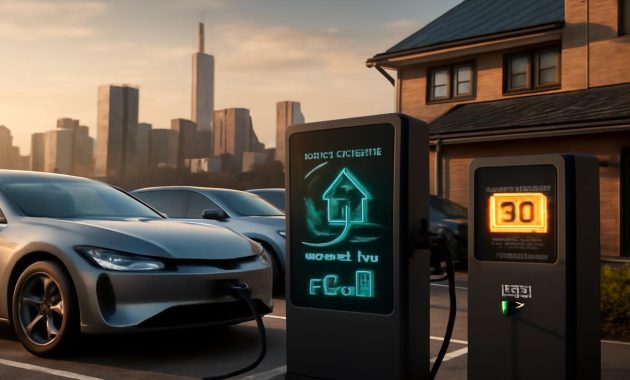
The first thing you notice is the silence. Not the thin, awkward silence of a room waiting for someone to speak, but a thick, velvety quiet that settles over a neighborhood in the early evening. Shanghai’s towers glow faintly in the distance, yet the usual mechanical hum is missing. In a narrow lane lined with sycamores, a row of cars sits parked in perfect stillness—sleek, glassy shapes that look more like resting animals than machines. A light breeze carries the smell of rain-on-concrete and a faint whiff of battery coolant, sharp and metallic. In the doorway of a small apartment, an old man in a white undershirt leans on the railing, watching as his grandson plugs the family electric car into a gray box on the wall. Not to charge it—this time—to feed power back to their home.
The Night the Cars Became Power Plants
Inside, the family’s apartment glows softly. Ceiling fans turn lazily. A rice cooker steams on the counter. The television murmurs in the living room while a phone charges on the coffee table. Nothing about this scene looks revolutionary. Yet, behind the plaster walls and cheap paint, something quietly radical is happening: the electricity flowing into this home doesn’t just come from a distant power plant. It’s coming from the car downstairs.
China has so many electric cars on the road now that, in some places, they’re no longer just consumers of energy; they’re becoming part of the grid itself. What began as a bold bet on electric vehicles—the subsidies, the ambitious quotas, the relentless push for battery factories—has led to a strange, almost science-fiction moment: millions of cars, sitting idle for most of the day, holding more stored energy than many power plants can produce at once.
On summer evenings when air-conditioners roar and demand for electricity spikes, grid operators used to sweat. They watched the lines of their graphs climb dangerously upward, hoping coal plants could respond quickly enough, hoping no cable somewhere decided to fail. Now, in pilot projects from coastal cities to inland industrial hubs, those same operators are watching something else: a new, shimmering layer of capacity in the form of parked EVs, each one a little black box of stored power that can be summoned, coordinated, and shared.
It didn’t happen overnight. But it happened faster than anyone expected. And if you listen closely, beneath the quiet of that Shanghai lane, you can almost hear the grid thinking—learning to treat every parked car as a tiny, mobile power plant.
The Silent Swarm: How Many EVs Are We Talking About?
To understand how this became possible, you have to feel the scale of China’s electric revolution—not as a tidy statistic, but as a physical presence. Step onto a busy street in Shenzhen or Guangzhou at rush hour and look around. The cabs? Mostly electric. The buses grumbling to a stop? Electric. Delivery vans weaving between lanes, scooters humming past with insulated food bags bouncing on the back—overwhelmingly electric.
Charging stations are tucked into nearly every corner: under apartment blocks, beside high-speed rail stations, in basement parking lots that smell of dust and rubber. Some are bright and futuristic, others dingy and improvised, but they’re everywhere, little portals for energy to move between grid and road.
China’s EV fleet, now numbering in the tens of millions, represents a battery capacity so vast it’s hard to visualize. Imagine parking every one of those cars in an enormous line, stretching across provinces, from coastal haze to desert sky. Each one is a cell in a larger organism, asleep for most of the day and night, doing nothing but slowly losing charge—or, in this new vision, quietly supporting the power system that sustains the cities they serve.
The strangest part is that this swarm of stored energy mostly sits unused. Most cars, no matter the country, spend over 90% of their time parked. Which means China has essentially installed an immense, mobile, and mostly idle battery network across its territory. It’s like building a forest of wind turbines and only turning on a few of them.
Someone, inevitably, asked a simple question: What if we could flip that logic? What if, instead of just charging, cars could also give power back?
Turning Cars Around: From Charge to Discharge
That question leads to a specific acronym whispered often now in meeting rooms and control centers: V2G—vehicle-to-grid. The idea is elegantly simple, like flipping an arrow: instead of just grid-to-vehicle, why not vehicle-to-grid, too?
In practice, it’s more intricate. You need cars designed to discharge safely, chargers that can handle bidirectional flow, software that can coordinate thousands of moving batteries, and regulations that decide who gets paid for what. But the intuition is as primal as an old village sharing fire between houses: when one place has extra, it helps out another.
China, with its centralized planning muscles and vast industrial ecosystem, is uniquely suited to try something this bold. Carmakers design EVs with bidirectional capability. Battery giants run simulations on how often you can safely tap those cells without wearing them out too quickly. Grid operators quietly plug real-world numbers into their models. And in low-key office buildings, engineers and policy planners huddle under fluorescent lights, asking how far this can go.
Already, in some pilot districts, electric cars charge up at night when power is cheap—often from wind turbines spinning hard in the cool dark hours when few people are awake to use the electricity. Then, during the day or at evening peak, a slice of that stored wind power flows back into apartments, offices, and shops. You don’t see it. You don’t hear it. But if you’re paying attention, you can feel the grid breathing differently, smoother, less panicked during hot afternoons and winter cold snaps.
How a Car Keeps the Lights On: A Day in the Life of an EV Battery
Picture a single electric car in Nanjing, belonging to a young couple in a mid-rise apartment: a white compact SUV, practical and unassuming. At 7:30 a.m., they unplug it, the cable clicking softly as it releases. The battery is full, charged overnight on inexpensive off-peak electricity.
They drive to work, dropping their child off at preschool, slipping into the unpredictable choreography of morning traffic. By the time the SUV pulls into a company parking spot at 9:00 a.m., half the city is awake and humming. Solar panels are beginning to push power into the grid. The car plugs into a station in the office garage and goes dormant.
Through late morning and early afternoon, the car barely moves, but its battery is part of a whispering conversation between thousands of vehicles and the utility’s control system. At noon, a cloud bank drifts over the city and solar output dips. Office towers draw heavily on the grid—air conditioners, elevators, computers, all clawing for current. For a brief window, the system asks: Is anyone willing to give a little back?
The couple’s car, among many others enrolled in a V2G program, responds. Just a trickle: a few kilowatts here, a few there. Enough to flatten a spike, shave off the dangerous edge of demand that used to force quick-start gas turbines or coal units to sputter into life. The owner won’t notice; the battery drains only slightly. Somewhere in a server farm, the energy sale is logged, a tiny credit ticking upward in the couple’s account.
By 5:30 p.m., as workers spill back out onto the streets, the grid flips logic. The sun is lower now, but there’s still power to be had. The car sips a bit more to return to a comfortable charge level for the ride home. The couple never thinks about grid frequency or demand curves. They only know that, at the end of the month, their electricity bill is a bit lower than it used to be—and sometimes even in the negative.
Later, back home, as evening slides into night, another pattern plays out. In some neighborhoods, during extreme heatwaves or cold snaps, homes with EVs become small islands of resilience. When the grid is strained or falters, those cars can temporarily power refrigerators, lights, a fan, maybe even a small air conditioner. The SUV downstairs becomes a family’s backup generator, but one that doesn’t roar or belch fumes—just a quiet, humming presence in the parking lot, holding the dark at bay.
Numbers in the Quiet: What the Energy Looks Like
To see this more concretely, imagine a simplified snapshot of energy flow on a peak-demand evening in a future Chinese city:
| Source / Use | Approx. Power | Role in That Hour |
|---|---|---|
| Coal & gas plants | 60–65% | Baseload and heavy lifting |
| Wind & solar | 20–25% | Clean but variable supply |
| Large stationary batteries | 5–8% | Fast response, grid balancing |
| EVs feeding power back | 2–6% | Peak shaving, local backup |
| EVs charging | 5–10% | Soaking up surplus, especially off-peak |
In that thin slice where EVs feed power back, a neighborhood’s worth of living rooms, kitchens, and bedrooms quietly depend on wheels and lithium as much as on distant turbines and smokestacks.
Worries Beneath the Shine: Batteries, Trust, and Control
Beneath the excitement lies a knot of unease. You can hear it in conversations in underground parking lots and online forums. Will this wear out my battery faster? What if I need to leave in an emergency and my car has been “borrowed” by the grid? Who really controls this energy that sits in my driveway?
Battery engineers will tell you that, managed carefully, shallow charging and discharging can actually be gentler on a battery than leaving it constantly full or empty. They’ll talk about state-of-charge windows, cycle depth, and temperature management systems that sound more like caring for a living organism than a hunk of metal and chemicals. But trust isn’t built from white papers and specifications. It’s built from lived experiences: from coming downstairs in the morning, turning the handle, and finding that your car still has more than enough power to get you where you need to go.
In early V2G pilots, car owners often set their own rules through simple apps: “Never discharge below 60%,” or “Only share power after 10 p.m.,” or “Prioritize keeping enough range for 80 kilometers.” Behind the scenes, algorithms juggle these constraints, like a conductor coaxing a symphony from thousands of cautious soloists. The car is no longer just a private object; it’s a participant in a subtle social contract between driver, utility, and city.
There is also a deeper, almost philosophical tension. For a century, the car symbolized autonomy, personal freedom, escape from the confines of home and work. Now, under this new model, cars are being knitted into one of the most centralized, regulated systems humans have built: the electric grid. The very tool once used to flee the city now helps shore it up.
In China, where large-scale infrastructure projects are often coordinated top-down, this integration may come more easily than in other places. But the questions linger, whispered at the edges of the system: Who decides when my battery is used? Can I opt out easily? How much is my participation worth?
The Grid’s New Conversation with the Weather
The deeper reason China is turning to its fleet of electric vehicles as a power resource has less to do with cars and more to do with clouds and wind. The country has installed vast forests of wind turbines on its plains and mountain ridges, and enormous swaths of solar panels that glitter like artificial lakes. This is beautiful in concept—clean energy sweeping across the land—but messy in practice.
Wind doesn’t blow harder just because people get home and flip on their air conditioners. The sun doesn’t care about dinner time. The grid, once built around power plants that could obediently ramp up and down with human schedules, is now having to learn the moods of the sky.
In this context, electric cars become not just gadgets or status symbols, but tools for timing. They help shift energy from when it’s generated to when it’s needed, smoothing over the mismatch between human habits and natural rhythms. When wind farms howl at 3 a.m. and cities sleep, EVs quietly drink in the surplus. When thunderstorms roll in at 7 p.m., knocking sunlight off solar farms, the same EVs can pour a little of that stored energy back out.
In control rooms lit by walls of screens, operators are beginning to think of the national grid not as a handful of giant power plants feeding passive loads, but as something closer to a breathing ecosystem. Power flows in loops rather than lines. Homes generate, store, and consume. Cars charge, drive, rest, and then, sometimes, give back. A storm hundreds of kilometers away might nudge software here to tweak how hard a line of chargers pulls or pushes. It’s less like running a machine and more like tending a weather system.
What This Means for Homes, and for the World
Zoom back down to that Shanghai lane for a moment. The old man leaning on the railing doesn’t know every detail of this grid choreography. What he knows is simpler: when there was a blackout last winter, his son plugged their car into a box, and the apartment stayed warm and lit. The neighbors came over, kids clustering around the light, elderly residents cradling their phones as they recharged. The car, a mundane object of school runs and grocery trips, became, just for that evening, the beating heart of the building.
Multiply that scene across thousands of neighborhoods, suburbs, and villages, and you begin to see the outline of something new. A future where resilience doesn’t just come from more massive plants and higher-voltage lines, but from everyday objects woven into the fabric of people’s lives. Where the boundary between “grid” and “home” is softened, blurred by millions of batteries, in cars and walls and basements, all quietly negotiating how to share.
Globally, other countries are watching this Chinese experiment closely. Some are already following, tentatively: pilot projects in Europe, testbeds in North America, talk of EVs as peaker plants, as demand-response tools, as backup for renewable-heavy systems. But the sheer density of vehicles and charging infrastructure in China gives it a kind of living laboratory no one else has at this scale.
Of course, this path is not guaranteed. Policies can change. Markets can stumble. Battery chemistries can evolve, making today’s solutions quaint. There are hard questions about mining, recycling, and the environmental footprint of so many batteries. Turning cars into power plants doesn’t erase those concerns; it just rearranges them. But it does offer something that feels rare in the story of modern energy: the possibility that the machines we’ve built for speed and convenience might also help us live more gently with the planet’s limits.
On a humid night, in a city where neon reflects off damp pavement, that possibility hums quietly behind concrete walls and steel doors. An electric car, its paint beaded with rain, rests under a streetlight. Inside its battery, lithium ions drift, barely moving. Above it, in the apartment it powers, a child falls asleep to the soft whirr of a fan, a pot of soup cools on the stove, and a lamp glows on a bedside table. The grid outside is vast, complex, sometimes fragile. But in this small pocket of calm, a simple truth holds: energy can flow both ways now.
The road is no longer just where power ends. In China, it is slowly becoming where power begins again.
FAQ
Can electric cars really power a home in China?
Yes. In several Chinese pilot programs, EVs equipped with bidirectional charging can supply electricity back to a home or building. With the right hardware, a typical EV battery can keep basic household loads running for hours or even days, depending on usage.
Does feeding power back to the grid damage the EV battery?
If managed carefully, not necessarily. V2G systems usually operate within safe charge windows and use shallow cycles, which are less stressful on batteries than full charge–discharge cycles. Manufacturers and grid operators design these programs to limit degradation, though long-term impacts are still being studied.
How do EV owners get paid for sharing their battery power?
In most trials, owners enroll in a program through their utility or charging provider. Software tracks when and how much energy flows from the car back to the grid, and owners receive credits or payments on their electricity bill, or direct compensation based on time-of-use pricing and grid needs.
Will my car still have enough charge if the grid uses my battery?
Yes, if the system is properly configured. Drivers typically set minimum charge levels in an app—such as never going below 50–60%—so they always have enough range for daily needs or emergencies. The V2G system only uses the portion of the battery above that threshold.
Why is China especially suited to using EVs for grid power?
China has a very large EV fleet, extensive charging infrastructure, and strong central coordination of both the power sector and industrial policy. It’s also rapidly expanding renewable energy, which makes flexible storage like EVs especially valuable to balance wind and solar variability.