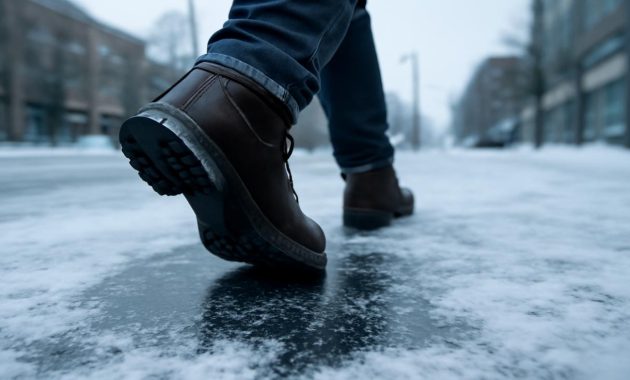
The first real cold snap always seems to arrive at night. One day the world is merely damp and gray, and by morning it has stiffened into something harder, slicker, more treacherous. The driveway shines in a way that feels wrong. The sidewalk looks just a bit too perfect, like it’s been polished. You crack the door, breathe in that metallic winter air, and sense it before you see it: black ice. Invisible, waiting, patient. Your foot hovers over the first step, and suddenly walking—this thing you’ve done since you were a toddler—feels like a risky sport.
Seeing the Invisible: Learning to Spot Black Ice
Black ice is the ghost of winter. It’s there, and then you’re on your back staring at the sky wondering what just happened. The trouble is, it doesn’t look like a sheet of villainous slickness. It often looks like nothing at all—just a darker patch of pavement, a slightly glassy sheen on a sidewalk, a whisper of shine on a wooden step.
Imagine a thin layer of water poured over black asphalt, then flash-frozen by a sudden drop in temperature. There’s no frosty white, no crunchy crystals, no warning texture under your boots. Just smooth, see-through ice that blends perfectly with the road or walkway beneath it. That’s black ice—more a feeling than a sight, until you learn to read the clues.
Those clues are subtle but consistent. After a thaw, when snow piles slump into slush and gutters gurgle with meltwater, and then the temperature plunges again—especially toward evening—that’s prime black ice time. Low spots in the driveway, shady patches on the sidewalk, the north side of the building, the end of the porch steps, the edge of parking lots close to snowbanks: these are the ambush points. Anywhere water can pool, then freeze without fanfare.
Look at the pavement. Dry winter asphalt is a matte gray, almost dusty. Wet asphalt glistens, but you can usually see ripples. Black ice, on the other hand, has that eerie, even shine, like someone brushed clear varnish over the ground. Streetlights reflecting in crisp, sharp lines rather than blurred smudges? That’s a red flag. The same goes for driveways that look “too smooth,” or brick paths where the grout lines seem to vanish under a glassy film.
One simple, old-fashioned trick: use your ears. Gently tap the ground ahead with your foot or a walking stick. Dry, gritty surfaces sound dull and rough. Thin ice has a faint, sharp, almost musical quality—like tapping a fingernail on glass. In the half-light of early morning, when the world is hushed, that tiny sound can be your first warning.
Gear Up From the Ground Up: Footwear that Grips, Not Slips
You can’t negotiate with physics. If the soles of your shoes can’t grab the ground, it hardly matters how careful you are. The difference between a close call and a fall often begins at your toes. Yet many of us step out in winter wearing boots that are built more for fashion than friction.
Close your eyes and picture your favorite winter shoes. Are they smooth on the bottom, or do they have deep, varied tread—channels, lugs, little diagonal lines? Smooth rubber is essentially a skate on ice. What you want is texture and flexibility. Soft rubber that can flex and deform slightly will bite into micro-roughness that your eyes can’t see. Stiffer, hard plastic-like soles might last longer, but they slide more easily on ice.
Pay attention to the pattern. Flat, uniform squares provide less grip than aggressive, uneven patterns that allow snow and slush to escape instead of packing underneath. If snow cakes into the tread and stays there, it can turn into a slippery layer between the boot and the ground, like walking on ball bearings. Look for soles that stay relatively clear as you move.
For truly icy weeks, consider removable traction devices—those stretchy bands with metal coils or spikes that slip over your boots. They can turn a regular shoe into something closer to a mountaineering crampon. Are they overkill for a quick walk to the mailbox? Maybe. But if you have a sloping driveway or a long, icy sidewalk to conquer daily, they can save your tailbone. Just remember to take them off indoors to protect floors and avoid tripping on hard surfaces.
And here’s an underappreciated detail: fit matters. If your heel lifts inside your boot with each step, you’re constantly a half-second behind your own movement, reacting instead of controlling. A snug, secure fit means your foot and the sole act as one unit. Lace up properly, adjust straps, and don’t be shy about retiring boots that have worn-down tread. Once the tread flattens, the shoe’s winter usefulness is largely gone.
Walk Like a Penguin (Seriously)
There’s a reason videos of penguins waddling across Antarctic ice rarely end in pratfalls. Their bodies have figured out something that we forget as adults: you don’t walk on ice the way you walk on dry ground. You adapt.
On bare pavement, we take long, confident strides, pushing off strongly with the back foot and letting our weight swing forward. On ice, that kind of stride becomes a launch mechanism—your foot shoots backward, your momentum keeps going, and down you go. To stay upright, you need to shorten the distance between your center of gravity and the point where your foot meets the ground.
So, think “penguin mode”:
- Short steps: Take quick, shuffling strides rather than long rolls. The shorter the step, the less time your weight is fully committed to a single slick spot.
- Feet slightly wider apart: A wider stance gives you a more stable base, like opening a tripod.
- Flat-footed contact: Place your whole foot down gently instead of landing heel-first. Imagine you’re trying not to wake a sleeping baby under the ice.
- Arms out, not in: Resist the instinct to shove your hands in your pockets. Let your arms float loosely at your sides, slightly out, ready to counterbalance a slip.
- Lean slightly forward: It feels counterintuitive, but a tiny forward lean ensures that if your feet slip, you’re more likely to fall forward, where you can catch yourself, instead of flat on your back.
The first few steps in this altered gait may feel silly—like you’re playacting an Arctic explorer on a city sidewalk. But there’s a quiet, reassuring rhythm to it. You become more deliberate, more aware of the ground beneath you, less of a hurried blur rushing from one heated building to the next.
Turn Your Home Territory into a Safe Zone
Most winter falls don’t happen halfway up a mountain trail. They happen in painfully ordinary places: the front stoop, the apartment steps, the driveway, the short stretch from the parked car to the sidewalk. The good news is that you have more control there than almost anywhere else.
Start with light and sight. If your porch bulb has burned out, replace it. If there’s a shadowy corner of your walkway, consider a small motion-sensor light. Black ice thrives in dimness; you don’t want to give it that advantage. In the early morning and after sunset, being able to see subtle shine or a darker patch can mean the difference between a cautious step and a reckless one.
Next, think about where water comes from and where it goes. Does your roof dump meltwater straight onto the front steps? Is there a low spot in the driveway where puddles linger? Maybe the downspout ends just shy of the sidewalk. Rerouting runoff with simple splash blocks, extended downspouts, or even a shovel-sculpted trench in a snowbank can drastically cut down on surprise ice patches.
De-icers and sand are winter’s quiet heroes. Keep a small bucket near your door, with a scoop you can grab one-handed. Rock salt can help melt existing ice, but it works best at certain temperatures and can be tough on plants and concrete over time. Alternatives like calcium chloride or magnesium chloride are often friendlier to surfaces and effective at lower temperatures. Sand or gritty cat litter won’t melt anything, but they will create immediate traction on stubborn ice.
Here’s a simple comparison to keep the options straight:
| Material | Main Benefit | Best Use |
|---|---|---|
| Rock salt (sodium chloride) | Melts ice in moderate cold; inexpensive | Driveways, walkways above very low temps |
| Calcium or magnesium chloride | Works in lower temps; gentler on surfaces | Steps, porches, high-traffic paths |
| Sand / grit | Instant traction; no melting needed | Stubborn black ice, steep slopes |
Don’t forget railings—they are not just decorative. A solid handrail on outdoor steps is as valuable as any winter safety tool. In icy weather, make a habit of using it every single time, on the way up and the way down, even if you think you don’t need it. That one extra point of contact can rescue you in the split second when your foot glides the wrong way.
Driveways, Parking Lots, and the Peril between Car and Door
There’s a particular kind of humbling spill many people know too well: arms full of groceries, a quick hop out of the car onto what looks like dull concrete, then your foot whooshes sideways and you watch oranges and cans of soup arc gracefully through the air. Parking lots and driveways are the quiet empire of black ice.
Cars create their own little climate zones. Snow melts from the warmth of the engine, drips, then refreezes when you’re not looking. When you park after a snowy or slushy drive, the heat from your tires will briefly turn packed snow into slush. As the car cools, that slush can harden into a thin, wickedly smooth crust.
Before you swing your legs out, pause. Open the door and look down. Tap the ground lightly with your heel. If it feels too slick or looks suspiciously shiny, re-plant your foot firmly on the car’s frame and re-strategize. Can you place your first step onto a patch of snow instead of the glassy patch? Can you slide your foot along the surface rather than stomping down?
Use the car as a handrail. Grip the doorframe or the top of the door as you stand. Step down slowly, keeping your center of gravity over the foot that’s still in the vehicle until you’re sure the outside foot is secure. When you walk away from the car, keep one hand brushing the side if you can. It’s comforting, and it gives you an instant point of support if you suddenly skid.
In parking lots, assume the glossy areas near snow piles are suspect. Meltwater trickles from those heaps during the warmer hours, then quietly freezes at dusk into thin, treacherous sheets. When possible, choose a spot with visible texture—areas where sand or plowed grit is scattered, or where the surface looks drier and duller. Those few extra steps from a safer parking spot are worth it.
9 Smart Ways to Outsmart Snow and Ice
By now you can feel the pattern: winter doesn’t just require warmer clothes; it asks for a slightly different way of moving through the world. To bring it all together, here are nine practical strategies you can carry with you into every cold, glittering, slippery morning:
- Scan, don’t assume: Treat every dark, shiny patch as potential black ice until proven otherwise, especially in shade, near drains, and around snowbanks.
- Choose real winter footwear: Wear boots with deep, flexible tread and non-slip soles; retire worn-out shoes whose bottoms have turned smooth.
- Add removable traction: Use clip-on ice cleats or traction devices on the iciest days, especially for sloped driveways or long walks.
- Adopt the penguin walk: Short, flat-footed steps, arms free for balance, with a slight forward lean and feet set a bit wider.
- Free your hands: Use a backpack or shoulder bag instead of armloads of items so you can keep your hands ready to catch or balance.
- Treat your home ground: Spread de-icer or sand on steps, walkways, and recurring trouble spots, and fix drainage that creates refreezing puddles.
- Use the things around you: Railings, walls, fences, and even parked cars can become temporary handholds while you cross risky patches.
- Slow your timing: Give yourself a few extra minutes when ice is likely; rushing turns manageable risk into avoidable accidents.
- Learn how to fall safer: If a fall is inevitable, try to bend your knees, tuck your chin, and land on softer, more muscular parts of the body rather than outstretched hands.
None of these habits have the dramatic flair of ice axes and ropes. They’re quiet, almost invisible practices. But woven together, they form a kind of winter literacy—an ability to read, respect, and move with the season instead of fighting blindly against it.
Listening to Winter, Instead of Losing to It
Winter has a way of teaching humility. The ground you thought you knew can vanish beneath you in a single misjudged step. Yet there’s something strangely intimate about learning to move safely on ice and snow. It asks you to slow down, to pay attention, to re-negotiate your relationship with the ordinary act of walking.
The world looks different when you listen for the brittle tap of your boot on a frozen patch, when you notice how a shadow falls across a sidewalk, how meltwater snakes along a curb and pools at the driveway’s edge. You begin to see patterns: the place where the neighbor’s gutter always drips and freezes, the corner of the parking lot that stays slick two days longer than the rest, the wooden deck board that never quite dries.
Instead of being surprised by black ice, you start to anticipate it. You adjust without drama—shortening your stride here, grabbing a railing there, sprinkling a quick handful of grit on the step before taking out the trash. You become a little more like the animals that share your winter: the fox that places each foot carefully, the crow that tests a branch with a hop before settling in.
Slips and falls will always be a possibility when snow and ice arrive, as much a part of the season as frosted windows and your breath steaming in the air. But with a little knowledge, a bit of preparation, and a willingness to move differently, you can walk through winter with far less fear and far more confidence.
On that cold morning when the driveway shines too smoothly, you’ll pause on the threshold, feel the chill touch your cheeks, and know what to do. Your steps may be smaller, your pace slower, but you’ll move forward with a quiet, practiced grace. The black ice is still out there. It just doesn’t get to be in charge anymore.
FAQ: Staying Upright on Snow and Ice
How can I quickly tell if a surface might be black ice?
Look for pavement that appears darker and more evenly shiny than the surrounding area, especially in shade or near snowbanks and drains. Tap it gently with your foot—if it feels slick and sounds sharp or glassy rather than dull and gritty, assume it’s ice and move cautiously.
What should I do if I start to slip?
Try not to jerk or twist. Bend your knees slightly, lower your center of gravity, and use your arms to balance. If a fall feels unavoidable, tuck your chin toward your chest, keep your arms bent (not locked straight), and aim to land on your side or buttocks, spreading the impact rather than crashing onto outstretched hands.
Are certain types of boots really better on ice?
Yes. Boots with soft, flexible rubber soles and deep, varied tread patterns provide much better grip than hard, smooth soles. Look for winter-specific or “non-slip” designs, and replace boots once the tread has noticeably worn down.
Is rock salt enough to keep my steps safe?
Rock salt can help, but it has limits. It works best at moderate cold and may not be effective in extreme low temperatures. Combining de-icer with sand or grit for immediate traction, and addressing sources of runoff that repeatedly refreeze, will give you more reliable protection.
What’s the safest way to walk from my car on icy days?
Before stepping out, check the ground and test it with your foot. Use the car for support as you stand up, keep your weight over the foot that feels secure, and take short, flat-footed steps away from the vehicle. Avoid shiny, wet-looking patches and aim for areas with visible texture or snow for better grip.