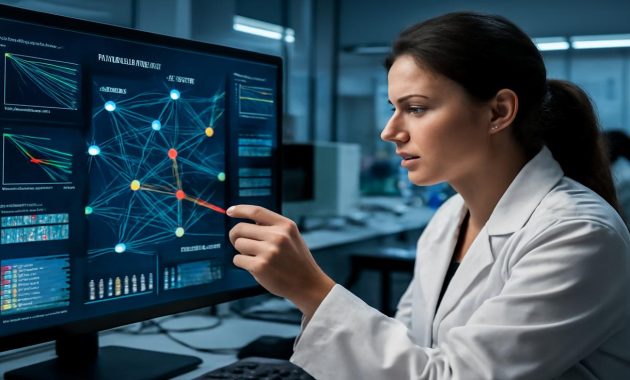
The first time the computer spoke up, the room went quiet. A dozen oncologists, biologists, and data scientists leaned toward a wall of screens filled with swirling data points—mutations, treatment histories, immune responses, even sleep patterns and exercise habits. On one monitor, a glowing line pulsed across a map of genes like a trail through a dark forest. The artificial intelligence system, trained on millions of data fragments from real patients, had just flagged something unexpected: not a miracle drug, not a secret herb, but a pattern—an invisible lever—buried in this chaos of information that seemed to tilt the odds of surviving cancer.
Listening to the Murmur of Cancer
For most of human history, we’ve confronted cancer like explorers lost in a dense fog. We could make out shapes—tumors, blood counts, images from a scan—but the deeper forces driving each case remained largely hidden. Two patients might share the same diagnosis, the same stage, even the same treatment, yet their paths would diverge in ways that felt almost arbitrary. One responded. One didn’t. One lived. One didn’t.
In the quiet corridors of research hospitals, this unpredictability became an ache. Doctors wanted to know why. They flipped through charts and stared at imaging scans, feeling there was a pattern just beyond human eyesight, like a faint murmur under the surface noise. Artificial intelligence, especially machine learning, is now listening for that murmur, turning the messy, sprawling reality of cancer into a landscape that can be navigated with more precision.
Modern AI doesn’t “think” like we do. It sifts. It sorts. It absorbs oceans of numbers—gene sequences, biopsy images, treatment timelines, environmental exposures, lifestyle patterns—and begins to notice the tiny ripples where one factor nudges another. In that ocean, it is searching for levers: small but powerful points of influence that, when pulled, might shift a person’s outcome.
The Forest of Data and the Search for Levers
Picture a forest at twilight. Every tree is a cell, every branch a possible mutation, every glimmer of light a response to treatment. For a long time, researchers had to walk through this forest with only a flashlight. They picked one path—one gene, one drug, one hypothesis—and followed it slowly, sometimes for years. AI arrives not with a bigger flashlight, but with the equivalent of a satellite map of the entire forest, updated in real time.
One of the most striking things researchers are learning is that cancer is not a single enemy, but an ecosystem. It evolves. It improvises. Tumors may look similar under a microscope, but their genetic fingerprints and metabolic behavior can be wildly different. Artificial intelligence excels at digesting that dizzying variety. Instead of asking, “Does this drug work for lung cancer?” we can ask, “For which kind of lung cancer, in which kind of body, at which moment in time, does this drug become a real lever?”
In specialized labs, AI systems pore over radiology images, learning to notice subtle patterns of blood flow and tissue texture that hint at how aggressive a tumor is. In genomic databases, other models comb through long lists of mutations, tracing their connections like a detective mapping a complex conspiracy. The goal is not to find one silver bullet, but to discover many small, well-placed switches we didn’t realize we could flip.
The Hidden Levers AI Is Bringing Into Focus
When researchers talk about “levers” against cancer, they mean any factor that can significantly change the trajectory of the disease: a drug combination, an immune trigger, a lifestyle shift, a timing decision. Artificial intelligence is starting to pull several of these into sharper focus.
Some of the most promising levers include:
- Precision drug targeting – Matching treatments not just to the tumor’s location, but to its unique molecular signature.
- Immune system activation – Predicting which patients will respond to immunotherapies and how to boost their effect.
- Earlier, subtler detection – Spotting cancers, or their precursors, before they become visible to the human eye.
- Metabolic vulnerabilities – Identifying how a tumor feeds and grows, then cutting off its energy supplies.
- Behavioral and environmental patterns – Revealing slow, cumulative forces like sleep, stress, pollution, and diet that push risk up or down.
When woven together, these levers don’t just alter treatment. They reshape the entire journey—from prevention, to detection, to therapy, to long-term survivorship.
Personalized Medicine: A Conversation Between Cells and Code
In one clinic, a woman sits across from her oncologist, the pale glow of a tablet screen reflecting in her eyes. A few years ago, she would have received the standard protocol for her breast cancer: surgery, a generic chemotherapy regimen, perhaps radiation. Now her tumor has been sequenced, its DNA translated into a digital language that an AI system can understand.
On the screen, the doctor shows her a simple chart: her cancer’s key mutations, matched against a library of treatments and outcomes gathered from thousands of patients like her. The AI has not issued a decree; it has drawn a map. Here are three combinations that, in similar patients, gave longer remissions. Here is one that carries a higher risk of toxic side effects, another that might leave her with more energy during treatment. These aren’t certainties, but probabilities—and probabilities, when you’re facing cancer, are powerful.
This is what people mean when they talk about “personalized medicine.” It sounds almost luxurious, but it’s really about specificity: tailoring the choice of drug, dose, and timing to the microscopic reality inside each person’s body. AI makes this possible by connecting patterns too complex for human minds to juggle alone. It can weigh thousands of variables—age, sex, gene variants, tumor subtype, prior illnesses, even medication interactions—and simulate the likely outcomes of different treatment paths.
In practical terms, this personalization becomes a set of levers. Perhaps a slightly lower dose of chemotherapy, when combined with a targeted drug revealed by the tumor’s mutation profile, gives nearly the same tumor control but far less damage to healthy cells. Perhaps delaying surgery by a few weeks to first shrink the tumor with a tailored drug combination leads to fewer complications and better long-term survival. AI is not replacing human judgment, but sharpening it, helping physicians pull the right lever at the right time.
How AI Is Quietly Changing the Daily Practice of Oncology
Though it can sound futuristic, much of AI’s influence is already seeping quietly into everyday cancer care. In radiology departments, image-analysis algorithms flag suspicious areas on mammograms and CT scans, not to override radiologists, but to ensure no tiny shadow goes unnoticed after a long day of reading images. In pathology labs, AI tools analyze digital slides of tissue samples, measuring patterns of cell shapes, densities, and colors that hint at how likely a tumor is to spread.
Behind the scenes, hospital databases are becoming treasure troves. Where we once saw only static patient records, AI now sees living histories: which combinations of drugs worked best in patients with certain molecular traits, which side effects tended to appear together, how small delays or dose adjustments impacted outcomes. This silent learning turns the experience of each patient into wisdom for the next.
Consider something as simple as scheduling. For some cancers, earlier chemotherapy or earlier surgery can have a measurable impact. AI tools, looking at vast numbers of cases, are beginning to suggest where time is a crucial lever—where a few weeks of delay are acceptable, and where they quietly erode survival odds. The insights don’t arrive as commands, but as risk scores, nudges, and probability curves that help doctors and patients choose more wisely.
New Eyes on Old Enemies: Detecting Cancer Before It Speaks
By the time many cancers are discovered, they have already been growing silently for years. The most effective lever, in those cases, would have been time itself: catching the tumor at its earliest whisper. Artificial intelligence is now helping us hear that whisper.
On a screen in a dim radiology suite, an AI model scans through low-dose CT images for lung cancer screening. To the human eye, the lungs may appear mostly unremarkable—faint contours of blood vessels, a small blur here or there. But the algorithm has been trained on hundreds of thousands of scans, each one labeled with what happened years later: who developed cancer, who did not, which early patterns foretold trouble.
Now, when it spots a cluster of pixels with a barely noticeable difference in texture, it raises a quiet flag. Not an alarm—just a suggestion: watch this. The radiologist zooms in and sees what might have gone unnoticed. A tiny nodule is entered into a follow-up schedule. Months or years later, that early glance may be the lever that made a lifesaving difference.
The pattern-detecting ability of AI doesn’t stop at imaging. Researchers are training models on blood tests that track fragments of tumor DNA, proteins, or other biomarkers floating in the bloodstream. These “liquid biopsies” are still developing, but AI can help distinguish random noise from meaningful signals—turning what looks like a chaotic soup of molecules into a coded message about cancer’s presence and behavior.
Table: Emerging AI Levers Across the Cancer Journey
| Stage of Journey | AI Role | Example Lever |
|---|---|---|
| Prevention & Risk | Analyze lifestyle, genetics, and environment | Personalized risk scores guiding screening frequency |
| Early Detection | Pattern recognition in images and blood | Flagging tiny lung nodules or subtle mammogram changes |
| Diagnosis | Classify tumor types and grades | Refining pathology reports with micro-pattern analysis |
| Treatment Planning | Match therapies to molecular profiles | Selecting targeted drugs based on mutation patterns |
| Follow-Up & Survivorship | Monitor for recurrence, manage late effects | Predicting relapse risk and tailoring surveillance intensity |
The Immune System: A Sleeping Giant Woken by Code
Perhaps the most dramatic scenes in this unfolding story of AI and cancer are happening in immunotherapy—a field that turns the body’s own defenses into weapons. The immune system is like a vast, ancient forest network, with signals moving invisibly from root to root. In some patients, immunotherapy drugs ignite a fierce response that melts tumors away. In others, they barely flicker.
Here again, AI is listening for patterns. It analyzes immune-cell populations, tumor microenvironments, and gene expression signals, looking for the signatures that predict a strong response. One patient’s tumor may be surrounded by immune cells that are simply exhausted, needing just the right nudge. Another’s may be cloaked in proteins that fool the immune system into ignoring it entirely. In each case, the most effective lever is different.
By parsing these subtle differences, AI helps scientists design smarter trials, reduce guesswork, and prioritize drug combinations that have the best chance of rousing the immune system where it’s most primed to act. Instead of testing endless permutations in the blind, researchers can focus on combinations that the data suggest will unlock powerful responses in specific subgroups of patients.
In some labs, AI is even being used to design new immune-stimulating molecules—tweaking their shapes and properties in virtual space before any chemical is ever mixed for real. Each simulated variation is tested in silico against countless virtual tumors, compressing years of slow trial and error into days or weeks of rapid iteration.
The Human Side of Algorithmic Hope
It’s easy to get swept up in the technical wonder of it all: the models, the data lakes, the millions of parameters humming away in distant servers. But at the heart of this transformation is something profoundly human: the hope that the next person walking into a cancer clinic will have a slightly better chance than the last.
This is where the tone of the conversation matters. Cancer patients are not datasets; they are people arriving with fear, with unfinished stories, with relationships and responsibilities and private dreams. When AI enters the room—through a tablet screen, a printed report, a doctor’s quiet explanation—it must do so in a way that deepens trust rather than erodes it.
Clinicians are learning to translate AI’s complex probabilities into plain, compassionate language. “This model suggests that for people like you, this combination tends to work better, but here are the trade-offs.” Transparency becomes a lever in itself: a way to empower patients with information without overwhelming them. When used thoughtfully, AI doesn’t replace the human bond between doctor and patient; it gives that bond more clarity, more options, and sometimes, more time.
The Limits, the Shadows, and the Road Ahead
For all its promise, AI is not a magic wand. Its power is bounded by the data it’s trained on, and those data often reflect the inequities of the real world. Many historical cancer datasets underrepresent certain groups—people of color, rural populations, those without consistent access to care. If not carefully addressed, AI can learn those gaps as blind spots. A lever that works beautifully in one group may be far less effective, or even harmful, in another.
There are also dangerous temptations: to trust algorithms too blindly, to mistake correlation for causation, to let models become black boxes that even their creators struggle to explain. In something as high-stakes as cancer, interpretability matters. Researchers are now building “explainable AI” tools that not only deliver predictions but also highlight the features and patterns they relied on. This allows physicians to challenge, refine, or override the suggestions when their clinical judgment demands it.
Despite these shadows, the direction is unmistakable. Every biopsy slide digitized, every genomic profile analyzed, every treatment outcome recorded and fed back into learning systems adds new threads to a growing web of insight. Step by step, AI is turning scattered, isolated experiences into a shared resource—a living atlas of what helps, what harms, and where the most promising levers truly lie.
Perhaps the most profound change is a psychological one. Instead of treating cancer as a monolithic enemy, we are starting to see it as a complex set of dynamic systems—systems that, while daunting, are not beyond understanding. Artificial intelligence doesn’t guarantee victory. But it gives us a richer map, more ways to intervene, and a better sense of where to press, when to wait, and how to adapt as the disease itself adapts.
One day, a child may look back at this era the way we look back at the time before antibiotics—amazed that we once fought such a formidable foe with so little precision. By then, the glowing lines on the screens may be as familiar to doctors as stethoscopes and blood-pressure cuffs are today. The forest of cancer will still be deep and intricate, but we will walk through it with a different kind of confidence, guided by the strange, tireless intelligence we’ve built to help us see what was always there: the hidden levers that, when pulled with care, can bend the arc of a life.
Frequently Asked Questions
Is artificial intelligence already being used in real cancer treatment?
Yes. AI is currently used in many hospitals and research centers to assist with image analysis (like mammograms and CT scans), refine pathology readings, help plan radiation treatments, and support decisions about which therapies might work best for certain tumor profiles. It rarely makes decisions on its own; instead, it acts as a tool that gives clinicians more detailed and timely information.
Does AI replace oncologists or other cancer specialists?
No. AI systems do not replace doctors; they support them. Cancer care involves complex decisions, emotional support, ethical considerations, and nuanced judgment that require human expertise and empathy. AI provides additional insights and pattern recognition, but clinicians remain responsible for interpreting that information and caring for patients as whole people.
How does AI “find” new levers against cancer?
AI analyzes large amounts of data—such as medical records, imaging, genomic sequences, and treatment outcomes—to detect patterns that are hard for humans to spot. These patterns may reveal, for example, which mutations respond best to which drugs, which combinations of treatments reduce side effects, or which early changes in scans hint at trouble. Each insight can become a lever: a specific factor that, adjusted correctly, improves outcomes.
Are there risks in using AI for cancer care?
Yes. If AI models are trained on biased or incomplete data, they may give less accurate or less helpful suggestions for certain groups of patients. There’s also a risk that people may over-trust or misinterpret AI outputs. This is why transparency, careful validation, diverse datasets, and close human oversight are essential whenever AI is involved in medical decisions.
What might cancer treatment look like in the future with AI?
If current trends continue, future cancer care is likely to be far more personalized and dynamic. Tumors may be regularly monitored through blood tests and imaging interpreted by AI, with treatments adjusted in near real time. Risk prediction could guide tailored screening and prevention strategies long before cancer appears. Rather than one-size-fits-all protocols, we may see evolving treatment plans guided by a constant dialogue between human clinicians, patient preferences, and intelligent systems that learn from every case.