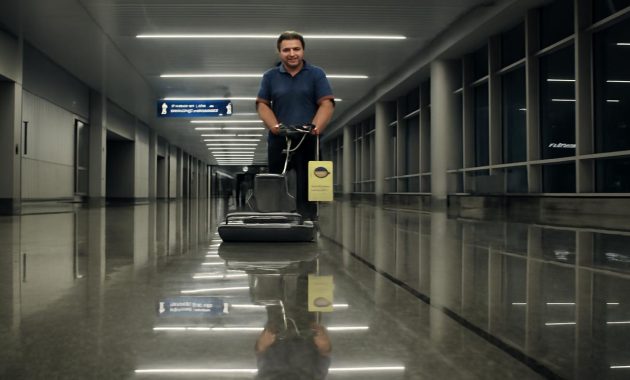
By the time most people notice an airport floor, it’s usually because something’s gone wrong—a sticky patch of spilled soda, a streak of mud, the faint drag of your suitcase wheels over a dull, tired shine. But walk into a terminal just after dawn, when the red-eye crowd has thinned and the sun is just beginning to glass the windows with light, and you might see something you’ve never really looked at before: a floor so glossy it seems to hold the reflections of planes, passengers, and coffee cups like a still pond. It looks like hours of work. It looks expensive. It looks… impossible. And yet, it often takes less than 30 seconds.
The quiet choreography before the crowds
You don’t see the beginning of the story, not really. By the time you rush through security, the work is already done. The concourse gleams, the restrooms look almost new, and the trash cans stand empty like they’ve never seen a boarding pass tossed carelessly inside. The people responsible for that unseen transformation move like background characters in someone else’s movie—fluorescent vests, rolling carts, a mop handle briefly catching the light before disappearing into a service closet.
One of those people is often someone like Luis.
Luis has worked the early shift at a mid-sized international airport for eight years. He arrives when the sky is still ink-dark and the automatic doors breathe out a cold, conditioned gust that smells faintly of jet fuel, coffee, and last night’s rain tracked in on rubber soles. He nods at the security officers, swipes his ID, and steps into a terminal that still carries the echo of yesterday.
“First thing I hear is wheels,” he says. “Suitcases. Even at three in the morning, there’s always someone moving.” Those wheels are his enemy and his muse. They grind in dust, leave curving trails of dullness on the waxed surface. Every cart, every stroller, every boot heel writes tiny stories into the floor—and his job is to erase them so cleanly that no one ever suspects they were there.
He used to dread the big stretches of concourse before the morning rush. “You mop, and it gets streaky. You buff, and it takes forever. People don’t care why it looks bad. They just see that it’s not perfect.” But that changed the day an older coworker handed him a small, unmarked bottle and said, “Try this on the high-traffic area. Thirty seconds. You’ll see.”
The little-known secret in a plain white bottle
If you went hunting for it on a store shelf, you’d probably walk right past it. The product airport cleaning staff quietly rely on for that quick, mirror-like shine isn’t dressed up in flashy branding or speckled with glittering promises. In many facilities, it sits in a plain container, sometimes with a handwritten label: spray buff. Other times, it’s called high-gloss restorer or simply floor finish rejuvenator.
Whatever name appears on the jug, the idea is the same: a thin, fast-drying restorative polish that wakes up a tired, scuffed finish in seconds instead of hours. It’s not a wax in the old-fashioned sense—not the kind you slather on thick and leave to haze. It’s more like a liquid reset button, a hybrid between cleaner and polish that quietly stitches the scratches and micro-scuffs back into a continuous, gleaming surface.
Luis remembers the first time he used it. “I thought it was a joke,” he admits. “This little bottle is going to fix weeks of traffic?” His coworker laughed. “Just don’t overdo it. Light spray. Then watch.”
He picked a patch of floor just outside a busy gate—where rolling bags had left pale, burnished arcs; where dried coffee splashes made faint, dark galaxies against the beige tile. He sprayed a fine mist, almost doubtful, then moved the buffing pad over it in a slow, overlapping pattern.
By the time he reached the far edge and turned around, the floor behind him had transformed. The old dullness was gone, replaced by a brightness that didn’t look fake or plastic, just… renewed. As the overhead lights hit it, the reflections sharpened like someone had just focused a camera.
“Thirty seconds,” his coworker said again, checking his watch. “Told you.”
What’s actually in this stuff?
To most cleaners, the product is just “the spray.” But inside that nondescript container is a quiet bit of chemistry. Typically, these airport-grade floor restorers are made from a mix of:
- Microscopic acrylic or polymer particles that flow into scuffs and tiny scratches
- Fast-evaporating solvents or water carriers so it dries quickly
- A touch of surfactant to lift light soil
- Gloss-boosting additives that catch and reflect light
Instead of stripping and rewaxing—a full-day ordeal that smells like a chemical storm and closes off entire corridors—this product acts like a spot healer for the floor’s current finish. It doesn’t replace the deep restorative work that has to happen every so often, but it makes that work needed far less often.
How 30 seconds really happens
The magic number—thirty seconds—doesn’t come out of nowhere. Watch an experienced airport cleaner in action, and you’ll see a small, practiced ritual that plays out like a fast, quiet dance across the tiles.
- The scout: They walk the concourse with their cart, eyes not on the passengers, but on the floor. They’re hunting for the dead zones—where the shine has flattened, where rubber has left grey ghosts, where last night’s storm left a faint road of dried footprints.
- The prep: A microfiber dust mop or vacuum skims over the surface first. This takes seconds but matters more than it looks; loose grit is the enemy of clean polish. Grind it in, and you’re making new scratches while trying to hide old ones.
- The mist: The product rarely floods the floor. Instead, it appears as a soft, almost invisible spray. Too much, and it gums up. Just right, and it vanishes almost as soon as it touches the tile, waiting to be spread into a thin, glassy film.
- The pass: A buffing machine or burnisher glides over the damp area. The sound is low, like a muffled hum. The pad presses the liquid into micro-scratches, levels it, then heats it just enough from friction to fuse and set.
- The reveal: The cleaner steps back. By the time a stroller or rolling carry-on passes over the spot, the floor is already dry. No “wet floor” signs needed for long stretches, no detours for sleepy travelers.
Done right, that whole sequence takes half a minute for a patch of floor large enough to cover several paces. It’s not a magic trick—it’s repetition, understanding, and timing. The staff measure their success not in compliments from passengers (they almost never get those), but in the absence of complaints. The floor is just… right.
Why airports, of all places, need this
Few buildings in modern life are as relentlessly used as airports. Think of it: thousands—sometimes tens of thousands—of people walk the same pathways every single day. They roll luggage, drag heels, spill lattes, drop crumbs, let their kids run barefoot after a long flight. And all of them are on a schedule that doesn’t care whether the wax is drying.
Traditional floor care schedules just don’t keep up with that pace. You can’t shut down a major corridor every evening to let a thick coat of finish cure in peace. You can’t ask a delayed flight’s worth of passengers to detour because the floor needs another hour. The building is always awake, always in motion, and the cleaning staff have to slip their work into the narrow gaps between footsteps.
The 30-second shine product became a kind of survival tool. It lets cleaners:
- Hit the worst spots quickly, instead of recleaning the entire floor
- Refresh the finish during small lulls in traffic
- Maintain a safe level of slip resistance while still delivering that glassy, confidence-boosting shine
- Stretch the time between deep-stripping and refinishing, saving money and chemical use
The result is a floor that looks like it’s been slowly and lovingly polished all night, when in reality, it’s been treated in fast, precise bursts, each one timed between boarding announcements and baggage claims.
The hidden craft in an overlooked job
There’s a particular kind of pride that grows in jobs no one talks about. For many airport cleaners, the floor is their signature, even if no one knows their name.
At 4:30 a.m., Luis sometimes pauses in the center of the concourse after a round of quick-restores. There’s a moment—a very brief one—where the overhead lights, still dimmed for early morning, cast clean lines along the tiles. They bounce off the surface in quiet streaks, refracted through the huge panes of glass that hold back the pre-dawn dark.
In those seconds, the floor mirrors the world: the silhouettes of early travelers slumped in their seats, an attendant adjusting a neck pillow display, a child trying to spin on the wheels of a carry-on. All of it floats across the gleam he just coaxed back from tired polymer and scarred finish. It’s not glamorous work. But it’s a kind of silent authorship.
Ask him what matters most in that little-known product, and he doesn’t say “shine” first. He says “trust.” Trust that the floor won’t be slippery when an elderly traveler steps off an escalator. Trust that it will dry fast enough not to soak the edges of a suitcase. Trust that, come sunrise, the airport will look like a place you can rely on.
Numbers that tell a quiet story
For facility managers, the appeal of these fast-shine restorers isn’t just emotional—it’s intensely practical. Across many airports and large public spaces, internal comparisons often look something like this:
| Care Method | Time per 100 sq ft | Typical Disruption | Shine Longevity* |
|---|---|---|---|
| Traditional strip & wax | 30–45 minutes | Area closed for hours | 4–6 months |
| Standard mopping & buffing | 8–12 minutes | Partial disruption | Days to weeks |
| Spray-buff restorer | 0.5–1 minute | Minimal, often none | Weeks, with touch-ups |
*Approximate and varies by traffic and maintenance routine.
The numbers aren’t glamorous either, but they are persuasive. Less disruption. Less labor. Less chemical waste. And, paradoxically, more of that feeling travelers subconsciously register as “this place is clean, and I’m safe here.”
Can you use the same trick at home?
When people hear about this kind of product, their next question tends to be quick: “Can I get something like that for my house?” The honest answer: sort of, but you need to be choosy.
True commercial-grade spray-buff or high-gloss restorers are designed for hard, durable, often waxed floors—think vinyl composition tile (VCT), terrazzo, and some sealed stone or concrete finishes. They’re meant to be used with machines, high-speed pads, and teams who understand slip-resistance regulations.
For a typical home, milder cousins exist under names like “floor polish,” “finish restorer,” or “gloss refresher” for sealed wood, laminate, and vinyl. They work on a similar idea: fill in micro-scratches, revive a dulled surface, dry quickly. Used sparingly and according to directions, they can also pull a bit of that airport-style magic on your kitchen or hallway.
But there’s a caution whispered in every janitor’s closet: more is not better. Overuse or layering the wrong product on the wrong floor can create build-up, haziness, or slippery patches. The airport staff’s secret isn’t just what they use—it’s how lightly, precisely, and professionally they use it.
Luis puts it simply: “We don’t make the floor shiny by drowning it. We make it shiny by respecting it.”
Seeing the invisible work
Next time you’re hustling through a terminal, eyelids heavy, boarding pass glowing on your phone, try this: slow your gaze to the floor for a moment. Look at the way the overhead fixtures draw pale lines along the tile. Notice how the reflections stay firm and clean, even where hundreds of feet have passed in the last few minutes.
Somewhere, maybe just out of view, someone in a uniform pushed a cart down that same stretch not long ago. They scanned, sprayed a thin veil of an almost anonymous product, and passed a humming machine over it. Thirty seconds. Maybe less. Then they moved on, already looking ahead to the next scuffed patch, the next quiet repair.
The floor you’re walking on is not an accident. It’s a series of tiny, nearly invisible decisions made by people whose names you’ll never learn. The little-known bottle in their hands is just one tool in a much larger craft: the art of making a place feel cared for.
You may forget the details of a flight—the number, the gate, even the airline. But your body remembers how a space felt beneath your feet. Airport cleaning staff know that better than most. They aren’t just polishing stone or vinyl; they’re maintaining the stage on which thousands of journeys begin and end, one 30-second shine at a time.
FAQ
What is the “little-known” product airport cleaners use for fast shine?
Most airports use a spray-buff or high-gloss floor restorer—a thin, fast-drying liquid that fills in micro-scratches and revives the existing floor finish in seconds rather than hours. It’s a professional maintenance product, not a simple household cleaner.
Does this product make floors dangerously slippery?
When used correctly on the right type of floor, these restorers are designed to maintain acceptable slip-resistance. Airport teams test and monitor their products carefully because safety regulations are strict. Over-application, however, can cause problems, which is why training and light use are critical.
Can I buy the same floor restorer airports use?
Similar products are sold through janitorial and commercial supply channels rather than typical grocery stores. While homeowners can sometimes purchase them, it’s important to match the product to your specific floor type and follow instructions closely to avoid build-up or damage.
Will this kind of product fix deep scratches or damaged floors?
No. Spray-buff and gloss restorers are meant for light to moderate surface wear—dullness, fine scuffs, and micro-scratches. Deep gouges, peeling finishes, or badly worn floors still require more intensive work like stripping, sanding, or full refinishing.
How often do airports use these quick-shine products?
Frequency varies with traffic and the airport’s maintenance schedule. High-traffic zones near gates, restrooms, and food courts might get quick touch-ups daily or several times a week, while lower-traffic areas need them far less often. The idea is targeted, efficient care—not constant reapplication.
Is this better for the environment than traditional stripping and waxing?
Used wisely, yes. Quick-restorer products allow facilities to extend the time between heavy strip-and-refinish cycles, which use more chemicals, water, and energy. Less frequent deep restoration can translate into a smaller environmental footprint, though responsible product choice and proper disposal still matter.
Why do airport floors look so shiny even with constant foot traffic?
It’s a combination of things: durable floor materials, well-planned maintenance schedules, daily cleaning, and the strategic use of fast-acting floor restorers. Behind that steady shine is a team that moves mostly unseen, timing their work between the passenger tides and relying on products that can deliver a visible result in under 30 seconds.