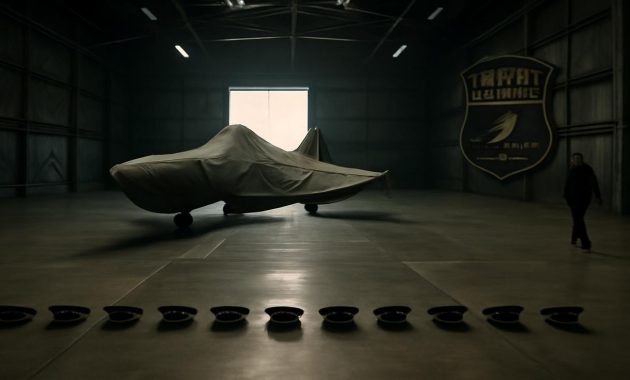
The hangar doors groan open just before sunrise, and a soft blue light spills across the concrete like water. The air smells of jet fuel and damp grass; somewhere beyond the runway a lone seriemas calls, its ragged cry cutting through the morning stillness. For years, this was the hour that defined them—eleven men and women in crisp flight suits, boots laced to perfection, hearts humming in rhythm with turbines spooling up. They had memorized the choreography of takeoff and landing, of formation turns and emergency drills, of service before self. And then, almost all at once, they began to walk away.
The Day the Hangar Fell Silent
In the living memory of many, the Brazilian Air Force has been a constant presence: streaks of smoke across the Independence Day sky, the distant thunder of engines over small towns, the calm authority of uniformed officers at airports and disaster zones. Inside the institution, however, another story has been quietly unfolding—a story of fatigue, temptation, and a private market whose siren call has become impossible to ignore.
It did not happen with a dramatic press conference or a televised ceremony. It happened through signatures: eleven senior officers, all of them forged by long years of military training, discipline, and sacrifice, submitting their resignations almost in sequence. Paper, ink, and a decision that would ripple from briefing rooms to flight lines. Among them was one pilot from the legendary Esquadrilha da Fumaça—the Smoke Squadron—the pride of Brazilian aerial acrobatics and a living symbol of national skill in the sky.
When that resignation crossed the commander’s desk, several officers remember the room growing very quiet. The Smoke Squadron is not just a job; it is the dream job, the apex of a career that often begins with a teenage cadet staring up at the belly of an airplane and thinking, “One day, that will be me.” To leave that behind is not a trivial choice. Yet the world beyond the base had changed faster than the world inside it. And change has a way of eroding even the strongest of vows.
Outside the perimeter fences, private aviation and defense companies were hiring. Not discreetly, not cautiously—but aggressively, openly, with salary offers that made seasoned officers rub their eyes and read the numbers twice. R$ 25,000 a month or more, sometimes far more when benefits and bonuses were added, for professionals trained at public expense, polished by military rigor, and now ready to bring that experience into a world where time is money and loyalty is measured in contracts.
From Cadet Dreams to Career Dilemmas
To understand what it means for eleven senior officers to resign almost at once, you have to go back to the beginning—back to when they were cadets, hair cropped short, boots too stiff, and eyes bright with possibility. The Air Force Academy is not a place one drifts into. It is a choice that begins with competitive exams, grueling physical tests, and an emotional bargain: give us your youth, your discipline, your holidays, and in return we give you a uniform, a mission, and a runway to call your own.
The training is long and unforgiving. Dawn runs with breath turning to white mist in winter air. Nights spent over maps and manuals, learning not just how to fly but how to think like an officer, how to command, how to remain calm when alarms are blaring and instruments are misbehaving. Friendships are forged like steel in those years—shared aches, shared failures, shared victories.
For a pilot destined for the Smoke Squadron, the journey is even more arduous. Selection is brutal because the job is unforgiving: formation flying with wings only meters apart, high-G maneuvers that bend the body and tax the mind, precision so sharp that even a small error would be visible to tens of thousands of spectators staring up with smartphones and wide eyes. These pilots become, in a sense, aerial artists. The sky is their canvas, and colored smoke their brush.
Many of the officers who resigned had spent the better part of their adult lives in this environment. They had missed family birthdays, postponed marriages, moved from city to city, lived with one ear always tuned to the phone in case the base called. This is the quiet cost of the uniform—one not always visible to the public watching a flawless airshow from below.
The Siren Call of the Private Market
Then, over the last decade, something shifted outside the bases. The growth of executive aviation, offshore operations, air taxi services, drone technology, and private defense contracts created a hunger for experienced, disciplined professionals. And there, just beyond the gate, was a ready-made talent pool: Air Force officers with thousands of flight hours and a reputation for reliability under pressure.
The offers started as rumors. A friend of a friend who’d left to fly corporate jets and now posted vacation photos from dream destinations. A former captain now working with a foreign aerospace company, boasting of flexible hours and a paycheck that made planning for the future less of a guessing game and more of a spreadsheet. Slowly, the rumors turned into e-mails, meetings, and phone calls.
It’s easy to imagine the inner conflict of a senior officer sitting at the kitchen table late at night, family asleep in nearby rooms, a contract on the laptop screen. R$ 25,000 or more per month. Health insurance that covers the kids’ braces with no drama. A clear promotion ladder—or at least the freedom to negotiate roles instead of waiting for them to be assigned. Perhaps a chance to live in one city for more than a handful of years.
Money, of course, is never the only factor. But it is the factor that quietly adjusts everything else. It determines whether a family can buy an apartment instead of renting indefinitely, whether a child can attend a certain school, whether caring for aging parents means sacrifice or simply planning. It is the background hum of anxiety—or its absence.
| Aspect | Military Career | Private Market |
|---|---|---|
| Monthly Salary (Senior Officer) | Often below R$ 25,000, with gradual increases | Starting offers at or above R$ 25,000 |
| Career Flexibility | Defined hierarchy, fixed pathways, frequent transfers | Negotiable roles, possibility of remote or stable location |
| Work-Life Balance | On-call duties, operational missions, irregular schedules | More predictable hours, customizable schedules in some sectors |
| Sense of Mission | High; service to country and public | Variable; focused on business and client needs |
| Job Security | Stable while in service, but with institutional constraints | Linked to market cycles and company performance |
The table is cold, rational, two-dimensional. Life, of course, is not. The decision to leave the military is not a mathematical equation; it is a slow-burning emotional process that involves identity, loyalty, fear, hope, and the stubborn human desire to feel that one’s sacrifices are recognized—if not in medals, then at least in the ability to live with dignity.
The Smoke Squadron Without One of Its Own
The Smoke Squadron has a particular weight in this story because it occupies such a vivid space in the Brazilian imagination. Anyone who has stood downtown on a national holiday and tilted their head back to watch those blue, green, and yellow trails crisscross the sky knows the sudden hush that falls over a crowd when the planes appear. Children stop fidgeting. Adults forget their conversations. For a few seconds, all eyes trace the same line of color across the firmament.
Inside the cockpit, however, the view is different—and not just because the earth is upside down half the time. The pilots are acutely aware that they are not only performing for the crowd; they are embodying an ideal. To wear the Smoke Squadron patch is to carry on your shoulders decades of tradition, countless hours of training, and the hopes of cadets watching from below and dreaming of someday joining you.
So when one of those pilots chooses to resign, the gesture is louder than the roar of the engines. It sends a quiet tremor through the ranks: if even the “privileged” elite of the Air Force, those who have reached the apparent pinnacle of a flying career, are stepping away, what does that say about the pressures building beneath the polished surface of the institution?
Within the squadron, empty rooms tell the story. A locker with its nameplate removed. A helmet bag taken home for the last time. A call sign that will no longer ring out over the radio during rehearsals. The remaining pilots keep flying, because that is what they do, but they do it with one formation slot now filled by someone newer, less seasoned, maybe a little more wide-eyed—and silently calculating how long they will stay.
What a Resignation Really Feels Like
From a distance, “eleven senior officers resign” sounds like an administrative note, the kind of line that appears in internal bulletins or legislative hearings. Up close, however, each resignation is a story with its own taste and temperature: the knot in the stomach before telling the commander, the carefully chosen words at home around the dinner table, the mix of relief and grief while folding the uniform one last time.
Many officers will never speak publicly about these moments; discretion is another habit learned in uniform. But you can almost hear the inner dialogue of someone weighing ten, fifteen, twenty years of service against the next twenty years of life: If I stay, what does my future look like? If I leave, what part of me do I lose?
There is also a subtle loneliness in the decision, even when done in a wave. The military is more than an employer—it is a tribe, a culture with its own language, rituals, and humor. To step out of that is to walk into a world where your rank means nothing, your medals are simply shiny curiosities, and your meticulous salute is just an oddly crisp way of saying hello.
And yet, for the eleven who left, the pull towards another kind of life overcame the fear of that unknown. Some were driven primarily by finances. Others by the desire for geographic stability, for seeing their kids grow up without constantly packing boxes for the next transfer. A few, perhaps, were moved by a quieter frustration: the sense that their expertise could be valued differently, more dynamically, elsewhere.
A Signal the Institution Cannot Ignore
Every organization loses people; attrition is as natural as gravity. What turns heads is not the fact of departure, but the pattern. When seasoned, highly trained officers in visible positions begin to leave in noticeable numbers, it becomes harder to frame it as coincidence or mere personal preference.
The Air Force, like any military branch, exists in a tension between tradition and adaptation. On one hand, stability, hierarchy, and a certain conservatism of structure are what keep planes flying and missions coherent. On the other hand, the world beyond the runway is moving at high speed. New technologies, new forms of war and peace, new generations with different expectations about work and life—these forces press against the base walls, even if you cannot see them.
The resignations of these eleven officers, including the Smoke Squadron pilot, function as a flare in the night sky. They illuminate questions that cannot be permanently ignored: How competitive are military salaries in an age where specialized skills are aggressively courted by the private sector? How sustainable is a career model that demands so much mobility and sacrifice, while younger professionals increasingly prioritize flexibility and mental health? How does an institution known for its discipline learn to negotiate with a market that is, by nature, fluid and opportunistic?
This is not simply about paying more—though that is part of it. It is about imagining new forms of career progression, recognizing expertise sooner, offering paths that allow officers to update skills and find roles that make sense for different stages of life. It is also about something deeper and harder to quantify: making sure that those who stay feel that they are not doing so out of resignation, but out of a genuine belief that the balance between sacrifice and recognition is worth it.
Between Sky and Ground: The Future at Stake
Stand at the perimeter fence of an air base at dusk and watch the last training flights coming in. The runway lights are a string of orange beads in the growing dark. Each landing is a small miracle of physics and trust—trust in the machine, in the crew, in the institution that trained you. For decades, that trust has been one of the Air Force’s greatest assets. With every high-profile resignation, however, a small crack appears in that invisible runway.
The issue is not only symbolic. Training a senior officer or an acrobatic pilot is expensive and time-consuming. When such a professional leaves, they take with them not merely their own capacity, but also their ability to mentor, to teach the shortcuts and cautionary tales that do not fit neatly into manuals. The gap they leave behind is not filled overnight; it is filled with time, with new trainees, with a learning curve that can be unforgiving.
On the other side of the fence, private companies rub their hands with a mixture of excitement and relief. They do not have to invest in basic training; the state has done that for them. They can swoop in with attractive offers and acquire talent already tempered by long nights in simulators and real missions that required calm minds and steady hands. For them, the presence of a former senior officer on the team is a competitive edge, a badge of seriousness and reliability.
There is no villain in this story—only forces pulling in different directions. Officers are not traitors for wanting a more secure or better-paid life. The Air Force is not a villain for struggling to respond at state-budget speed to private-market dynamics. Companies are not evil for seeking the best people they can find. But somewhere in the middle, between the roaring takeoff and the quiet signing of resignation papers, lies a national question: how does a society value those it has trained to protect its skies, once the time comes for them to choose what to do with the rest of their lives?
Perhaps the answer will emerge slowly, as institutions adjust, as policies are debated in rooms far from the runway’s glow. Perhaps it will emerge through new hybrid models—reserves, flexible contracts, temporary returns to service—that blur the line between military and civilian careers. Or perhaps it will emerge from voices inside the hangars themselves, younger officers who have watched this wave of resignations and are quietly deciding what they want their own paths to look like.
For now, the fact remains: eleven senior officers have walked out through the gate in their last official day, one of them leaving a Smoke Squadron patch folded neatly in a drawer. Above them, the sky remains just as wide, just as blue, just as full of possibilities and risks. Whether they continue to cut through it in uniform or in civilian livery, one thing has not changed: every time an aircraft lifts off, it carries with it a story of ambition, sacrifice, and the constant negotiation between duty and desire.
Frequently Asked Questions
Why are senior Air Force officers resigning now?
A combination of factors is at play: more attractive private-sector salaries (often above R$ 25,000), a desire for geographic and family stability, and evolving expectations about work-life balance. These issues have been building for years and are now becoming visible through concrete decisions.
Is the private market really paying that much more?
In many cases, yes. Experienced pilots, engineers, and officers with leadership backgrounds can receive offers that match or exceed R$ 25,000 per month, especially in sectors like executive aviation, offshore operations, and aerospace industries.
What makes the resignation of a Smoke Squadron pilot so symbolic?
The Smoke Squadron represents the elite of the Air Force’s flying community and is deeply rooted in national pride. When even one of its pilots chooses to leave, it signals that the pressures and incentives affecting the broader force are strong enough to reach its most prestigious units.
Does this wave of resignations threaten operational safety?
Not immediately. Military institutions are designed with redundancy and continuous training. However, the loss of highly experienced officers can create medium and long-term challenges, especially in mentoring new generations and maintaining specialized capabilities at peak level.
What could be done to retain more officers?
Possible measures include reviewing salary structures, offering more flexible career paths, creating incentives for staying in critical positions, and modernizing policies related to transfers and family support. Retention is not just about money; it is also about recognition, stability, and meaningful professional growth.