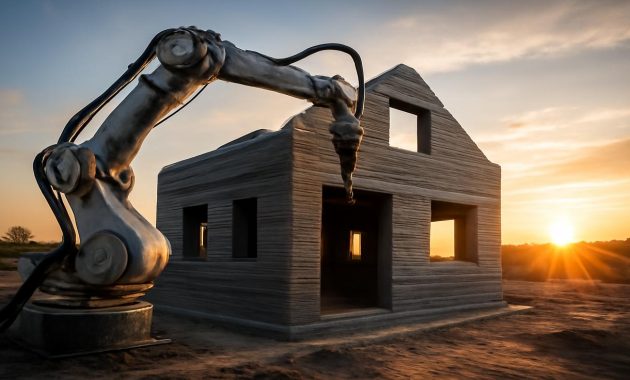
The first sound is a low mechanical hum, somewhere between a cat’s purr and distant thunder. It rises in the half-light before dawn, at the edge of a dusty field where, just yesterday, there was nothing but scrub and rocks. Now, under a pale sky, a machine about the size of a delivery van extends its arm and begins to draw the outline of a house directly onto the earth—only instead of ink, it prints walls. Within minutes, the smell of fresh, wet mortar mixes with the cool morning air. By the time the sun is high, the skeleton of a 200 m² home is already standing, its curves precise, its corners clean, its walls lifted from the ground in steady, looping ribbons.
The Day a Robot Became a Builder
For most of human history, building a house has been slow, sweaty, profoundly human work. You’d hear the clink of hammers, the scrape of shovels, the chorus of shouted instructions. Weeks became months as walls crept upward, plank by plank, brick by brick. But this morning scene—one compact robot, one empty lot, one full-size home in less than 24 hours—is something different. It feels, in the quiet, like the future arriving without asking permission.
The robot doesn’t stop to rest or sip coffee. Its articulated arm glides along a pre-programmed path, extruding a thick, paste-like building material—often a blend of cement, sand, water, and special additives—layer upon layer. A continuous bead of material forms a wall that looks almost like coiled pottery, each ring stacked on the last. Lintels for windows and doors appear like frames in a slow-motion animation. As the machine moves, the air fills with the murmur of pumps and the soft shush of material landing precisely where it was told to go.
Imagine standing there watching: in the morning there is only a slab, bare and unremarkable. By afternoon, you can walk through doorways that didn’t exist at sunrise. You can pass your hand over a window ledge that was air just hours ago. And by the following dawn, you can stand in the center of a finished shell of a home big enough for a family of four or five. Four walls, multiple rooms, curved edges, sometimes even built-in benches or shelves—summoned into being by a digital blueprint and a machine that never gets tired.
The 24-Hour Home: How It Actually Works
Behind the quiet poetry of those rising walls is a surprisingly simple idea: treat a house like something you can “print.” Instead of a desktop printer feeding paper, you have a large-scale robotic system feeding a concrete-like mix. Instead of lines of ink, you have paths of structural material defined by software. That’s the core of robotic, or 3D-printed, construction.
The process usually begins days before the machine rolls out onto the site. Architects and engineers design the home in specialized 3D software, carving out where every wall, doorway, and cutout will go. They decide the thickness of each layer, the pattern that will provide strength, and the exact paths the robot will follow. The resulting digital file becomes the robot’s instruction manual: a script it will follow with millimeter precision, again and again.
On-site, a small team—sometimes as few as three or four people—prepares the foundation, checks the site level, and positions the printer. Instead of dozens of laborers, scaffolding, and pallet after pallet of bricks, you have one central machine and large hoses feeding it the building mix from nearby mixers. Once everything is calibrated, someone taps a screen, and the robot begins its work.
The material it extrudes is designed to be just right: wet enough to flow, but stiff enough to hold shape the moment it lands. Think of squeezing thick frosting onto a cake, only this frosting hardens into stone. Each new layer bonds chemically with the one beneath it, creating a strong, cohesive wall. The robot moves steadily along its path, guided by sensors and sometimes even real-time feedback systems that adjust for small irregularities in the ground or weather conditions.
What’s startling isn’t just the speed, but the consistency. There’s no guessing if a bricklayer is having an off day, no crooked courses, no forgotten measurements. The wall that emerges is exactly the wall that was drawn on the screen. At the end of 24 hours, the structural shell of a 200 m² home stands finished. Traditional follow-up work—installing roofs, windows, doors, plumbing, and electrical systems—still needs people. But the slowest, heaviest part of the build, the part that usually eats up the most time and money, has been transformed into an overnight job.
The Numbers Behind the Breakthrough
In a world where housing shortages are measured in millions of units, numbers matter. A 200 m² home built by conventional methods can take months: excavation, foundations, walls, roofing, finishing. Delays ripple through the process—bad weather, supply issues, labor shortages, permitting bottlenecks. By contrast, a system that can construct the full structural envelope of a 200 m² home in just 24 hours doesn’t just save time. It rewrites the arithmetic of shelter.
To get a feel for what’s changing, consider the comparison below:
| Aspect | Traditional Build (Approx.) |
Robotic / 3D-Printed Build (Approx.) |
|---|---|---|
| Time for Structural Shell (200 m²) | 8–12 weeks | ≈ 24 hours |
| On-Site Labor Crew | 15–30 workers | 3–6 operators/technicians |
| Material Waste | High (off-cuts, breakage) | Low (precise deposition) |
| Design Flexibility | Costs increase with complexity | Complex curves at similar cost |
| Estimated Shell Cost | Higher (labor-intensive) | Potentially 20–40% lower |
These figures vary by region and project, but the trend is clear. Instead of incremental improvement, we are looking at an order-of-magnitude shift for one of the most stubborn bottlenecks in the housing pipeline: getting solid walls up, fast and affordably.
It also changes something subtler: the rhythm of building. Instead of long schedules and sprawling logistical plans, we start to think of homes in batches, printed in small neighborhoods, row after row. Entire blocks could go from dirt to livable shells in weeks instead of years. In cities struggling with ballooning rents and sprawling informal settlements, that difference feels less like a technological gimmick and more like a lifeline.
Why This Matters for the Housing Crisis
Walk through almost any major city and you can sense it: the tension in the rental listings taped to café windows, the queues at housing offices, the invisible lines between those who can afford a stable home and those who can’t. The global housing crisis isn’t one problem; it’s a knot of many—rapid urbanization, land scarcity, financial speculation, and the blunt reality that building safe, durable homes has just been too slow and too expensive.
Robotic construction won’t fix all of that. But it targets one crucial lever: the cost and speed of creating physical structure. If the structural shell of a home can be finished in a single day, several outcomes become possible:
- Developers can deliver more units in less time without multiplying labor forces.
- Nonprofits, municipalities, and social housing agencies can stretch limited budgets further.
- Reconstruction after disasters—earthquakes, floods, storms—can move from years-long marathons to focused, rapid responses.
In regions where informal settlements sprawl for kilometers—shacks of thin metal, tarps, and scrap wood—imagine being able to deploy a few robotic printers and, in a single season, replace hundreds of precarious dwellings with solid, weather-resistant homes. The walls of these printed houses can be designed for thermal comfort, with cavities for insulation or integrated channels for wiring and plumbing. They can be shaped to withstand local winds and flooding patterns. They can even be adapted for multi-story construction as the technology matures.
This doesn’t make land cheaper. It doesn’t untangle zoning laws. But when you strip 20–40% of the cost and months of time out of the core construction phase, many projects that once seemed marginal or impossible suddenly become viable. It lowers the threshold for saying yes to housing rather than no.
What It Feels Like to Live in a Printed Home
Step inside one of these houses once the dust has literally settled and the trades have come and gone—electricians wiring, plumbers connecting, carpenters fitting doors and cabinets—and what you notice first is how strangely organic it feels. The walls might curve gently instead of meeting in sharp, 90-degree angles. Window seats might grow directly out of the structure, as if carved from stone. Light brushes across the layered texture of the printed walls, catching shadows in the horizontal lines like ripples in sand left by the tide.
There’s a softness to the acoustics; sound doesn’t bounce quite as sharply as in bare concrete boxes. The air holds a faint mineral scent, something like rain on warm pavement, fading as the house dries and breathes. In summer, the thick walls store coolness; in winter, they hold precious heat. The house feels at once futuristic and almost ancient, like a cave shaped by algorithms.
For the families who move into such a home, the marvel of how it was made fades quickly into the more immediate reality of having a front door that locks, a solid roof over their heads, and perhaps for the first time, a space that is reliably theirs. Children don’t care that a robot extruded the walls; they care that their room stays dry in a storm. Parents don’t marvel at parametric design; they marvel at a kitchen that doesn’t flood every rainy season.
Psychologically, though, there’s something powerful in knowing that your house wasn’t built through exhausting, back-breaking labor that someone else endured for months, but through a system that minimized human strain and waste. There is a sense of living in proof that the way we’ve “always done it” is not the way we have to keep doing it forever.
But What About the Jobs?
Whenever a robot steps onto a site that once belonged entirely to people, a question hangs in the air: who loses work? Construction has long been a source of income for millions around the world, from skilled tradespeople to day laborers. Replacing crews of bricklayers with a handful of machine operators seems, at first glance, like inviting unemployment.
The reality is more nuanced, and it begins with an uncomfortable truth: in many regions, there aren’t enough skilled construction workers to meet housing demand as it is. Building has been getting slower, not faster, because companies struggle to fill positions. Younger generations, in many places, are less eager to take on heavy manual labor. Aging workforces and safety concerns further strain capacity.
Robotic construction shifts the types of jobs required rather than eliminating the need for human involvement altogether. The walls may be printed, but:
- Foundations still need to be prepared and poured.
- Roofs must be built, trusses installed, tiles or metal sheets laid.
- Electrical, plumbing, heating, and ventilation systems are still highly human, skilled tasks.
- Interior finishes—flooring, fixtures, cabinets, painting—remain craft-rich work.
New roles also appear: operating and maintaining the printers, developing custom materials, writing and optimizing print designs, training crews and overseeing fleets of machines. The muscle memory of a veteran mason doesn’t become useless; it can inform how we design structural paths and details for new printed forms. Apprenticeship might shift from “how to lay the perfect brick” to “how to program the perfect wall,” but the underlying knowledge of load paths, moisture, and weathering remains invaluable.
The crucial question for societies is whether they will invest in retraining and education, ensuring that construction workers of today can become the supervisors, technicians, and foremen of tomorrow’s robotic job sites. Without that, the risk of displacement is real. With it, robotic construction can become less a job-killer and more a back-saver—removing some of the most dangerous, repetitive tasks while keeping people at the center of building and design.
Limits, Questions, and the Road Ahead
It’s tempting to declare that a robot that can print a 200 m² home in 24 hours has “solved” housing. It hasn’t. Technology rarely sweeps away the messy human realities of politics, economics, and culture. Instead, it hands us new tools and asks: what will you do with these?
There are real limits and open questions. Building codes in many regions weren’t written with printed walls in mind. Inspectors must learn how to evaluate these structures, how to test their fire resistance, their durability, their performance over decades. Insurance companies need data on how they weather storms and earthquakes, how they age in heat and humidity. Neighbors and future inhabitants must be brought into the conversation: do these houses fit their needs, their aesthetics, their traditions?
Material sustainability is another frontier. Many current systems rely heavily on cement, which has a significant environmental footprint. Research is racing to develop lower-carbon mixes, incorporating recycled aggregates, industrial byproducts, or even earth-based materials that can be printed. The dream is not just fast housing, but fast, low-carbon, locally sourced housing.
Then there’s equity. Who will benefit first from this technology? Luxury experiments for the few, or robust shelter for the many? Robotic printers could just as easily build custom villas as they could mass-produce affordable homes. The outcome will depend less on the machines themselves and more on the policies, incentives, and public imagination that shape their use.
Still, if you return to that quiet field at dawn, to the sight of a machine methodically sketching a family’s future into the air, it’s hard not to feel a tremor of possibility. The hum of the pumps, the steady motion of the arm, the walls rising with each pass—these are not just sounds of efficiency. They are the early notes of a new way of thinking about shelter: as something that can be dignified, fast, customized, and accessible.
The path from prototype to normality is never straight. But one thing is certain: the idea that a full-sized, 200 m² home can be raised from foundation to structural completion in a single day has slipped from science fiction into the dust and sunlight of real construction sites. It puts a new card on the table in our struggle with the housing crisis. Whether we play it wisely is up to us.
FAQ
Are 3D-printed homes as strong as traditional houses?
Properly designed and built 3D-printed homes can meet or exceed the strength of many traditional masonry structures. The printed walls are engineered for load-bearing capacity, and the materials are tested for compressive strength and durability. As with any building system, quality of design, materials, and oversight is critical.
Can these robotic systems build multi-story houses?
Yes, in some cases. While many current projects focus on single-story homes, research and pilot builds have shown that multi-story 3D-printed structures are possible, often with added reinforcement and careful engineering. As the technology matures, taller and more complex buildings are likely to become more common.
How much cheaper is a 3D-printed home?
Cost savings vary by region and design, but the structural shell of a 3D-printed home can often be 20–40% cheaper than conventional methods, mainly due to reduced labor and material waste. Total project savings may be smaller once finishing work is included, but they can still be significant, especially at scale.
Are these homes environmentally friendly?
They can be more sustainable than traditional builds because they minimize waste and can optimize material use. However, many current systems rely on cement-heavy mixes, which have a high carbon footprint. Ongoing research into greener materials—such as low-clinker cements, recycled aggregates, or printable earth-based mixes—aims to improve their environmental performance.
When will 3D-printed homes be common in most cities?
Adoption depends on local building codes, market demand, and investment. Some regions are already piloting small neighborhoods and social housing projects. Widespread use may take 5–15 years, as regulations adapt, technology becomes more standardized, and builders gain experience and confidence with these methods.