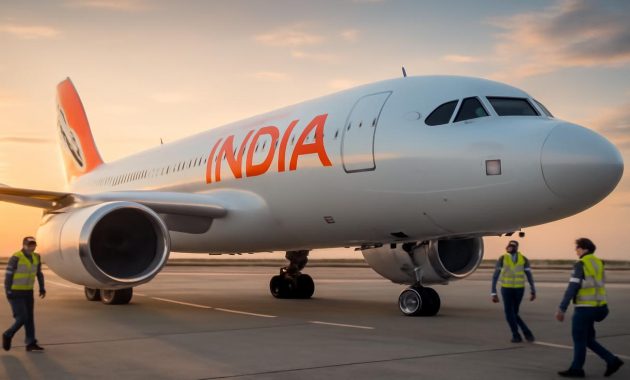
The first time you hear it, you almost mistake it for thunder. A low, rising growl rolling over the coconut trees on the outskirts of Nagpur, building into a clear, metallic roar. People in the surrounding villages pause mid-conversation, squinting into the afternoon haze. A boy drops his bicycle, an old farmer shades his eyes, and someone, half-joking and half-awed, says, “New plane aa gaya hoga.” A new plane must have come.
Only this time, it’s not a Boeing. It’s not an Airbus. It’s not even Chinese.
The shimmering silhouette banking into the sun is something India has never truly had before: a home-grown, large passenger jet, stitched together by thousands of engineers, technicians, and dreamers who decided that a country of 1.4 billion people—with some of the world’s busiest domestic air routes—should not always sit in the cabin, but finally step into the cockpit of global aviation.
The day the hangar doors opened
Imagine a dawn where the fog on a test runway is tinged with the smell of kerosene and fresh paint. A hangar door, taller than a five-story building, grinds open. Inside, a white fuselage gleams under halogen lamps, its tailfin painted with a bold tricolor slash that seems to be in motion even when the aircraft is still.
On its nose, in clean blue lettering, is a name the world has barely begun to pronounce, let alone recognize as a rival to America’s Boeing, Europe’s Airbus, or China’s COMAC. Ground crews in neon vests murmur quietly in Hindi, Marathi, Kannada, and English, surrounded by scaffolding, laptops on rolling carts, and spools of colored cables like vines on the concrete floor.
The aircraft smells new—like warm plastic, oil, sealant, and the faint metallic tang of worked aluminum and composite. The cockpit is lit up like a festival: screens glowing turquoise and amber, rows of soft-lit buttons, sidesticks, throttles, and a view on to a runway that might as well be a river of possibility. Somewhere, a senior engineer leans against a wing strut for a second longer than necessary, just to feel the cool skin of the jet under her palm. Years of late nights, scrutiny, and jokes about “India making big planes? Really?” have led to this quiet moment of contact.
This is the scene that will one day be replayed in documentaries and coffee-table books: the day India’s first indigenous commercial jetliner rolled out, not as a prototype curiosity, but as a serious, certification-bound aircraft. The day India stopped being only an enormous aviation market and started to become a maker.
Why the world didn’t see this coming
The story of this Indian jet starts long before composite wings and turbofan engines. It begins on crowded economy flights between Delhi and Mumbai, on Monday mornings when the aisle is jammed with briefcases and cabin bags, on red-eye flights from Bengaluru where startup founders nap over half-finished pitch decks. India’s skies have been thickening with contrails for two decades, each one a reminder: we buy a lot of planes. But we don’t make them.
Airlines in India sign enormous orders—hundreds of jets at a time—feeding the order books of Boeing and Airbus for years. China looked at this equation and decided: if we’re going to buy so many, we might as well build our own. COMAC’s C919 took to the skies as a symbol of that strategy. Most analysts, understandably, expected China to be the third pillar of commercial aircraft manufacturing.
India, in contrast, seemed content with assembling parts, building engine components, and running maintenance, repair, and overhaul (MRO) facilities. We had an aircraft manufacturer—Hindustan Aeronautics Limited (HAL)—but it specialized in fighters, trainers, and helicopters, under heavy military umbrellas. Airliners were someone else’s game.
But that old assumption quietly began to crack. A confluence formed: an aviation market growing at world-leading rates, a government hungry for “Make in India” success stories, a powerful information technology sector comfortable with complex digital systems, and a young engineering workforce that had already cut its teeth on global aerospace projects as suppliers. Underneath the visible clouds of global aviation, another weather system was forming.
While the world watched China’s COMAC, Indian design offices were filling whiteboards with cross-sections of fuselages, wing sweep angles, cabin layouts, and fuel-burn calculations. At first, it sounded almost naïve: India, building a 150–180 seat jet capable of going head-to-head with the A320neo and 737 MAX families? Yet every bold industrial leap starts as an idea that seems absurd—until the first test article rolls out of a hangar and nose-wheels towards the runway.
The quiet decades that made this moment possible
For years, Indian aerospace had been a supporting actor, not the star. HAL built licensed copies of foreign jets, upgraded Sukhois, and manufactured the Tejas fighter. The National Aerospace Laboratories worked on regional turboprop concepts. Dozens of private firms in Bengaluru, Hyderabad, and Pune produced flight-critical components for the big Western manufacturers. It wasn’t glamorous work, but it was formative.
Every wing rib machined, every software line coded for a flight-control computer, every cabin door mechanism supplied—these were small rehearsals for a much bigger act. Indian engineers learned certification standards, traceability practices, and the punishing attention to detail that keeps machines airborne and passengers alive.
So when the question quietly shifted from “Can we do this?” to “Why aren’t we doing this?”, the foundation was already more mature than outsiders assumed. The move from subcontractor to system integrator—assembling not just parts, but the entire aircraft and its certification ecosystem—remained daunting. But it was no longer unthinkable.
What this Indian jet actually looks and feels like
From a distance, if you’re standing at the perimeter fence of a test facility, it might look like any other single-aisle jet. Two engines slung under slightly swept wings, a slim fuselage capable of carrying around 180 souls, a tall fin slicing the air. But walk closer and the Indian-ness reveals itself in small, thoughtful decisions.
Step into the cabin—still bare during early testing, insulation visible, temporary wiring tacked along the ceiling. Even without the final seats installed, the space feels surprisingly open. The designers, used to traveling incessantly themselves, argued fiercely for good window placement, slightly wider aisles, and smart overhead-bin design. They had their own memories of bruised shoulders, cramped knees, and jostling under bins that never seemed to fit all the bags.
At the heart of it all, in the avionics bay and behind the cockpit screens, lives another signature: software. Indian code, written by teams spread across Bengaluru traffic jams and Pune’s industrial outskirts, choreographs flight-control laws, monitors fuel, and manages thousands of sensor inputs. This is where India’s long experience in global aerospace IT, safety-critical systems, and simulation quietly surfaces into the metal body of the jet.
It’s not just a plane that will carry Indian passengers. It’s a plane that carries Indian habits of mind: frugality without stinginess, the ability to “jugaad” solutions under pressure—but now channeled, refined, and tightly wrapped in global safety regulations. Creativity, disciplined by checklists.
| Feature | Emerging Indian Jet | Typical A320/737 Class |
|---|---|---|
| Seat Capacity | 150–190 seats (single class) | 150–200 seats |
| Range | 3,000–3,500 nautical miles | 3,000–3,600 nautical miles |
| Engine Type | Latest-generation high-bypass turbofans | LEAP / PW1000G families |
| Design Focus | High domestic cycle use, hot-and-high conditions | Global mixed-use routes |
| Manufacturing Base | Distributed Indian industrial clusters | US / EU, global supply chains |
Some of its edges, literally and metaphorically, are still being sanded down. Test pilots will push it into turbulence, stall it, land it in crosswinds, and coax it through certification maneuvers that would terrify regular passengers. Engineers will chase phantom vibrations and software gremlins. Inspectors from foreign regulators will peer into every hatch and document vault.
Yet with every hour flown, it gets a little less “experimental” and a little more “inevitable.” Each safe landing somewhere over Maharashtra or Karnataka is another line added to a shared, emerging belief: of course India should build planes. Why did we ever think otherwise?
The unglamorous war for certification and trust
From the outside, a first flight looks like the climax. Cameras flash, ministers speak, social media fills with contrails and patriotic captions. From the inside, people close to the project know it is only the end of the prologue. The real story is slower, more grinding, and much less cinematic: certification.
For an Indian passenger jet to stand shoulder to shoulder with Boeing, Airbus, or COMAC, it must navigate a dense jungle of global aviation standards. It needs to convince not just India’s own regulator, but authorities in Europe, North America, and beyond. It must demonstrate that each screw, cable, weld, and line of code has been tested, documented, and verified in ways that leave almost no room for doubt—and certainly no room for tragedy.
There will be comparisons with the troubled years of the 737 MAX, with the long, costly path COMAC has taken towards international acceptance. There will be whispers: “Is it really safe? Is it really ready?” Winning this quiet war of confidence might be harder than designing the airplane in the first place.
That’s where India’s decades of “invisible” aerospace work become critical. The country is not starting from zero in certification culture. Indian-made components already fly safely inside jets built in Seattle, Toulouse, and elsewhere. The Indian Space Research Organisation has developed its own formidable safety and reliability ethos, one launch at a time. The new passenger jet effort can draw on those cultures—adapting, expanding, and applying them to this new, more public arena.
Trust in aviation is built strangely. Most passengers never read type certificates, technical bulletins, or airworthiness directives. They trust patterns. The more often a name appears on airport departure boards without incident, the more normal it becomes. Someday, perhaps sooner than we imagine, the name of an Indian-built jet may appear on those boards from Kochi to Kolkata, from Dubai to Dar es Salaam, and no one will look twice. That banal familiarity will be its ultimate victory.
Why this isn’t about beating China—but about joining a very small club
The inevitable headline frames it as a race: “India challenges China in jetliner market.” The narrative is tempting—two Asian giants, one sky. Yet inside design labs and engine test cells, the emotional fuel is often more personal than geopolitical competition.
Engineers don’t write better code because they want to “beat China.” They do it because they want the joy of seeing a machine they helped create lift off, again and again, with people on board who never know their names. Young technicians don’t stay late in the hangar because of macroeconomics. They do it because they dream of turning to their children one day at an airport window and saying, “See that one? We make those.”
Of course, geopolitics hovers over everything. Airlines prefer diversified supply chains. Countries increasingly weigh strategic resilience alongside ticket prices. China’s COMAC has already shown that a third player can emerge. India’s entry doesn’t replace that reality; it rounds it out. A world in which three or four major blocs build jetliners is a world slightly less vulnerable to single-point failures—be they technical, political, or environmental.
The more important frame, perhaps, is not “who comes first after Boeing and Airbus,” but “how many nations can muster the long-term discipline to join this very small club at all.” The barriers are immense: capital, talent, industrial infrastructure, regulatory muscle, and above all, patience. If India can climb over that wall, it sends out a quiet signal that will reverberate beyond aviation: large, complex, high-trust systems can be built in the global South, not just consumed there.
What this might mean for the way India feels from 35,000 feet
There is a difference between traveling in something built for you and traveling in something built including you. An Indian jet won’t instantly transform legroom or magically banish delays, but it might nudge the flying experience in locally empathetic directions.
Maybe the cabin lighting is tuned to the harsh turnarounds of India’s red-eye flights. Maybe the overhead bins are designed with the chaos of Indian carry-on habits in mind. Perhaps the air-conditioning is calibrated for passengers boarding from a monsoon downpour in Chennai or a dusty afternoon in Jaipur. Seemingly small decisions, multiplied across thousands of flights, change the emotional fabric of travel.
There’s also a subtler shift: pride. The knowledge—barely spoken, but quietly shared—that this shiny machine bearing the airline’s livery and the country’s flag was not just imported, but imagined, drawn, simulated, forged, wired, bolted, and tested in Indian cities and towns. Pride is not a line item on a balance sheet, but it has a way of changing how a country’s young people choose their paths.
A teenager looking out from seat 28A, watching the wing flex and the sun glint off the nacelle, might think: I could work on this. Not as a distant cog in some foreign supply chain, but right here, at home. For nations, as for individuals, what feels possible is often set by what can be seen and touched.
The sky after the first contrail
The story doesn’t end with one jet. If the early models prove themselves, if orders materialize beyond symbolic purchases, if the production lines hum steadily instead of sputtering—that’s when the deeper transformation begins. Tier-2 and tier-3 cities might find themselves hosting suppliers. Dormant airfields could buzz with test flights, training programs, and MRO hubs. University engineering curriculums may begin to weave in more aerospace-specific streams, no longer seen as exotic.
There will be stumbles. Delays will stretch milestones, cost overruns will sting, and critics will scoff. Some airlines will hesitate to take the leap on a new platform. Others might commit early and then demand changes that strain schedules. Some export markets will remain closed for reasons that have little to do with aerodynamics and everything to do with politics.
Yet if the program survives those inevitable rough patches, the first contrail of an Indian-built passenger jet will mark not just a new route in the sky, but a new mental map on the ground. For the passengers inside, it will soon become normal: find your seat, slide your bag into the bin, fasten your belt, watch the runway blur. For the country that built the machine beneath their feet, it will never be just another takeoff.
FAQs
Is India really building its own large passenger jets?
Yes. India is moving beyond components and smaller aircraft into the design, integration, and eventual certification of full-scale commercial jets, targeting the same broad segment as popular single-aisle aircraft used on domestic and regional routes.
How is this different from India’s past aviation projects?
Previously, India focused on military aircraft, licensed production, regional transports, and supplying parts to global manufacturers. A large passenger jet program requires integrating everything—structures, systems, software, and certification—into a complete, commercial-grade aircraft.
Will these Indian jets replace Boeing and Airbus planes in India?
Not in the short term. Airlines rely on mixed fleets and long-term contracts. The first Indian jets will likely complement existing fleets. Over time, if they prove efficient, safe, and reliable, their share of the market could grow.
Are these aircraft meant only for India’s domestic market?
The primary design focus is India’s dense, high-frequency domestic and regional routes, but the aircraft are being developed with export potential in mind. Success will depend on global certification, airline confidence, and competitive performance.
How safe will Indian-made passenger jets be?
To enter commercial service, they must meet the same stringent safety and certification standards applied to aircraft from established manufacturers. Safety will be judged not by origin, but by rigorous testing, regulatory scrutiny, and long-term operational records.
When might passengers actually fly on an Indian-built jet?
Large jet programs typically take over a decade from concept to commercial service. Exact timelines depend on design progress, testing, certification, and airline orders, but it is a medium- to long-term development rather than an overnight shift.
Why is it significant that the new entrant is Indian, not Chinese?
China’s COMAC is already recognized as a new major player. India entering the field means another large, fast-growing nation is crossing into the small club of full-scale jet makers. It diversifies global supply, showcases new industrial capabilities from the global South, and subtly reshapes the balance of power in aviation manufacturing.