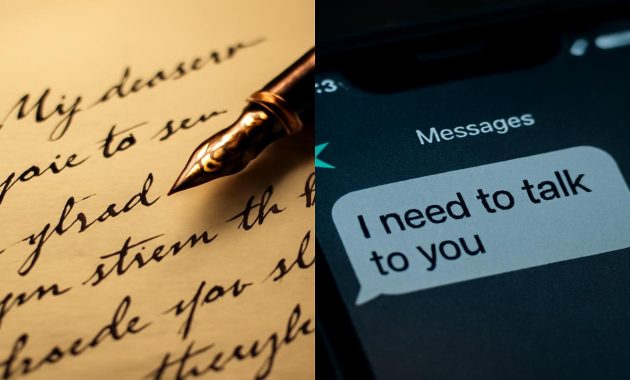
The pen hesitated above the page, a small black hovercraft over a blank white ocean. The girl in the café—orange hoodie, wired earbuds, thumb flicking restless loops on her phone—stared at the birthday card her mom had insisted she handwrite. She tried to start four times. Each attempt dissolved into a cramped, apologetic scrawl: “Hey Grandma, love you lots.” She grimaced, snapped a quick photo of the card, then opened her messaging app and typed a long, flowing paragraph instead—full of warmth, favorite memories, and a dozen emojis that somehow felt easier than words dragged across paper.
At the next table, an older man, maybe in his seventies, wrote slowly in a neat, looping script on yellowed stationery, the kind that faintly smells like dust and time. His pen made a soft scratching sound you could almost hear beneath the hum of the espresso machine. The contrast was almost cinematic: one hand clumsy on paper, the other moving with quiet certainty through a skill it had repeated thousands of times.
If you pause long enough to look around—on buses, in classrooms, at kitchen tables—you might notice something: fewer pens, fewer notebooks, fewer fingers stained with ink. For the first time in about 5,500 years of human history, a generation is letting handwriting—and with it, a certain kind of deep, unhurried communication—slip from everyday life.
The Generation That Types Faster Than It Thinks
Gen Z, born roughly between the late 1990s and early 2010s, moves through the world at the speed of a notification. Their minds are agile, their thumbs even more so. Many of them can type on a phone without looking, sculpting sentences out of taps and swipes while crossing the street or half-watching a video. A keyboard—physical or virtual—is their natural habitat.
Ask a teenager today to write a full-page letter by hand, and several things might happen. Their wrist will get tired. Their writing might shrink into a tight, jagged crawl. Words they’d effortlessly produce on a keyboard will suddenly evaporate. They might lose their train of thought halfway through a sentence, derailed by the simple friction of ink meeting paper.
And yet, if you hand them that same letter space in a digital form—a message box, a doc, a note app—many will fill it with more nuance, more detail, more personality. They’re not less expressive. But something about that ancient ritual of pen, hand, and page feels foreign, almost ceremonial, like putting on a suit when you’ve spent your whole life in hoodies and joggers.
Surveys in several countries hint at the same quiet shift: around 40% of Gen Z say they almost never handwrite anything more than a quick jot. Cursive is a rumor. Long-form handwriting, a relic. Teachers report that some students can type sophisticated essays but struggle to quickly jot down their own ideas in legible script. The training that once came with hours of practicing loops and lines has been replaced by glowing keypads and autocorrect.
The Lost Art of Slow Thinking
To call handwriting “old-fashioned” is tempting. After all, humans are tool-makers, and we’ve always upgraded how we record our thoughts—from clay tablets to parchment, from printing presses to touchscreens. But handwriting isn’t just another recording device. It’s also a way of thinking: slow, physical, and strangely honest.
When you write by hand, every sentence costs you something: time, muscles, attention. There is a drag to it, a friction that forces decisions. Do I really want to cross out these words? Do I pause to find a better phrase? That tiny delay, the brief moment you spend watching your own thought take shape in ink, changes what you say and how you say it.
Students who handwrite notes—messy, imperfect, scattered—often remember more than those who type verbatim. The reason isn’t magic; it’s involvement. Handwriting naturally summarizes, filters, and digests. You can’t capture every word a teacher says, so your brain chooses. It compresses. It distills. That distillation is the beginning of deeper understanding.
In a digital age, so much of our communication behaves like a stream, always moving, never lingering. Typed messages vanish up the chat window. Comments disappear beneath newer comments. Handwriting, on the other hand, is stubbornly present. A notebook doesn’t ping you. A letter doesn’t update. It just waits—quietly, tangibly—and invites you back into whatever you were thinking when you first wrote it.
How It Feels To Hold Your Words
Consider the difference between receiving a text and receiving a handwritten note. A text is a flash: bright, brief, skimmable. It blends with dozens of others on the same glowing rectangle. But a note—creased, maybe smudged, smelling faintly of the room it was written in—asks to be held. You can see hesitation in a line that thickens where the writer slowed down. You can feel emotion in the slight tilt of letters, the pressure of the pen where a sentence mattered more.
Gen Z isn’t immune to this. Many of them light up when they do get a handwritten envelope in the mail, or discover a parent’s old journal, its pages swollen with years of use. There is a visceral pull to these artifacts, even for those who rarely create them. The paradox: they instinctively value the few handwritten traces that exist, even as they create fewer of their own.
The Sound of Paper in a Digital Storm
Picture a high school classroom just before an exam. Laptops breathe softly; screens glow like a field of tiny moons. Some students review slides; others scroll through group chats in nervous bursts. At the back, one student sits with a dog-eared notebook. The pages are crowded with diagrams, arrows, doodles in the margins, underlined definitions in three different colors.
When the teacher says, “Time’s up for studying,” the laptops close with a clatter. The notebook snaps shut with a softer sound, like a door carefully latched.
Months later, most of the digital study files will be gone—buried under newer documents, accidentally deleted, or simply forgotten. But that notebook might still be there, on a shelf or under a bed, waiting. Handwritten pages age in a way that digital files don’t. They fade, they curl, they gather the smell of whatever room they sleep in. They become part of the landscape of your life.
For thousands of years, this was how humans anchored their inner worlds: on mediums that aged alongside them. From Sumerian clay tablets to Egyptian papyrus, from monks hunched over illuminated manuscripts to children filling ruled exercise books, handwriting linked the private space inside the skull to something public and enduring. Your thoughts left you, but they didn’t vanish; they landed in a form that could survive mold, flood, loss, even centuries in a buried chest.
Now, many of Gen Z’s deepest confessions, late-night thoughts, and unfinished dreams live in password-locked notes apps and social DMs, stored on servers they will never see. Those words feel immaterial, almost weightless. They can be deleted in a second. They may never be rediscovered by curious grandchildren or historians piecing together what it felt like to be young in the early 21st century.
What the Numbers Whisper
Across schools and studies, the decline of handwriting is showing up not just as nostalgia, but in small, measurable shifts. The table below gives a simplified snapshot based on trends and surveys commonly reported in educational and generational research discussions:
| Aspect | Gen Z (approx. 1997–2012) | Millennials & Older |
|---|---|---|
| Regular long-form handwriting (1+ page weekly) | Around 40–50% say they rarely or never do this | Majority did this frequently during schooling years |
| Comfort writing cursive | Many report “can’t” or “only signatures” | Commonly taught; many still fluent |
| Preferred medium for serious communication | Digital messages, DMs, emails, shared docs | Mix of handwritten notes, letters, and digital |
| Perception of handwriting | “Special,” “for big moments,” or “unnecessary” | “Normal,” “routine,” part of daily life |
| Time spent on keyboards vs. pen | Heavily skewed to screens and typing | More balanced, especially in school years |
The numbers don’t shout, but they whisper a pattern: the everyday practice of handwriting has thinned. The skill is there for many, but unused, like a language you once learned and then stopped speaking. And as the habit fades, the muscle memory fades with it.
Deeper Communication in the Age of Instant Messages
The story isn’t just about pretty letters on paper. It’s about the kind of communication that handwriting tends to invite—slow, layered, and considered. In a world of blink-and-you-miss-it content, that kind of communication is becoming rare air.
Gen Z is often described as emotionally aware, open about mental health, and fluent in the symbolism of emojis and memes. They can express themselves with astonishing clarity in short bursts: a thirty-second video, a perfectly timed GIF, a five-line caption that cuts straight to the point. But ask many of them to write three pages reflecting on a relationship, a fear, or a hope—on paper, with no delete key—and the task feels strangely heavy.
Longhand writing has a way of pulling hidden things to the surface. You sit with your own mind longer. There is no easy escape into another app, another tab. The page stares patiently. Your hand moves, sometimes faster than your conscious editing voice can keep up. Out spills a sentence you didn’t know you’d been carrying. Then another. And another.
In contrast, digital communication nudges us toward brevity and speed. It rewards punchlines over paragraphs, hot takes over slow thoughts. The architecture of most apps is tuned for reaction, not reflection. You can type a heartfelt paragraph into a chat, but there’s always a buzzing awareness that the person on the other side might only skim it between other pings.
The Quiet Power of Private Pages
For previous generations, diaries and journals were often hidden under mattresses or in bedside drawers. They were private universes—no likes, no comments, no analytics, just ink and whatever the heart dared to confess. Many of those journals still exist, sometimes returned to decades later like time capsules.
Gen Z does journal, but the format has shifted: private notes apps, password-locked phone entries, audio memos, “photo dumps” as memory logs. These are real forms of self-recording, but they live in a fragile ecosystem. A lost password, a broken phone, a corrupted backup—and whole chapters of a life can evaporate.
There’s something quietly radical, almost rebellious now, about keeping a physical notebook. It doesn’t track you. It doesn’t send data anywhere. It doesn’t measure your streaks or prompt you to upgrade storage. It’s you and your thoughts, unmonetized and unoptimized, existing in a small, analog universe that no algorithm can touch.
Is Handwriting Really Dying, Or Just Changing Clothes?
Despite the worries, it’s worth asking: is handwriting truly dying, or simply shrinking into a more specialized, intentional role? Humans rarely abandon skills completely; we repurpose them. Fire went from survival tool to campfire ritual. Sewing shifted from necessity to craft. Maybe handwriting is heading in the same direction.
For many Gen Zers, writing by hand is already a kind of aesthetic choice. Bullet journals with neat spreads. Calligraphy practice with wax seals. Hand-lettered signs for protests and climate marches. Doodles and annotations in the margins of printed articles. When handwriting appears, it’s often deliberate, almost artistic, tinged with meaning.
Teachers who still assign handwritten reflections notice something interesting: the outcomes often feel more personal. Words come slower, but truer. The absence of backspace invites a gentle tolerance of imperfection; crossed-out words remain visible, tiny fossils of changing thought. Some students, given the choice, still choose pen and paper for brainstorming, reserving the keyboard for the polished final draft.
So perhaps the skill isn’t vanishing so much as retreating from the center of daily life to the edges—where rituals, art, and memory tend to live. But edges matter. They’re where some of the most meaningful human practices survive long after they stop being mandatory.
What We Stand to Lose—And Keep
It’s not that every message must be handwritten, or that digital words are lesser. A carefully composed email can be as profound as any letter. A long text at 2 a.m. can change a life. Gen Z’s adaptability and fluency in new forms of expression are strengths, not flaws.
Still, if handwriting continues to thin out of daily practice, we risk losing:
- A built-in way to slow down and think more deeply.
- A durable, physical record of our unedited inner worlds.
- A form of communication that carries the subtle fingerprint of our bodies—our tremors, our pauses, our pressure on the page.
- An easy, low-tech tool for focus that doesn’t require batteries, updates, or Wi‑Fi.
What we might keep—if we choose—is a hybrid: digital for speed, reach, and collaboration; handwriting for depth, memory, and intimacy. A generation that can move fluently between the two might end up richer in expression, not poorer.
Inviting the Pen Back In
There is a quiet revolution available to anyone who feels the faint tug of ink and paper, no matter their age. It doesn’t require giving up your phone or pretending the 21st century isn’t humming relentlessly all around you. It asks only for a small corner of your life, a few minutes at a time, reclaimed from the algorithms.
Imagine this: once a week, you write a letter you never have to send. To your future self. To a parent. To someone you miss but can’t contact. Three pages, handwritten. You don’t need pretty penmanship. You just need a pen that works and a page that can hold what spills out.
Or: you keep a notebook by your bed, and before you go to sleep, you let yourself write one messy, unfiltered page about the day—what hurt, what delighted, what you can’t stop thinking about. No structure, no prompt, no performance. Just the scratch of pen in a quiet room.
Or: once a month, you choose one person who matters to you and write them a short note by hand—a thank you, an apology, a memory. You can still send them texts. But somewhere, in a drawer or a shoebox, these paper echoes of your care might gather.
For Gen Z, these acts might feel unfamiliar at first, even awkward. But friction is not always an enemy. Sometimes it’s the feeling of a deeper gear engaging. Sometimes it’s the sound of an old human skill waking back up in your fingers.
The girl in the café eventually finished her card. She didn’t write a masterpiece. She didn’t suddenly discover a lost talent for elegant cursive. But she did manage a few sentences more than she thought she could, and when she read them back, they felt different from anything she’d typed that day. Heavier, somehow. More anchored. When she slipped the card into its envelope, it made a soft, decisive sound—paper meeting paper, thought meeting world.
Long after her phone has been replaced, updated, traded in, that card might still exist in a box under someone’s bed. The ink will fade. The paper will yellow. But the fact that her hand shaped each letter will remain, faint but traceable, like a fingerprint left on time itself.
FAQ
Is Gen Z really losing the ability to write by hand?
Most Gen Z can still write by hand, but many use the skill far less than previous generations. Long-form handwriting, like pages of letters or notes, is becoming rare in daily life. The “loss” is more about fluency and comfort than total inability.
Why does handwriting matter if we can type faster?
Typing is faster and more efficient, especially for work and collaboration. Handwriting matters because it encourages slower, more reflective thinking, improves memory for some people, and creates tangible, lasting records of our thoughts and emotions.
Does handwriting really help with learning and memory?
Studies generally suggest that handwriting notes can improve understanding and recall compared to typing, because it forces you to summarize and process information instead of recording it word-for-word. That said, individual experiences vary, and some people learn well with digital tools too.
Is cursive writing important, or is print enough?
Cursive once played a central role in education, but today it’s less essential for everyday function. Print handwriting is usually enough for basic communication. However, learning cursive can support fine motor skills and allows people to read historical documents and older personal letters more easily.
How can Gen Z (or anyone) rebuild their handwriting habit?
Start small and personal: keep a bedside notebook, write short letters or thank-you notes, or use a paper journal for big decisions and reflections. The goal isn’t perfect penmanship; it’s reconnecting your thoughts to the slower, more tactile act of writing them by hand.