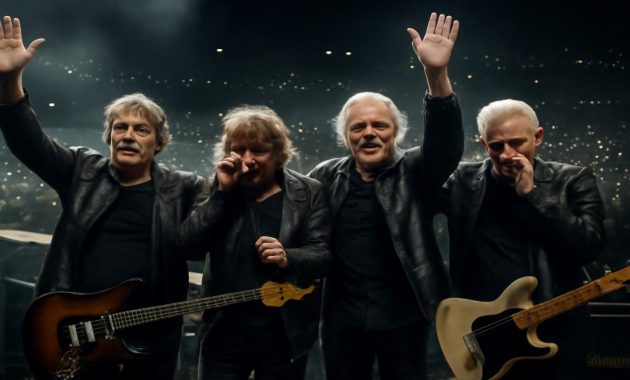
The news arrives on a rain-bright Tuesday, the kind of gray afternoon when everything feels a little quieter than it should. A single notification lights up your phone: “Legendary rock band Blackriver Line announces retirement after 50 years.” You blink once, twice. You read it again. Retirement. Fifty years. Blackriver Line. Your thumb hovers over the screen, suddenly unsure, as if opening the article will make it real.
You don’t need to be told which song they’re talking about. Everyone knows it. The one that has played at more weddings than anyone can count, that has echoed through stadiums and supermarket aisles, car radios and cheap headphones. The one that you slow-danced to in a gym that smelled like sweat and punch and teenage anxiety. The one your dad played on vinyl on Sunday mornings. The one that showed up in that streaming playlist on the worst night of your life and somehow made it feel survivable.
“River in the Radio.” Just four words, and your mind fills in the guitar line automatically—the clean, chiming opening, the drum fill like the sound of a heart catching itself. You can almost feel the volume knob under your fingers, turned just a little louder than is polite.
The Day the Music Paused
By evening, the announcement has spread everywhere: music sites, news broadcasts, group chats lit up with a dozen variations of “Did you see?” and “I’m not ready” and “I thought they’d outlive us all.” It’s not a scandal, not a breakup, not a tabloid implosion. It’s something more ordinary, and yet more devastating: a farewell.
The band’s official statement is modest in that familiar Blackriver Line way, unsigned but unmistakably them: “After five decades on the road and in your headphones, we’re heading home. Thank you for giving us a life in music. We’ll be doing one final tour to say goodbye properly. Bring your voices.”
That last line lingers. Bring your voices. As if they’re gently reminding you that this was never just about them. It was about you, and every person who ever howled the chorus into the night sky, drunk on youth or grief or joy or all three mixed together.
Somewhere across town, in a small apartment with cracked windowsills, a fan sits at a secondhand table and absentmindedly hums the refrain of “River in the Radio” while scrolling through an article about the band’s early years. The journalist calls the song “inescapable.” But that’s not quite right. It’s not that the song is everywhere—it’s that it was there when you needed it. That’s different. That’s something closer to grace.
The First Chord That Changed Everything
The story of Blackriver Line starts far away from the streaming era that would later swallow them whole. It begins in a basement that smelled like dust and rain-soaked coats, in 1974, in a small town where the nights were long and the choices were few: get out, give up, or turn up the volume.
Legend says there were four of them that first night, crammed between a broken washing machine and a stack of milk crates. Eli Hart, with his too-big guitar and too-fast fingers. Mara Lane, barefoot, coaxing cathedral sounds from a pawnshop keyboard. Jonah Price, who played the drums like he was trying to outrun his own heartbeat. And on bass, Leo Cortez, grinning like he already knew this was going to matter to someone, someday.
Nobody knew then that half a century later, their band name would flicker on LED screens in stadiums, or that there would be documentaries and tribute albums and think pieces calling them “the soundtrack to five generations.” Back then, all they wanted was a song that sounded like the inside of the life they wished they had—a little louder, a little freer, a little less alone.
“River in the Radio” didn’t come right away. They made three albums before it arrived, each one a little less clumsy, a little more like themselves. There were near-misses and almost-hits, late-night drives in rusted vans, bar gigs where the applause was mostly from each other. They were a good band, even a great one in certain corners, but they weren’t yet the band.
The story, as Eli tells it in a documentary years later, is that the song started with a single chord. “It sounded like a streetlight,” he says, shrugging. “Like that moment when everything is dark except that one pool of yellow on wet pavement. I just kept hitting it, like, there’s something here.” Mara added a piano ripple that felt like water over stone. Jonah found a drum pattern like footsteps on a bridge. Leo anchored the whole thing, simple and steady, like a heartbeat that refuses to quit.
They recorded it on a rainy afternoon with the studio windows fogged up, the engineer half-convinced this was just another decent track on a decent record. No one in the room knew that the song would slip its leash and travel the world.
The Hit That Belonged to Everyone
When “River in the Radio” finally found its way onto the airwaves, it didn’t explode right away. It seeped in. A late-night DJ in a city they’d never visited played it once, then twice, then nearly every shift. College kids taped it off the radio and passed it around. A cassette made its way into a car that drove three states over, then five, then ten. Little pockets of listeners started humming the melody in grocery stores and at bus stops, like they’d known it forever.
What made it different wasn’t just the hook (though, honestly, that hook could pull the moon out of the sky). It was the way the song felt like it already remembered you. The opening line—“You were just a shadow in the static till the night turned up your name”—landed with the weight of experience even when you were too young to have much of one. It implied a before and after, a moment when everything turns and you realize the world has been holding its breath for you.
By the time the video hit television—grainy, low-budget footage of the band playing in what looks like an abandoned train station lit by strings of mismatched bulbs—people were already claiming the song for themselves. Couples called it “our song.” Friends used it as a shorthand for late-night drives and sprawling conversations and the feeling that maybe, just maybe, you are not as alone as you thought.
Over the years, it threaded itself through the ordinary rituals of life. It played at prom, under banners that would wilt by morning. It floated through hospital waiting rooms from somebody’s headphones, a private comfort in a public place. It showed up in movie soundtracks right when the main character realized they needed to leave the small town or forgive their father or choose themselves.
Eventually, the track did all the things hits are supposed to do. Platinum records. World tours. Licensing deals. College marching bands arranging it for halftime shows. Choirs turning the bridge into a soft, swelling storm of human voices. But none of that explains why, fifty years later, it’s still the song that your uncle cries to in the kitchen at 2 a.m., or why a kid born yesterday might one day discover it in some algorithm-generated playlist and feel that strange shiver of recognition.
The Quiet Power of Familiar Notes
What makes a song like that stick for half a century? Part of it is craft: the shifting dynamics, the way the chorus climbs but never quite resolves the way you expect, leaving a small, necessary ache. Part of it is timing, arriving in that narrow corridor of cultural space where a generation is just old enough to start asking hard questions and just young enough to believe the answers might still change.
But another part can’t be charted. It lives in the private stories that orbit the music like a constellation only you can see. The Thursday you sat on the roof with your best friend, sharing one pair of earbuds. The moment your mother, usually so guarded, reached over in the car and turned up the volume, whispering, “This one got me through some things.” The way the outro guitar line looped in your head as you watched the sunrise after the worst breakup of your life.
Some songs are events. “River in the Radio” became a place—a room people could enter when they needed to remember they once believed in something braver than the present moment.
The Last Tour, the Long Goodbye
The farewell tour is announced with dates that sprawl across continents like a fragile, glittering web. Cities blink by on the poster: London, Tokyo, São Paulo, Chicago, Cape Town, Sydney. There’s a small note at the bottom: “One last flood of sound. See you there.”
Tickets sell out faster than anyone expects, even though everyone should have expected it. There is a sense—urgent, breathless—that this is a pilgrimage rather than a concert. People rearrange weddings, dip into savings, share hotel rooms with strangers they meet on fan forums. Parents bring kids. Kids bring parents. Some bring ashes in tiny necklaces, the remains of someone who always said, “Next time they tour, I’m going.”
At each stop, the ritual is the same and somehow always different. The lights dim. The murmur of thousands condenses into a single held breath. And then, after a handful of other songs—deep cuts and singles and that one track they rarely played live in the early days—they get to it.
The first chord of “River in the Radio” lands like muscle memory. Even if you haven’t listened in years, your body remembers where the chorus lives, the exact moment when you’re supposed to lift your voice. Eli’s hair is gray now; his hands move a fraction slower, but the tone is there, unmistakable. Mara’s keyboard is sleeker, digital instead of analog, but her touch is the same slow tidal wash you remember. Jonah’s sticks are taped in bright colors so his grandkids can spot them on the livestream. Leo stands in his usual place, that same unshakeable pulse under everything.
Halfway through the tour, in a city they first played forty-seven years ago for a crowd of fifty bored barflies, the band pauses before the intro. The stadium is a sea of phone screens and handmade signs, every one of them a story shortened to a few scribbled words: “Walked down the aisle to this.” “Dad’s favorite song.” “Sober 3 years today.”
Eli steps up to the mic and says, “We wrote this one in a room so small you had to move the amp to open the door. We had no idea it would find its way to all of you. Thank you for letting it live with you this long.” It’s quiet enough to hear the click of a pick against strings. Then the chord rings out, and the stadium erupts—not in screams, but in something softer and wilder, like a communal exhale.
A Setlist Written in Shared Time
For fans following the tour with almost devotional attention, the setlist becomes a language in itself. Which early tracks make the cut. Where they choose to place the hit. How the encore shifts from city to city. Somewhere between the statistics and the stories, you can trace a life lived in 4/4 time.
| Tour Year | Average Set Length | Placement of “River in the Radio” | Typical Crowd Reaction |
|---|---|---|---|
| 1979 Club Tour | 11 songs | 2nd half, often before the closer | Growing sing-alongs, curious new listeners |
| 1986 Arena Tour | 18 songs | Final song of main set | Stadium-wide chorus, lighters aloft |
| 1999 Reunion Run | 20 songs | Encore centerpiece | Multi-generational sing-along |
| 2015 Anniversary Tour | 22 songs | Stripped-down acoustic version mid-set, full-band reprise at the end | Tears, phone lights, spontaneous harmonies |
| 2025 Farewell Tour | 24 songs | Final song of the night, preceded by a moment of silence | Roaring gratitude, then a lingering hush as the last note fades |
In city after city, something almost invisible happens: as the familiar chorus swells, strangers reach for each other. Arms loop around shoulders. Hands find hands. It’s messy and imperfect and very, very human—this need to anchor ourselves to one another when faced with the end of something we believed might never end.
After the Amplifiers Go Quiet
Retirement in music is rarely neat. There are always rumors of reunions, whispered possibilities of one last benefit show, the hint of a secret track on some future compilation. The band is careful not to slam the door, but they’ve said what they needed to say: no more tours, no more albums under the Blackriver Line name. The machine that carried them across fifty years of culture is finally winding down.
So what happens now—to them, and to us?
For the band members, the answers are simultaneously small and enormous. Grandchildren’s school plays. The strange quiet of weekends without flights. The luxury of writing songs without wondering whether they’ll fit into a setlist. Growing tomatoes. Sleeping in. Listening, maybe for the first time in decades, to other people’s music with no professional curiosity attached.
For the rest of us, the change is subtler. The knowledge that there will never be another first time hearing that song live shifts it slightly in your chest. It becomes something fully in the past, a relic made of sound waves and thin, warbling MP3 files and grooves on vinyl.
And yet, in another sense, nothing changes at all. The track still sits there, patient, in your library or your childhood bedroom or a dusty box of CDs. Somewhere, right now, a kid who has never heard of farewell tours is pressing play because a recommendation engine tossed “River in the Radio” into their day. The opening chord rings out, and the song does what it has always done: it reaches.
There is a famous quote—overused, maybe, but hard to shake—that says we don’t remember days, we remember moments. The retirement of a band like Blackriver Line is not just an ending; it’s a reminder to gather up the moments that their music has quietly witnessed and see them for what they are: evidence that we have, in fact, been alive this whole time.
How a Song Outlives Its Singers
Someday, Eli, Mara, Jonah, and Leo will be names in liner notes and footnotes, figures in documentaries queued in some streaming backlog. But the sound—that impossibly familiar lift into the chorus, the hush before the bridge—will keep moving.
Maybe that’s the secret comfort. Bands retire. Stages go dark. Even legends have to put down their instruments. But the echo—the shared breath of thousands of voices rising on the same line—isn’t so easily retired. It lives on in throats and memories and the tiny speakers of cheap earbuds on late-night buses.
The last time you hear “River in the Radio” live, you might not know it’s the last time. Or you might, standing there in a crowd buzzing with the knowledge that this is it, trying to memorize everything: the way the bass vibrates through your ribs, the smell of spilled beer and rain on asphalt, the stranger next to you yelling the bridge slightly off-key. You close your eyes for a second, just to feel it more clearly.
Long after the final chord, after the band has bowed and the lights have come up and the stagehands start their quiet dismantling of this temporary cathedral, the song is still ringing in your ears. You step out into the night. The city feels different, though it’s exactly the same. Somewhere, a car passes by with the radio turned up, some other song filling its interior with anonymous melody.
You walk home humming. Not because you’re afraid of forgetting, but because, deep down, you know you won’t.
Frequently Asked Questions
Why did Blackriver Line decide to retire after 50 years?
The band has cited age, family, and a desire to step away while they can still perform at a level they’re proud of. After five decades of touring, recording, and living on the road, they chose to end this chapter on their own terms, with a planned farewell tour rather than a slow, uncertain fade.
Will they release any new music after retiring?
They’ve announced that there will be no new albums or tours under the Blackriver Line name. Individual members may still create solo projects, collaborate with other artists, or release archival material like live recordings or demo collections, but the band as a collective is closing the book.
What makes “River in the Radio” so iconic compared to their other songs?
“River in the Radio” combined an unforgettable melody with lyrics that felt deeply personal and strangely universal. Its emotional arc—nostalgia, longing, and a glimmer of hope—resonated across generations. The song also arrived at the right cultural moment, spreading slowly through radio, mixtapes, and later digital platforms until it became a shared emotional landmark.
Is the farewell tour really the last chance to see them live?
According to the band, yes. They’ve been clear that this is the final full tour and the last time they’ll regularly perform as Blackriver Line. While one-off appearances or special tributes are always possible in theory, fans are treating this farewell run as the last guaranteed opportunity to experience the band in concert.
How can new listeners start exploring Blackriver Line’s music?
A good entry point is to begin with the album that features “River in the Radio,” then explore backward to their raw early work and forward to their more experimental later years. Listening in order of release lets you hear the band evolve—from basement rehearsals and scrappy first records to confident stadium anthems and reflective, late-career songwriting.